Earth Strike: Star Carrier: Book One sc-1, page 29
part #1 of Star Carrier Series
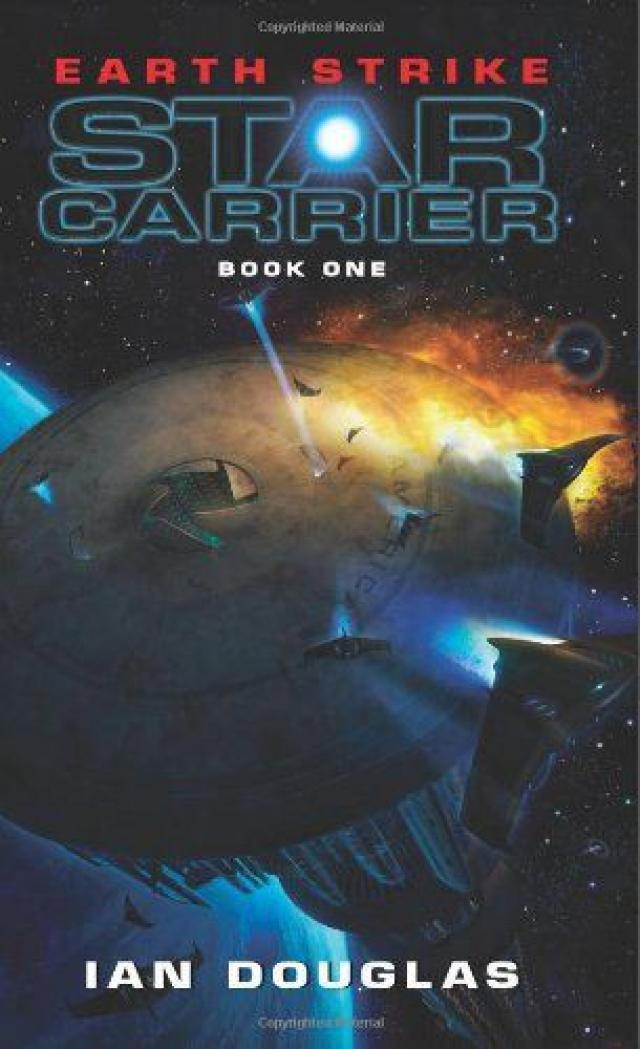


Dixon flew with America’s lead squadron, VFA-51, the Black Lightnings.
“What’s our squadron status, CAG?”
“Three at full readiness, Admiral. One, the Rattlers, is light at nine spacecraft on the flight line. I took what was left of the Dragonfires and put two of them in with the Black Lightnings, the other two in with the Nighthawks.” He hesitated. “One pilot hasn’t reported back aboard, so the Nighthawks are down one fighter as well.”
“Understood. How fast can you get them off the carrier?”
“The Nighthawks and the Impactors are on ready five, Admiral. Lightnings at ready ten. The rest…half an hour.”
“Do it. Commander Craig will be sending down specific orders. Your people are going on deep recon.”
“All of them?”
“As many as we can kick out there, CAG. And as quickly as we can do it.” He began filling Dixon in on his conversation with Caruthers, and on the threat of a Turusch alpha strike from one side of the sun, with a diversion on the other.
“I see,” Dixon said after Koenig had explained the situation. “If Force Bravo isn’t there, we’re late to the party. If it is, we show up early, with real shit for odds.”
“That’s about the size of it. The battlegroup will be following along behind you.”
“To pick up the pieces?”
“Are you and your people up for this, CAG?”
“Of course we are. It’ll be worth it, if we can spoil their strike. I’ll pass the word.”
“Good. We’ll begin launching as soon as we begin gravitic acceleration. You may scramble your pilots.”
“Aye, aye, sir.”
When Koenig emerged from the simlink, Quintanilla was gone. The two-G acceleration had let up a moment before, and he must have left then.
“All hands, this is the captain. Stand by for gravitic acceleration, five hundred gravities, in five…four…three…two…one…boost!”
Space-bending energies flowed from America’s zero-point fields, projecting ahead of the ship’s enormous shield cap, folding a tight little knot of spacetime in upon itself. The artificial singularity grew rapidly with the influx of energy. As the star carrier began falling toward it, the singularity vanished, to be reprojected again a few nanoseconds later.
Carefully balanced to avoid catching the ship in a destructive flux of tidal forces, the singularity continued winking on and off, on and off, creating the effect of a steady pull of five hundred gravities out ahead of America’s shield. Mars and the Phobos Synchorbital facility both dwindled away rapidly, vanishing in an instant as they dropped astern at five kilometers per second per second.
And the carrier fell outward into darkness.
Flight Deck
TC/USNA CVS America
Mars Space, Sol System
0315 hours, TFT
Joseph Dixon squeezed down into his Starhawk, letting the seat accept his weight and enfold him in its harness. Above him, his crew chief slapped the top of his helmet. “You’re good t’go, CAG!”
“Keep the coffee hot, Chief. We’ll be back.”
“Roger that!”
The cockpit sealed around him, plunging him momentarily into darkness. The lights came up an instant later.
Around him, on the Alpha flight deck, other Black Lightning pilots were racing across the deck, lowering themselves into cockpits, settling into their seats. The alarm klaxon blared somewhere overhead, echoing through the cavernous chamber.
He turned his full attention to his instruments, both those glowing at him from his console and those now appearing in open windows in his mind as his neural hardware linked in. His fighter was sinking now through the viscous black liquid of the nanoseal covering the hatch beneath him. He felt the sudden shift of attitude as his nose pivoted down; he brought up his visual display, and found himself looking out through the carrier’s open launch deck, at stars wheeling past as the hab modules continued to turn.
“This is Lightning One-zero-one,” he announced over the comm. “I am clear of the hatch. Ship systems are hot. AI on-line. Weapons safed. Ready for drop.”
“One-zero-one, PriFly. You’re clear for drop, CAG.”
“Copy. Release when clear.”
“Hold for other fighters in your stick coming on-line. Ten seconds, CAG.”
Dropping was slow. The launch tubes had the advantage of giving the fighter an extra burst of speed-a free six hundred kilometers per hour of velocity, but fighters could only launch two at a time that way, and it took special preparation to get all twelve spacecraft in a squadron up to the keel for sequential loading into the tubes. This time out, the Nighthawks were going out the bow-the luck of the draw, since they were next on the rotation and the fighters already loaded on the spinal flight deck.
Everyone else would be dropping out of one of the three rotating flight decks, outboard on the hab modules. The hab rotation gave them a free half-G kick outward, a lateral delta-V of five meters per second, easily compensated for later. The advantage was that six fighters could be launched at a time, with just thirty seconds between drops; an entire squadron could be spaceborne in half a minute.
“And three!” the voice of PriFly announced. “And two! And one! And drop!”
The steady pull of half a gravity vanished as he went into free fall, his fighter slipping through the launch deck opening and into space. To either side, the other five fighters of his stick fell in perfect unison. Peters. Aguilera. Hennessey. Michaels. And one of the replacements from the Dragonfires, Collins.
He had an uneasy feeling about that one. She’d come from a squadron that had suffered a paralyzing sixty-six percent casualties, including, he gathered from the psychtech’s report, her lover. She might well be psychologically unstable, even after three weeks.
Still, she’d been cleared by psych, as had the other Dragonfire pilot transferred to the Lightnings. That was Allyn, the Dragonfires’ former skipper, and she would be hurting, too, after losing most of her squadron. It was important to get them back into the thick of things as quickly as possible, let them start fitting in with the new unit before they had too much time to think of dead comrades.
The other two Dragonfire pilots, Tucker and Gray, had been assigned to the Nighthawks…except that Gray didn’t have medical clearance yet. According to the records, Gray was absent in any case, left behind when America had pulled clear of the dock. He might have some explaining to do once this was all over.
The Starhawk’s AI rotated the fighter and applied a gravitational boost of two Gs. The maneuver was perfectly orchestrated with the other five Lightnings in the stick. They continued to fall out from the America at five meters per second, but now they were accelerating alongside the mammoth vessel, clearing the rim of the shield cap, then pulling out ahead of the carrier. Dixon saw movement out of the corner of his eye and turned his head. Two of the Nighthawks had just exited America’s spinal launch tubes, hurtling into the distance at 167 meters per second.
Ahead, Dixon could see the familiar kite-shaped constellation of Boötis; alongside was a U-shaped curve of stars, like an upraised arm. That was Corona Borealis, and the provisional navigation point for him and three other pilots-Aguilera, Hennessy, and Collins.
Astern, the second stick of six fighters in the Black Lightnings dropped clear of America. Friedman, Walsh, Cutler, Huerta, Hernandez. And the former CO of VFA-44, Allyn.
Once clear of the America’s shield cap, they used maneuvering thrusters to adjust their Starhawks’ attitudes and kill the sideways drift imparted by their drop, and configured their craft into high-G needles.
“America CIC, this is Deep Recon Red,” Dixon said. “Handing off from PriFly. We are clear of the ship and formed up. Ready to initiate PL boost.”
“Copy, Deep Recon Red. Primary Flight Control confirms handoff to America CIC. You are clear for high-grav boost.”
“Acknowledge. Cleared for boost.” Dixon switched to the formation frequency. “Okay, people. You heard the lady. Engage squadron taclink. Fifty-kay acceleration in three…two…one…engage!”
And the fighters vanished toward the unwinking stars at half a million meters per second.
Oceana Naval Station
North American Periphery
2245 hours, local time
It had taken almost an hour to get here.
Trevor Gray had dropped off the rented broom at the Columbia Arcology, then caught a suborbital hopper for the twenty-minute flight to Oceana.
Four centuries before, Naval Air Station Oceana had been the largest U.S. naval base on the East Coast, and the command center for all Atlantic strike fighter activities when they were not actually on deployment. The relentless rise of the warming oceans eventually had forced the evacuation of nearby Virginia Beach, Portsmouth, and vast swaths of tidewater Virginia.
The naval base had remained, however, first under a sealed dome, then building up as the water levels rose, creating the iconic flat-topped base on pylons, often derided as the world’s largest and least maneuverable seagoing aircraft carrier.
The hopper had touched down on the upper landing deck in darkness at just past 2230 hours, local time, and Gray, with the handful of the military passengers from Morningside Heights, had checked in at the base quarterdeck.
The place was crowded. The recall order had caught a lot of naval and Marine personnel on Earth, and all of them were trying to get back to their ships.
Gray slapped his hand on the reader pad as a bored rating asked for his name and id. When Gray’s data flashed up on the man’s screen, however, he appeared to become more interested. “Lieutenant Gray? Fighter pilot, VFA-44?”
“That’s me.” A bold enough statement, considering he still wasn’t sure what he wanted to be.
“Okay…according to this thing, sir,” he jabbed a finger at his console monitor, “your ship, the America, is boosting out-system. She left Mars half an hour ago.”
“Shit.” All he could think was that Collins was going to have a field day with this. “Where are they headed?”
“Classified…but I’d be willing to bet it has something to do with all the commotion about the Tushies out at Neptune, wouldn’t you say?”
“Reasonable guess.”
“I thought so. Anyway, a few hours ago, a request came through from the America for replacements. Two brand-new squadrons of Starhawks. With nugget pilots. We were putting together a flight plan to get those squadrons out to Mars.”
“So you’re sending them out there now?”
“The request was from your admiral, and it was flagged ‘urgent,’” the rating said. “How would you like to skipper them out to the ship?”
Gray thought about this. Technically, he was still off the flight line, pending a final clearance from psych. Either the enlisted rating hadn’t noted that data line on his electronic id…or he didn’t care.
Skippering a bunch of kid-nuggets to America? Sure, he could do that. Oceana was where Gray had begun his flight training four years ago. There were several dozen squadrons home-ported there, and some hundreds of fighters. Carriers throughout the fleet used them as reserves, replacing individual spacecraft-or entire squadrons-when they wore out, or when they were used up.
Hell, it wasn’t like he had anything back in the Manhattan Ruins to go home to.
“Sounds like a plan,” he told the rating. “Where do I sign on?”
“Billingsly!” the rating shouted, turning to look over his shoulder. “Get this man down to Flight Ops!”
It might be against his better judgment, but he was going back to the America.
Chapter Twenty-One
18 October 2404
Oceana Naval Station
North American Periphery
2314 hours, local time
The fighters would be making the ferry passage fully armed.
Normally, this kind of shuttle flight would be made with the spacecraft unarmed, but these were special circumstances. Oceana was rife with rumor about the threat from Outside…rumors of Turusch ships bombarding Triton, of a battle with High Guard ships, of clashes with Confederation fleet elements in deep space.
There was no way to verify any of it. Even after Gray was back within reach of local Net-Clouds, information on any of the ships of the Confederation Navy had been blocked, and he didn’t have the passwords to mindclick access to it.
As the rating at Oceana’s quarterdeck had suggested, it almost certainly meant a Turusch incursion of some kind. The more certain he became of that, the more he felt a pounding need to get back to the carrier.
Back where he belonged.
“Starhawk Transit One, Oceana Control,” the voice said in his mind, “you are cleared for launch.”
“Roger that, Oceana Control.”
The launch tunnel was wide, flat, and slanted upward at 45 degrees from deep within the Oceana base. It would be decidedly unhealthy to engage drive singularities inside the tunnel, where a miscalculation could eat the fighter going up in front of you. Instead, they would be accelerated up and out by a magnetic sling, and engage drives once out over the ocean.
“Railgun power in three…two…one…release.”
Gray’s fighter began moving-with only about two gravities of acceleration, moving up the long, slanting tunnel toward a patch of black night sky. Behind him, twenty-three other fighters followed in tight, four-ship groups. The Starhawks were configured in their atmospheric flight modes, black manta rays with down-curving wing tips. Gray snapped out of the tunnel and into open sky.
A green light in his mind showed that all of the Starhawks had emerged at once. Black ocean blurred beneath his keel.
“Fifty-gravity acceleration,” he told the others. “Engage!”
He moved his hands through the control field, and his Starhawk began accelerating as his drive singularity became a white-hot star out ahead of his craft, devouring air molecules in his path and drawing behind him a white contrail of shocked water vapor. He brought his nose up, and in seconds he was thundering vertically though a low cloud deck, then punching past more rarified altitudes, the air growing thinner with each passing second.
The stars shone ahead, bright, cold, and hard.
“Oceana Control,” Gray called. “Starhawk Transit One passing one-hundred-kilometer mark.”
“Copy that, Starhawk Transit One. Oceana Control handing off to SupraQuito Control.”
“Copy that.”
One hundred kilometers was the traditional, if arbitrary, point at which space began as Earth’s atmosphere thinned away to almost nothing. Behind and below the accelerating Starhawks, the night side of Earth spread out in a vast, black bulk blotting out half of the sky. Scattered city lights showed here and there, some as sharp pinpoints, some as broader masses of light, some as diffuse glows beneath layers of cloud.
A lightning storm pulsed and flickered silently within the clouds off to the south.
This was something from which Gray could never walk away. He knew that now. When he’d been considering resigning his commission and going down to the fleet to serve out his time, he’d thought that what he was clinging to was the privilege and prerogatives of a naval officer. But that, he now knew, wasn’t it, not at all. He’d lived once scavenging garbage in the Ruins; he could live that way again, if forced to.
But the thought of giving up flight, free, unfettered flight among the stars…
“So…Lieutenant Gray,” one of the pilots called to him from the pack-Anders, Transit One-five. “They say you’ve had experience. You seen any action?”
“Yeah. I’ve seen action. Keep it quiet, people. Form on my heading. Engage squadron taclink.”
He gave the tactical display a last check, making certain that neither local traffic nor the ring arcs out in synchorbit lay anywhere near their outbound course. Slamming into one of SupraQuito’s hab modules at a few million meters per second was an excellent way of ending your Navy career…and taking quite a few civilians with you.
His nav marker was set for the calculated position of the America, somewhere out near Mars, about twelve light minutes away.
“Fifty-kay acceleration,” Gray announced, “in three…two…one…go!”
They went.
Red Bravo Flight
America Deep Recon, Sol System
0415 hours, TFT
Commander Marissa Allyn put her Starhawk into a high-velocity coast configuration, knowing that her shields would be dropping soon. She was seven AUs out from Sol, her outbound voyage one quarter over.
After launching from the America, she’d formed up with three other Lightning pilots-Lieutenants Cutler, Friedman, and Walsh. At the CAG’s orders, they’d linked their ships and boosted at fifty thousand gravities, leaving Mars and the America far behind in an instant.
Ten minutes after engaging their drives, they were moving at just over 299,000 kilometers per second-a hair less than the speed of light-and had traveled almost 90 million kilometers. At that point, they’d shut down their drives, drifting now at near-c, cocooned within the gravitic shields that deflected the bits of dust and stray hydrogen atoms that could fry an unprotected pilot at those velocities.
To Allyn, it felt like only a few minutes had passed, but her AI informed her that she’d been drifting now for one hour. Since shutting down the gravitic drive, she’d coasted outward for more than a billion kilometers, traveling so quickly that her subjective time had been shortened to four and a half minutes.
“Reconfiguration complete,” her AI informed her.
“Okay,” she told it. “Drop shields.”
Lowering shields at near-c was risky, and advisable only for short periods of time. The reconfiguration had moved a large percentage of her ship’s nanomaterial mass forward, creating a cone-shaped shield forward containing her fighter’s store of water, which was used as reaction mass for the plasma maneuvering thrusters. The Starhawk, in fact, was now imitating the America and other capital ships, creating a radiation shield forward to screen the pilot from high-energy particles. The defense wasn’t perfect. Some heavy particles, when the fighter hit them at near-c, generated cascade radiation that filtered back through the shielding mass, with long-term problems for the pilot’s health.