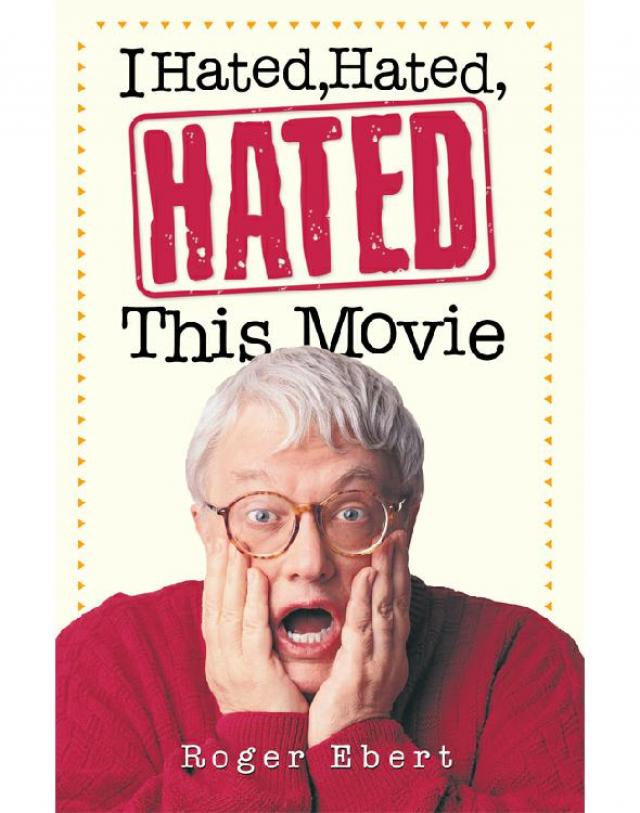
I Hated, Hated, Hated This Movie, page 9


In the new film, directed by Bill Condon, there’s once again an attempt to establish a real world in which Candymen aren’t possible. Kelly Rowan stars as a New Orleans schoolteacher whose father was killed years earlier, Candyman style. Now her brother has been accused of killing a Candyman expert, and a student in her class has started drawing the Candyman. How does the kid know about him?
The movie doesn’t develop, alas, with the patience and restraint of the earlier film. It’s got one of those sound tracks where everyday sounds are amplified into gut-churning shockaramas, and where we are constantly being startled by false alarms. There’s a scene, for example, where a character walks up behind the teacher, and the sound track explodes. My notes read: Scream! Shock! Rumble! Crack!—followed, of course, by the guy saying, “Sorry, I thought you heard me.”
The movie also pulls the old “It’s only a cat routine,” where a shrieking, snarling presence from out of frame turns out, yes, to only be a cat. There is even an “it’s only a raven” sequence, no doubt in honor of Clive Barker’s predecessor in the macabre, Edgar Allan Poe.
The story proceeds. Characters near and dear to Kelly are slashed Candyman style. Eventually, led by the little student from her class, who seems tuned in to the Candyman, she is led to an old plantation, where all is explained. Read no further if you would rather not know that the Candyman turns out to have been a slave who fell in love with his master’s daughter, and she with him. When she became pregnant, the enraged plantation owner set a mob on the slave, which cut off his hand and smeared him with honey, so that he was stung by thousands of bees, which is how he got the name Candyman.
Is there an entomologist among us? Are bees attracted by honey? I would have guessed they’d be rather blasé about it, and would be more quickly attracted if the victim had been smeared with one of those perfumes they advertise on cable TV. Never mind. The slave, whose name is Daniel Robitaille, sees his bee-stung face in his lover’s mirror, and somehow his spirit goes into the mirror, so that if you look in a mirror and say “Candyman” five times, that’s going to be more or less the last thing you do. (I have tried this, and it doesn’t work.)
The story goes to some lengths to develop sympathy for the terrible tortures he was subjected to, as a victim of racism who dared to love a white woman. (Because the Candyman is played by Tony Todd, who has more than a passing resemblance to O.J. Simpson, there are several scenes that have a curious double resonance.)
I suppose that Clive Barker would be happy to explain for us how Candyman: Farewell to the Flesh is a statement against racism, and maybe it is, although it sure does go the long way around. The message may be that because slaves were mistreated, we pay the price today, perhaps every time we look in the mirror and see our racism reflected back at us. (Hey, I didn’t take those EngLit symbology classes for nothing.)
Like many movies with morals at the end, however, it has its slasher and eats him, too. If the last fifteen minutes of the movie are devoted to creating understanding for Daniel Robitaille, the first eighty-five are devoted to exploiting fears of slasher attacks by tall black men, with or without a hook for a hand. And the flashback is rather overelaborate: Did the mob vote against lynching Robitaille, deciding, “Naw, let’s just cut off his hand and smear him with honey, so he can become an urban legend?” If not, it seems they went to a lot more trouble than most mobs in those sad days.
I am left with questions. Why did the Candyman visit Chicago? Why did he prey on innocent young black victims who had done him no harm? Which is he? A mythical force brought to reality by psychic mind power, or an immortal being fueled by the life force of the bees, who lives in mirrors? I spend my days pondering questions such as these, so you won’t have to.
Cannonball Run II
(Directed by Hal Needham; starring Frank Sinatra, Burt Reynolds; 1984)
The clue to Cannonball Run II is in Frank Sinatra’s first scene, but you have to look carefully. The scene starts in Sinatra’s office, and we’re looking over Sinatra’s head at Burt and some other people. At least, it looks like Sinatra’s head, except there’s something a little funny about the ears. Then we see Sinatra. He talks. We see Reynolds. He talks. And so on, until, if we know something about movie editing techniques, we realize there isn’t a single shot showing Sinatra and Reynolds at the same time. Also, there’s something funny about Sinatra’s voice: He doesn’t seem to be quite matching the tone of the things said to him. That’s the final tip-off: Sinatra did his entire scene by sitting down at a desk and reading his lines into the camera, and then, on another day, Reynolds and the others looked into the camera and pretended to be looking at him. The over-the-shoulder shots are of a double.
This is the movie equivalent to phoning it in. You can’t blame Sinatra. Everybody else is walking through this movie, so why shouldn’t he? Refusing to appear in a scene with your fellow actors is no worse than agreeing to appear in a scene that nobody has bothered to write. Cannonball Run II is one of the laziest insults to the intelligence of moviegoers that I can remember. Sheer arrogance made this picture.
The movie stars Burt as J. J. McClure, cross-country racer. Dom DeLuise is back as his sidekick. Some of the other familiar faces from the first awful Cannonball movie include Dean Martin and Sammy Davis, Jr., and they are joined here by Shirley MacLaine, Jamie Farr, Susan Anton, Marilu Henner, Telly Savalas, Catherine Bach, Foster Brooks, Sid Caesar, Jackie Chan, Tim Conway, Richard “Jaws” Kiel, Don Knotts, Ricardo Montalban, Jim Nabors, Louis Nye, Molly Picon, and the pathetic Charles Nelson Reilly. It’s a roll call of shame. Some of these actors are, of course, talented. Shirley MacLaine won an Academy Award the same year she made this. Burt can be good, but you can’t tell that from this movie. Cannonball Run II is a day off for most of these performers, who are not given characters to play, readable dialogue to recite, or anything to do other than to make fools of themselves.
The name of the director is Hal Needham. He is a crony of Reynolds’s, a former stunt driver who has brilliantly demonstrated the Peter Principle by becoming a director, thus rising far above his level of competence. This is the sixth time Needham has directed Reynolds. Greater love hath no actor, than that he sacrifice his career on the altar of friendship. When Reynolds appeared in Needham’s awful Stroker Ace in 1983, he excused himself by saying the role had been intended for Steve McQueen; he stepped in after McQueen’s death as a favor to his friend Needham. What’s his excuse this time?
Cannonball Run II was made for one reason: The original picture made money. There may be a sucker born every minute, but so many of them fell for Cannonball Run that there may not be many left who are willing to fall twice for the same scam.
Caveman
(Directed by Carl Gottlieb; starring Ringo Starr, Barbara Bach, Shelley Long, Dennis Quaid; 1981)
Selections from Caveman Basic, a word guide that was handed to patrons as they entered the theater to see Caveman:
AIEE: Help! Save me!
ALOONDA: Affection, desire.
BO-BO: Man, friend, human.
CA-CA: Excrement.
FECH: Bad, no good, ugly
GWEE: To go.
HARAKA: Fire, burning thing.
KUDA: Come here, where are we now this way right here.
MA: Me, myself
MACHA: Wild animal, beast, nonhuman.
NYA: No, none, not happening, negative.
OOL: Food.
POOKA: Hurt, injured, messed up no good.
WHOP: Stop whoa, hold it!
ZUG-ZUG: Sexual intercourse.
Selections from my thoughts after having seen the film:
Aieee! This movie is fech! We can hardly wait for the end so we can gwee. We kill time in between by eating popcorn and other ool. The movie is ca-ca. There are a few good moments, mostly involving the giant prehistoric dinosaurs and other machas, especially during zug-zug. But the movie is mostly fech, nya, and pooka, if you ask ma.
And yet Caveman is fairly successful, maybe because there’s a real hunger for an Airplane!-type satirical spoof. It gets good laughs with scenes like the one where John Matuszak throws himself over a cliff along with a rock. But it has a basic problem, which is that there is no popular original material for it to satirize. There has never been a really successful movie set in prehistoric times, although God knows they’ve tried, with movies like When Dinosaurs Ruled the Earth and One Million Years B.C. Those movies were self-satirizing; by the end, they were making fun of the way they started out.
Caveman seems more in the tradition of Alley Oop, crossed with Mel Brooks’s Two Thousand Year Old Man. But the only artistic cross-reference it can manage is from the opening scene of Stanley Kubrick’s 2001: A Space Odyssey. In Caveman, the cavemen are shown in the process of discov-ering modern fire, cooking, and music. During their epochal discoveries, the sound track teases us by quoting from Strauss’s “Thus Spake Zarathustra,” but never quite getting it right. Why bother to rewrite Strauss? He’s out of copyright.
The movie has an interesting cast—or would have an interesting cast, if the actors were given interesting things to do. Ringo Starr plays the leader of a wandering tribe, and onetime Oakland Raider Matuszak is the leader of the stronger tribe and the boyfriend of Barbara Bach, who wears push-up skunk skins. Starr feels great aloonda for Bach, and whenever he sees her, zug-zug is not far from his mind. But Matuszak is the kind of guy who can break a dinosaur’s drumstick in two, and so Starr has to outsmart the big guy. Thus, intelligence is born.
It’s a little depressing to realize how much time and money went into Caveman, an expensive production shot on location in Mexico. This very same material could have been filmed quickly and cheaply on a sound stage, since the production values are obviously not going to make us laugh any louder. And with the added flexibility and the lower stakes, maybe a little spontaneity could have crept into the film. As it stands, the filmmakers seem to learn comedy as slowly as the cavemen learn to whop before they step in the haraka.
Christopher Columbus: The Discovery
(Directed by John Glen; starring George Corraface, Marlon Brando; 1992)
Christopher Columbus: The Discovery makes a voyage of its own, back through time to the 1930s and 1940s, when costume dramas like this were made with great energy and style. Something seems to have been lost in the years between. The movie takes one of history’s great stories and treats it in such a lackluster, unfocused manner that Columbus’s voyage seems as endless to us as it did to his crew members.
The movie stars the French actor George Corraface in the title role, which he occupies as if it were a Ralph Lauren ad. He looks great, has a terrific smile, and sure fills out a breastplate, but where is the anguish and greatness that Columbus must have possessed? Corraface is not helped by a peculiar supporting cast, headed by Marlon Brando’s worst screen performance in memory.
As Torquemada, the inquisitor, Brando sulks about the set looking moody and delivering his lines with the absolute minimum of energy necessary to be audible to the camera. Brando has phoned in roles before, but this was the first time I wanted to hang up. Self-conscious about his weight, Brando is swathed in vast black cloaks that are always tucked up right under his chin (they don’t even move when he walks around). Orson Welles, also a big man, had the grace to accept his body instead of trying to hide it from the camera.
After Columbus survives a weird grilling from Torquemada, which sounds like the oral exam for his doctorate in theology, he convinces King Ferdinand and Queen Isabella (Tom Selleck and Rachel Ward) to allow him to sail in search of the New World. Here as elsewhere in the movie, dialogue and motivation seem to be missing; there is a hint that Isabella is smitten with Columbus, and that Ferdinand is jealous, but the scenes have been edited so severely that only hints remain, in the form of lots of furrowed and/or lifted brows.
Once Columbus and crew sail for the New World, the movie breaks down into routine travelogue shots and equally unsurprising vignettes of shipboard life, some centering around the decision of Columbus to give a young Jewish cabin boy a free ticket out of intolerant and anti-Semitic Spain. As the crew threatens mutiny, Columbus offers to be beheaded if land is not sighted in three days, and indeed the ax is descending on his bare neck when the wind picks up and land arrives, just in time.
Curious that I do not remember this near-beheading incident from my school days; you’d think it would rank right up there with George Washington and the cherry tree. One of the many odd things about this film is the way Corraface, as Columbus, is so philosophical and cheerful about the prospect of losing his head. He seems to consider it just one of those things.
Columbus and his discovery of America are of course not Politically Correct subjects just at the moment (Native Americans point out, not unreasonably, that from their point of view he discovered nothing). And of course Columbus and other early European visitors brought disease and genocide as their cargos. Nothing if not Politically Correct, the producers, Alexander and Ilya Salkind, supply a zoom shot to the Santa Maria at anchor at San Salvador, and we see a rat scurry down the anchor rope and swim ashore.
This shot symbolizes all the evil that Europeans brought to the New World, I guess. The Salkinds and their director, John Glen, are more generous in showing us what the visitors found here. True to the traditions of all historical romances set among native peoples, Columbus and his men encounter a large group of friendly Indians, of which one—the beautiful daughter of the chief—is positioned, at length, bare-breasted, in the center of every composition. (My survey of the other friendly Indians leads me to the conclusion that the chief’s daughter is chosen by cup size.)
Columbus sails back to Europe, there are various silly fights and killings among the men he left behind, and Brando utters another portentous word or two, after which the movie is over. Another Columbus movie is promised us this fall, starring Gérald Depardieu. It cannot be worse than this one. I am especially looking forward to the chief’s daughter.
The Clan of the Cave Bear
(Directed by Michael Chapman; starring Darryl Hannah; 1986)
What was it like, back there at the dawn of time? What was it like to be a human being, and yet have none of the things we take for granted, such as houses, feminism, and shoes? How did we take that first great leap out of the caves and into the Iron Age? Or, if you really want to roll back the clock, that leap out of the rain and into the caves?
The Clan of the Cave Bear attempts to answer those questions by making a great leap backward in the imagination, to that precise moment when the first Cro-Magnons were moving in and the last Neanderthals were becoming obsolete. Unfortunately, the movie never really does reconcile itself to the prehistoric past.
It approaches those times with a modern sensibility. It shows us a woman winning respect from a patriarchal tribe, when, in reality, the men would have just banged her over the head real good. It isn’t grim enough about what things were probably like back then. It tells a nice little modern parable about a distant past that is hardly less idealistic than the Garden of Eden. Instead of people who are scarred, sunburned, scrawny, and toothless, it gives us graduates of the Los Angeles health club scene, and a heroine who looks as if she just walked over from makeup.
It also packs a lot of things into a short span of that long-ago time. Although whole eons were available to it, the movie covers just a few short seasons, as a wandering tribe of primitive Neanderthals encounters an amazing sight: a Cro-Magnon woman (Daryl Hannah), tall and blond and smarter than they are. The girl is adopted into the tribe, and right away she causes trouble.
She can’t understand why the men get to have all the fun, and use all the weapons, and make all the decisions. One day she sneaks out and practices on the slingshot. On another day, she challenges the tribe’s attitudes about sex, seniority, and even about self-defense. In her spare time, she invents arithmetic and becomes chief adviser to the medicine man. This isn’t the first Cro-Magnon, it’s the first Rhodes Scholar.
The movie dresses its actors in furs and skins, and has them walk about barefoot and talk in monosyllables. But it never quite makes them seem frightened, ignorant, vulnerable, and bewildered. To capture the sense of wonder of those days when the human race reached its turning point, The Clan of the Cave Bear needs great images, not tidy little dramatic scenes with predictable conclusions. It needs sights such as the opening of 2001, when the bone went flying into the air. Or it needs the muddy, exhausted desperation of the characters in Quest for Fire, a movie that did feel like it took place in prehistory. The Clan of the Cave Bear is about the first generation of designer cavemen.
The performances are doomed from the start, because the actors are asked to play characters who are modern in everything but dress and language. Every one of these people has motives that are instantly recognizable and predictable. There is no sense of the alien and the unknown, no sense that these people have ideas and feelings that would be strange to us.
Even their quasi-religion is familiar: They believe each person has an animal spirit, which is its partner or symbol, and that if a person’s spirit is strong, it gives them strength. This is pseudo-anthropology crossed with Indian folklore and the Boy Scouts.
The ending of The Clan of the Cave Bear emphasizes its bankruptcy, because there isn’t really an ending, just a conclusion—a romantic shot of the woman continuing on her lonely quest. The great failure of the movie is a failure of imagination.