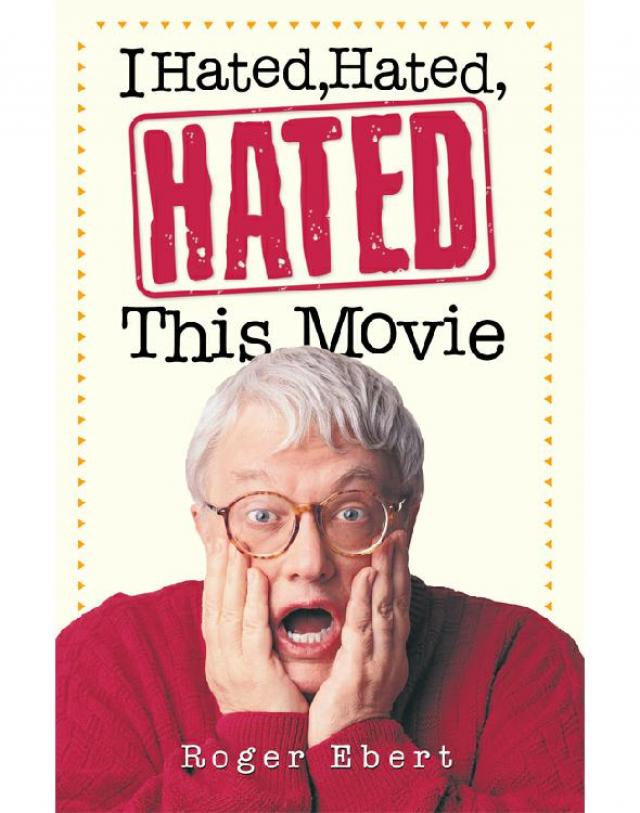
I Hated, Hated, Hated This Movie, page 8


But enough on the technical side. What about the story here? It has to be seen to be believed—something I do not advise. There’s all kinds of murky plot debris involving nasal spray with cocaine in it, ghosts from the past, bizarre sex, and lots of nudity. We are asked to believe that Madonna lives on a luxury houseboat, where she parades in front of the windows naked at all hours, yet somehow doesn’t attract a crowd, not even of appreciative lobstermen. What does she dedicate her life to? She answers that question in one of the movie’s funniest lines, which unfortunately cannot be printed here.
When it comes to eroticism, Body of Evidence is like Madonna’s new book. It knows the words but not the music. All of the paraphernalia and lore of S&M sexuality are here, but none of the passion or even enjoyment. We are told by one witness that sex with the Madonna character is intense. It turns out later he’s not a very reliable witness.
Bolero
(Directed by John Derek; starring Bo Derek, George Kennedy, 1984)
Bolero is a film starring Bo Derek as a woman who believes that the cure for a man’s impotence is for his woman to train as a bullfighter. Bolero is also the name of the composition by Ravel that Dudley Moore played in 10 while making love with Derek. So much we already know. Also, let’s see here, paging through the old dictionary . . . a bolero is a Spanish dance, characterized by sharp turns and revolutions of the body and stamping of the feet, and it also is a jacket of waist-length or shorter, usually worn open. So that explains the jacket of waist-length or shorter, usually worn open, which is Bo Derek’s only item of clothing during one scene in the movie. It also explains the sharp turns and revolutions of her body during the same scene, although there is no stamping of the feet, except by the viewer.
But I am still a little confused by the relationship between Derek and the bullfighter who is her lover. If you have not seen the movie, let me explain. Derek has graduated from a fancy women’s boarding school, and after mooning her professors she departs in search of a tall, dark, and handsome man.
First she meets a sheik, but he turns out to be a dud, maybe because he spends too much time inhaling the magic fumes of his hookah. So Bo goes to Spain, where she meets this all-around guy who herds cattle on a mountaintop, owns a winery, and is a bullfighter. If he also was an investment banker whose last book read was The Prophet, he could be a Dewar’s Profile. Bo and the guy make love at sunrise. Unfortunately, the sun rises directly into the camera at crucial moments. Then her lover goes into the ring to fight with the bull, and is gored in that portion of his anatomy he can least afford to spare in any continuing relationship with Derek. He is brave. While doctors fight to save his life, his only thought is for his dog. He asks Bo to be sure that the dog gets home safely.
Before long, Bo is observing that her lover is acting depressed and distant. Could this possibly be because of his horrible injuries? You would think so, and I would think so, but Bo tells him it doesn’t matter, and then she vows that he will live to fight again another day, so to speak. Then she starts taking bullfighting lessons. Oh, but I almost forgot. The Arab sheik tears himself away from his hookah long enough to fly to Spain and kidnap her. She is tied up in his open biplane, but manages to untie herself and jump off the plane. Then Bo is immediately back in her lover’s hacienda again. How did she get to the ground? For anyone with Bo’s faith, all is possible, and I think this is a real good omen for the lover. If she can get down in one piece, think what he might be able to do.
Let’s face it. Nobody is going to Bolero for the plot anyway. They’re going for the Good Parts. There are two Good Parts, not counting her naked ride on horseback, which was the only scene in the movie that had me wondering how she did it.
Breaking the Rules
(Directed by Neil Israel; starring Jason Bateman, Annie Potts, C. Thomas Howell; 1992)
Breaking the Rules is a movie about a guy who finds out he has a month to live, and decides to spend it in the worst buddy movie ever made.
The movie has to be seen to be believed. It is a long, painful lapse of taste, tone, and ordinary human feeling. Perhaps it was made by beings from another planet, who were able to watch our television in order to absorb key concepts such as cars, sex, leukemia, and casinos, but formed an imperfect view of how to fit them together.
This is the kind of movie where a scene is intended to make you cry, but you’re not crying, you’re wondering just how bad the dialogue can possibly be, and whether the filmmakers are indeed lacking in all instincts about what is believable or acceptable behavior, and what is not.
The movie opens with three childhood chums whose idea of a good time is to ride inside the dryers at the laundromat. One of the buddies throws up inside a dryer, and they get in trouble. One wonders, watching this scene, if the filmmakers know it is dangerous for kids to play inside laundry dryers? If they think it’s funny to show such a practice? If they couldn’t think of any other kind of prank?
The payoff comes when the kids are confronted by angry adults, and all three of them simultaneously point at the other two guys while chiming in unison, “He did it.” This establishes the ground rules: These characters know they are in a movie, and are reading dialogue, not performing ordinary human speech.
Flash-forward ten years. One of the kids stages a reunion between the other two, who are no longer on speaking terms. Reason: He has leukemia, and a month to live. All three young men immediately decide to get a van and set off cross-country to California, where it is the dying lad’s final wish to appear on Jeopardy.
Along the way, they stop off for some Nevada casino action, and meet a waitress who instantly marries the dying kid and asks him to sleep with her because she wants his baby. Nope, says the doomed one; it’s my buddy who wants to sleep with you. Ever the good sport, the waitress sleeps with the buddy on her wedding night—on a couch in the same room where the other two friends are sleeping. How do they react? They pull the sheets over their heads, and giggle.
One appalling scene follows another. The illness, the death, the funeral, the videotape. Was there no one to cry out, “Stop this madness?” No one to read the script and see that it was without sense or sensibility? No one to listen to the dialogue and observe that nobody in the whole world has ever talked like this? No one to say that you cannot inspire sympathy for characters who act in a manner contrary to all common human decency? A good documentary about the making of Breaking the Rules might perhaps provide a useful record of the decay of intelligence and sanity in our time.
Brother Sun, Sister Moon
(Directed by Franco Zeffirelli; starring Graham Faulkner, Alec Guinness; 1973)
Franco Zeffirelli’s Brother Sun, Sister Moon is a big, limp Valentine of a movie, filled with an excess of sweetness and light. What a shame. His subject is Francis of Assisi, one of the most interesting and natural of saints, but Zeffirelli has portrayed him as sort of the first flower child.
Well, maybe he was. It may be true that Francis went out into the fields and spoke to the birds. But is it true, as Zeffirelli seems to believe, that the birds had more to say than Francis did? He hardly gives us six lines of intelligent or perceptive dialogue in the movie; the rest is empty, pretty phrasing. After a while we long for a cynic to wander into the movie and ask Francis a few pointed questions.
The movie shows every sign of having been taken apart and put back together again. The opening—a rambling, confused editing job—looks as if it’s meant to cover up for an original beginning that ran too long. While Francis tosses and turns on his bed, we get flashbacks to a field of battle and memories of how he went off to be a soldier. The task of a movie’s first ten minutes, at the very least, is to orient us and give us a general idea of what to expect. Brother Sun, Sister Moon opens on confusion and complexity, which is bad enough; what’s worse is that once the opening is out of the way, the movie levels off into one note, indefinitely held.
Francis is portrayed as a wispy-bearded youth with a glow in his eye; if we didn’t know he was a saint we might think he was a little tetched in the head. That’s especially true when he leaves his sickbed and walks out onto a rooftop to catch a bird. It’s not the bird that matters; it’s the way he walks, waving his arms and teetering back and forth, always about to fall off. Surely even a saint can keep his balance.
After a suitable period of standing on the rooftop, Francis goes out into the fields and finds there a ruined church. He takes unto himself a band of followers, not omitting the obligatory local aristocrat who comes to scoff and stays to plaster, and they rebuild the church. The local church authorities, who are gowned and bejeweled as if they had first dibs on Marco Polo’s plunder, are scandalized. Who ever heard of a Christian who embraced poverty and humility?
But Francis perseveres, and eventually the local bad guys set his church on fire. I guess it’s set on fire, anyway; clouds of smoke pour from behind the church, but we see no flames. Did Zeffirelli decide to go with a smudge pot and save the rebuilt church? I dunno, but this is the kind of movie where you think of things like that. Anything to stay awake.
Now comes the big scene, where Francis and his followers go to see Pope Innocent, who is played by Alec Guinness. Zeffirelli has constructed a set for the papal chambers that makes Anthony Quinn’s digs in Shoes of the Fisherman look like the ballroom of the Honolulu Hilton.
Dozens—perhaps hundreds—of altar boys swing incense burners. Squadrons of Swiss Guards swing open massive bronze doors. The College of Cardinals sits almost immobile, their robes so heavy they can hardly move. Scheming papal advisers are arrayed behind the throne. And Guinness is costumed in such a manner as to remind us of the ecclesiastical fashion show in Fellini Roma. Did Zeffirelli mean his scene to be satire, or merely wretched excess? Also, does the pope always have 200 divines on hand just to hold an audience for a few barefoot monks?
Well, believe it or not (there are gasps of dismay from the cardinals), the pope comes out in favor of poverty and self-denial, and gives Francis his blessing. Whereupon Francis presumably goes out and incorporates the Franciscan Order, although that’s not in this movie; maybe we’ll get a sequel. Zeffirelli himself says you can’t think too much about his movie; you have to accept it as a simple experience. “You have to hang your brains outside by the door before you go into this film,” he said, and it looks as if he started with himself.
Caligula
(Starring Malcolm McDowell, John Gielgud, Peter O’Toole; 1980)
Caligula is sickening, utterly worthless, shameful trash. If it is not the worst film I have ever seen, that makes it all the more shameful: People with talent allowed themselves to participate in this travesty. Disgusted and unspeakably depressed, I walked out of the film after two hours of its 170-minute length. That was on Saturday night, as a line of hundreds of people stretched down Lincoln Avenue, waiting to pay $7.50 apiece to become eyewitnesses to shame.
I wanted to tell them . . . what did I want to tell them? What I’m telling you now. That this film is not only garbage on an artistic level, but that it is also garbage on the crude and base level where it no doubt hopes to find its audience. Caligula is not good art, it is not good cinema, and it is not good porn.
I’ve never had anything against eroticism in movies. There are X-rated films I’ve enjoyed, from the sensuous fantasies of Emmanuelle to the pop absurdities of Russ Meyer. I assume that the crowds lining up for admission to the Davis Theater were hoping for some sort of erotic experience; I doubt that they were spending $15 a couple for a lesson on the ancient history of Rome.
All I can say is that the makers of Caligula have long since lost touch with any possible common erotic denominator, and that they suggest by the contents of this film that they are jaded, perverse, and cruel human beings. In the two hours of this film that I saw, there were no scenes of joy, natural pleasure, or good sensual cheer. There was, instead, a nauseating excursion into base and sad fantasies.
You have heard that this is a violent film. But who could have suspected how violent, and to what vile purpose, it really is? In this film, there are scenes depicting a man whose urinary tract is closed, and who has gallons of wine poured down his throat. His bursting stomach is punctured with a sword. There is a scene in which a man is emasculated, and his genitals thrown to dogs, who eagerly eat them on the screen. There are scenes of decapitation, evisceration, rape, bestiality, sadomasochism, necrophilia.
These scenes—indeed, the movie itself—reflect a curiously distanced sensibility. Nobody in this film really seems to be there. Not the famous actors like Malcolm McDowell and (very briefly) Peter O’Toole and John Gielgud, whose scenes have been augmented by additional porn shot later with other people and inserted to spice things up. Not the director (who removed his credit from the film). Not the writer (what in the world can it mean that this movie is “Adapted from an Original Screenplay by Gore Vidal”?) Not even the sound track. The actors never quite seem to be speaking their own words, which are so badly dubbed that they sometimes seem at right angles to the drama itself.
Caligula has been photographed and directed with such clumsiness and inelegance that pieces of action do not seem to flow together, the plot is incomprehensible, the events are framed as if the camera is not sure where it is, and everything is shot in muddy, ugly, underlit dungeon tones. The music is also execrable.
So what are we left with? A movie that may be invulnerable to a review like this one. There are no doubt people who believe that if this movie is as bad as I say it is, it must be worth seeing. People who simply cannot believe any film could be this vile. Some of those people were walking out of the Davis before I did Saturday night; others were sitting, depressed, in the lobby. That should not, I suppose, be surprising.
The human being is a most curious animal, often ready to indulge himself in his base inclinations, but frequently reluctant to trust his better instincts. Surely people know, going in, that Caligula is worthless. Surely they know there are other movies in town that are infinitely better. Yet here they are at Caligula. It is very sad.
My friendly recommendation is that they see The Great Santini, to freshen their minds and learn to laugh and care again in a movie. People learn fast. “This movie,” said the lady in front of me at the drinking fountain, “is the worst piece of shit I have ever seen.”
Camille 2000
(Directed by Radley Metzger; starring Daniéle Gaubert, Nino Castelnuovo; 1969)
It is said that Orson Welles saw John Ford’s Stagecoach 200 times before directing Citizen Kane. According to a press release here on my desk, Radley Metzger has seen John Huston’s The Treasure of the Sierra Madre 103 times. That was not enough.
I think Metzger was better—or worse, that is—back when he had only seen it maybe twenty times. Blinking his eyes as he emerged into the sunlight, he directed I, a Woman, which was the worst movie of all time (up until then).
Then he went back to see Sierra Madre another, say, two dozen times, and after that he directed Carmen, Baby, which was almost as bad as I, a Woman but made less money. Then, a glutton for culture, he saw Sierra Madre forty-one more times, and made Therese and Isabel, which was even worse than I, a Woman.
So that made eighty-five times he had seen The Treasure of the Sierra Madre. Eighteen times to go. I wonder if he was the guy who sat behind me the last time I saw it at the Clark. He was reciting the dialogue under his breath and when the usher protested, he flashed a card with the name Fred C. Dobbs on it. (This is not made up.)
Anyway, after seeing Sierra Madre 103 times, Metzger was ready for the big time. Camille 2000 is shot in color. It is dubbed into English instead of subtitled. It is wide screen. It has a pretty girl in it. Her name is Daniéle Gaubert. Whoever painted that big sign in front of the theater has an accurate critical sense. The sign says: “See Daniéle Gaubert presented in the nude . . . and with great frequency.” That captures the essence of Metzger’s art.
Well, Daniéle Gaubert is presented in the nude all right, amd she has a lot of love scenes with Nino Castelnuovo. The way they make love is interesting. Their key technique is to assume the conventional configuration and then . . . not move! Mostly, they’re looking at themselves in the mirrors. There are mirrors all over her bedroom. No matter where they look, they see themselves in the mirror. Daniéle and Nino aren’t too bright, I guess. They’re just about to start making love when their eyes wander, and they get interested in that beautiful couple up on the ceiling.
Anyway, after twenty minutes of this, Metzger speeds up his pace. There’s a fascinating close-up of a flower, and as it goes in and out of focus we hear a lot of heavy breathing and see Daniéle’s face on the left side of the screen. Apparently something is happening to her. Maybe a manicure.
I’m not sure, but I think the heavy breathing was dubbed in from Metzger’s Therese and Isabel. That one starred Essy Persson, the all-time heavy-breathing champ. It was a movie about a woman who looked at the ceiling and breathed heavily. She didn’t need a lover, she needed a Vicks Inhaler.
Candyman: Farewell to the Flesh
(Directed by Bill Condon; Kelly Rowan, Tony Todd; 1995)
In the original Candyman (1992), a couple of Ph.Ds from the University of Illinois theorized that the Candyman was an urban legend, brought to life by the faith of all the people who believed in him. But it turned out there was a much more Gothic and supernatural explanation, and we learn more about his origins in the new Candyman: Farewell to the Flesh.
The Candyman stories, based on books by Clive Barker, are an attempt to make an intelligent fable out of a bogeyman, and Bernard Rose’s 1992 film did a good job of it, with Virginia Madsen and Kasi Lemmons as the researchers who track down tales of a slasher with a hook for a hand. He was terrorizing Chicago’s Cabrini-Green housing project, but in the second film he has moved back home to New Orleans, and started preying on his own descendants instead of innocent bystanders.