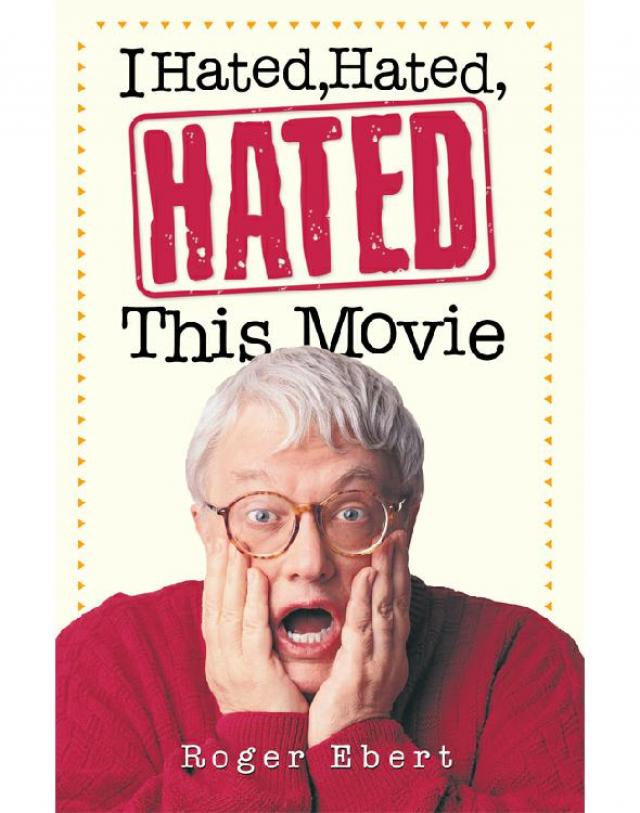
I Hated, Hated, Hated This Movie, page 18


There is nothing wrong with making a Godzilla movie, and nothing wrong with special effects. But don’t the filmmakers have some obligation to provide pop entertainment that at least lifts the spirits? There is real feeling in King Kong fighting off the planes that attack him, or the pathos of the monster in Bride of Frankenstein, who was so misunderstood. There is a true sense of wonder in Jurassic Park.
Godzilla, by contrast, offers nothing but soulless technique: A big lizard is created by special effects, wreaks havoc, and is destroyed. What a coldhearted, mechanistic vision, so starved for emotion or wit. The primary audience for Godzilla is children and teenagers, and the filmmakers have given them a sterile exercise when they hunger for dreams.
The Good Son
(Directed by Joseph Ruben; starring Macaulay Culkin, Elijah Wood; 1993)
Who in the world would want to see this movie? Watching The Good Son, I asked myself that question, hoping that perhaps the next scene would contain the answer, although it never did. The movie is a creepy, unpleasant experience, made all the worse because it stars children too young to understand the horrible things we see them doing.
The story begins with the death of the hero’s mother. His father needs to go to Japan urgently on business, and so young Mark (Elijah Wood) goes to spend a couple of weeks with his aunt and uncle’s family in Maine. They’ve had tragedy, too: A baby boy drowned in his bath some time ago. Now young Henry (Macaulay Culkin) has the house all to himself—except for his sister, who may not last long.
The two boys seem to be about nine or ten. They are allowed to roam freely all over the island, which seems to be have been designed as a series of death traps for kids. Mark almost falls out of a towering tree house, and then, led by Henry, stands on the edges of cliffs, walks around the rim of a deep well, runs down the railroad tracks, and eventually watches with horror as Henry kills a dog and later causes a highway crash by dropping a human form off a bridge.
This is a very evil little boy; the movie could have been called Henry, Portrait of a Future Serial Killer. But what rings false is that the Macaulay Culkin character isn’t really a little boy at all. His speech is much too sophisticated and ironic for that, and so is his reasoning and his cleverness. He would be more frightening, perhaps, if he did seem young and naive. This way, he seems more like a distasteful device by the filmmakers, who apparently think there is a market for glib one-liners by child sadists.
Young Mark quickly realizes how evil Henry is, but no one will listen to him—not his uncle, not his aunt, not even the friendly local child psychiatrist. Everything leads up to a cliff-hanging climax that somehow manages to be unconvincing, contrived, meretricious, and manipulative, all at once. I don’t know when I’ve disliked the ending of a movie more.
The screenplay is by Ian McEwan, that British master of the macabre (The Comfort of Strangers was based on one of his novels). But don’t blame him. He has already published an article in a London newspaper complaining that once the Culkin family came aboard the movie, the original screenplay was the last of anyone’s considerations. The story was shaped to fit Macaulay, he charges. Strange. You’d imagine that the tyke’s parents and managers would have paid good money to keep him out of this story.
One of the reasons the movie feels so unwholesome is that Macaulay seems too young and innocent to play a character this malevolent. At times, hearing the things he’s made to say, you want to confront the filmmakers who made him do it, and ask them what they were thinking of.
For that matter, what were Culkin’s parents thinking of when they pushed him into a movie where he drowns his baby brother, tries to drown his little sister, and wants to push his mother off a cliff? If this kid grows up into another one of those pathetic, screwed-up former child stars who are always spilling their guts on the talk shows, a lot of adults will share the blame.
The movie is rated “R.” Market surveys indicate that kids want to see it, probably because it stars their Home Alone hero. This is not a suitable film for young viewers. I don’t care how many parents and adult guardians they surround themselves with. And somewhere along the line, a parent or adult guardian should have kept Macaulay out of it, too.
The Good Wife
(Directed by Kem Cameron; starring Rachel Ward, Sam Neill; 1987)
It gets lonely out there in the country. Sometimes it gets so lonely a woman just doesn’t know what to do. “I just wish something would happen to me,” Marge complains to her husband. “Anything.” But it always seems like things happen to someone else. Just this morning, for example, she assisted in the delivery of a child. Tonight she will go to bed with her brother-in-law. You see how it is.
The Good Wife is slow, solemn, and boring, and so I assume it is meant to be a serious study of Marge and her problems, recycled D. H. Lawrence, maybe. But this material is so dead that maybe having fun with it was the only hope; it needed a David Lynch or a John Cleese to make it work.
The movie stars Rachel Ward as Marge, the repressed young wife, and Bryan Brown as Sonny, her loving and long-suffering husband. They live on a farm in Australia where, as already noted, nothing much seems to happen, not even after Sugar, Sonny’s brother, comes to live with them.
Sugar is a total loser who asks Marge if he can sleep with her. Marge advises him to ask her husband. The husband generously gives his permission, but about three seconds later Marge is more bored than ever, if you get what I mean. Meanwhile, the hotel in town hires a new bartender, a slick Clark Gable type played by Sam Neill.
Sexual conduct must have been more permissive in Australia in 1939 than it is these days. Neill gets off the train, sees Marge standing in the station, walks two blocks with her, shoves her up against a hedge, and sexually assaults her. She fights him off, and he says bitterly, “One chance is all you’ll get with me.”
Marge returns to her lonely farm and begins to develop an obsession about the bartender. She can think of nothing else. She goes into town and gets drunk and shouts lewd suggestions at him in front of the whole barroom. Her husband comes and takes her home in the truck. And so on.
There are some murky minor characters, such as Marge’s sluttish mother, who are no doubt supposed to provide some psychological insights. But basically what we have here is a sad woman who is mentally ill, and a husband who is incredibly patient with her. Or, as the movie’s press release phrases it, “She is bored, hot, and in trouble—a dangerous combination.” Out in the audience, I was bored and hot, an even more dangerous combination.
Goodbye, Lover
(Directed by Roland Joffe; starring Patricia Arquette, Dermot Mulroney; 1999)
I’ve just transcribed no less than eleven pages of notes I scribbled during Goodbye, Lover, and my mind boggles. The plot is so labyrinthine that I’d completely forgotten the serial killer named The Doctor, who murders young women by injecting curare into their veins with a syringe. When a character like The Doctor is an insignificant supporting character, a movie’s plate is a little too full, don’t you think?
Goodbye, Lover is not so much a story as some kind of a board game, with too many pieces and not enough rules. The characters careen through the requirements of the plot, which has so many double-reverses that the real danger isn’t murder, it’s being disemboweled by G-forces. There’s no way to care about the characters, because their fates are arbitrary—determined not by character, not by personality, but by the jigsaw puzzle constructed by the screenwriters (there are three of them—which for this material represents a skeleton crew).
And yet the film does have a certain audacity. It contains a character played by Patricia Arquette who is the most enthusiastic sexual being since Emmanuelle, and another, played by Don Johnson, who just plain gets tuckered out by her demands. (At one point, they’ve taken the collection in church and are walking down the aisle with the offering, and she’s whispering that he should meet her for sex tomorrow, or else.) There’s also a droll supporting role for Ellen DeGeneres, as a police detective who keeps picking on her partner, a Mormon man who doesn’t, I hope, understand most of her jokes. One of her key clues comes with the discovery of a Sound of Music tape, which arouses her suspicions: “I don’t trust anybody over the age of ten who listens to The Sound of Music.”
The movie opens with phone sex and never looks back. We meet Sandra (Arquette), a Realtor who memorizes Tony Robbins self-help tapes, treasures The Sound of Music as her favorite movie, and likes to whisper, “I’m not wearing any underwear.” She is having an affair with Ben (Johnson), and at one point handcuffs him with some sex toys she finds in a house she’s selling. When the clients return unexpectedly, poor Ben barely has time to release himself and hide the cuffs in his pants pocket. (The Foley artists, concerned that we may have missed the point, cause the cuffs to rattle deafeningly, as if Ben had a tambourine concealed in his underwear.)
Sandra is married to Jake (Dermot Mulroney), who is Ben’s brother. Ben is the straight arrow who runs an ad agency, and Jake is the unkempt alcoholic who nevertheless is a brilliant copywriter. Why is Sandra cheating on Jake? The answer is not only more complicated than you might think—it’s not even the real answer. This is one of those plots where you might want to take a night school class about double-indemnity clauses in insurance policies before you even think about buying a ticket.
My space is limited, but I must also mention the GOP senator who is caught with a transvestite hustler; the struggle on the condo balcony; the motorcycle-car chase; the sex scene in a church’s organ loft; the black leather mask; the Vegas wedding chapel ploy; Mike, the professional killer (not to be confused with The Doctor); and Peggy, Ben’s secretary, who is played by Mary-Louise Parker as the kind of woman who would be a nymphomaniac in any other movie, but compared to Sandra is relatively abstentious.
There is a part of me that knows this movie is very, very bad. And another part of me that takes a guilty pleasure in it. Too bad I saw it at a critic’s screening, where professional courtesy requires a certain decorum. This is the kind of movie that might be materially improved by frequent hoots of derision. All bad movies have good twins, and the good version of Goodbye, Lover is The Hot Spot (1990), which also starred Don Johnson, along with Virginia Madsen and Jennifer Connolly, in a thriller that was equally lurid but less hyperkinetic. Goodbye, Lover is so overwrought it reminds me of the limerick about that couple from Khartoum, who argued all night, about who had the right, to do what, and with which, and to whom.
The Guardian
(Directed by William Friedkin; starring Jenny Seagrove; 1990)
Of the many threats to modern man documented in horror films—the slashers, the haunters, the body snatchers—the most innocent would seem to be the Druids. What, after all, can a Druid really do to you, apart from dropping fast-food wrappers on the lawn while worshiping your trees?
That’s what I would have said, anyway, until I saw The Guardian, a movie about a baby-sitter whose goal is to capture babies and embed them in a vast and towering old sacred druidical tree, which she appaently carts around with her from state to state and aeon to aeon.
The Druid, who is probably immortal but takes the human form of a foxy British governess, is played by Jenny Seagrove. Even the people who hire her observe that she’s too pretty to be a governess. They are a Chicago couple (Dwier Brown and Carey Lowell) who move to Los Angeles after he gets a better job in the advertising business. A lot better: In Chicago they lived in a two-bedroom flat, but in L.A., despite the higher real estate prices, they’re able to rent a house by a famous architect (Brad Hall), who even drops in personally to repair the doors. The house is right on the edge of one of those vast deep green forests that we all know are such a feature of Los Angeles topography.
The nanny brings good references with her, and has one of those British accents that costs a lot to acquire and maintain. She also knows a lot about children. She knows, for example, that after thirty days the “baby-cells” in the bloodstream are replaced by grown-up cells. This seems to be particularly important to her.
Having established these facts, The Guardian then bolts headlong into the thickets of standard horror film clichés: Ominous music, curtains blowing in the wind, empty baby cribs, dire warnings from strange women, manifestations of savage canines, and the lot. The architect comes to a gruesome end, the husband suspects the nanny’s vile scheme, and about the only original touch in the movie is that, for the first time in horror film history, a chain saw is used against its intended target, a tree.
The Guardian was directed by William Friedkin, sometimes a great filmmaker (The Exorcist, The French Connection). His most recent previous film, based on a true crime case, was named Rampage and was not even properly released. I saw it and admired it. Now this. Maybe after years of banging his head against the system Friedkin decided with The Guardian to make a frankly commercial exploitation film. On the level of special effects and photography, The Guardian is indeed well made. But give us a break.
Gunmen
(Directed by Deran Sarafian; starring Christopher Lambert, Mario Van Peebles, Patrick Stewart; 1994)
The opening sequence of Gunmen begins with a shot of a sweaty, unshaven face with a fly crawling upon it. Not long after, a prisoner is astonished when the wall of his cell is blown away and he is beckoned to freedom by a man standing outside. Both of these visuals are recycled from famous spaghetti Westerns.
This is a bad omen. Most directors have at least one or two original ideas when they start a film, and they tend to put them right at the beginning, as audience grabbers. When Deran Sarafian borrows well known ideas from famous movies right at the get-go, it doesn’t bode well for what’s to follow. Nor should it.
Gunmen is a movie without plan, inspiration, or originality—and to that list I would add coherence, except that I am not sure this movie would place much value on a plot that hangs together. The film’s ambitions are simple: To give us a lot of action, a lot of violence, a few ironic lines of dialogue, and some very familiar characters. To call the characters in Gunmen clichés would be a kindness; my notion is that they’ve been wandering in actionpic cyberspace for years, occasionally surfacing in our dimension as B-movie heroes.
The movie stars Christopher Lambert (he eats the fly in the opening scene) and Mario Van Peebles, in a murky tale of drugs and revenge south of the border. Van Peebles plays Cole, a New York–based drug enforcement agent, who is in an unnamed South American country to mop up illegal drug profits and avenge his father’s death. Lambert plays Servigo, a drug runner who may have information that can help him.
The idea is that these two men will have a love-hate relationship throughout the movie, and we will find it amusing. I can’t argue with the first half of the idea. In one of the movie’s less plausible developments, they actually shoot each other in the leg, and then we get allegedly hilarious scenes in which they limp in unison. Anyone who has ever been shot in the leg and tried to walk immediately afterward was not hired as the technical consultant on this movie.
The dialogue is hard to describe. Imagine the worst spaghetti Western you ever saw, shot in Italian and then dubbed into English by actors familiar only with the most basic movie clichés. Now imagine a film shot in English in which people talk the same way. You’ve got it. Then imagine them talking that way while inhabiting familiar moments from old movies. Not just the scenes I’ve already mentioned, but the jump off the cliff from Butch Cassidy and the Sundance Kid and the gag about being handcuffed together from The Defiant Ones, among many other films.
Several years ago, in Ebert’s Little Glossary of Movie Terms, I first formulated the Cole Rule. This is the motion picture production rule that states: No movie made since 1977 containing a character with the first name “Cole” has been any good. There may, of course, be exceptions to that rule. Gunmen is not one of them.
Guyana—Cult of the Damned
(Directed by Rene Cardona, Jr.; starring Stuart Whitman, Gene Barry, Joseph Cotten; 1980)
Guyana—Cult of the Damned has crawled out from under a rock and into local theaters, and will do nicely as this week’s example of the depths to which people will plunge in search of a dollar. The movie is a gruesome version of the Jonestown massacre of 1978, so badly written and directed it illustrates a simple rule of movie exhibition: If a film is nauseating and reprehensible enough in the first place, it doesn’t matter how badly it’s made—people will go anyway.
The film was produced, directed, and cowritten by one Rene Cardona, Jr., whose credits in the movie’s press release portray him as a ghoulish retailer of human misery. He is the producer of Survival, about the cannibalism of the Andes survivors, and of The Bermuda Triangle, and now of the disquieting story of the Guyana massacre. “At least fifteen film producers went after the story,” the release says, “but Cardona got there first.”
Good old Cardona. He got there first with a film that mixes fact, fiction, and speculation with complete indifference, and that contains an amazing absence of any real curiosity about the bizarre deaths in Jonestown. It presents them as a horror story, but it doesn’t really probe for reasons or motivations.
“This story is true,” we’re promised at the outset. “Only the names have been changed.” The story may be true, but the research sure isn’t original; the screenplay seems to have been written at typing speed and based on wire service stories of the massacre. The movie’s held together with a voice-over narration (handy if you’re planning to dub into several languages), and the characters are almost always seen from the outside: We get no scenes attempting to probe the personalities of the cult members.