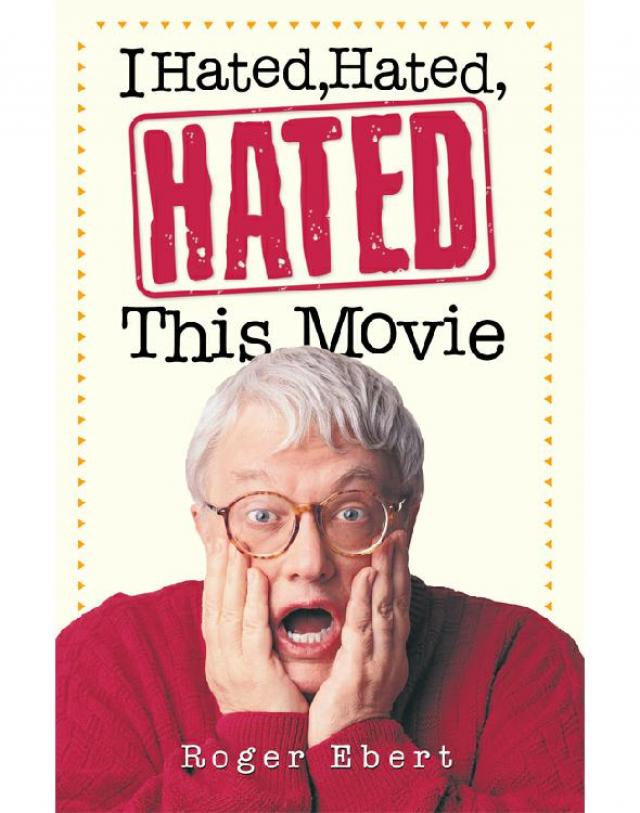
I Hated, Hated, Hated This Movie, page 25


The movie is a feature-length version of a 1992 short film made for MTV by John Payson. Less is more. The idea of singing, dancing cockroach buddies can easily be explored in all of its manifestations, I am sure, in a film much briefer than eighty minutes, which is how long Joe’s Apartment runs, illustrating my principle that no good film is too long and no bad film is short enough.
The plot has been recycled out of many another Manhattan comedy about the evil property developer who wants to tear down the colorful little brownstone and put up some architectural monstrosity. The rent-controlled apartment building in this film is occupied by a little old lady, who is tripped by hidden wires and in other ways forced out of her flat by the nephews of the evil slumlord (played by Don Ho; yes, Don Ho). But then the hero, Joe (Jerry O’Connell) moves into the apartment, posing as her heir, and so the nephews start on him. The real tenants of the apartment are tens of thousands of cockroaches, who at first dislike Joe but eventually become his friend and gang up on the slumlord.
I am not sure I need to go into all of the details involving Joe’s new girlfriend Lily (Megan Ward), or how hard she works on her garden, or how well Joe collects manure from the carriage horses of Central Park to help her, or how her dad is a senator (played by Robert Vaughn; yes, Robert Vaughn). If you want to know how the pink scented urinal cakes come into the story, send me a stamped, self-addressed postcard. On second thought, don’t stamp it.
The roaches are the real centerpiece of the movie. These are not ordinary roaches. They sing and dance. Some people will be reminded of the singing mice in Babe, but singing mice are one thing and a roach quintet is quite another. The insects have obnoxious piping little voices and sound like the Chipmunks if they had inhaled helium.
Some of the roaches are given names, but I must say none of them really emerged as individuals for me. They were more of a large squirming mass, and when several hundred of them crawled across Joe’s face, I for one was happy to be sitting in the back row, lest a fellow moviegoer be moved to hurl. The special effects are very good, I suppose. You can see every detail of the carefully articulated armor on their little tummies, if you want to.
Jonathan Livingston Seagull
(Directed by Hall Bartlett; 1973)
At the point when I walked out of Jonathan Livingston Seagull—some forty-five minutes into the movie—the hero had learned to avoid garbage and fly high, but the film, alas, had not. I hardly ever walk out of movies, and in fact I sometimes make a point of sitting through bad ones, just to get ammunition for a juicy review. But this one was too much.
It is based, to begin with, on a book so banal that it had to be sold to adults; kids would have seen through it. The Little Engine That Could is, by comparison, a work of some depth and ambition. Consider that the movie made from the book has now been made the object of a lawsuit by the book’s author and you have some measure of the depths to which we sink as Jonathan dives.
Jonathan not only dives, and perfects his aeronautical ability, and makes his name as the flocks leading nonconformist, but he also talks. Allowing him to talk is perhaps the movie’s basic strategic error. Jonathan talks under his breath with great gasping urgency: He talks to himself about how if only he could hold his wings a little different, etc., he, too, could dive for fish and not have to scavenge garbage.
And then there’s the problem of the birds. The movie uses real birds, and it’s a little sickening to show them being knocked out and batted around in the interest of the story line. I left when Jonathan had dragged himself, groggy and bleeding, onto some flotsam. Who wants to pay to see birds bleed?
Jungle 2 Jungle
(Directed by John Pasquin; starring Tim Allen, Sam Huntington; 1997)
There is a scene early in Jungle 2 Jungle that indicates how brainless the movie is. Before I explore its delights, I must make you familiar with the premise. A Manhattan commodities broker journeys up the Amazon to obtain a divorce from the wife he has not seen in many years. She works now among the Indians. The broker is astonished to find that he has a son, who has been raised by his estranged wife in the jungle. The son now wants to return to New York with his father, because he has promised the tribal chief he will bring back the fire from the torch atop the Statue of Liberty.
Now, as we rejoin our story, the broker (Tim Allen) and his son (Sam Huntington) arrive at Kennedy Airport, and here is the brainless part: The boy, who is about thirteen, is still dressed for the jungle. He wears only a loincloth and some feathers and suchlike; no shirt or shoes. If memory serves, he carries his deadly dart blowgun, which is the sort of thing you’re not allowed to have on an aircraft, but never mind: Did either of this child’s parents stop to consider that perhaps the lad should have jeans and a sweatshirt for a 3,000-mile air journey? Such garments are available in Brazil. I know; I’ve been there. I flew upstream in a plane with pontoons, and landed on the Amazon above Belim without seeing a single person in a loincloth, although I saw many Michael Jordan T-shirts.
But no, the parents didn’t stop to think, and that is because they don’t think. Why don’t they think? Because no one is allowed to think in this movie. Not one single event in the entire plot can possibly take place unless every character in the cast has brains made of Bac-O-Bits.
The plot of Jungle 2 Jungle has been removed from a French film called Little Indian, Big City. The operation is a failure and the patient dies. The only reason I am rating this movie at one star while Little Indian, Big City got “no stars” is that Jungle 2 Jungle is too mediocre to deserve no stars. It doesn’t achieve truly awful badness, but is sort of a black hole for the attention span, sending us spiraling down into nothingness.
Most of the comic moments come from the “fish out of water” premise, or “FOW,” as Hollywood abbreviates it (you know a plot’s not original when it has its own acronym). The kid has been raised in the jungle, and now, in the city, he tries to adapt. There are many jokes involving his pet tarantula, which he has brought along with him, and his darts, which Allen uses to accidentally put his fiancée’s cat to sleep.
The fiancée is played by Lolita Davidovich, who is supposed to be a successful businesswoman, but dresses as if she aspires to become a lap dancer. The joke is that she doesn’t like the idea of her future husband having a jungle boy. Additional jokes involve Martin Short, who plays Allen’s associate and has stolen Jim Jarmusch’s hairstyle, although not his wit. There are also some Russian Mafia guys, who march in and out like landlords in a Three Stooges comedy.
Little Indian, Big City (1996) got many if not most of the year’s worst reviews, but when I heard it was being remade with Tim Allen, I must confess I had some hope: Surely they would see how bad the premise was, and repair it? Not a chance. This movie has not learned from the mistakes of others, and like a lemming follows Little Indian over the cliff and into the sea.
Kazaam
(Directed by Paul M. Glaser; starring Shaquille O’Neal, Francis Capra; 1996)
Kazaam is a textbook example of a filmed deal, in which adults assemble a package that reflects their own interests and try to sell it to kids. How else to explain a children’s movie where the villains are trying to steal a bootleg recording so they can sell pirated copies of it? What do kids know, or care, about that?
The movie stars Shaquille O’Neal, the basketball player, as Kazaam, a genie who is released from captivity in an old boom box, and has to perform three wishes for a little kid (Francis Capra). Right there you have a wonderful illustration of the movie’s creative bankruptcy. Assigned to construct a starring vehicle for Shaq, the filmmakers looked at him, saw a tall bald black man, and said, “Hey, he can be a genie!” At which point, somebody should have said, “Okay, that’s level one. Now let’s take it to level three.”
Shaq has already proven he can act (in Blue Chips, the 1994 movie about college basketball). Here he shows he can be likable in a children’s movie. What he does not show is good judgment in his choice of material; this is a tired concept, written by the numbers. Kids old enough to know about Shaq as a basketball star will be too old to enjoy the movie. Younger kids won’t find much to engage them. And O’Neal shouldn’t have used the movie to promote his own career as a hopeful rap artist; the sound track sounds less like music to entertain kids than like a trial run for a Shaq album.
The plot: A wrecking ball destroys an old building, releasing a genie who is discovered by a kid named Max (Capra). The rules are, he gets three wishes. The twist is, the genie doesn’t much like people, having made no friends in 5,000 years and having spent most of that time cooped up in bottles, lamps, radiators, etc. The other twist is, the kid doesn’t much trust people, because his father has disappeared.
The genie, however, helps the kid find his father, only to find out the father is involved in an illegal music pirating operation. The father is not quite ready to go straight, but eventually, after some action sequences involving an evil gang, he realizes that his future depends on living up to his son’s expectations.
Uncanny, how much this plot resembles Aladdin and the King of Thieves, a Disney made-for-video production. In that one, Aladdin has never known his father, but an oracle in an old lamp tells him where the father is to be found, and the helpful blue genie helps him go there. His father is the King of the Thieves, it turns out, and may not be entirely ready to go straight. But after some action sequences involving the evil gang of thieves, the father realizes that he must live up to his son’s expectations, etc.
Did anybody at Disney notice they were making the same movie twice, once as animation, once as live action? Hard to say. The animated movie at least has the benefit of material that fits the genre, much better songs, a colorful graphic style, and another outing for the transmogrifying genie with the voice by Robin Williams. Kazaam, on the other hand, by being live action, makes the bad guys too real for the fantasy to work, and the action sequence feels just like the end of every other formula movie where the third act is replaced by fires and fights.
There are several moments in the movie when fantasy and reality collide. One comes when the genie astonishes the kid with a roomful of candy, which cascades out of thin air. I was astonished, too. Astonished that this genie who had been bottled up for most of the last 5,000 years would supply modern off-the-shelf candy in its highly visible commercial wrappers: M&M’s, etc. Does the genie’s magic create the wrappers along with the candy, or does the genie buy the candy at wholesale before rematerializing it?
There is also the awkwardness of the relationship between the genie and the kid, caused by the need to make Kazaam not only a fantasy figure, but also a contemporary pal who can advise the kid, steer him straight, and get involved in the action at the end. Genies are only fun in the movies if you define and limit their powers. That should have been obvious, but the filmmakers didn’t care to extend themselves beyond the obvious commercial possibilities of their first dim idea. As for Shaquille O’Neal, given his own three wishes the next time, he should go for a script, a director, and an interesting character.
Lair of the White Worm
(Directed by Ken Russell; starring Amanda Donohue, Hugh Grant; 1988)
Let this much be said for Ken Russell’s The Lair of the White Worm: This movie provides you with exactly what you would expect from a movie named The Lair of the White Worm. It has a lair, it has a worm, the worm is white, and there is a sufficient number of screaming victims to be dragged down into the lair by the worm.
Russell provides you with your money’s worth. Why he would have wanted to make this film is another matter. This is the kind of movie that Roger Corman was making for American-International back in the early 1960s, when AIP was plundering the shelves of out-of-copyright horror tales, looking for cheap story ideas. Corman would have found The Lair of the White Worm on the shelf right next to Dracula; both books were written by the same strange man, Bram Stoker.
In losing a juicy early-1960s AIP horror movie, we have gained a juicy late-1980s horror movie that would probably seem better if Russell’s name were not connected to it. People expect something special from Ken Russell, whose inflamed filmography includes such items as Women in Love, The Music Lovers, The Devils, The Boyfriend, Tommy, Altered States, Crimes of Passion, and Salome’s Last Dance. Every one of Russell’s films have been an exercise in wretched excess. Sometimes it works. Russell loves the bizarre, the Gothic, the overwrought, the perverse. The strangest thing about The Lair of the White Worm is that, by his standards, it is rather straight and square.
The movie begins on an archaeological dig in the wilds of Scotland, where a curious fossil is discovered, a fossil that seems neither man nor beast, nor reptile, for that matter, and yet contains aspects of more than one species. What does the skull represent? That is an assignment for young Angus Flint, who has the perfect name for an archaeologist, and who has made his find in the barnyard of the Trent sisters, Mary and Eve. Eventually, Flint discovers some of the family history. The Trent girls lost their father when he disappeared during a spelunking expedition in a nearby cave. And local tradition has it that the medieval lord of the area once slew a giant dragon.
Anyone who has ever seen a horror film can carry on unassisted from here; no prizes for reaching the end before Ken Russell. The skull obviously belongs to a race of giant dragons, or worms, and one of them quite possibly devoured the late Mr. Trent down in that cave. Russell introduces us to two more characters, and the chase is on. One of them is Lord James D’Ampton, descendant of the dragon-slayer. The other is Lady Sylvia Marsh, who dresses like a tasteful Elvira and lives in the moldering Gothic mansion down the lane.
More than this I will not tell. No, not even to hint that the worm of Stone Rigg Cavern can manifest itself in human form. Certainly not that. What I will say for The Lair of the White Worm is that this is a respectable B-grade monster movie, more tame and civilized than the Mad Slasher movies that have all but destroyed the genre. It has everything you want: shadows, screams, feverish scientific speculations, guttering candle flames, flowing diaphanous gowns, midnights, dawns, and worms. Ken Russell was once, and no doubt will be again, considered an important director. This is the sort of exercise he could film with one hand tied behind his back, and it looks like that was indeed more or less his approach.
Lake Placid
(Directed by Steve Miner; starring Bill Pullman, Bridget Fonda; 1999)
“What an animal does in the water is his own business—unless he does it to man.” So says Sheriff Keough, one of the crocbusters of Lake Placid. I couldn’t disagree with him more. The thirty-foot crocodile in this movie stays in the water, contentedly munching on bears and cows, until scuba-diving beaver-taggers invade his domain. It’s their own fault that the beast gets mad and eats a scientist and half a game warden.
The croc inhabits Black Lake, in Maine. (There is no Lake Placid in the movie, which may be its most intriguing mystery). It is, we learn, an Asian crocodile. “How did he swim across the sea?” a lawman asks, not unreasonably. “They conceal information like that in books,” one of the movie’s croc lovers answers sarcastically. I dunno; I thought it was a pretty good question.
As the movie opens, two game wardens are tagging beavers, to study their movements. Suddenly they’re attacked by an underwater camera, which lunges at them in an unconvincing imitation of an offscreen threat. It becomes clear that Black Lake harbors more than beavers, although for my money the scenes involving beavers were the scariest in the movie. Can you imagine being underwater, inside a beaver dam, with angry animals the size of footstools whose teeth can chomp through logs?
When it becomes clear that Black Lake harbors a gigantic beast, an oddly assorted crew assembles to search for it. There’s fish warden Jack Wells (Bill Pullman), museum paleontologist Kelly Scott (Bridget Fonda), Sheriff Keogh (Brendan Gleeson), and millionaire croc-lover Hector Cyr (Oliver Platt), a mythology professor who believes “crocodiles are divine conduits.” Oh, and there’s Mrs. Bickerman (Betty White), who lives in a cute little farm cottage on the shores of the lake and lost her husband a few years ago. That’s her story, anyway.
Whether the movie was intended at any point to be a serious monster thriller, I cannot say. In its present form it’s an uneasy compromise between a gorefest and a comedy—sort of a failed Anaconda. One peculiar aspect is the sight of an expensive cast in such a cheap production. We’re looking at millions of dollars’ worth of actors in the kind of aluminum boat you see on display outside Sam’s Club. Given the size of the crocodile, this movie lends a new meaning to the classic Jaws line, “We’re going to need a bigger boat.”
There’s tension between the locals and the visitors, between the croc lovers and the croc killers, between the sheriff and the state game officials, between the sexes, and between everybody else and Betty White, who uses language that would turn the Golden Girls green. Almost all of the disagreements involve incredibly stupid decisions (would you go scuba diving in a lake with a hungry giant crocodile?). New meaning is given to the disclaimer “no animals were harmed during the filming of this movie” by a scene where a cow is dangled from a helicopter as bait for the crocodile. I believe the cow wasn’t harmed, but I’ll bet she was really upset.
Occasional shots are so absurd they’re just plain funny. Consider the way thousands of perch jump into the air because they’re scared of the crocodile. What’s their plan? Escape from the lake? I liked the way the croc’s second victim kept talking after he’d lost half his body. And the way the Fonda character was concerned about toilet and tent facilities in their camp; doesn’t she know she’s an hour’s drive from Freeport, Maine, where L. L. Bean can sell her a folding condo?
The movie is pretty bad, all right. But it has a certain charm. It’s so completely wrongheaded from beginning to end that it develops a doomed fascination. We can watch it switching tones within a single scene—sometimes between lines of dialogue. It’s gruesome, and then camp, and then satirical, and then sociological, and then it pauses for a little witty intellectual repartee. Occasionally the crocodile leaps out of the water and snatches victims from the shore, looking uncannily like a very big green product from the factory where they make Barney dolls. This is the kind of movie that actors discuss in long, sad talks with their agents.