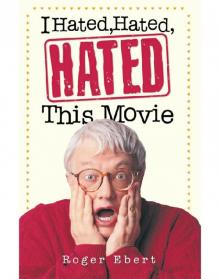
I Hated, Hated, Hated This Movie, page 36


Anne Heche, as Marion Crane, lacks the carnal quality and the calculating detachment that Janet Leigh brought to the original film. She is less substantial. Van Sant’s decision to shoot in color instead of black and white completes the process of de-eroticizing her; she wears an orange dress that looks like the upholstery from my grandmother’s wingback chair. Viggo Mortensen is also wrong for Sam Loomis, the lover. Instead of suggesting a straight arrow like John Gavin in the original film, he brings an undertow of elusive weirdness. The only new cast members who more or less get the job done are William H. Macy, as the private eye Arbogast, and Philip Baker Hall, as Sheriff Chambers. By having a psychiatrist (Robert Forster) reproduce a five-minute speech of clinical diagnosis at the end of the film, Van Sant demonstrates that a completely unnecessary scene in the original, if reproduced, will be completely unnecessary in the remake as well.
I viewed Hitchcock’s Psycho a week ago. Attending this new version, I felt oddly as if I were watching a provincial stock company doing the best it could without the Broadway cast. I was reminded of the child prodigy who was summoned to perform for a famous pianist. The child climbed into the piano stool and played something by Chopin with great speed and accuracy. When the child had finished, the great musician patted it on the head and said, “You can play the notes. Someday, you may be able to play the music.”
Puppet on a Chain
(Directed by Geoffrey Reeve; starring Barbara Parkins; 1972)
There must be a wonderful world inside Alistair MacLean’s head. I imagine the climate is fair there, and the winters mild. It is a world where there are no cities that do not drip with intrigue, and only the most romantic of those make the grade: Amsterdam, London, Zurich. Between the cities there are continents occupied by fortresses and dragons, neat continents like Africa and Asia. There are no flatlands inside Alistair MacLean’s head, no small towns, no marshes, no boring people, and no real people. Just bizarre, fantastical people who eventually find themselves crowded together into too small a space and have to shoot their way out.
But these people are bored, alas. They are bored because they are romantic heroes who work for the CIA or the international heroin trade, and the ordinary stuff of life is too goddamn dreary for them. They would not know how to operate an alarm clock if you gave them one, but they can defuse bombs and drive speedboats. And they devote their lives to doing things in illogical ways. If something has always been done one way, and not another, they will find a new way to do it no matter what the cost or inconvenience.
Take heroin smuggling, for example. They would never dream of flying it in from Mexico or hiding it in a Lincoln Continental as was done in The French Connection. No, that would be too mundane. They must infiltrate a 150-year-old family importing business in Amsterdam and set up a complicated system of helicopter drops, midnight boat rides, hollow dolls, trick grandfather clocks, and phony Bibles.
Why go to all this trouble? For example, there is the problem of getting the heroin out of the warehouse and into the castle where it will be stuffed into the dolls and grandfather clocks. How do they do this? They take the insides out of the Bibles, fill them with heroin, and give the Bibles to phony nuns who carry them to the chapel in the castle, where they trade them for real Bibles. Yes, it’s as simple as that. And so subtle, too, that it takes a trained CIA operative like Barbara Parkins to realize that the nuns are wearing diamond rings on their fingers and high-heel shoes and mesh stockings.
All of this reminded me of the final chapters of Huckleberry Finn, where Jim is locked in the smokehouse and Huck and Tom want to get him out. You remember. Jim and Huck think the perfectly obvious way to pull off the job is to dig a hole under the smokehouse and let Jim crawl out. Elementary. Too elementary for Tom Sawyer. He wants Jim to play an escaping prisoner role right out of Lord Byron and Sir Walter Scott. He has to tame spiders and make them his pets, and scratch messages on tin plates and throw them outside, and write his name in blood on the wall, and on the day of the escape he has to chain his own leg to his bed. Why? So they can saw it off in order to free him, of course.
Some days it is just easier not to escape. That was the feeling I had about the Amsterdam heroin-smuggling outfit. They put themselves to so much trouble that with just a little more effort they could have made as much money running a franchised chicken operation. When they kill a person, for example, they paint up a doll so it looks like the person and then they hang the person and the doll next to each other.
Dying is very important in the world inside Alistair MacLean’s head, you see. A man must die with style or he is not a man—not a stylish man, anyway. Nobody dies in bed except, of course, under unspeakable circumstances. Nobody is shot if he can be garroted, garroted if he can be run down by a speedboat, or ran down by a speedboat if he can be double-crossed by a twenty-two-year-old girl pretending to be a mentally retarded heroin victim with the IQ of a child. You see how it works. These thoughts and others crossed my mind as I was watching Puppet on a Chain.
Radio Flyer
(Directed by Richard Donner; starring Lorraine Bracco, John Heard; 1992)
Radio Flyer pushes so many buttons that I wanted to start pushing back. One of the things I resisted was the movie’s almost doglike desire to please. It seems to be asking, how can anyone dislike a movie that is against child abuse, and believes little red wagons can fly? I found it fairly easy. The movie pushes so many fundamental questions under the rug of its convenient screenplay that the happy ending seems like cheating, if not like fraud.
Radio Flyer begins with the compulsion, common to so much children’s literature and film, to place its little heroes in a cruel and heartless world. Like all those cartoon characters who lose their parents, are kidnapped, or have their homes burned down or their families lost at sea, this one begins on a sad note, with a divorce. The central characters, Mike and Bobby, are then taken by their mother to California, where she marries a sadistic, drunken bully who wants to be called The King. When mom isn’t around, The King likes to beat little Bobby, who gets black-and-blue welts as a result.
The mother (Lorraine Bracco) is a strange case, an engaging, intelligent, hardworking woman who somehow fails to notice that she is married to a monster. She also misses the welts on Bobby’s back, and of course her kids, feeling untrusted and abandoned, do not tell her about the beatings. Instead, they begin to plan an escape for little Bobby by outfitting his Radio Flyer wagon with wings and an engine, so it will fly, and he can leave town and never come back.
They have some reason to think this plan will work. A kid named Fisher once coasted his wagon down a hill and up the slope of a barn, and he flew through the sky so high he was almost able to hitch a ride on the tail of a plane that was taking off from the valley. Of course, Fisher also suffered a terrible fall, and when we finally meet him, late in the picture, he is crippled, but there you have it: Heroes have to take chances.
I will not regale you with the details by which Bobby’s maiden flight takes place. I was so appalled, watching this kid hurtling down the hill in his pathetic contraption, that I didn’t know which ending would be worse. If he fell to his death, that would be unthinkable, but if he soared up to the moon, it would be unforgivable—because you can’t escape from child abuse in little red wagons, and even the people who made this picture should have been ashamed to suggest otherwise.
Who was this movie made for? Kids? Adults? What kid needs a movie about a frightened little boy who is at the mercy of drunken beatings? What adult can suspend so much disbelief that the movie’s ending, a visual rip-off from E.T., inspires anything other than incredulity? What hypothetical viewer could they possibly have had in mind?
Radio Flyer was a famous screenplay by David Mickey Evans before it was a movie. It was one of the hottest screenplays in town, maybe because of the incongruity of its elements. If somebody at a story conference didn’t describe this movie as “child abuse meets Peter Pan,” they were missing a bet. It is utterly cynical from beginning to end, and never more cynical than in its contrived idealism. Was the screenplay so sought-after, so expensive, that no sane voice was heard, raising fundamental objections? Hollywood fought tooth and nail to spend a fortune on this screenplay. Was the movie launched in some kind of mass hysteria?
I know that the voice-over narration suggests that maybe this wasn’t the way the story really happened, and is only the way Mike, the older brother, now remembers it as an adult. Okay, but then what did really happen? Did Bobby fall to his death? Did the cops haul away The King? Did mom wise up? Radio Flyer is a real squirmarama of unasked and unanswered questions. At the end, there’s an 800 number you can call if you want information on child abuse. I imagine the volunteers at the other end would have some pithy observations about this movie.
Rapa Nui
(Directed by Kevin Reynolds; starring Jason Scott Lee, Sandrine Holt; 1994)
Rapa Nui slips through the National Geographic Loophole. This is the Hollywood convention that teaches us that brown breasts are not as sinful as white ones, and so while it may be evil to gaze upon a blonde Playboy centerfold and feel lust in our hearts, it is educational to watch Polynesian maidens frolicking topless in the surf. This isn’t sex; it’s geography.
For years in my liberal youth I thought this loophole was racist, an evil double standard in which white women were protected from exposure while “native” women were cruelly stripped of their bras, not to mention the equal protection of the MPAA. Watching Rapa Nui, in which there are dozens if not hundreds of wonderful bare breasts on view, I have changed my mind. Since female breasts are the most aesthetically pleasing part of the human anatomy, it is only a blessing if your culture celebrates them.
The movie, which is sublimely silly, takes place in the South Seas in the carefree days before missionaries and other visitors arrived to distribute brassieres, smallpox, and VD. The action takes place on Easter Island, “the navel of the world,” whose inhabitants languish under a senile king. The king is of the Long Ear tribe, which has enslaved the Short Ears and impoverished the island by building dozens of giant stone faces. The purpose of the faces is to attract the great White Canoe that the king believes will carry him off to heaven. No face can be big enough. “Build another one,” he tells the slaves at one point. “Then take the rest of the day off.”
This is a king, played with superb comic timing (by Eru Potaka-Dewes), who has lots of good lines. “Tell me you won’t make fishhooks of my thigh bones,” he tearfully implores his high priest. The priest, however, has the movie’s best line: “I’m busy! I’ve got chicken entrails to read!” Meanwhile, sweating slaves pull giant sledges and plot rebellion.
The plot stars Jason Scott Lee as Noro, a young Long Ear who has fallen in love with a Short Ear girl, the breathtakingly lovely Ramana. He goes to the chief for permission to marry her, which is granted—but on two conditions. (1) He must win the annual competition among the young men of the island; (2) she must spend six months locked in the darkness of the Cave of the White Virgin.
This is a lot better deal for him than her. The competition, sort of a Polynesian triathlon, requires the young men to climb down a cliff to the sea, swim to an offshore peak, climb the peak, steal the first eggs of spring from birds’ nests, swim back with them, climb the cliff, and present the eggs to the chief. Break an egg, and you’re an omelet. Meanwhile, the bride-to-be slowly goes blind in the Cave of the White Virgin, so called because that’s what you become after you lose your tan in the dark—always assuming, of course, that you were a virgin to begin with.
Concern for my reputation prevents me from recommending this movie. I wish I had more nerve. I wish I could simply write, “Look, of course it’s one of the worst movies ever made. But it has hilarious dialogue, a weirdo action climax, a bizarre explanation for the faces of Easter Island, and dozens if not hundreds of wonderful bare breasts.” I am, however, a responsible film critic and must conclude that Rapa Nui is a bad film. If you want to see it anyway, of course, that’s strictly your concern. I think I may check it out again myself.
Rape Squad
(Directed by Robert Kellichien; starring Peter Brown; 1975)
Sitting through Rape Squad is a fairly weird experience because the audience doesn’t know how to take it: A lot of the knee-jerk movie responses are challenged. It’s not an old-style sexist movie, but it’s not a feminist movie, either. The men in it are creeps at best and sex maniacs at worst, so the audience can’t get off on the usual macho punch lines. But the women, who organize an antirapist guerrilla unit, get the idea while floating completely nude in a whirlpool bath. So while they’re doing their rewrite of Betty Freidan, they’re putting on a skin show at the same time.
The whole movie’s like that, and we’re not surprised to learn that it was directed by a man but its principal author was a woman. The dialogue adopts a militantly feminist position, but the actresses recite it wearing miniskirts and see-through blouses (on those occasions, indeed, when they bother to dress at all).
In a typical scene, one of the squad members distributes antirape leaflets in a parking lot, which requires her to lean over the hoods of cars and display an expanse of thigh to truck drivers eating their lunch nearby. When they make rude remarks, she counterattacks fiercely, getting so angry that it’s necessary for her to lean forward and display some cleavage. We don’t know whether to look or listen. The story involves a rapist with the nickname “Jingle Bells,” who’s been terrorizing young women with his attacks. His disguise includes a goaltender’s mask, so he can’t be identified in lineups. Five of his victims, dissatisfied with the police work on the case, decide to form their own rape crisis program and take karate lessons. The karate instructor is a compact young woman who could no doubt demolish Bruce Lee single-handed; she has the girls practice hitting a dummy in the groin with nightsticks.
Once trained, the rape squad turns into a feminist vigilante unit. They’re everywhere, like Batman and Robin. A black pimp, for example, is mistreating one of his girls in a parking lot. A squad member calls in. The entire karate class piles into a VW bus and races to the rescue. The pimp is kicked unconscious while the girls bang up his Thunderbird with sledgehammers. Mission accomplished, they leave. The pimp groggily wakes up, only to be knocked unconscious by the hooker, who has instantaneously had her consciousness raised.
Wouldn’t you know, though, that when the chips are down, our heroines make all the dumb mistakes women do in movies where they’re mere sex objects (instead of liberated sex objects). Jingle Bells lures them into an abandoned zoo at night. The girls walk along single file. One decides to return to the car. Bells picks her off. Another one loses the heel from her shoe. He gets her, too. The other three turn around and there are frantic cries of “Where’s Gloria?” Where do you think? Haven’t you seen any Westerns lately, with the Indians picking off the stragglers?
There’s also a certain amount of entrapment, which the movie apparently approves of. Rape squad members wear their sexiest dresses to a nightclub where the manager is an alleged rapist. One of the girls allows herself to be picked up and taken to the guy’s apartment to see flicks of his last ski holiday in Switzerland. Uh, huh. Astoundingly, no such film is there to be shown. Why, the beast wants to make out! The victim screams, the rape squad breaks through the door, the karate instructor sends the depraved monster flying through the air, the girls wreck his apartment and then they pour indelible blue dye (labeled “sulphuric acid”—their little joke) on his genitals. That way, I guess, the next time he tries to get fresh with a sister she’ll know him by his true colors.
Rapid Fire
(Directed by Dwight H. Little; starring Brandon Lee, Powers Boothe; 1992)
Rapid Fire is a movie weary almost unto death with the sameness of its genre. It’s yet another mindless slog through the familiar materials of drug dealing, the Mafia, and the martial arts. The star is Brandon Lee, son of the legendary Bruce Lee, who, like James Dean, did something original and then died, inspiring hordes of feeble imitations. The costars include Powers Boothe, who has an uncanny ability to appear in movies that are beneath his talent, and Nick Mancuso, also talented, but oddly miscast as a Mafia don.
The plot has been pieced together from countless other movies, and involves Mancuso’s determination to get his hands on a piece of the action in a major heroin-smuggling operation that brings drugs from an unnamed Asian nation to Chicago. Brandon Lee is an innocent Chicago art student who, coincidentally, witnessed the massacre at Tienanmen Square and is a ranking martial arts champion. After he accidentally witnesses Mancuso committing murder during a fund-faiser for Chinese dissidents, Lee becomes the object of a four-way tug-of-war involving the Mafia, the drug smugglers, the good police, and the corrupt police.
If this sounds perhaps a mite ludicrous, it’s because the filmmakers consider the plot only a clothesline on which to hang five major martial arts sequences, all of which illustrate three ancient standbys from my Bigger Little Movie Glossary: The Talking Killer Syndrome (in which the bad guys talk when they should be shooting), the Principle of Evil Marksmanship (no bad guy can hit anything with a gun, while no good guy ever misses), and the One-at-a-Time Attack Rule (in martial arts movies, the enemies obligingly approach the hero one by one).