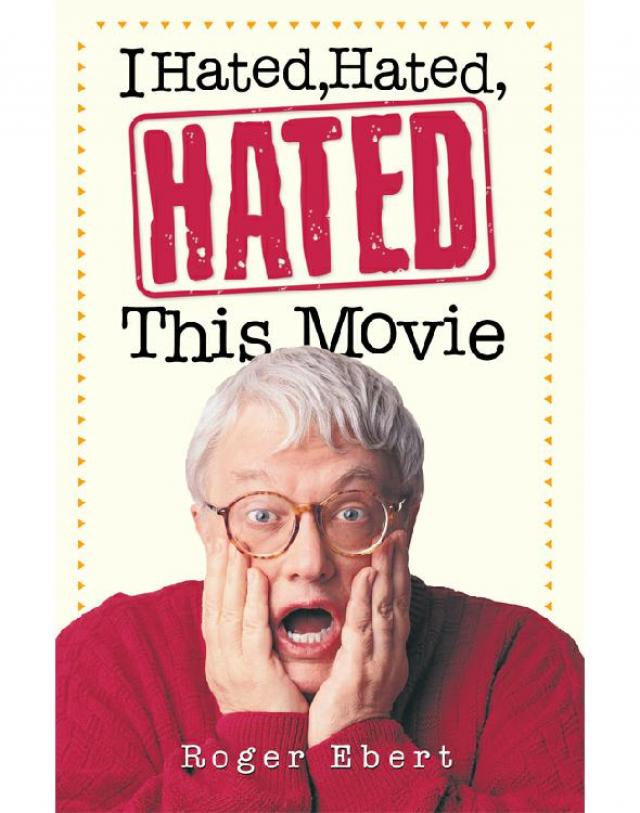
I Hated, Hated, Hated This Movie, page 19


Instead, there are lots of sermons in which Stuart Whitman, as “Reverend James Johnson,” seems to be trying to cross Hitler with Elmer Gantry, as he exhorts his cult members to follow him from San Francisco to Guyana—and to permit his dictatorship there. Whitman plays the cult leader as so rabid and fanatic—such a complete bad guy—that it’s difficult to believe anyone would have followed him anywhere. Surely the real Jim Jones must have been somewhat more charismatic?
The scenes in Guyana show crowds of extras herded here and there in the jungle camp and forced to listen to more fanatic sermons. For variety, we get scenes showing cult members being publicly humiliated and tortured; one scene involves electric shocks to the genitals of a young boy. Meanwhile, the narrator introduces such supporting characters as Whitman’s mistress (Jennifer Ashley), public relations expert (Yvonne De Carlo), and lawyer (Joseph Cotten). They all appear in a few scenes, look thoroughly ill at ease and embarrassed, and are dispensed with.
During all the garbage that precedes it, we’re waiting uncomfortably for the film’s climax, the massacre with the cyanide in the soft drink. The movie spares no details. The cult members line up and drink their poison or have it forced down their throats, and then they stagger around, clutch their stomachs, and scream in pain. Later, the film shows actual photographs of the real victims, while we are solemnly reminded that “those who forget the past are condemned to repeat it.” So remember: Don’t drink cyanide.
All of this is disgusting, and all of it is sad. Why did a reputable studio (Universal) pick up this vile garbage for national release? Because there is money to be made from it, I suppose. The movie brings absolutely no insights to Guyana. It exploits human suffering for profit. It is a geek show. Universal and its exhibitors should be ashamed.
Gymkata
(Directed by Robert Clouse; starring Kurt Thomas, Richard Norton; 1985)
I’m not sure Gymkata is the movie it was intended to be—not if they intended to make a straightforward action picture. You know you’re in trouble when you get to the big scene and the audience is supposed to scream and it laughs. This is one of the most ridiculous movies I’ve seen in a while, but make of this what you will: I heard more genuine laughter during the screening than at three or four so-called comedies I’ve seen lately. I was even toying with praising the movie as a comedy, but I’m not sure the filmmakers would take that as a compliment.
The movie stars Kurt Thomas, in real life a world-champion gymnast, as a young man who is recruited by the U.S. government to break into the obscure Asian mountain kingdom of Parmistan and bring out his father, who is a captive there. Here’s the catch: To enter Parmistan, all foreigners have to play The Game, which means running a deadly obstacle course. “In the last 900 years, no foreigner has survived The Game,” the lad is informed ominously. In that case, how did the father get into Parmistan? Never mind. Logic will get you nowhere with this movie. That becomes apparent when we meet the Khan of Parmistan, who is played by Buck Kartalian as a cross between a used-car salesman and a counterman in a deli. This man is roughly as Asian as Groucho Marx. The Khan has a beautiful daughter (Tetchie Agbayani) who does indeed look Asian, and one of the several inexplicable lines of dialogue about her is, “Don’t worry—her mother is Indonesian.” What a relief.
The Kurt Thomas character meets the beautiful princess, who is to be his guide to Parmistan, and falls in love with her. Back in her native land, alas, she is engaged to marry the evil Zamir (Richard Norton), who is the Khan’s chief henchman. Thomas is chased by various bands of thugs, and saves himself by using his gymnastic ability. For example, running down a narrow street, he spies a parallel bar between two buildings, starts swinging from it, and smashes the thugs with his deadly feet. Good thing that bar was there.
Halloween: H20
(Directed by Steve Miner; starring Jamie Lee Curtis; 1998)
Notes jotted down while watching Halloween H20:
• Medical science should study Michael Myers, the monster who has made the last two decades a living hell for Laurie Strode. Here is a man who feels no pain. He can take a licking and keep on slicing. In the latest Halloween movie he absorbs a blow from an ax, several knife slashes, a rock pounded on the skull, a fall down a steep hillside, and being crushed against a tree by a truck. Whatever he’s got, mankind needs it.
• How does Michael Myers support himself in the long years between his slashing outbreaks? I picture him working in a fast-food joint. “He never had much to say, but boy, could he dice those onions!”
• I have often wondered why we hate mimes so much. Many people have such an irrational dislike for them that they will cross the street rather than watch some guy in whiteface pretending to sew his hands together. Examining Michael Myers’s makeup in Halloween H20, I realized he looks so much like Marcel Marceau as to make no difference. Maybe he is a mime when he’s not slashing. Maybe what drove him mad was years and years of trying to make a living in malls while little kids kicked him to see if he was real. This would also explain his ability to seem to walk while somehow staying in the same place.
• I happen to know Jamie Lee Curtis is one of the smartest people in Hollywood. I cannot wait for the chapter on horror movies in her autobiography.
• There is a scene in the movie where a kid drops a corkscrew down a garbage disposal. Then the camera goes inside the garbage disposal to watch while he fishes around for it. Then the camera cuts to the electric switch on the wall, which would turn the disposal on. I am thinking, if this kid doesn’t lose his hand, I want my money back.
• Michael Myers may also have skills as an electrician. All of the lights and appliances in every structure in this movie go on or off whenever the plot requires him to. I can imagine Myers down in the basement by the fuse box, thinking, “Gotta slash somebody. But first . . . geez, whoever filled in the chart on the inside of this fuse box had lousy handwriting! I can’t tell the garage door from the garbage disposal!”
• I think Jamie Lee Curtis shouts “Do as I say!” twice in the movie. I could be low by one.
• Yes, the movie contains the line “They never found a body.”
• Michael Myers, described in the credits as “The Shape,” is played by Chris Durand. There is hope. Steve McQueen started his career in (but not as) “The Blob.”
• Half of the movie takes place in an exclusive private school, yet there is not a single shower scene.
• Speaking of shower scenes: Janet Leigh, Jamie Lee’s mother, turns up in a cameo role here, and she started me thinking about what a rotten crock it is that they’re remaking Psycho. I imagined Miss Leigh telling her friends, “They wanted me to do a cameo in the remake of Psycho, but I said, hell, I’d do Halloween H20 before I’d lower myself to that.”
Happy Gilmore
(Directed by Dennis Dugan; starring Adam Sandler, Carl Weathers; 1996)
Happy Gilmore tells the story of a violent sociopath. Since it’s about golf, that makes it a comedy. The movie, the latest in the dumber and dumbest sweepstakes, stars Adam Sandler as a kid who only wants to play hockey. He hits the puck so hard he kills his father, who is in the act of filming a home movie. Actually, he kills his father’s camera, but it’s a small point.
Happy can’t skate very well, and when he’s not chosen for the hockey team, he beats up the coach. Life seems to hold no future for him. After his father’s death he is taken in by his beloved grandmother (Francis Bay), and then a crisis strikes: The IRS seizes Grandma’s house and possessions. How can Happy possibly earn $275,000 to pay all of the back taxes?
During a visit to a golf-driving range, he discovers a hidden talent. He can hit the ball hundreds of yards, straight as an arrow. He’s taken under the arm of a veteran golf pro named Chubbs (Carl Weathers), who tries to teach him the game, but it’s Happy’s tendency to explode and pound his clubs into the ground when he misses a shot. (Chubbs retired from the Tour when a one-eyed alligator bit off his hand in a water trap; he is now forced to use a flimsy wooden hand, which he grasps with his real hand, which is clearly outlined beneath his shirt sleeve. No prizes for guessing that the alligator will turn up again.)
Happy’s long game is great but his short game stinks. He goes on the Tour, where the defending champion, Shooter McGavin (Christopher McDonald), becomes his archenemy. They go mano á mano for weeks, in a series of golf scenes that are too heavy on golf for nongolfers, and too irrelevant to the ancient and honorable game for those who follow it. At a Pro-Am tourney, Happy teams up with Bob Barker, whose fight scene seems longer in the preview trailer than in the movie.
The Happy Gilmore character is very strange. I guess we are supposed to like him. He loves his old grandma, and wins the heart of a pretty P.R. lady (Julie Bowen), who tries to teach him to control his temper. Yet, as played by Sandler, he doesn’t have a pleasing personality: He seems angry even when he’s not supposed to be angry, and his habit of pounding everyone he dislikes is tiresome in a PG-13 movie. At one point, he even knocks the bottom off a beer bottle and goes for Shooter.
It was a Heineken’s beer, I think. The label was a little torn. Maybe nobody paid for product placement. Happy Gilmore is filled with so many plugs it looks like a product placement sampler in search of a movie. I probably missed a few, but I counted Diet Pepsi, Pepsi, Pepsi Max, Subway sandwich shops, Budweiser (in bottles, cans, and Bud-dispensing helmets), Michelob, Visa cards, Bell Atlantic, AT&T, Sizzler, Wilson, Golf Digest, the ESPN sports network, and Top-Flite golf balls.
I’m sure some of those got in by accident (the modern golf tour has ads plastered on everything but the grass), but I’m fairly sure Subway paid for placement, since they scored one Subway sandwich eaten outside a store, one date in a Subway store, one Subway soft-drink container, two verbal mentions of Subway, one Subway commercial starring Happy, a Subway T-shirt, and a Subway golf bag. Halfway through the movie, I didn’t know which I wanted more: laughs, or mustard.
The Happy Hooker
(Directed by Nicholas Sgarro; starring Lynn Redgrave, Jean-Pierre Aumont; 1975)
If Horatio Alger were alive today, he would no doubt be appalled by The Happy Hooker, the story of a girl who gets started off on the right foot in life but, through pluck and endurance, makes bad. The movie’s a success story in reverse, starting with its heroine being named Secretary of the Year in her native Holland and ending with her imprisonment in New York on charges of operating a disorderly house.
What all of this is supposed to prove is beyond me, unless it’s that America is still the land of opportunity, until you get caught. The film’s based on the autobiography of Xaviera Hollander, the former hooker who now writes a column for Penthouse in which readers can obtain the most astonishing advice about vacuum cleaners, household pets, and cold baths. I have no way of knowing if the book was based on fact—nor can the movie, being R-rated, give me many clues.
That’s not to say I would have preferred an X-rated porno flick like The Life and Times of Xaviera Hollander, which opened here during the summer to little or no acclaim. No, I like the R rating for The Happy Hooker. It gives the movie a certain restraining charm. What was the last bordello epic you saw in which all the most interesting scenes were set in the parlor? The movie at times makes Miss Hollander’s enterprise seem so wholesome, so much of a spirit with such other moneymakers as commodity futures and the franchising game, that it’s a wonder the postal service hasn’t commemorated the industry by now.
That’s largely due to the charm of Lynn Redgrave, in the title role. Miss Redgrave is the distinguished British actress, daughter of Sir Michael, sister of Vanessa, who vowed when The Happy Hooker started filming that it would be a tasteful comedy and wouldn’t embarrass the family. By and large, she’s right. The movie’s got a sort of innocence to it, and when Xaviera pedals between clients on her ten-speed bike she seems to be hooking just for the fresh air.
She’s lured to New York in the first place by a marriage proposal, but the would-be suitor turns out to be a twerp, and she gets a job as a secretary and translator. In walks a Frenchman with a charming stutter (Jean-Pierre Aumont), and she falls for him. They indulge in unspecified offscreen bliss long enough for her to meet the Frenchman’s friends, who include New York’s top madam, and then the Frenchman exits after giving her a large envelope filled with currency.
He has, she announces tearfully, made her feel like a whore—but she counts the money and her tears dry. And from then until the final calamitous police raid (which is only revenge by a cop who tried and failed to rape her, you understand), Xaviera services a growing clientele of New York’s top businessmen, opens her own brothel, and learns such profundities as that “all men are really little boys.” The movie has a happy ending—she and her girls get out on bail—and all that’s left for next time is a sequel showing her writing her magazine advice column. Maybe it could be called “Miss Lonelytarts.”
Hard Rain
(Directed by Mikael Salomon; starring Morgan Freeman, Christian Slater; 1998)
Hard Rain is one of those movies that never convince you their stories are really happening. From beginning to end, I was acutely aware of actors being paid to stand in cold water. Suspension of my disbelief in this case would have required psychotropic medications.
Oh, the film is well made from a technical viewpoint. The opening shot is a humdinger, starting out with a vast floodplain, zooming above houses surrounded by water, and then ending with a close-up of a cop’s narrowing eyes. But even then, I was trying to spot the effects—to catch how they created the flood effect, and how they got from the flood to the eyes.
Funny, how some movies will seduce you into their stories while others remain at arm’s length. Titanic was just as artificial and effects driven as Hard Rain, and yet I was spellbound. Maybe it was because the people on the doomed ship had no choice: The Titanic was sinking, and that was that.
In Hard Rain, there is a bad guy (Morgan Freeman) who has a choice. He wants to steal some money, but all during the film I kept wondering why he didn’t just give up and head for dry ground. How much of this ordeal was he foolish enough to put up with? Water, cold, rain, electrocutions, murders, shotguns, jet-ski attacks, drownings, betrayals, collisions, leaky boats, stupid and incompetent partners, and your fingertips shrivel up: Is it worth it?
The film opens in a town being evacuated because of rising floodwaters. There’s a sequence involving a bank. At first we think we’re witnessing a robbery, and then we realize we are witnessing a pickup by an armored car. What’s the point? Since the bankers don’t think they’re being robbed and the armored-truck drivers don’t think they’re robbing them, the sequence means only that the director has gone to great difficulty to fool us. Why? So we can slap our palms against our brows and admit we were big stupes?
By the time we finally arrived at the story, I was essentially watching a documentary about wet actors at work. Christian Slater stars, as one of the armored-truck crew. Randy Quaid is the ambiguous sheriff. Morgan Freeman is the leader of the would-be thieves, who have commandeered a powerboat. Ah, but I hear you asking, why was it so important for the armored car to move the cash out of the bank before the flood? So Freeman’s gang could steal it, of course. Otherwise, if it got wet, hey, what’s the Federal Reserve for?
Minnie Driver plays a local woman who teams up with Slater, so that they can fall in love while saving each other from drowning. First Slater is in a jail cell that’s about to flood, and then Driver is handcuffed to a staircase that’s about to flood, and both times I was thinking what rotten luck it was that Hard Rain came so soon after the scene in Titanic where Kate Winslet saved Leonardo Di Caprio from drowning after he was handcuffed on the sinking ship. It’s bad news when a big action scene plays like a demonstration of recent generic techniques.
Meanwhile, Morgan Freeman’s character is too darned nice. He keeps trying to avoid violence while still trying to steal the money. This plot requires a mad dog like Dennis Hopper. Freeman’s character specializes in popping up suddenly from the edge of the screen and scaring the other characters, even though it is probably pretty hard to sneak up on somebody in a powerboat. Freeman is good at looking wise and insightful, but the wiser and more insightful he looks, the more I wanted him to check into a motel and order himself some hot chocolate.
Hard Rain must have been awesomely difficult to make. Water is hard to film around, and here were whole city streets awash, at night and in the rain. The director is Mikael Salomon, a former cameraman, who along with cinematographer Peter Menzies, Jr., does a good job of making everything look convincingly wet. And they stage a jet-ski chase through school corridors that’s an impressive action sequence, unlikely though it may be.
I was in Los Angeles the weekend Hard Rain had its preview, and went to talk to the cast. I found myself asking: Wasn’t there a danger of electrocution when you were standing for weeks in all that water with electrical cables everywhere? That’s not the sort of question you even think about if the story is working. Hey, how about this for a story idea? An actor signs up for a movie about a flood, little realizing that a celebrity stalker, who hates him, has been hired as an electrician on the same picture.
Hav Plenty
(Directed by Christopher Scott Cherot; starring Christopher Scott Cherot, Chenoa Maxwell; 1998)
I’ve grown immune to the information that a movie is “a true story,” but when a movie begins with that promise and a quote from the Bible, I get an uneasy feeling. And when it starts with a “true story,” a Bible quote, and clips from home movies, and photos of several main characters, I wonder if I’m watching a movie or a research project. Amateur writers love to precede their own prose with quotations. I don’t know whether they think it’s a warm-up or a good luck charm.