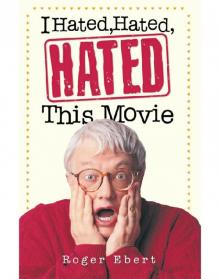
I Hated, Hated, Hated This Movie, page 22


Is this a children’s movie? I confess I do not know. Millions of kids will go to see it. There used to be movies where it was bad for little kids to hurt grown-ups. Now Kevin bounces bricks off their skulls from the rooftops, and everybody laughs. The question isn’t whether the movie will scare the children in the audience. It’s whether the adults will be able to peek between their fingers.
Home Fries
(Directed by Dean Parisot; starring Drew Barrymore, Catherine O’Hara; 1998)
There is a moment about halfway through Home Fries when one of the characters is snaking a rubber tube up through the toilet of a house trailer, in order to pump in carbon monoxide and asphyxiate the woman inside—who he mistakenly thinks is the mistress of the stepfather he has earlier frightened to death. And I’m thinking—you know, this scene requires a whole lot more setup. And then I’m thinking, no, a scene like this only works if there is no setup at all.
The whole movie is kind of like that. The leaden plot hangs heavy on the characters, who could take flight if they could only break free from it. This is one of those movies where you wish you could just beam all of the characters up into another movie. I especially liked the work done by Drew Barrymore and Catherine O’Hara, but lord, the mileage they have to cover, slogging through the inane byways of the story line.
The movie opens with a key piece of information. A doctor steers his car past the drive-thru window of a Burger-Matic, and says to the window girl, “My wife knows about us!” The girl (Barrymore) says, “Did you tell her about this?” and thrusts forward her pregnant belly. “Do you want a ride home?” asks the miserable doc. The girl is contemptuous: “I don’t need a ride home. I need a father for my baby.”
Now in a screenplay class this would be a good opening for a movie. But a wise teacher, asking his students to write more, would add, “And, please—no helicopters!” Because, yes, later that night, the doctor’s car is attacked by a combat helicopter, and is literally frightened to death.
The helicopter is piloted by two brothers in the Air National Guard. They are Dorian and Angus (Luke Wilson and Jake Busey), the sons of Mrs. Lever (O’Hara) by a first marriage. Her current marriage, of course, is to the doctor, and she has ordered the attack by her sons in revenge because she knows the doc is fooling around.
She does not know, however, that Sally, the Barrymore character, is the other woman. Nor, after Dorian comes to work at the Burger-Matic, does Sally know Dorian is the stepson of her dead lover. Nor does Dorian know Sally was fooling around with the doc. He takes the burger job at Angus’s urging, because they suspect that radio emissions from the helicopter were picked up on Sally’s radio earphones in the drive-thru line.
Sometimes it really would be easier to just write about the damn characters.
Vince Gilligan, who wrote the original screenplay, at least gets credit for writing the opposite of an Idiot Plot. The Idiot Plot, you will recall, is a plot in which the secrets are so obvious, and are concealed through such a convoluted chain of contrivances, that if one character were to blurt out one piece of information, everything would instantly be solved. In Home Fries, the situation is so complex that even though people constantly blurt out almost everything they can think of, the mystery still persists, and even at the end the puzzled characters are still trying to explain it to one another.
The Catherine O’Hara character is the one person who holds most of the threads (although she only belatedly figures out who Sally the burger girl is). Her relationship to her sons puts one in mind of Greek tragedy (shouldn’t those boys realize it’s time to move away from home?). But at least she’s consistent: You cheat, you pay. And she defends her sons with ferocious intensity.
Drew Barrymore, as Sally, focuses on what her character knows and how she feels about it, and succeeds in creating a pure performance that sort of stands outside the movie. This same burger girl, looking this way, talking this way, could be carefully packed and moved intact into a better film. Even the inevitable childbirth scene is more or less effective in her hands, despite the fact that the insecure screenplay doesn’t take any chances and combines it with a chase scene.
Another problem is that the filmmakers haven’t decided how relatively smart the people in the movie can be. All movies have some people who are smarter than others, of course, but at some point a movie has to decide what the parameters are. O’Hara, as Mrs. Lever, is so much smarter than her dimwit sons that if we were going to pack them up, we’d have to ship them to a Pauly Shore movie. It’s not that a woman that smart can’t have sons that dumb. It’s that they couldn’t get into the Air National Guard.
Howling II
(Directed by Philippe Mora; starring Christopher Lee, Sybil Danning; 1986)
There is a moment in Howling II when Sybil Danning and two other werewolves revert to their native state. Fangs grow from their mouths, their nails turn into claws, and they are covered with fur. Then they have a ménage à trois, snarling and snapping at each other and raking each other with their claws, in what must be the most unintentionally funny movie scene of the week.
You do not see scenes like this in other movies. You do not see a lot of well known actresses appearing in them. Let us therefore speak in praise of Sybil Danning. I have interviewed her three times, and have always found her with one of the best senses of humor in Hollywood. She appears in movies like this for the money, of course, but also (I suspect) because she laughs out loud when she reads the scripts.
I’d like to check out Danning’s closets at home. If they let her keep the costumes from her movies, I’ll bet she has quite a collection. For example, the cloak that Lou Ferrigno made her wear in Hercules and the 7 Gladiators, because her muscles were distracting from his.
I Am Curious (Yellow)
(Directed by Vilgot Sloman; starring Lena Nyman; 1969)
If your thing is shelling out several bucks to witness a phallus (flaccid), then I Am Curious (Yellow) is the movie for you. But if you hope for anything else (that it might be erotic, for example, or even funny), forget it. I Am Curious (Yellow) is not merely not erotic. It is antierotic. Two hours of this movie will drive thoughts of sex out of your mind for weeks. See the picture and buy twin beds.
It is possible, of course, to manufacture an elaborate defense of the movie. I could do it myself with one hand tied behind my back. I could talk about the device of the film-within-a-film and the director’s autobiographical references, and all that. But the movie is boring, stupid, and slow.
I wondered at times, during my long and restless ordeal while the picture ground out at roughly the rate of three feet every seven years, whether it was perhaps intended as a put-on. But I doubt it. I think there actually is a director in Sweden who is dull enough to seriously consider this an act of moviemaking. There is a dogged earnestness about the “significant” scenes in the movie that suggests somebody moved his lips when he wrote the script and had to use a finger to mark his place.
Beyond that, there’s also a pudgy girl with an unpleasant laugh (she thinks she’s so cute). And a boy who looks like Archie rolled into Jughead. They do not exactly talk about current political and social problems, but they recite words associated with them. You can hear words like class structure, labor union, Vietnam, racism, Franco, nonviolence and, of course, the Bomb. But these words are never quite assembled into sentences.
There are also, of course, the celebrated sex scenes. They may not be sexy, but they are undeniably scenes. The boy and the girl perform in these scenes with the absorption and determination of a Cub Scout weaving a belt. The one interesting aspect is that the hero succeeds in doing something no other man has ever been able to do. He makes love detumescently. The hell with the movie; let’s have his secret.
I Know What You Did Last Summer
(Directed by Jim Gillespie; starring Jennifer Love Hewitt, Sarah Michelle Gellar, Ryan Phillippe, Freddie Prinze, Jr.; 1997)
The best shot in this film is the first one. Not a good sign. I Know What You Did Last Summer begins dramatically, with the camera swooping high above a dark and stormy sea, and then circling until it reveals a lonely figure sitting on a cliff overlooking the surf. The shot leads us to anticipate dread, horror, and atmospheric gloominess, but, alas, it is not to be.
Like so many horror films, this one is set on a national holiday—the Fourth of July. (Christmas and Graduation Day are also popular, although Thanksgiving now seems reserved for movies about dysfunctional families.) In a small North Carolina town, a beauty pageant ends with Helen (Sarah Michelle Gellar) being crowned the Croaker Queen. (The reference is to a fish, but the pun is intended, I fear.) Blinking back tears of joy, she announces her plans: “Through Art, I shall serve my country.”
We meet her friends: Her obnoxious rich boyfriend Barry (Ryan Phillippe), her brainy best friend Julie (Jennifer Love Hewitt), and Julie’s boyfriend Ray (Freddie Prinze, Jr.). Barry is a jerk who likes to get in fights and drive while drunk (“Can you say ‘alcoholic’?” Julie asks him). They build a bonfire on the beach and debate the old urban legend about the teenage couple who found the bloody hook embedded in their car door. And then, on the way home, they strike a shadowy figure walking in the road.
In a panic, they dump him into the sea, even though he is not quite dead at the time. They’re afraid to go to the police and risk reckless manslaughter charges. (“This is your future, Julie,” Barry screams at her.) Helen then goes off to New York for her showbiz career, and Julie heads for college, but by the next summer they’re back home again, pale, chastened, and racked by guilt.
That’s when one of them gets a note that says, “I know what you did last summer.” As they panic and try to find out who sent it—who knows what they did—the movie loses what marginal tension it has developed, and unwinds in a tedious series of obligatory scenes in which nonessential characters are murdered with a bloody hook wielded by The Fisherman, a macabre figure in a long slicker and a rubber rain hat.
“This is a fishing village,” one of the friends says. “Everybody has a slicker.” Yes, but not everybody wears it ashore, along with the hat, during steamy July weather. Only The Fisherman does. And since the movie doesn’t play fair with its Fisherman clues, we’re left with one of those infuriating endings in which (danger! plot spoiler ahead!) the murders were committed by none of the above.
The ads make much of the fact that I Know What You Did Last Summer is from “the creators of Scream.” That means both scripts are by Kevin Williamson. My bet is that he hauled this one out of the bottom drawer after Scream passed the $100 million mark. The neat thing about Scream was that the characters had seen a lot of horror films, were familiar with all the conventions, and knew they were in a horror-type situation. In I Know, there’s one moment like that (as the two women approached an ominous house, they observe ominously, “Jodie Foster tried this . . .”). But for the rest of the movie they’re blissfully unaware of the dangers of running upstairs when pursued, walking around at night alone, trying to investigate the situation themselves, going onto seemingly empty fishing boats, etc.
After the screening was over and the lights went up, I observed a couple of my colleagues in deep and earnest conversation, trying to resolve twists in the plot. They were applying more thought to the movie than the makers did. A critic’s mind is a terrible thing to waste.
I Spit on Your Grave
(Directed by Meir Zarchi; starring Camille Keaton, Eron Tabor; 1980)
I Spit on Your Grave is sick, reprehensible, and contemptible. Attending it was one of the most depressing experiences of my life. This is a film without a shred of artistic distinction. It lacks even simple craftsmanship. There is no possible motive for exhibiting it, other than the totally cynical hope that it might make money. Perhaps it will make money: When I saw it on a Monday morning, the theater contained a larger crowd than usual.
It was not just a large crowd, it was a profoundly disturbing one. I do not often attribute motives to audience members, nor do I try to read their minds, but the people who were sitting around me on Monday morning made it easy for me to know what they were thinking. They talked out loud. And if they seriously believed the things they were saying, they were vicarious sex criminals.
The story of I Spit on Your Grave is told with moronic simplicity. A girl goes for a vacation in the woods. She sunbathes by a river. Two men speed by in a powerboat. They harass her. Later, they tow her boat to a rendezvous with two of their buddies. They strip the girl, beat her, and rape her. She escapes into the woods. They find her, beat her, and rape her again. She crawls home. They are already there, beat her some more, and rape her again.
Two weeks later, somewhat recovered, the girl lures one of the men out to her house, pretends to seduce him, and hangs him. She lures out another man and castrates him, leaving him to bleed to death in a bathtub. She kills the third man with an ax and disembowels the fourth with an outboard engine. End of movie.
These horrible events are shown with an absolute minimum of dialogue, which is so poorly recorded that it often cannot be heard. There is no attempt to develop the personalities of the characters—they are, simply, a girl and four men, one of them mentally retarded. The movie is nothing more or less than a series of attacks on the girl and then her attacks on the men, interrupted only by an unbelievably grotesque and inappropriate scene in which she enters a church and asks forgiveness for the murders she plans to commit.
How did the audience react to all of this? Those who were vocal seemed to be eating it up. The middle-aged, white-haired man two seats down from me, for example, talked aloud. After the first rape: “That was a good one!” After the second: “That’ll show her!” After the third: “I’ve seen some good ones, but this is the best.” When the tables turned and the woman started her killing spree, a woman in the back row shouted: “Cut him up, sister!” In several scenes, the other three men tried to force the retarded man to attack the girl. This inspired a lot of laughter and encouragement from the audience.
I wanted to turn to the man near me and tell him his remarks were disgusting, but I did not. To hold his opinions at his age, he must already have suffered a fundamental loss of decent human feelings. I would have liked to talk with the woman in the back row, the one with the feminist solidarity for the movie’s heroine. I wanted to ask if she’d been appalled by the movie’s hour of rape scenes. As it was, at the film’s end I walked out of the theater quickly, feeling unclean, ashamed, and depressed.
This movie is an expression of the most diseased and perverted darker human natures. Because it is made artlessly, it flaunts its motives: There is no reason to see this movie except to be entertained by the sight of sadism and suffering. As a critic, I have never condemned the use of violence in films if I felt the filmmakers had an artistic reason for employing it. I Spit on Your Grave does not. It is a geek show. I wonder if its exhibitors saw it before they decided to play it, and if they felt as unclean afterward as I did.
In Dreams
(Directed by Neil Jordan; starring Annette Bening, Aidan Quinn; 1999)
In Dreams is the silliest thriller in many a moon, and the only one in which the heroine is endangered by apples. She also survives three falls from very high places (two into a lake, one onto apples), escapes from a hospital and a madhouse, has the most clever dog since Lassie, and causes a traffic pile-up involving a truck and a dozen cars. With that much plot, does this movie really need the drowned ghost town, the husband’s affair with an Australian woman, the flashbacks to the dominatrix mom, and the garbage disposal that spews apple juice?
All of this goofiness is delivered with style and care by a first-rate team; this is a well-made bad movie. The heroine, named Claire, is portrayed by Annette Bening as a woman in torment. She begins to dream of horrible things, and realizes an evil killer is causing her nightmares (“He’s inside my head!”). Her husband (Aidan Quinn) goes to the cops with her premonitions, but gets the brush-off. A frequent dream involves harm to a child; it turns out to be her own.
Eventually she falls into the hands of a psychiatrist (Stephen Rea) who is wise, kindly, and patient, and locks her up in two cruel institutions. One has a padded cell and is guarded by a Nurse Ratchet clone. The other looks like the original snake pit crossed with a dorm at summer camp. The psychiatrist isn’t even the villain.
In Dreams is the kind of movie where children’s nursery rhymes and sayings are underscored like evil omens. “Mirror, mirror, on the wall . . .” we hear, while the sound track vibrates with menace, and a mother, a daughter, and their dog walk on the banks of a reservoir which was, we learn, created in 1965 by flooding a village that still lurks beneath the waters, a ghost town. Scuba divers explore it, and we see that the napkin dispensers are still on the counters in the diner, while holy statues float around the church.
Was the villain (Robert Downey, Jr.) drowned in this town? It’s not that simple. The explanation of this movie contains more puzzles than the plot itself. Let’s say we grant the premise that the villain can indeed project his dreams into the mind of poor Claire. In addition to being clairvoyant, is he also telekinetic? Can he make children’s swings move on their own, turn on boom boxes at a distance, project words onto a computer screen, and control garbage disposals?
And does he control the family dog, which has an uncanny ability to find its masters anywhere, anytime? (This is such a clever dog it should know better than to lure Claire into the middle of that highway—unless of course, its dreams are also under remote control.) And what does the buried village have to do with anything? And although the killer was abused as a child by his mother, whose high heels supply a central image, what does that have to do with the nursery rhyme about how “My father was a dollar”?