Monument Maker, page 1


ALSO BY
DAVID KEENAN
England’s Hidden Reverse
This Is Memorial Device
For the Good Times
The Towers The Fields The Transmitters
Xstabeth
Europa Editions
27 Union Square West, Suite 302
New York NY 10003
info@europaeditions.com
www.europaeditions.com
This book is a work of fiction. Any references to historical events, real people, or real locales are used fictitiously.
Copyright © David Keenan 2021
First published in Great Britain in 2021 by White Rabbit,
an imprint of The Orion Publishing Group Ltd
First US publication 2023 by Europa Editions
Pierre Reverdy poems translated by David Keenan
with the kind permission of the Comité Reverdy
Pierre Reverdy, “Secret” and “Adieu,” Oeuvres complètes. Tome 1
© Editions Flammarion, Paris, 2010
Pierre Reverdy, “Voyages Sans Fin,” Main d’oeuvre
© Mercure de France, 1949
All rights reserved, including the right of reproduction in whole or in part in any form.
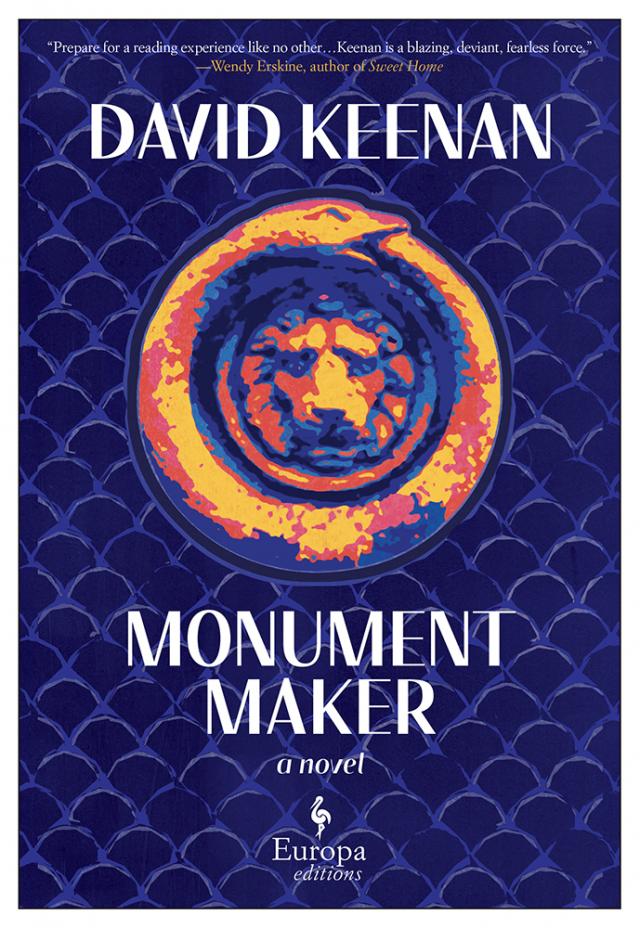
Original cover photo by Heather Leigh
Cover design and illustration by Ginevra Rapisardi
Art direction by Emanuele Ragnisco
instagram.com/emanueleragnisco
ISBN 9781609458287
David Keenan
MONUMENT MAKER
MONUMENT MAKER
To the Glory of God
BOOK ONE: NAVE
1. CATHEDRAL OF OUR LADY OF CHARTRES
I met her at a bookstall in a romantic European village on the outskirts of which I had set up camp in a single, bleak, storage container, painted blue, on the edge of a disused quarry, next to a ghastly man-made lake whose opaque grey waters, in which I dipped the stone effigies that at that time in my life I was caught up in creating, seemed like a skin on the sky, these ritual creations in which I would carve abstract shapes and symbols, using blunt compasses which I would purchase at a nearby market that specialised in silverware and archaic utensils and religious icons (it was a very Catholic village), these strange signs that would speak and make themselves known to me (bird souls, I called them) and that I would then incise into these special stones with the aid of these blunt compasses, these incantations, it appears to me now, these obsessive incantatory actions, which is what masonry is, which is what true stonework is, at heart, according to Pierre, according to the obscure book that he self-published and that came to be the only text that mattered to me, at this point in my life, and which had the quality of speech which is best heard by the heart, by the wounded heart, best of all, as if it had been published expressly for myself, and had lain in wait for me, up until I was ready for it, up until my heart lay in pieces, in the past, shattered along with my belief in love as more than just a word for a season, a term, and not as something that preserves the lovers, forever, something that raises them up, beyond all other achievement, which is when I cracked its code, I believe, as I worked on its first, and still unpublished, English translation, and what that meant, I think, is that I was, in a sense, possessed by the spirit of Pierre, by his marvellous artistic seriousness, by what he said about these stones, his history of these stones, his tracking of certain relationships with these stones, it opened a whole new world to me, one that came to full fruition when I was introduced to my own Eurydice, my own manifestation of the fixed form of the female, forgive me, I know that it’s not an acceptable idea these days, though would that I could fix it further, in stone, after my hero, then mark these bastard words, I would, my hero whose watery vault I return to now, in whose paint-grey waters, beneath which the entire world stands, upside down, and undifferentiated, I dip my dolls, I almost said, my carvings, I mean, my ritual offerings, and I line them up, before me, as stones with names, as something fixed, that has spoken, forever, like an army of emissaries, to elsewhere, a determined crusade, to where there is no way, ever, I can ever accompany them.
I must remember you, Flower.
What a beautiful thought I am thinking, when I think of my ex-lover’s thighs, but still I am in tears as I write this. Is there a name for the space just above the thigh, the crease that lies just below the pelvis, or for the men who are haunted by it? I shall call it the Meridian, this valley of flesh, made anew, as every man is, for its vision; and those who would recognise the women who have worn this, most perfect, those who would be as lovers of the lines: Meridians.
Still, if I could capture anything in stone, it would be the vision of my ex-lover, on her back, with her breasts exposed, disarrayed on the bed, disarrayed, I say, and with that I taste it, her hair wild blonde hair, the perfect arc of her eyebrows, the expression on her face, and the Meridian, incised, perfectly, in a single, perfect, gesture; is tastes like this.
There is nothing water longs for more than to be surrendered on the rocks, are the first words of the book I gave a season of my life to translating, a season that resulted in my destitution, in my abandonment, and, some might say, enemies of mine, grudges held along the way, in my temporary insanity.
Is any insanity temporary? Does madness not leak? Not through stone. Not through marble or clay. Not through hard fired earth.
Harder.
I disposed of my father’s caul in Durham, dropped it from the bridge into the river that flows past the cathedral, imagined it floating, undrowned, into the sea, and made my way to the cathedral itself, where I pictured all of the wooden fittings in flames and reduced to ashes and only the stone of the cathedral left standing. Stone is stronger than wood, more eternal, I told myself, as I stood before the wooden carvings of the dead Jesus and his mother, both of which were scorched with molten lead, from a fire.
Harder.
In the Whispering Gallery in the dome of St. Paul’s, I repeated the word cunt in the hope that it might enter the ear of another and cause offence.
Harder.
I allowed my ex-lover to be fucked by other men. I dressed her. I chose the panties she would pull to one side as other men entered her. Sheer animal-print panties. Tiny turquoise bikini bottoms, tight, around the mound of her pussy.
Harder. Harder.
I toured the monasteries and cathedrals of France and wrote my name on every one of them.
Harder.
Is there a pill that can stop these words in my brain?
This is the pill.
Harder.
I should like to call myself Astonished, a Greek name, at the end of my life.
I intend that this book should be as a mausoleum for the two of us, and the state of our bodies, guesswork, now, buried, still entwined in each other, our very bones confused, our skulls fused in some unimaginable cataclysmic attempt at ultimate union, which is what sculpture is, which is what these language marks, carved into white by a pressure in my brain that I know can only find release in the idea of being caught up in something eternal, something that stands, as a monument, to the lovers in time, which is what these words are, then, which is an attempt to perceive the lineaments of what lies, beneath, this eternal mirror, that might hold us.
Yet I can’t resist telling you she had long blonde hair. I can’t resist the telling of her perfect hourglass figure, I squeeze it now, in my mind, in the past I hold her tight by the pinch of her waist and I draw myself inside her again, and again.
I held her, tight, by the waist, as we made love that first evening, on a chair in this echoing blue metal storage container, we fucked on our first date, she was overcome, she said, I was forceful, that was the word she used, a word I intend to always honour, even when I fail, a word like grace and chivalry and forceful, and she pulled me into her and she said to me, harder, harder, and I imagined us turned to stone, and how beautiful that would be, to be fixed, at the moment of peak passion, is the most perfect of monuments.
I can’t resist telling you, either, of the way she dressed. She wore nylons and heels and long flowing dresses. She wore hoops in her ears and grey, smoky eyeshadow. Her backside was one of the most voluptuous arses ever to tour the continent, and everywhere we went I was forced to put up with catcalls and illicit tonguing, grabbing of the balls and thrusting, and (of course) the miming of fucking her from behind. Show me a statue that provokes that kind of response. Show me the stone that can move like that. I will show you.
At the Cistercian abbey of Trois-Fontaines there was a sense that time had somehow withdrawn all that was not essential to the scene. Windows lay boarded like so many attenuated evolutionary sideroads. The air was dry, and warm, and sibilant; the sound of birds seemed as if piped in; reduced, but not merely, to its effect. You stood on the grass then, the abandoned pavilions behind you, and two trees, in the shape of dark, bristled tongues, spoke up, out of the ground, and tongued the air around you, as I, the jealous lover, hovered, perpetually out of shot. Which allows me to return there. And to watch you, darling, of my sacred manhood, queen, of my past. To watch you walk slowly across the lawn in your heels, as if you were alone with the seeing of yourself. You have a black-and-white shawl around your shoulders, with ripples, like water. You hold a flower in your hand. I will name no other flower. And there is birdsong again. And the light has held its breath, which is what a statue is.
Which is what a statue is. What we mean when we use the word love. Light holding its
She was in an unhappy relationship when I met her and I was the, what is the word, I feel like there should be a word for the tools you open coffins with, the tools with which you prise open ancient sarcophagi, which is what it felt like, it had that degree of revelation, our first love, compasses, a word like that, para-somethings, incisors, where you crack something that has fixed and stuck, where you crack it open, and that first light: incisive. That first light: gasping, and you feel it yield, until the energy is wordless, and no longer you and I, and you have your fingers in my mouth, and I have grabbed hold of her jaw, strong, and hard, and fixed her beneath me, and we are speaking in breaths, in shallow breaths of my finger on her tongue, pressing down, our skulls, bearing down, on each other, is so close. And we are back, and we are after.
Afterwards, in a strange discomfited glow, I tell her I’m a sculptor. I work in stone, I tell her. I am a monument maker.
I saw her partner in town. Her ex-boyfriend. She had warned me about him. David is a psycho, she said, only she said it Davide. He’s a psycho so look out for him, she said. Davide had short blonde hair and wore a leather jacket and looked like shit. I asked her about him. What are you doing sprawled all over my makeshift bed in a rusting shipping container at the bottom of a long-abandoned quarry, I nearly said to her, but I didn’t, if this guy is so great? He’s so full of himself, she said to me, after I rephrased it. He’s so self-centred. Plus, your cock, she said, to be honest, it’s about maybe an inch in total bigger than his. I never knew it made such a difference. Is an inch all it takes?
But I was talking about letting go. Pierre’s book had been published privately, in an edition of 120 copies, by a connoisseur printer of eccentric architectural works in 1986. And what a year for samizdat architectural works that was. I could list my favourites. But the point is this: the sound of the rain on the roof of my metal encampment. Listen to it. Imagine yourself there.
There is nothing water longs for more than (other than?) to be surrendered on the rocks (I have given the rendering of this opening sentence much thought over the years and I have come to regard it as an essentially untranslatable statement that masks a gnomic, astrological reference, as well as, of course, reflecting Pierre’s fascination with the lives of rocks, the being of stones and their firing, at distance, by the stars themselves, and the relationship between water and stone, and what came first, but more so, it occurs to me now, there is the aspect of Pierre’s Christian upbringing, here, in essence, his fascination with Christianity, and his concept of a sacrificial universe, of all the little deaths that life requires, and of course the fish, risen up, on land, is the sign of both evolution and of the secret Christ, returned). There is a wanting that expresses itself in (and as) the elements, to come up against all that they are not. Indeed, the elements are in a perpetual conference of mutual deciding (a polis of elements, as the poet Charles Olson would have it, and whose influence I acknowledge here, on my own work, my own unravelling and decoding, though I can find no trace of Olson in Pierre’s reading, in his notebooks and effects, outside of the recurrence of the phrase “human universe,” the title of an essay written by Olson in tribute to the Mayan conception of life and cosmos). What is soft longs to be hardened, what is spectral dreams of fixed lineaments and form, what is gaseous here imagines being pressed into the soft earth by a beautifully carved effigial slab (and here Pierre references the infamous two-volume set Incised Effigial Slabs, published by Faber & Faber at, one imagines, considerable expense, and, surely, with little hope of recouping their costs, in the year of 1976, and whose personal copy, complete with detailed marginalia, sits before me, on the mantelpiece of the room in which I write). What is flesh longs to fall, from a height, onto the hard stone floor of a cathedral.
The monastic architecture of France (and here, I would imagine, Pierre defers to Joan Evans, author of the spellbinding Monastic Architecture in France, published by Cambridge in 1964), as seen from the standpoint of the late twentieth century, seems some of the most bereft of classical buildings, the least occupied of styles, the greatest reminder of futility and pointlessness, the most like a temporary shelter, from time, and from life, in its understated grandeur, in its mute appeal there is a great slowing that generates the feeling, when experienced in the flesh, in the cold, hard, stone, on a sharp autumn morning in the early 1980s, say, with the dew on the grass and the smell of the leaves, burning, somewhere, out of sight, and that particular silence, that monastic silence that is not true silence but rather a return to silence after speech, which can never be true silence, true silence is original, and unworded, this return to silence, then, all around, that the world has ceased in its turning, that it has been temporarily arrested, by a force, raised up, from inside the world, against itself. This is stone, and how it can be set to speak.
Flower, in a cornfield, in the sun, outside the town of Souvigny, where we had gone to see the implacable remains of the Benedictine priory, implacable, I say, but then I think twice, because implacability, even, remains something to be read, as the red tulips on Flower’s black-and-white blouse now speak to me and say the word flower, the word flower is carried by women, to be laid down, I think, as she spins around slowly in the sunshine and the pollen is golden in the air.
I want to enter into pure description.
Harder.
I was seized with a mania to create in stone.
Harder.
I want to describe the experience of her.
Harder.
I have named parts of the body and set flags in it as mine, as my own, its hairs, and places. I say the body, but really I mean one body only. The body of my ex-lover. The lips of her labia are felt-grey, mouse-eared. When she opens, she opens like a butterfly. I remember a night, a last night. We had made love and she had called me a wolf. I had held my fingers inside her mouth and tight around her jaw as we came together. Afterwards, she sat on a footstool and displayed her newly shaved pussy to me, her ankles still tight around her ankles, her panties, I mean, still tight, and she opens them, the veil, with her fingers, and she is looking for praise, she is vulnerable and eternal in the same moment, temporal and transcendent, bashful, which is the name of it, and I lean down, I have half pulled up my briefs, and I taste the bright grey of her lips and I taste soft, wet, stone.
I get into a conversation. One night I’m drunk at a party, one of these outdoor French nocturnal parties, and Flower’s boyfriend Davide is there, he is wearing motorcycle leathers and with short blonde hair in the dark and he approaches me and we start to talk and he uses the term beef curtains. There is a spatchcocked chicken on the grill and he sticks a prong in it and he says, beef curtains, do you know that one, I had to explain it to my mother the other night, he says, and he laughs, and he winks at me.
Let me tell you the story of my first understanding of the importance of architecture. It happened when I read a story about a sculptor, a stonemason, a worker in basalt, and an author, name of Pierre Melville. There was an article in a newspaper. Pierre had come out of nowhere. His early sculptures had been hailed as the ultimate extension of Gian Lorenzo Bernini’s baroque conception (by critics of a modernist, iconoclastic bent, obviously), extrapolating from Bernini’s vison of a total work that could be viewed, somehow, as extended in time, as well as in place, and what Pierre had done, these critics argued, was mint a form of sculpture that somehow demonstrated its movement into form, its uncovering, in other words, in time, as well as its simultaneous withdrawal, back, into its point of origin, which Pierre termed its nebula.