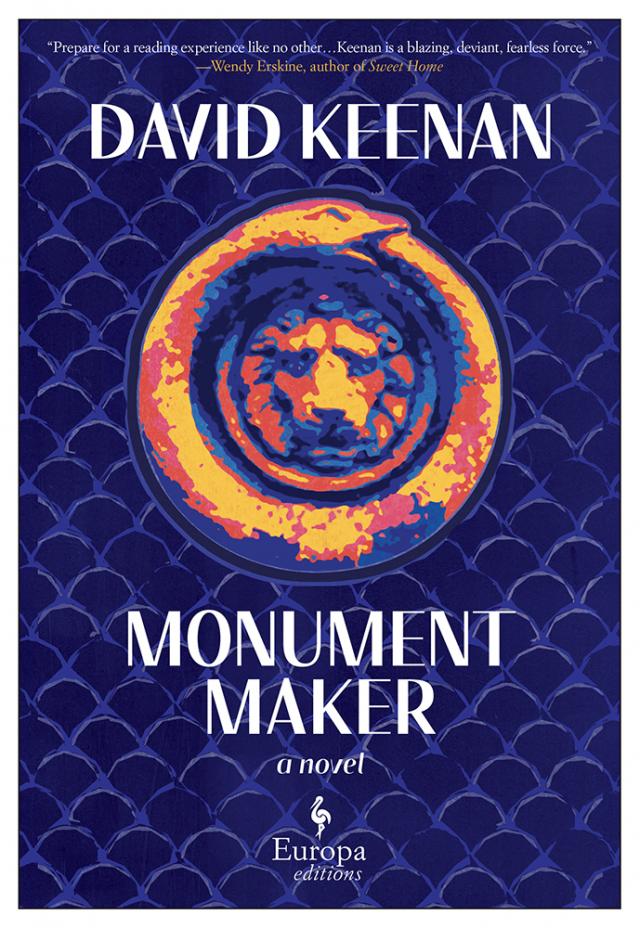
Monument Maker, page 62


Together we began to prepare for the Burntisland Conference. The idea was that we would present our experiment with time as a refutation of Semitic ideas. The liberating of time meant that compassion and love were sundered. As players in the show we came, and we went, in rapture. History itself was a great game, a theatre: of war; of love; of endings and beginnings; but still a theatre. And man, the new man, the subterranean man, the man who travelled in the backroads of history, at will, was its only fit judge. Now that history was self-directed, and could be corrected, now that it was indistinguishable from the machinations of man himself, guilt was at an end. We made history as men. And we judged it accordingly.
I told The Grey Owl about Jack Frost’s love of pop music, the idiot girls whose autographs he sought, his passion for costume and camp. We can use that against him, I said. We can expose him as a decadent fairy. No, he said. He could be useful to us. When you came back from the past, when you emerged from the mirror city, I said, Jack Frost was the first person you contacted. He was waiting for you at the bar when you made your entrance. Haven’t you read any Shakespeare? The Grey Owl asked me.
It was the night of the conference. We came on stage in long black robes, by this point The Grey Owl’s trademark. We faced down our opponents, those that pooh-poohed us. We presented date-coded blow-ups of the photographs, then followed up with the kind of inspirational rhetoric that would enshrine them as the founding documents of our assault on Semitic slavery and our philosophy of lighting out into the past and into the future. Death, The Grey Owl said, and the reports that he stammered when he said this are true, as though his body was unconvinced and in fact was actually protesting, death provides the momentous energy of expanding creation, he said, which means that when we make battle—inside our bodies, inside our minds, or upon the world—we are at the bridgehead of creation. But the doctrine of “as above so below” means that it is not a sacrifice, as the Semitic races would have us believe, rather, an eternal taking part, and a coming into being, guilt-free, forever.
We stood at the front of the stage, our toes gripping the edge like a pair of upside-down bats, and leered at our audience. This is what it’s all about, I said to myself.
We fell in love with the subterranean monuments, the night-time of Europe, I told them, because the basic architecture of our souls was pagan. A simple gravestone, a cross, a church no longer had any significance. We demanded antechambers, tunnels, bunkers, lost rivers, deserted airfields, caverns, caves, secret ladders, tributaries, shadows, abandoned railroads, underground factories, deserted quarries, deep pools, hollow mountains, noise, bonfires, crisis, war, secret files, as truer reflections of the endless shadowland of the soul, yet none of us realised what our demands would ultimately lead to: that ours was the great psychic revolt of the age, and that our insistence on the existence of subterranea, and our determination to sound their depths, would open up parallel tunnels in the mind and in time and space.
Of course there were critics, contradictors. You opened up nothing, The Green Beret said, the mirror city was built by the government who were obviously involved with time travel experiments, you just stumbled upon it, and what exactly was the technology, someone else shouted, a small man with a comedy nose and an over-large suit with no name tag, what did it consist of, was there a portal, did you step into something, were there buttons, what did it feel like, did it hurt, did it feel like you were taken apart atom by atom and rearranged somewhere else, did it turn you on, Token Bob shouted, a low blow, for sure, and I looked around at The Grey Wolf and it’s true that his head was in his hands and he was bent over in his chair, although the reports that he was trying to cover up his tears are simply offensive, he had just travelled backwards through time, he was beyond the astronauts at this point, beyond the so-called psychedelic adventurers, beyond the brains of the greatest men of the twentieth century, because after all no one was coming back in time to say hello to him, and so he was moved, it’s true, but not to tears, if anything, he told me later, and it was unlike him to open up in this way, it was a sudden dizziness, he said, like looking down on a dark lake from up above and suddenly the lake winks at you, he said, like an eyelid shoots across it, however briefly, and you realise that when you thought you were staring into nothing you were in fact staring straight into an eye, an eye with no pupil, so how were you to know, but an eyeball, nonetheless, brave traveller.
The synod afterwards was dramatic; the first official synod of the newly christened SIRK. Ranged around the table there was Token Bob (homeland security), The Iron Giant (secretary), The Plug (propaganda), The Flashlight (archivist), The Lightning Bolt (away team) and Jack Frost, whom The Grey Owl had insisted we bring onside (logistics). There were also two secretaries, whose conflicting minutes speak of the feeling of something going on in the room that was protean on the very deepest of levels. The Grey Wolf had insisted on booking them at the last minute. What great man in history, he had asked me, what great man since the invention of the nib or the quill hasn’t looked towards his biographers? What great man ever went unrecorded?
At points the noise of the typewriters was deafening, marking rounds with their bells like a boxing match, and several times I had to shake myself from a trance as I felt the individual letters impressing themselves on the soft grey of my brain as if my thoughts were being spelled out letter by letter, at incredible speed, and for long minutes I had to grip the desk and hold on for dear life.
Jack Frost stood up and gesticulated, his body contorted like he was standing on his hind legs for the first time ever, like he had only just staggered up and out of the sea. Token Bob was laughing, hysterically. The Iron Giant rose to calm things. The Grey Wolf pushed back his chair. At length he made a show of removing a small hip flask from his inside pocket with a jewelled engraving of a headless man on the side, biting the top off with his teeth, pushing the chair back with his legs and while balancing precariously with his feet on the edge of the table taking a long drink and spitting the contents out in a great arc across the table.
Everyone was stunned. The typists froze. I sat bolt upright in my chair.
Tell me, he said, when was the last time anyone in this room got rat-arsed?
I had a few ales last night, The Iron Giant offered. Me too, Token Bob said. And I’m paying for it this morning, I can tell you. I’m not talking about a few pints of an evening, The Grey Wolf said. I’m taking about systematic derangement. I’m talking about visionary excess.
Once, back when I had just left school, I drank a half-bottle of whisky in my bedroom on a summer’s afternoon while reading a book of Wordsworth’s poetry, The Iron Giant said. Who on earth reads Wordsworth in this day and age? I thought to myself. That’s as may be, The Grey Wolf said. But let me get to my point. What takes place in the inner sanctum, the holy order—at which he made a point of looking each and every one of us square in the eye—stays in the inner sanctum. Let us drink to knowing, to daring, to willing, and yet to remaining silent. Then he passed around the hip flask so that each of us in turn could swear and drink from the same cup. Some of them, I won’t name any names, had obviously never tasted alcohol in their lives before, as there were numerous oohs and aahs and oh my Christs as they forced this green-golden mixture down their throats like they were sucking it straight from The Grey Wolf’s prodigious member itself. Later I found out that it was absinthe that we had been drinking, from an old family stash. The Grey Wolf had dosed us.
No sooner had we finished drinking than an argument broke out. The Plug described The Pink Panzer as an entertainer. A crowd-pleaser, he called him. It was true that The Pink Panzer had a flamboyant style. His reports were riddled with brackets, columns, colons, semicolons, subsections, clauses, footnotes, indexes, asides, digressions, subtexts, elaborations, underlinings, diagrams, doodles and marginalia, drawings, like once where he drew a walking map of the twenty-two districts of the underground city of Burlington and colour-coded it like a Tube map, all painstakingly footnoted, the first map ever to come to light before its decommissioning, or the time he produced a fold-out supplement in the shape of a concertina for Passing Through Doubt, a literary magazine run by a priest with a philanthropic taste for the esoteric that I’m told is now very collectable and that consisted of Notes Towards an Introspective Vision of Subterranea, where he had argued—I can’t be clear as I’m not well versed in the subject myself—for something along the lines of extending, or rather inverting, the poet Charles Olson’s vision of projective verse and his notions of scale in time and space wherein he posited that Olson had failed to anticipate that the birth of his idea would result in a dark twin, which implied a contraction, an introspecting of language, a shortness of breath, a gulping, gasping-for-air poetry of being buried half-alive, and a language that had more to do with grammar—structural, organisational—a language that would be as implacable, now, as those first stone circles, in time, as inexplicable, too, and as unconcerned by meaning, as the tightening of a fist.
For his Notes Towards . . . essay, The Pink Panzer had letterpressed a fold-out visual poem that he claimed was empty of any content outside of suffocatingly dense relationships of structure and tone, like a tuning fork for the whole of reality, in fact he compared it to the Kabbalistic Tree of Life, a glyph was how he described it, though to most people it looked more like an early computer print-out or a supermarket receipt, and of course his publishing in what many aficionados still flippantly derided as “the pink press” gave him both his handle and his reputation as a performer. Token Bob, so the rumour went, was his partner, in secret.
On hearing this slander, this bald-faced accusation of playing to the balcony, Token Bob first made a big deal of stubbing his cigar out on the sole of his shoe, a brown brogue with a small leather tassel on the front that he invariably wore with dark, variously striped socks, a brogue that had seen better days in a charity shop on Dumbarton Road, if we’re being honest. Then, moving in a deliberately exaggerated fashion, he seemed to flit across the room, and just as it looked like he was going to grab The Plug in some kind of death grip, he inserted a single finger into The Plug’s hair and wound it to a tight curl, then he grabbed a knife from the kitchen drawer that was lying open right next to him and with a single slicing motion he cut The Plug a new bald spot. And The Plug burst into tears, somewhat miraculously, as no one had ever heard him express anything that could be termed an emotion outside of obsession or excitement or resentment.
It was true that he was often seen to resent, whether another rising star in the group or a new subterranean find, the mapping of a new ruin, the giving of a speech, he was one of those people, I suspect, and they’re more common than anyone cares to admit, because if we did admit it, what then, there’d be no one to be successful for, all it would create would be enemies and God knows a man has enough of those, the kind of people who see their failure in anyone else’s success, a quality which of course was actually desirable in our own line of research, the ability to always see the reverse, to picture the opposite, but which in The Plug’s personal life, it was said, had brought him nothing but grief, treating his daughter like an aged crone, his wife like an enemy or more properly an agent provocateur, his friends as combatants, his parents as ghosts, a subterranean who turned his own world upside down in some kind of futile attempt to balance the scales, the avant-garde, truly, for he was at the very edge of the avant-garde, and had much in common with the most far-out practitioners of the radical art he claimed to despise, in that he refuted almost any kind of artistic practice altogether, hated poetry, condemned painting, disdained novels, rejected film, put up with photography on account that it was uncreative, despised sculpture, all except for the strange sculpture that was the figure of his letterhead, this strange Romanesque statue of a man with two heads, a muscular Janus or a mischievous Gemini, it was never clear, and of course he claimed he had moved beyond art altogether, more, that he had cured himself of art and come out the other side, he said, and he went so far as to maintain, in fact, that if he was a fascist dictator his first order of the day, even before banning training shoes and leisurewear, would be to ban art altogether, to announce a moratorium on expression, whether of the self or of “the universe,” to turn the imagination into the very same deep, dark lochs that dotted the Highlands of Scotland, which would constitute a radical rewilding of art, these places of perfect stillness and infinite mystery, untouched by humanity, a virgin darkness, the kind of spiritual conservatism that posited a hymen in the brain and a corresponding concept of mental chastity, and now here he was in tears while Token Bob continued to interfere with his hair, now taking two strands and pleating them together until there were two circular bald patches surrounded by thin dreadlocks, so that someone, The Iron Giant, I believe, said that he looked like an analemma, which is the empty figure eight that the sun traces in the sky across the space of a year, and at this The Plug wept, this drain-clearing noise that had obviously given him his name along with his dedication to Victorian sewage works, lost rivers, floodgates, anything to do with the subterranean transport of water, and then he began to recant everything, confessing through the tears, explaining how he was still in thrall to opinion, he admitted, in other words he was sentimental, he said, God damn that word, and then he broke down again, dismissing all of his opinions, the very minutiae of his arguments, arguments that had been debated over and subscribed to and that had consoled and alienated in equal measure, confessing that every one of them had been conceived with the service of the identity that had come to possess him in his mind, he recanted everything, his creed, his allegiance, his membership, I’m spooked, he said, I’m haunted, forget your abandoned buildings, I’m the very ghost of place, insisting that everything had been done in service to this phantom child, this demon, he called it, this terrible dictatorial image inside his head, I have fallen for ideas, he confessed, and all the while the typists were still typing, these two young girls, one of whom I saw look up when The Plug said the word demon with an expression of actual delight, a secret gambler with an illicit run on the horses, at which point I fancied she slid a single hand into the warmth between her legs, the transcription clearly shows that she was typing with one hand from this point on, you can see the impact on the paper of the individual letters, craters, I thought to myself, as if they had been dropped like bombs into an empty no man’s land, and of course I thought of the trenches, and I flitted back there in my mind, via the secret tributaries that tunnel beneath the page, and I imagined a literary underground, a book as a tomb for language and of a literary Valley of the Kings, a vast subterranean network connected across time and space and all that would entail, the empty bunkers, the daring passageways, the perpetual lack of sunlight, at which point The Grey Owl turned to face us, The Grey Bat, because he may as well have been hanging upside down from the ceiling, or scaling the walls with a backflip, and I felt myself caught in this rush of language that felt more like a palpitation, like balancing on a precipice, and I was overcome with fear, not that my heart would pop, more that it would let me down, at which point The Grey Bat dropped a large book onto the table with a bang that woke the entire room from this strange fugue, this atmosphere of teary disassociation that he had somehow orchestrated (with the aid of some occult family-brewed absinthe, we now know), and he announced our founding text, The Tomb of the Song, he said, a Jewish parable, he admitted, to slow gasps and popping sounds, but from one who got away, he insisted, from one who woke up, and a few people breathed a sigh of relief, a few people shook their heads, the room was divided almost fifty-fifty between people who believed in the reality of the Jewish Question and its relationship to our own interests and people who thought we were bats but who were caught up in the eccentricity of the venture regardless, and then he started to read from the text and I was caught up almost immediately, I confess, I recognised myself in its very cadence, I felt myself transported, as he described a song that had once been heard in the distance by three wise men, three wise men that had pronounced the correct words, the precise spell, that would turn a wounded animal to stone, and they drowned that animal, and that was the first turning to stone, and whose reward, after the animal had passed through the final waters, was the song of the birds from some way off, a song that was as beautiful as the first morning, according to historical accounts, though some translations and various dubious adaptations—it remains one of the most “bootlegged” of the Kabbalistic literature, if contradictorily the least studied, or perhaps the best studied, should I say, by people who understood the great silence at its centre—describe it as being more like the purring of a cat, the sound of an old motorcycle in the mountains, of the sky in Greece at night, of the echo of an abandoned swimming pool in California—and it’s true there is a barren Jewish “Mem” emblazoned on the cover, which means Abandoned Echoing Swimming Pool—of a child’s foot cracking very delicate ice, if fish could sing, someone else said, and the result was horrifying rather than cute, a nursery rhyme you have convinced yourself you always knew, someone else suggested, and best of all, the sound of a light being switched off while holding your breath, and I thought, wait, though, if the song is of a bird, in the distance, if this is the sound of the first moments of creation, then what is that bird perched on, and where does it nest, and I thought of high clifftops, and I visioned lonely stones that the sun could rise above, at last, and we all looked around at each other and I knew we were thinking the same thing, that in our hearts we were subterraneans, and as soon as we felt that great space open up beneath us our first urge was to run down ropes and risk never coming back up, that was when we realised the earth-shaking nature of our mission and felt our membership as a calling, as medieval knights, as blind moles digging tunnels, into the depths of our own obsession and all of its repercussions, in our thoughts and in our lives, and once more felt like masters of our fate, and afterwards I approached Jack Frost and he used much the same language, comparing us to a sacred growth in a backstreet in a small town, risen up in the crack between the stones, in the concrete seam of some invisible wall, this organism, this entity that finally understood its own importance, though honestly he repelled me still, I’m no part of that organism, I said to myself, no part of Jack Frost, even as our fate and our beliefs held us together, still I refused him, idiot, I said, crippled, full of malice, bitter, broken down, troublemaker, at one point I called him all of these, I confess, and he deserved every one of them, yet now I wonder why I would abuse someone that was such an integral part of my own life while the other side of my brain convinces me it was my part to play and there was no other way for us to relate, that the script had been written with us in mind, and that in some book written deep beneath the world there was a small room, a tiny chapel, consigned to rumour, barely locatable, that was dedicated to our interactions regardless, well, the chapel had already been built, I told myself, the structure assigned its place deep inside ourselves and inside history, which is a darkness that awaits explorers like ourselves, and I feel excited when I say that, and proud of the hobby that had made of us brave explorers, we had started out as amateurs, enthusiasts, back then we felt it was more about ourselves, the unspeakable frisson of being lost underground in secret bunkers or in abandoned industrial architecture, how time had tamed even the most grotesque excesses and made them beautiful, even terror, even scale, we were pioneers, a privileged avant-garde who lived down below and not up above and who were the lucky witnesses of this hidden grandeur, this secret pleasure in the reverse, whereas now it was clear that it was the architecture that looked to us, these secret rooms, these memories entombed against the past and the future that longed to be burgled, that thrilled at the lifetime’s dedication it took to map their position and the scale of the logistics and the adventure, so that even the curses associated with the desecration of graves seemed more like self-scarification or symbolic twinings, the sex play of a witchy lover, we believed in lovers not victims, lovers in pain and lovers in torment and lovers buried deep beneath the earth, even as we felt ourselves bugged, wired, put upon, pushed to the margins of society due to our insistence on the lie that sustained the truth, our eyes wide open and cast down, tightrope walkers, even as we were bent crooked on canes and couldn’t read a damn menu or look up a book at the library or like The Pink Panzer took to writing experimental prose in obscure journals, some of which, it is alleged, were funded by the CIA, which proves that wherever a frontier is being fought the secret service are never far behind, in other words they patrol the perimeter of the mind, has it ever struck you that the reality that mind insists on, and by this I mean the mind of sleepwalkers, of dogs, of shoppers, is that of a concentration camp, wired off, compartmentalised, with gas chambers and death camps for all that it refuses to accommodate, work details for interlocutors who cross the line, punishment blocks for new arrivals, ablutions for the filth, guards to beat lifers black and bloody, unable to see the view from the other side of the fence, forced to carry great weights on their backs, falling like dominoes, ready, at any moment, to respond to orders, no matter how distasteful, then imagine digging a hole, going underground and so avoiding all of their defences and their traps, the searchlights at night and the barbed wire, the early-morning roll call, naked in the square in the mist, the flea-bitten beds, the endless soup, that was how we answered the Jewish Question, we broke out and formed our own society, and in our personal lives people asked questions about us, who was that writer that walked off into the snow, and they would occasionally see us at the cafeteria at Safeway in the afternoon and would lament our wasted potential, he was a boy genius, they would say, a lovely kid, and look at him now, we were the disappeared, though really the escapees, now fugitives, forced into clandestine activities, and so wretched myths survived about us, that we had gone down, that we were personae non gratae, and of course it was a bluff perpetrated by the security services, which is half the people in your life, half, who am I even kidding, most of the people in your life wish to convince you that there is nothing beyond the border of their own minds but abortion and madness and fantasy, and a pile of corpses, ultimately, so as to dissuade any escape bids, and after the reading, which had been very powerful and moving, we exited the building, squinting in the early-evening sun, a historic committee, the vanguard of a new subterranea, though to the people around us we were dreary old men, dodderers, in love with Latin, calligraphic purists, wearers of hats, and as we came out onto the beach, an uninviting part of the coast due to our forced relocation, The Grey Owl made his dramatic speech about walking on water, where he claimed that stone was a component of all elements, there was stone in the sea, in the sky, stone in our souls, that’s what supports you, he said, then he went into this vision of the sea being covered with stone, like a fake stone lake in Eastern Europe dreamed up by communists, and he came up with a whole back story to accompany it, a great feat of imagination, the submarines going in and out, the thickness of the stone—fourteen feet—the lights beneath it so that it was illuminated like an underwater city, by this point we had made our way to the beach and we stopped at the foot of the waves and sure enough there was the sound of huge stones moving in the silence somewhere down below, shipwrecks suffering in the deep, scuttled vessels grinding against each other, I thought to myself, when all at once the water seemed to still and solidify, I remember the reflection of the sun on it like a galleon from a dream of the beginning of the world, and The Grey Bat made his move, turning and tearing at his mackintosh while walking straight towards the water, by this point the typewriters have been abandoned though we still have the girls’ testimonies as they followed us across the sands and they describe it as “balancing,” which has subsequently been twisted and taken to mean that The Grey Bat, this athlete that could hang from his toes over a drawbridge if he felt like it, somehow balanced on an underwater prop or a sunken wall in order to generate the illusion of stone, of walking on water, when it was plain to everyone who saw it, and there were seven independent witnesses, not including the girls, that he never once looked down, never for a second faltered or even looked around himself, rather he strode out across this paralysed sea and afterwards he drew a blade across his finger and he never bled, I have stilled the waters, he said, look here, and he gave us his thumb, cut open but with no sign of life inside, and I thought of the Witkiewicz painting Suicide-to-be Three Seconds Before Pulling the Trigger, a painting that my wife clipped out of a dearly held collection of his work, a fact I only stumbled across many years later when I went to look it up in order to show a fellow connoisseur who was already in love with Rudolf Bauer and Austin Osman Spare, and couldn’t locate it, began in fact to wonder if I had made it up or dreamed it or perhaps even painted it myself, a thought that triggered an evening’s frenetic cross-checking across various periodicals in order to ascertain its existence, and of course I lost my wife to suicide in the end so I was doubly spooked, it was my first experience of what I might called cursed art, art that speaks so particularly it can lure you into death or disaster, art that demands some kind of existence in the world beyond itself, or that implies it, rather, art that isn’t a mirror but a simultaneity, a necessary part of the unfolding, and that enters your life as a catalyst, a catalyst of sorrow, often, a day-old flower already trodden, a young girl who catches her shadow in a vision of death taunting the living, it’s a collision, there’s no point in trying to pretend otherwise, and right at that moment I saw the same painting in front of me, the gun pressed against The Grey Bat’s head, only shooting blanks, these terrible echoes through time, echoes through empty swimming pools, through tunnels, which even at this point I am subjected to daily, on my own out here, and I saw him that night, like the painting come to life, all of himself, in his death-defying bravery, in the spell of his mania, his walking on water, his refusal to bleed, I give him three years tops, I said to myself, three years spent together, and from then on it was a romance, a speedboat that went careering into the future with the two of us onboard like handsome playboys but with no one at the helm.