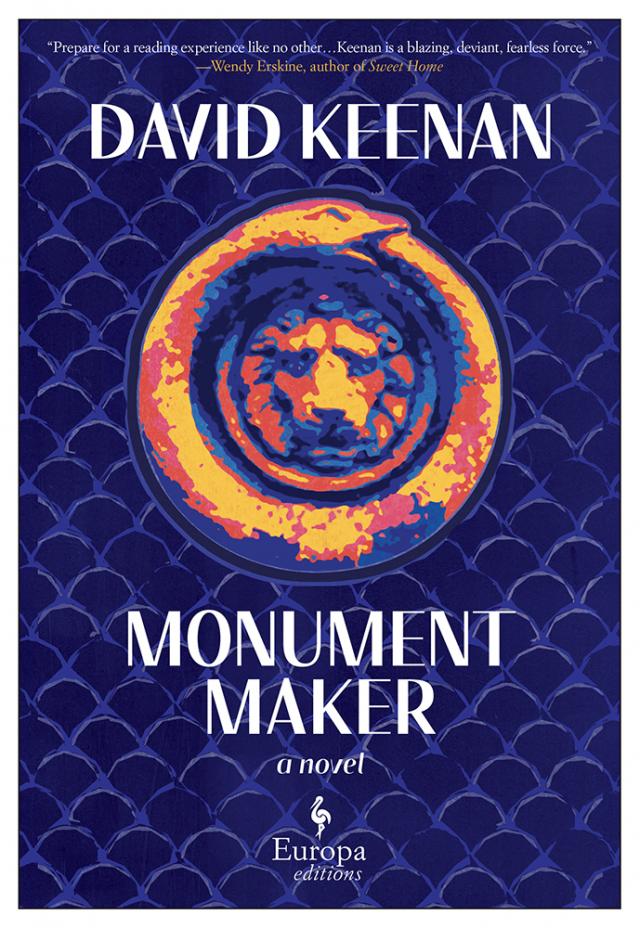
Monument Maker, page 61


Later, after we’d put the boys to bed, he suggested we go see the sights. Let’s make for the heart of the city, he said.
Ostend is the queen of the Belgian seaside resorts. Even in its earliest form, as seen on surviving maps, the city has the appearance of an open heart, a vulva or a rose. Late-night bar gave way to late-night drinking den gave way to illicit basement joint until it felt as if we were pursuing a point at the very end of the night, a particle of an impossible density and of the colour cobalt, the light at once dimming and coming up.
We arrived at what appeared to be an abandoned bar on the very fringes of the city, though its distant silhouette had made it seem more like a ruined castle or a secret rock formation in the depths of a forest. There was a poster on the wall advertising some forgotten concert by an emaciated singer dressed completely in black who looked like the living dead and who wore a wide-brimmed hat that cast a shadow over his face. The Grey Wolf led us to the back of the building, where we descended a flight of stairs to a subterranean bunker. At the door we were instructed to remove all of our clothes except for our undergarments and our shoes.
I was filled with silence, and with not speaking. I removed my clothes.
When we reached the bottom of the final set of stairs, this set of stairs that plunged and spiralled through endless darkness, The Grey Wolf stepped forward and parted the black curtain in front of us.
Three men and a woman, all of them in nothing but underwear and shoes, stood drinking at the bar. The men wore surly expressions while the woman gazed straight ahead, her elbows planted on the edge of a table, as she made some kind of emphatic point.
The Grey Wolf ordered for both of us. I confess, for a second,
I wondered whether the glassware was sanitary. But as we drank the mezcal I felt the light inside me equilibrate, somehow, the goings-on around us, so that I was able to soak in the scene without concern. I thought of the pulque gods, I had seen them in a book, how their bodies were two colours, mirrored, as was their function inside the body itself, to mirror, and to forgive, and I thought of Melanie, too, my other half.
The Grey Wolf took my arm and ushered me into a back room. It was like I could hear the wind from a long way away, and a bird, singing, somewhere a final bird is singing, I said to myself, somewhere in back of things, I told myself, and I told myself, it takes you all of your life to hear it, even though it has been pursuing you since the beginning of time, I said to myself, I am that, I said to myself, who knows, my spike had been drinked, I had woken up, I was beyond words, who knows, if a head speaks and there is no one there to understand that it has spoken, I said to myself, then has it spoken at all, and yet I heard it with my own two ears, and if a flower blooms, once, and no one ever notices it, I said to myself, and I wondered, then, has it bloomed at all, and I thought, the world is reliant on invisible flowers, on lonely dares on precarious clifftops, and in the corner there was a single white cubicle, and open the door, I heard him say, but when I looked around he had disappeared, though his voice remained in my head, this voice, that it occurred to me had been making its way towards me from the beginning, like a long-range spacecraft, tumbling, rapturously, into orbit, which is open the door, it said, and I crept forward, slowly, like I was crossing cracked ice but underneath it was nothing, emptiness, this same silence that held me up threatened to drown me forever, and I pushed the door open and it swung back slowly on its hinges, the rust the colour of old flames, the cubicle the stained off-white of military barracks
~^~*~^~
~^~*~^~
The next morning we hired bikes and drove along the promenade. We struggled with the gears and several times swerved into oncoming traffic.
We made our way to a seawater swimming pool that had been dug out of the rocks and that The Grey Owl had read about in a brochure. One hardly gets the time to read, being a full-time adventurer, he protested, before falling asleep with a copy of the Reader’s Digest spread out on his ample chest.
The sight of the boys leaping from the rocks reminded me of a painting of young boys along the cliffs of St. Andrews Bay.
In the evening we hired a taxi to take us to a memorial for forces killed in the Second World War that The Grey Wolf claimed included members of his own family. Our taxi driver spoke no English and confused the word harbour with memorial and so kept driving us to empty marinas and windswept bays where we would pace the ground, fruitlessly, before getting back in. At one point we pulled up on the beach and the driver got out and pointed towards the moon. Maan, he said. Then he pointed to the water. Meer, he said. Maanmeerial, he said, maanmeerial.
On the way back, as we walked along the seafront, one of the boys started acting up. At first he complained about the taxi ride, claiming it had made him seasick. You mean motion sickness, The Grey Wolf corrected him. No, he said, I mean seasick. I hate Belgium, he said. My legs are burned. The Grey Wolf turned him around to reveal a pair of badly sun-scarred legs. How could we have let this happen? he asked, lifting the boy over his shoulder. Let’s get this boy home, he said. What were we thinking?
Back at the guesthouse things escalated when a fellow boarder alerted the authorities to the boy’s moaning. They thought someone was being abused, they said. In the event they took the boys away from us and lined them up in the corridor outside while they questioned The Grey Wolf and myself, both of us at this point in nothing but our dressing gowns.
They asked us what we were doing here, whether the children were our children or if they had legal permission to be with us. We had no proof, nothing to show parental consent or to confirm our status as teachers. But out in the corridor the boys were giving them no quarter. Call my mother, one of them said. She’ll confirm everything. They called the number and got his sister on the phone. Yes, he lives here, she said. Yes, everything’s fine. They asked her about The Grey Owl and she claimed she knew him, calling him De Schrijver. He’s covered all the bases, I thought to myself, and I marvelled at his foresight. We have all the information we need, the authorities said, handing the boys back into our care.
Nevertheless, there was a feeling of paranoia, and as soon as the lights went out we packed our bags and fled, checking into a single room above a bar with several double beds and with net curtains that opened to reveal the beach in silence and the tide temporarily stilled.
This is more like it, The Grey Wolf said. Now we’re talking. You boys should know about alcohol, he said, and he opened a bottle of vodka and poured us all a shot. Look out there, he said, you think that’s down below, that it’s underneath or beyond you. It’s right here, he said, pointing to his chest, and he raised his glass, although I fancy he was moved beyond anything he had expected, as his eyes glazed over while he proposed a toast to deep-sea creatures, to those without eyes, he said, wherein the boys all clinked their glasses and vowed to never leave the sea, even though we had all left it long ago, and forever.
There was a small terrace bar below our room and once we had put the boys to bed I joined The Grey Wolf for a nightcap. He seemed preoccupied. The sea has got to him, I thought to myself. Do you have any idea where we are? he kept asking me. Of course, back then, I thought it was a silly question. We’re here, I said, we’re in Belgium. But now I think he was trying to tell me that we had escaped into time and further, that we were safe there. He put his hand on my leg. I felt like we were military commanders and the sea our frontier and somewhere beyond the horizon a battle taking place, a battle whose strategy consisted of every move we had ever made in our lives, every sickness, every pleasure, every stirring urge.
I have unlocked the tunnels, he said. I have gone deeper than any man has gone before. That’s how I came to be here. I walked in the garden, he said. I entered the abyss.
I fancied that in the distance I could hear explosions, see flares going up, the way the light caught it was as if the sea itself was on fire. I had to pull myself together. What do you mean? I asked him. Where are these tunnels?
What am I doing here right now? he asked me. I shook my head.
I have uncovered a passage from the past to the future, he told me, only one that runs both ways.
What do you intend to do with it? I asked him.
I came to get you, he said.
I was taken aback.
I came back because I wanted to ask you what it was all about, he said.
All what is about?
Time, he said, the universe, he said, everything. And then he sighed, and placed his hand on my thigh.
That was so like The Grey Owl; who else would even ask that? That combination of earnestness and naivety. I turned the question over in my mind. The life and death of every cell, the thoughts blowing through my mind like leaves, the memories whose only proofs were chemical, this light that now seemed to fill me and to make me brave, and complete.
It is the state of my body, I said to him. It just came to me, a dimly remembered quote, who knows where from. It is the state of my body that will figure the final judgement, I said to him.
The body in the cubicle in the dark? he asked me. The body of knowledge? The body of history? The body of Jesus Christ himself?
What was it that you stole through the tunnels? I asked him, warming to my theme. It was your body. The body is the vessel that travels through time.
That’s true, he said, but only in a limited sense. The body travels forward in time. There’s no reverse, no backwards gear. The body is like a time machine with the rudder jammed. But there are tunnels, in the head, tributaries, if you like, that lead off from consciousness, and these are the true highways, the only way of travelling backwards and forwards.
Yet they are part of the body, I said, they’re chemical, biological.
That’s well observed, he said. But ask yourself this. Is mathematics chemical? Is logic? Is fate and destiny? Is literature?
Nothing makes sense, I said to him, and I sat back in my chair, in silence.
I’ll tell you something that makes sense, he said, leaning forward conspiratorially. Putting your foot on the gas and getting the fuck out of here.
I resigned from my job. As soon as I got back home I resigned. I took my darling wife out for a sad dinner in a dimly lit Italian restaurant. I have to leave you, my darling, I told her. Then I got down on one knee and laid my head on her lap. I could feel the pulse of our unborn baby, a broadcast from another world, now.
The next day the journal arrived, the one with The Grey Wolf’s pictures from the mirror city beneath Burntisland. There were photographs of three-wheeled tricycles piloted haphazardly along the seafront; of empty gym halls and of boys on trampolines; of endless lines of military graves; and in one picture, a blurry Polaroid that was so out of focus it was impossible for anyone else to identify the man in question, I recognised the contours of my own visage, somewhat the worse for wear, in a subterranean nightspot somewhere on the continent.
I telephoned Token Bob. When had the pictures been handed over? As soon as The Grey Wolf had emerged from the underworld, he insisted. It was impossible, I said. These things have only just taken place, I told him. He laughed at me then, but this was before the whole UFO incident when he still saw himself as rigorous, the poor fantasist bastard.
A second meeting was called, a return to Burntisland scheduled for two weeks’ time. In the meantime, I focused on the disposal of my particulars. I signed the house over to my wife. I cashed in my savings plans and used them to pay for a round-the-clock carer. I called what was left of my family and lied, signed off, bid them au revoir.
They had never understood me, my passions had remained secret, my triumphs untranslatable. I manufactured a series of lies, one per family member. That I was fleeing debts; that I was moving to a political commune in Natividad, Bolivia; that I was being taken into the witness protection programme after exposing a communist terror plot; that I had given myself up to a life of outlawry; that I had “gone native,” so to speak; that there had been several attempts on my life that had forced me to go underground; that I was about to kick the bucket and was heading off to the Scottish mountains to have my entrails eaten by birds of prey; that I had a job driving trains through underground munitions plants whose location I could never reveal (in truth a long-cherished fantasy); that I had fallen in love all over again.
The last one I saved for my father, who was so far gone that his personality had been erased to the point of complete forgiveness for everything. I fell in love with a man, I told him. A wonderful man. Your uncle Sam was a wonderful man, he said. Many men were in love with him. I’m leaving my wife, I said, my poor suffering wife with her shrivelled legs, her once lovely legs, now hidden beneath a permanent tartan blanket. Legs change, my father said. I have been part of a time travelling experiment, I told him, only this time going backwards as well as forwards. You remind me of someone I used to know, he said, but I can’t quite put my finger on it. Goodbye, I said to him. Of course, he said. Goodbye.
On the night before my departure, the bulk of the tears having already been shed, my wife joined me for a last vegetarian meal that we ate together in silence. In the distance we could see the tall blocks of flats that would soon become my home. Will you be able to see me from there? she asked me as I cleared the plates. With the aid of binoculars, I would expect so, I said. Will you zoom in on me now and then? she said. Just so I know there’s a pair of eyes out there looking? We could arrange times, I suggested. We could arrange times where I would definitely look, and you could be right there at the window. You’ll see me, but I won’t see you, she said. It’ll be like acting. I feel like I’m acting right now, I confessed. You can’t choose your part, she said. But you can empathise with it, I said. I feel sorry for my part, she said. It was a very small role.
I brought up Rilke’s Diaries of a Young Poet; in my opinion they have the answer to everything. I talked at length about the section where Rilke writes of the idea of demanding you of yourself. Think about that, I said. But I could see that it had little effect.
We sat for a time in silence, only interrupted by the ticking of a clock in an empty room, before I carried her to bed, an old four-poster with a high view out to the river and in the distance a row of trees that in the darkness resembled the spine of a dinosaur. I turned the radio on, the shipping forecast, inevitably, and I went into the room next door to pack.
I packed a few suits, two pairs of shoes, a basic toilet bag, a paperback edition of The Collected Poems of A.E. Housman, a small hip flask, a George V knuckleduster made by my father when he was in jail in Ireland, and an anonymous flat cap that I intended to use as a disguise when moving around above ground.
In my head there was music, piano music, accompanying the radio in the background, and when my wife began to sing from the bed next door it was as if she was accompanying the song in my mind, not so much in the words but in the melody, which was alternately nostalgic and strident. It made me think about the possibility of life on other planets.
2. SO BELOW
The Grey Owl, like many of us, was preoccupied with the Jewish Question. We sat on the balcony with the lights out, the city laid out like a war map in front of us. The Jewish Question is as important as ever, he said. It boils down to this. What place compassion? To take the side of the Jews is to say live and let live, let God be the judge of history. To take the anti-Semitic stance is to reject all appeals to outside authority, to colonise consciousness with the rapacity of a Roman legion or an Egyptian dynasty or a German Reich, and to wake up to history as the men who direct it. The choice is that, or to count yourself to sleep inside it.
The Jewish Question must be answered, Julius Streicher said. What he meant was that there was a frontier of consciousness that was both individual and historical that had yet to be fully explored. They intended to lay siege to Semitic reality, this people—these time travellers, these heralds of a new aeon, really, in their repercussions—and to expose it as nothing more than a series of props or facades no more convincing but every bit as seductive as the Hollywood sign itself, which, of course, was built by international Jewry. This manifested itself in the destruction of compassion.
Hans Frank called them lice. For Hugo Höppener it meant sterilisation. But Erhard Wetzel brings up guilt. He says extermination of the Polish population would result in guilt. Why wouldn’t the extermination of the Jewish race result in guilt? Because they were envisioned as the source of guilt itself. The Nazi assault was nothing more than a storming of heaven, which is every possibility under the sun. After the destruction of the Jews, guilt would henceforth manifest itself as a form of ennui, a simple falling short of possibility. In the face of that, an armed Jewry is a terrible thing, I said. Think about it, The Grey Owl said. A sea of misfortunes.