Monument Maker, page 2
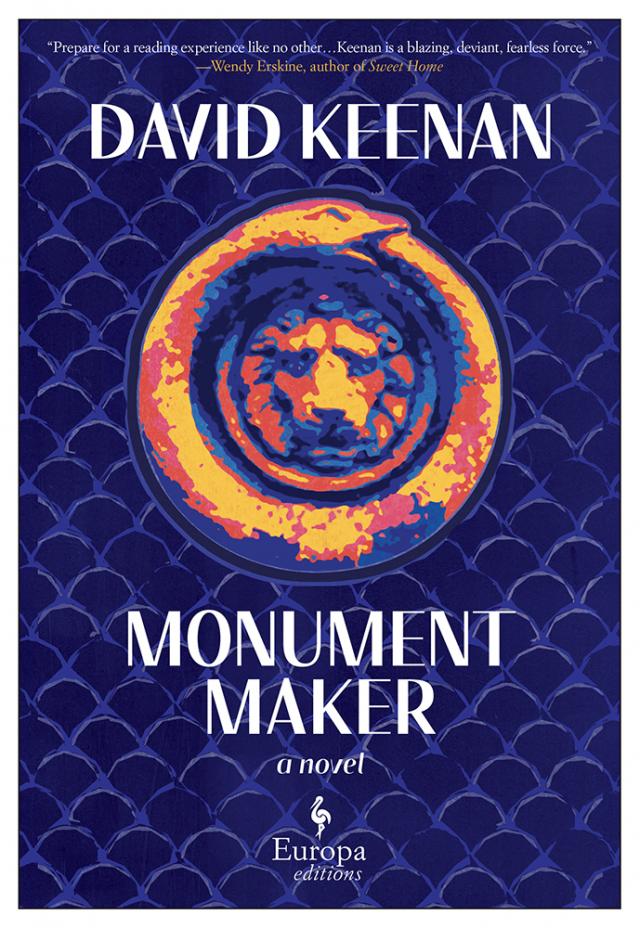


And I felt it right then inside me. This word, Nebula. This word, Flower. And this, idea. Because I, myself, felt myself, to be in a constant predicament of becoming and withdrawing. I recognised it. And that night, the night after I read the article, my parents and I were staying at the home of a friend of the family, a holiday home in France, a gloomy place with wooden floors and haunted outbuildings, which is where I chanced upon this article about Pierre, in a magazine that had been discarded by a previous guest, and which I read by candlelight, by the pulse of candlelight, which seemed to double its effect, and as I read it I had the strangest feeling, and I masturbated, I masturbated about the future, set in stone, and all the withdrawing and becoming, up ahead.
In the morning I pointed it out to my father. Papa, I said, that is what my father liked me to call him, he was French on the brain, Papa, I said, would you look at this gentleman who sculpts artworks that retreat all the way back to their origins and he laughed and said, ah-ha, Monsieur Melville, he said. These days he is nothing but a monument maker, he said, and he shrugged. Those words; I shuddered. What do you mean? I asked my father. These days, my father said to me, Pierre is a bourgeois, he said. He is an architect of tombs, he said. Because he sold out. And then he told me the extraordinary story of Pierre’s ascension through the art world and his success as an architect and how he had been contacted by an anonymous donor who wrote to say that he wanted to pay a stipend to Pierre for the rest of his life, a considerable stipend, if he would agree to one thing only, one working, was what the anonymous benefactor said, that is the term he used, and that is that I want you to design and build my own tomb, he said, money no object, vision no limit, only I remain anonymous, as does the location of the tomb, which we can work out legally, he said, and afterwards, he said, after the tomb is completed, and I give you ten years, God willing, he said, I will continue to pay you in perpetuity, forever, until the day of your death, but your final act, after signing a non-disclosure agreement, obviously, will be to return, with a select band of family members and friends, and have my body, at the time of my death, placed in your vault, according to your vision. I never want to see it, I never want to discuss the plans. I merely want to sign off on the budget, because I have complete faith in you, he said, this voice said, these words said, on the page, and after I am interred, it said, I want you to collapse the entrance, to bury it without a trace, and to leave me, forgotten, except in the mind of an artist, and his workmen, and a select group of lovers and friends, in the Valley of the Kings, in other words, is what it said.
And there was much speculation. And Pierre was allowed to talk about it in public, there was no clause against that, why not, and so he told people, I am working privately these days, he said, in his own terrible pronunciation that made him sound like an intelligent halfwit, I am engaged in the burial of a living man, he said, on Pebble Mill at One, I think he might have said that then, and when the girl asked him why he had taken a job that would remove him from the public eye for so long and what about his career, Angela Rippon it may have been, he simply said, I am captured by it, is what he said, and though Rippon pressed him about what exactly he was captured by, was it the idea, was it the money, was it the opportunity to fix monuments, in secret, still he just sat there, and stayed mum, which led to the rumour that he had gone feudal and that he was just the latest in a long line of clowns who had been flattered into building monuments to temporal power, to mere economic triumph, to game-playing and bullshit and filthy lucre.
Although he is today best known as a sculptor and architect, Pierre Melville began life as a poet. He had published several volumes by the time he was in his early twenties, two of which have been translated into English. One was titled White Marble, the other Lonely Caravan, but you can forget about ever finding a copy of that one because you have no chance. They were figurative sculptures in text, was what Pierre said on the back, talking about his poems, apparently, but who knows how reliable the translation is, I said to my Flower, when I gifted her a second-hand copy of White Marble, inside of which I had inscribed a pair of brackets and inside of them my initials (D.K.), who knows how seriously to take that, I said, it could be some kind of retrospective anointing of Pierre’s earlier works with everything that we know now, his proclivities, his visions, I said, the terms themselves, I said, could be approximate, a mere happenstance of translation or a brazen rewriting of history, even. But then, I said to her, and I showed her this; then this, I said:
How, have I been
to Purgatory,
how, have I, in the manner
Of the Saints, which is,
to have gone so far, inside
as to come upon cold
white marble, is to approach,
bright ggrey
stone
Then this, I said, and I showed her some more poems and we kissed and she tongued my lips as I held her by her slender waist and ate from between her legs and slid her dress up and drew myself into her again and again until we collapsed on the filthy sheets as the sun was coming up, all aglow, I thought, all aglow, which is what blood does, when it has found its medium. But white marble; white marble struck me as some kind of final frontier. And so, I set out.
I read some book about how the prerequisites of sculpture were something like mass and balance and motion and outline and detail, something ludicrous like that. Even then, when I was only beginning, when I was only—what’s the term?—feeling my way, even then I knew that it was about presence, and its lack, about form, and its shadow, about, let’s face it, a chasm and a cocoon. Have you ever seen Bernini’s Apollo and Daphne?
What does it mean to look? And shut your mouth about the gendered gaze for a minute with that claptrap. What does it mean to look, for the first time; do you believe that is possible? If not, whatever do you go to art galleries for? What do you travel to Florence for? What do you fall in love for, over and over again?
First look: what a wonderful look I am looking as I am looking at the woman that I loved. She is filling our car with petrol. She has on patterned tights and aviator shades. Her long blonde hair, her waist. Is there no way to re-see it? We take a picnic, perched up on logs, looking out across a wide field. There are bees in the air and the horizon is lit up like a foundry. She spots a bird, and she names it, and I watch it fly off, as named, by her. Is there no way to re-see it?
What does the myth of Daphne and Apollo mean? It strikes me as this: Daphne (and what a beautiful name that is naming) knows she will be pursued forever, and so she fixes herself, or rather disguises herself, in movement, in agelessly slow movement, in simple matter—almost, but not quite—in order to both elude, and to endlessly bewilder and attract, her would-be god suitor.
Have you ever seen Bernini’s tomb for that wretched pope of his? The red marble like wounded flesh or brain stuff, the Fates, singing, standing in for concepts, bracketing the scene, on both sides, and the pope up above; but there, in the middle, is the shining skeleton of Death itself, golden and enfolded in the flesh of the brain, as if the flesh grew bones as its own persecutor, and brain stuff drew all three. But then the bones hold the hourglass in their hands, and Death presents it to us, so.
These are the words that I fantasised my Flower might say to Pierre as he held her on the end of his dick and speared her in bed every night (though by that point whether he was capable of the action of spearing or not is something we’ll never know).
I love your big cock, baby.
Harder.
Do me, baby.
Slap my swollen titties.
Feel how wet you’ve got me.
Make me come, oh make me come.
Give me your juice, baby.
I’m your little slut.
I hope you know I’m a real whore.
Baby, your cock is too big, baby.
Slap my ass while you fuck me.
Slide my panties down, like that.
Finger my mound.
You like my little shaved pussy, I did it for you.
It’s like an iron bar, baby, it’s like a fucking, iron, bar.
These are the course notes for the first semester in sculpture I will never teach.
Everything is empty and insincere. These are the words written over the collapsed tomb of a dead man, which is the state of my body, since I lost my Flower, forever. This is the strength of my antipathy towards love, which betrayed me, you, love, I say to the stone that promised me, you are a betrayer, even as I see, in my touching, of cold white marble, the lineaments of desire are longing, there, in stone, longing to be uncovered, wanton, to be disrobed, obedient to the most disobedient impulse as if it were fused, in every rock itself, as if, in the base matter of the earth, in every grain of sand, the eternal relationship, fixed, as surely as the cross.
Stonemason, carve your stone. There is no such thing as inanimate matter.
And now I can hear her writing the farewell letter in my head, the farewell letter that she never wrote, because there was no farewell letter, and yet, why can I hear it, why is its tone so implacable, where is the inflection, it reads like a chapter from The Bible, lifeless, you think, but here is all of life, you think, again, as she explains to you the nature of change, as if either of the two of you were in any way unfamiliar with the nature of change, and yet, to speak it, it is heartbreaking, to admit that we are not permanent, you and I, well, it’s further than I can go, and I prefer to be press-ganged to those ends, and never to willingly offer myself up, and so I am replying, in my mind, in my mind I am the one writing the sad farewell letter, now, and I’m saying, you make me anxious and you make me doubt, you make me believe this whole world is a battlefield, you make me feel like I have to play the game when really, now, at this age, I have no heart for it, and then I recall Pierre, spearing you, and eliciting those words, in my head, and I feel like a wounded animal, that has stumbled, and that will struggle to regain its feet.
Pierre and I took the car, a rusty old turquoise Morris Minor, in the rain, all the way from Linlithgow, where we were staying, to visit Durham Cathedral. Why were we in Linlithgow? I honestly can’t recall; the palace, perhaps, but why? There was a lovely bookshop there, and a tea room by the canal, and a house, up high stone steps, that slept two, if one of us slept on the couch, which was me, and the only thing I remember now about that visit, this strange annex in my life, is that I took down the net curtains from the window and wrapped them around me on the couch in place of a duvet so that now I remember that trip as wearing a chrysalis or a shroud.
The floor had rusted through his car. We could see the road beneath us as we sped.
The title of Pierre’s book, in my translation, is Full Length Mirror. He never commented on the quality of the translation at all and, to be honest, there wasn’t a huge amount of text to speak of, outside of the odd, offbeat introduction, which is what struck me so powerfully in the first place, and which took me a season to translate, an introduction that somehow sets you up to read the pictures as a form of unfolding autobiography, even when they contain nothing but stone and tree and sky, but most especially the enigmatic photographs of monastic architecture that feature himself, his chic 1970s car, and a ghostly, elegant female, who in one picture appears to expose her breasts to the cameraman. But who was the cameraman? He remains uncredited and unfound. Though there are a few stories. Like this one.
Pierre and his lover Hildegard are driving from Paris to view the Benedictine nunnery of Saint-Désir at Lisieux, which features, according to my translation of Full Length Mirror, “a carving that shows the birth of the infant Jesus, as a fully formed adult, in the outspillage of the menses of his mother.”
On the road they pick up a hitch-hiker. In one of the shots of the nunnery, it is true, there is the shadow of a finger to the left of the viewfinder. He has run away. The hitch-hiker. Not from a home or from a prison or a press-gang situation, but from a marriage. Do me a favour, this dark-skinned stranger says to them, from the back seat of the car, from somewhere barely imaginable, but almost imaginable, now, thanks to this Full Length Mirror; make love tonight, he says. And we can imagine Pierre, or his partner, looking in the rear-view mirror right then.
They pull up at the nunnery. They have themselves photographed beneath the outspilling menses by this hitch-hiker guy. I have that photograph. It’s a Polaroid. Hildegard is wearing a long yellow dress with a large belt and with her hair in a svelte blonde bob. You can pick out the nipples on her small tits through the cloth of her top. She wears a neckerchief like an air stewardess or an artist’s muse would.
But he said to me, on the way to Durham, the one thing he said to me about the translation: Full Length Mirror, really? he said. I said to him, what, so what would be a truer equivalent? And he said, Delicate Prism, Deep Ocean of Thought, and then he said: Monument Maker.
I called my Flower from the road, from a call box by the bridge. I love you and want to be with you and all I need to know is that you are the centre, that holds, in my life. Then I stopped talking and I waited. I waited till dreams like my heart lay all broken. That’s how I feel, she said, but they weren’t the same words that I had spoken, she had not mouthed the sentiment that I had offered her, she had not mirrored me in stone. And I thought of a tomb, with a collapsed entrance, that no one, again, will ever see.
We stood in front of the figure of the Christ and his mother, carved from trees, in the vestibule of Durham Cathedral. Wood? Wood is of no interest to us, I thought, why has Pierre stopped, why is he stooped over these two wooden figures, these husks. The pair were spattered with metal, as if the lead in the roof had melted on them during an air attack by the Nazis. I thought of the longing of the elements to be anything but what they are, and I saw the love between Christ and his mother. But I felt good about the wounding. Something of Christ melting under the assault of the Nazis, his actual skin spattered, even though he was nothing but a rotten old tree, made me feel hot, and horny, and real.
I am addressing the ghost of my love, which is a husk now, too. My love, I say, and what a beautiful say I am saying when I am saying what it is that I say. I am speaking to the beyond, now. I would like to tell it something of my love because I know now that it cares. And that is why it remains, perpetually, just out of reach. I call it love, and I stand by that. I fix it: here. Why do you insist on pursuit? But that is too much. I no more intend to unmask it than I would remove all of your clothes, in love, lover. I will keep the panties on, even as they are tight around your ankles, and I will draw them as lines, written, into stone.
In Durham we sat in a bar at Halloween and Pierre drank one beer after another before falling down and cursing everyone else in the place. I succeeded in getting him outside, where he announced to the cathedral and the air, and the shadow passing on the river below, and the moon, obviously, as well as random passers-by, that he wished to be rid of this woman for life, he said, and he gnashed his teeth and swung his fists at the air, what woman, and I thought is it Hildegard, Hildegard, it must be.
The moon shone deep into the waters, birds rose up like words, or like lonely letters, gathering, together, in love, which is what words is, above a river, in Durham, a river I drowned my own father in, and why? Because I felt the need of the growing of a new father, I said, the time has come, I said to myself, and even though it was a drunken thought I gave it to you, the beyond, I gave thought and agency and urge to you, by which I mean I gave spelling to you, and you worded, in my head, what was to be done, what was the gratuitous drowning of the father, only this time, as my own murder of him, as I threw the little sewn pouch that contained his caul into the river below.
If I were to describe the interior of the Benedictine abbey of Le Bec-Hellouin, founded in 1034 (can you imagine such a thing, what architects that we are unable even to dream), then I would describe it as resembling the interior of a pink, white, shell, the kind you would find on the beach, once, long ago, in the past, or of an echoing swimming pool, drained, and ornate, that you visited once, as a child, and that now is bereft, forever, because of that visit, or as an absence, a sealing-off, and a jealous secreting, of space, which is what I should have done with you, honey. That’s what the caption reads, beneath the photograph, in my own, unpublished, translation.
There is a car parked up, against the wall. The exterior is a poker face. God’s face is a poker face, it says, but inside, the pool, the pink light, the soft reflections, the staircase to the cells, with seaweed, swaying, in the concrete breeze. A priest, his robes rippled, in motion, is caught in the light.
Here’s a story I remember that always bugged me. It really got to me that back when Pierre had first come on the scene, my Flower described him as implacable. He’s implacable, she said, and she shook her head, after a dinner party that had gone awry where we had invited Pierre along with what I felt was the central cabal of aesthetes of stone, the Meridians, I named us, in my head, and there had been much drinking and comparing of historical minutiae when Pierre appeared from the bedroom, in a state of inebriation, inexplicably dressed in a white tracksuit with green trims, and challenged any one of these outmoded bastards, is what he said, because you know nothing about love, he said, and he said to them, I intend to take off into the air, all the while wearing a green-and-white sweatband too, and aviator shades, aviator shades that were tied to his ears with elastic bands, and he said, do as I do, not as I say, he said, and he pressed play on a cassette recorder, and this music came out, this pop music, this rap music, and then he laughed, as if of course that was impossible, write books like me, impossible, make stone speak like me, impossible, rise up into the air like me, impossible, second-guess my taste in music, impossible, steal the love of my life from me, completely, fucking, impossible, as he ran across the room as fast as he could and proceeded to run up the side of the wall, back-flipping just before the ceiling and spinning round and landing, miraculously, in a perfect circle, on his feet. Can any of you relics do that? he said. And everyone was agog. Aghast. And it was no longer about sculpture; it was sculpture itself. And then my Flower turned to me and she said, wow, he is completely implacable, and I said to myself, no, even my own reading of this is not real. Which is the story of monasticism.