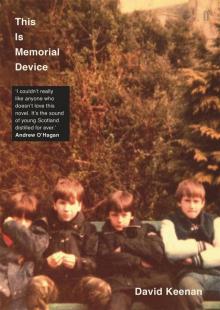
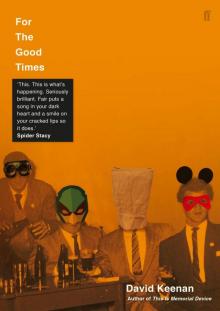
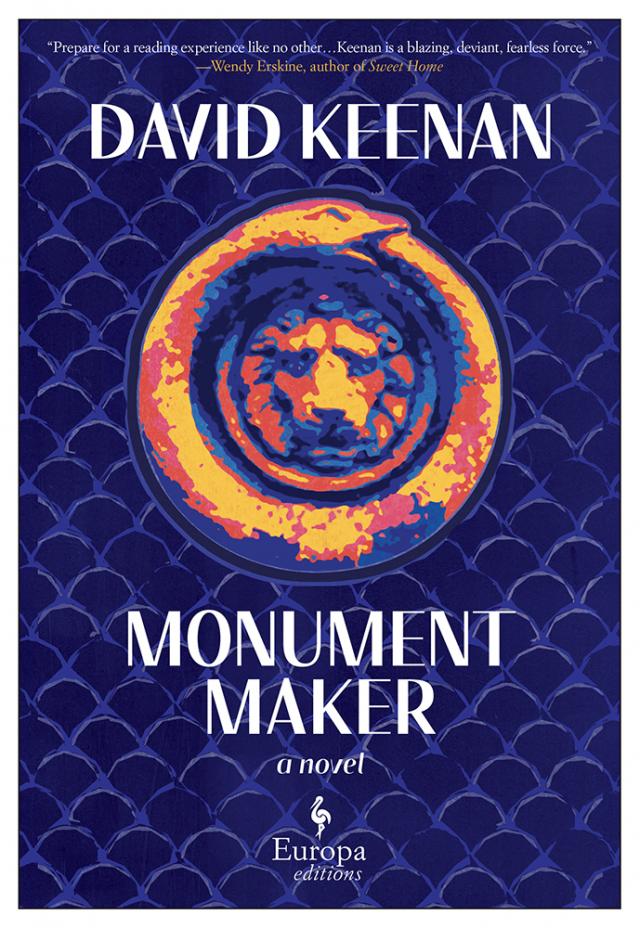
Monument Maker, page 49


I threw some sheets across a wide table in a back room and laid out the beast. Dr. Strindberg’s pretty wife came to the door and gasped. What is it? she said. One of yours, I said to her. One of your creations come to life. Bring me my tools, oxygen and some sedatives, I said to her.
For four hours I worked on the beast. I opened up its chest and probed inside. Its construction was far beyond our own abilities. Inside it there was tiny circuitry, like a tag, almost, and its entire skeletal system had been bolstered with a metal that seemed perfectly soft and pliable. The face fit perfectly, the transplant as seamless as my own, although much more grotesque, an ancient, amphibious mask that was cold and rubbery and that spoke of the depths, the depths of evolution, the depths of the sea. At either side of the neck there were pale fleshy gills. Yet its body seemed that of a fat, stunted dog, a sea lion that had grown hair and sprouted thin, muscular legs, each of which ended in long curled claws like a hawk or griffin’s. I sewed it back up and did my best to repair that gaping wound on its head. Then I left it to recover.
I went to speak with Dr. Strindberg’s pretty wife and I found her weeping in her study. Where are these terrible things coming from? she demanded of me. I have been assailed by them, she told me. My mind has been invaded by these hybrid creatures, she told me. And now they crawl along our streets, now they bleed down from our mountains. I thought it a strange phrase, to bleed down, as if they poured forth from a wound.
Excuse me, the young boy interrupted me, but have you started speaking funny? You know, like old-fashioned funny, like in an old book or a different century? The century is regressing, I told him, time is running backwards as we progress, I said to him, time’s wingèd chariot hurrying near. Just wondering what it was all about, he said. Sorry, keep going.
The creature awoke with a start. (Wow, okay.) Then it made the strangest sound. I had it tied to the table and covered in a bloodied sheet and it turned its thick neck to look at me, with eyes of helpless terror, and it made this sound: Ah-Eh-Oxt. (What?) Ah-Eh-Oxt. (It’s just a groan, just an inarticulate animal groan of pain.) But no, it repeated the phrase, again and again. Ah-Eh-Oxt. Ah-Eh-Oxt. It was language. The beast was trying to communicate, or so I convinced myself. (An exit, it’s saying an exit.) No, you’re just repeating what it is saying, that’s not what it means. (It’s saying it’s exhausted, it’s saying it doesn’t want to live any more, it’s asking you to end it.) No. It’s saying something else.
Dr. Strindberg’s pretty wife fetches him from his quarters and he arrives a little worse for wear. He stares in horror at the beast strapped to the table. Gad, he says, it’s some kind of evolutionary throwback! That’s where you’re wrong, I tell him. This thing comes from the future. I explain how we found it in the marketplace being set upon by an angry mob. You repaired the wound? he asked me. You stitched up the belly? Yes, I said. Where did you learn your surgical skills? I was apprenticed to a radical surgeon as a young man. A radical surgeon? What does that mean? A surgeon who pioneered experimental techniques. You mean a surgeon who could have come up with this? he said, gesturing towards the thing on the table, which was now unconscious and breathing in a slippery, laboured manner. What makes you think it was surgically engineered? I asked him. Come on, man, he said, this kind of hybrid makes a mockery of any creator! I wanted to say to him that we were the creators and that it was we who had made a mockery but instead I nodded slowly and held my peace.
Just then there was the sound of a fracas outside the building (a fracas?). An angry mob was chanting and demanding the death of the devil we were protecting. Stones and handfuls of dirt rained down on the shutters. I accompanied the doctor out into the street. He stood on the steps and addressed the rabble (the rabble?). We have a poor wounded creature in here, the doctor said. Cease with these protests immediately. As doctors we have taken a solemn oath to protect the life, and where possible alleviate the suffering, of all sentient beings. It’s not a sentient being, it’s a monster, someone shouted. The whole building is a collection of monsters, someone else shouted. You’ll bring curses down upon our town, someone else said. The beast must be destroyed. God demands it. He won’t stand for mockery, the doctor whispered to me, and gave me a look. Listen, the doctor said. We need to get to the bottom of this. We need to find out where this creature has come from and if there are more of them. We need to examine it. Then we’ll put it to the stake, someone else cried. Time, the doctor said, and he raised up his hands, all we need is time. Please. There were mutterings in the crowd and they slowly began to disperse.
An hour later a military convoy came tearing into the yard. Soldiers dressed in protective full-body suits stormed the hospital. In every ward the madmen were screaming and harming themselves and weeping silently in the corners. They came to the room with the beast. They made us stand outside in the corridor at gunpoint. From inside the room I heard that same word, that same sound. Ah-Eh-Oxt. Then the sound of a gunshot. And another. And another. A group of soldiers emerged from the room with the thing in a body bag. Behind them came the one with the gun. I was unable to see his face through his tinted visor, but I swear as he turned to go I saw a thin ratty tail attached to the back of his suit.
I went upstairs to the dead and I sat with them. I was looking for a sign, an intimation of what was to be. (That’s ironic since you seem to know exactly what is going to happen.) Shut up. They looked at me, and then they held their heads to the ground. I went back to work.
We treated a man for a syndrome where he would obsessively predict the time at which various things would take place, various trivial things. For instance, at ten o’clock, he would say, I will proceed to enter the bath. At approximately 5.24 P.M. the sun will go down on another blessed day. At 8.10 I will remove my slacks and hang them over the back of a chair there to await my rendezvous with them at 6.10 the next morning. But then he began to predict other things, greater things. He had been an officer in the German army during the war and had served on the Russian front, where he had taken a head wound and deteriorated from there. His family had washed their hands of him. But like me, his wound or the terror of his service or a combination of both had gifted him with prophecy. I looked into his eyes, which were glazed over and somewhere else, somewhere in the future, and I thought that prophecy, too, is a way of keeping terror in abeyance, and I felt fuzzy, like the connection to myself, myself in the prison, this wretched self right here in front of you, was shaky, and that it would be possible, with a great effort of will, to up and break the connection and to strand myself in the past and in the future. To split myself in two. But there was something else, something in the telling of it that insisted on maintaining the link. For now. Okay. Okay. We carry on.
Stories circulated around Wuppertal, sightings of mythical beasts come down into the valley, rumours that secret Nazi experiments had resulted in hybrid life forms, that the Allies had introduced monsters into Germany, that the house of madmen was really a front for the creation of basilisks. We experienced suspicion and outright hostility on the streets.
While wheeling two of our madmen around the park in the afternoon I was once more approached by the elderly gentleman who had first called me Donald, the gentleman I had disabused and denied, but here he was again, and he approached quickly and grasped my hands and he said to me: I know. You said this would happen, he said to me. But you must accept that I know. Dr. Strindberg’s pretty wife had accompanied me. By this point she was starting to show. She had led Dr. Strindberg to believe that the baby was his. The elderly gentleman looked towards her bump and then back at me. Everything has been prepared, he said. For the influx. This time I nodded. I acted as if I understood. Yes, I said. The influx.
The Estimator, the madman who announced the forthcoming time and date of everything, began to make obsessive drawings on bits of scrap paper in the day room, covering sheets of toilet paper, the edges of newspapers, the envelopes of the sad letters his relatives would occasionally send him. I showed them to Dr. Strindberg’s wife. He had drawn a great hotel, a great haunted hotel, whose rooms were peopled by monsters. I told her, I have this hotel in my head. I explained to her how when I was a prisoner in Italy during the war I had created a towering mansion in my head whose rooms I would wander for hours and where at the top of a set of stairs, in a lonely room with one window, I had secreted my young wife. You are married? she asked me. I was married, I corrected her, once. But I am carrying your child, she said. Listen, I said to her. I have something to confess to you. My face is not my own, I told her. I was given this face and this future as a second chance. I came back. But now I believe I have come back for you. Do you believe in fate? I asked her. Do you believe in destiny? But something is out of joint, I told her. I feel as if I have failed to keep an assignation with myself. You saw the man who accosted us in the street? Well, I feel I am in conspiracy with him, somehow. I feel myself to be like a blind man who has been told that he is at the centre of all events. And now the contents of my head, the contents of the life that I have inherited, are invading the present. I prophesied all this, I said.
Who are you talking to? the young boy asked me. Where are you right now? I am escaped, I said to him. I am disappeared.
I am disappeared.
I am returning home. I am booked into a private hotel built high on the cliffs above the River Calder. I am eating in its handsomely appointed dining room. Above the fireplace there is a painting of a young man. He has the same face as you. Seated across from me there is my son. He has the same face as me. The face of Donald, that is. The face of a Januist. I have brought him back home. Though, really, I have secreted him in my past. We crossed Europe in the space of three months. Germany–Belgium. Belgium–France. France–England. I returned to staging my own travelling psychic review in order to fund our trip. Many impossible things have taken place. The dead too have followed in my wake. The disappeared have returned. I cross to the viewing gallery and I peer down into the gorge. The bilious flora and fauna twist up towards me. The trees are alive with the sound of exotic birds. The sun is high in the sky. Across the river the spires of Chapelhall are hazy in its light. The animals wander in the shade of the grove and children hold them in their arms and are not afraid. Animals that have the aspect of lambs and of lions. Animals with tiny bodies and long ponderous legs graze on the highest branches. Creatures with the face of silly fishes and with hairy bodies like cattle or yaks roll over to expose their tender undersides to the light. We watch them, the dead, as one. I take my son’s hand, my son who wears the same impossible face as myself, and we walk towards the village. Calderbank, too, has become a great grassland, a verdant field with clusters of houses scattered here and there. We cross the green grass and send up a cloud of tiny whirring insects, their bodies completely covered in eyes. It is as if nature cannot evolve fast enough to take in all of this wonder. We pause in the shade of a tree. This whole world was stone, I tell my son, once upon a time this whole world was dead stone. Grass grew from the wound, I tell him. Flowers grew from the corpses.
Something is moving in the undergrowth. It bursts past us, pursued by a man with an old-fashioned blunderbuss over his shoulder. He looses several shots into the air and the animal bounds off, its long tongue wagging, its face with an expression of simple joy. The man stops us and asks us where we are from. An outlandish pair, he calls us. Yes, we tell him, we have travelled from Germany, that once we lived here, long ago, we say, and have come back. It’s very busy in Germany, he marvels. I know everyone around here, he says, and I can’t say I can place your faces. Oh, we have returned with different faces, I say to him. That’ll be it, he says, before continuing his leisurely pursuit of the strange creature who waits for him, pretending to hide. In the distance the sound of church bells can be heard.
Wait, the young man interrupts. Wait. I remember, too. What? I remember the crossing, do you remember? We crossed the sea on a great ship, a great ship of rust and of rope and of old black wood. Don’t you remember looking down, looking down through the pale-blue water? You said it was the colour of blood, the true colour of blood. Yes, I tell him. Yes. I remember. Do you remember the horses? Yes. Now I remember. Now I remember the horses. The waters were as quiet as can be, except for some froths, except for some froths of water. The froths were being sent up by the horses. The horses were walking at the bottom of the water. The horses were walking on the bottom of the ocean, all with wounds in their stomach. They were marching blind at the bottom of the water and they were bleeding there. They were bleeding an ocean. An ocean of pale-blue blood flowed from the wounds on their chest and submerged them completely. This was the separation of the firmament. This was the first act of God. Now I understand. We are walking in the stuff of our own wounds. That is what the horses said. We are walking in the rends of our own flesh.
The man who called me Donald returned. He returned to the mental hospital one evening when Dr. Strindberg’s pretty wife had fallen into labour. He delivered you to us in secret. Who? You. My son. He delivered you to us with the face of the disappeared. He looks just like you, the man who delivered you exclaimed, a man who from now on I will refer to as Richard Snow. I looked like you? You looked like me, like my new face. An impossibility. Exactly. We hid you in the attic with the spectres of the disappeared. Richard Snow informed me of his true identity. He claimed to be a Januist. The one that was left behind, he said. Then one night he appeared with a film camera and a projector. He appeared with a film camera and a projector and told me that he had come with great tidings. He said that he had come to put on a show for the dead and the disappeared. We set up a projector in the loft space against one wall. We gathered the missing all around us. We held our little baby in our arms. With everyone’s eyes we watched as the Januist project flickered back into life. A horsebox stood by the edge of the ocean. One by one a series of huge oversized horses fitted with elaborate black leather blinds walked down the gangplank and straight into the ocean.
But it was impossible. The horsebox had room for two or three horses at most but still they came, one after the other, in their tens and twenties, and now in their hundreds, never-ending. The dead stood there in silence as the horses filed into the water and walked up to their bellies through the water and disappeared beneath the water. I stood up and shouted in protest at Richard Snow. He laughed and nodded and confessed to me. It is all done with the aid of a simple loop, he said. The drowning of horses is achieved by means of a loop? I demanded. The horses don’t drown, he told me. These are our horses, he said. But there is a loop. Haven’t you realised yet? he said to me. Can’t you work out where the loop is set? You mean I am caught up in the same loop? I asked him, and I felt the dead huddle around me, I felt them as if to say, cut this loop, and free us, let us go, even if just to lie prone at the bottom of the water, even if only to be swept away by the tide. You are that loop, Richard Snow told me. You are the one that can never drown.
I recalled my rescue from a sinking ship. My fleeing from the island. My crossing of the ocean with the horses down below. But for what reason? I demanded of him. Of your own choosing, he said to me. But why are we bleeding? I asked him. Why are we wounded? You’re the only one who can answer that, Richard Snow told me. You are the one who came back in blood.
The soldiers burst into the cell.
You’re free, they tell us. Hitler is kaput! You’re free to go.
This is the book, I tell them.
I have come to rescue all of the disappeared, to reunite all true loves, to turn history to dust, I tell them.
I am the one who came back in blood, I tell them.
I get up, and I take your hand, and together we walk out into it.
SEDILIA
APPENDIX CELEBRANT: VICTORY GARDEN,
A SCIENCE FICTION BY PAIMON
(TRANSLATED FROM THE FRENCH BY DAVID KEENAN)
EARTH’S ORBIT, 2099
Adam Aros watched from the observation deck as the New Jerusalem disengaged with a gentle puff and began its slow descent to earth. Spaceships make silent music, he thought to himself, and for a moment a hymn came back to him, and a singer too. A feather on the breath of God; that was it. But who was the singer? That eluded him. Are we down below or up above, he often wondered, in all of this space. The changeover wasn’t particularly perilous; there were safeguards in place all along the Victory Gardens. But the symbolism was hard to miss. The chain had been broken. Just like water, time will find the weakest point. After that, the deluge. Still, he could already see its replacement, suspended high above the sea and climbing, a creature without eyes, approaching slowly but surely, blind to the folly of climbing out of the sea in the first place. He caught the words of another song. There was something haunting in its delivery. But who was the singer? It eluded him still. He looked to his WordPool and drew up an entry.
WordPools aren’t predictive; at least, that’s what they maintain. But it was impossible not to read something into the spontaneous texts they delivered. In the twenty-first century they had come to replace astrology and Tarot cards, geomancy and divination, or at least to rival them, although they had initially been designed as a tool for creative writing. Then some scholar, some wayward academic, had announced them as the future of literature. Now nearly everyone carried one. Well, everyone with a brain. The more you used them, the more their stories became living counterparts to your own, as key words and obsessions, sudden inspirations that struck during the day, dreams, fears and fantasies, characters and observations from your own life were fed into the device and algorithms turned them into an ongoing saga, a second internal dialogue, once removed, the voice of the conscience or a consciousness, a daemon or the very word of God, according to just how far-out you wanted to get about it.