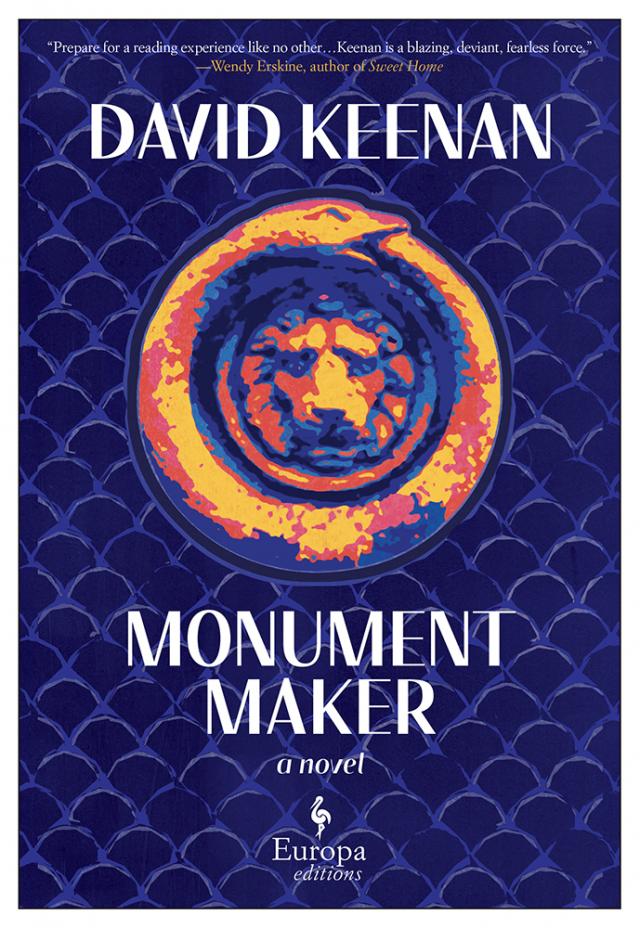
Monument Maker, page 65


Somehow, in the corridors of his dreams, he has stumbled upon a secret dumping ground for a cosmic killer who is literally taking people out of history. The hero dedicates his life to the solving of this mystery and the way he goes about it is that he employs various eccentrics: nudist painters from out in the sticks; slum-dwelling occultists; a taxidermist from Bethnal Green; the famous Siamese twins from Upper Clapton, The Clapton Clique, as they were known, due to their insular nature and their tendency to shun the attentions of fascinated strangers; but it isn’t until he makes the acquaintance of a certain Jack Frost that he begins to make serious inroads in his investigation.
I shuddered when I heard his name, although I knew it was coming. Everyone who reads it gets a shiver, my boy said, not like somebody has walked over their grave, more like someone else was in their grave in place of them. But he’s not in the grave, I said. Jack Frost has gained entrance to the book.
I asked him what Frost’s contribution to the narrative was, what background details were given. Not much, he said. He is described as looking like a shrivelled child, like a smudged punctuation mark, a comma, perhaps, or an ampersand, a semicolon, a question mark, an empty set of brackets, I can’t remember exactly what, his body seems to curl in on itself, like he has a deformity, which in the book gives him a contradictory ability to be invisible, like he isn’t noticed, and of course every time you come across a comma in the book you think maybe that’s him, maybe he’s so grotesque as to be able to disguise himself as actual punctuation right in front of your eyes as an ampersand like this & or as a semicolon like this; oh my days, I said to myself, Jack Frost has only gone and done it; he’s penetrated the tunnels that lie beneath literature itself.
A smart move to enter via genre, I thought to myself. The place is riddled with secret pathways and yawning chasms and mysterious openings that are stranger than fiction itself, not to say possessed of a certain timelessness that forgives these kinds of grand gestures. It made sense. It all made too much sense. Jack Frost on the trail of The Grey Bat. My nemesis and my great love, at war, in the subterranea of certain fringe novels.
Can you hear that? I said suddenly. I thought it was an owl, but it was a siren. I’m shaken up, I said. I admit it. Then I turned to George. Everyone wants you to die, I said. In your life you will meet two or three people at most who truly want you to live, I said. The rest will instruct you in how to die. That includes your family and your friends. My boy nodded. I owe him so much, I told him.
I acted quickly. Who knows where else in the story these words are speaking. I realised that in order to stay the advance of Jack Frost, in order to save the life of The Grey Owl, in order to build a definitive bridgehead in this battle that was raging across time, across literature, across grammar itself, I had to write the next chapter of the story myself. The Grey Owl had made the ultimate sacrifice. He had given up authorship of his own story. In doing so he had given me the opportunity to rescue him.
I turned to my boy, and without thinking, without an idea in mind, I began. Let me tell you the story of a man who tries to build himself a time machine, I said to him.
He decides that he will take note of a certain period in time and space, I began, a certain phase of reality, and attempt to document and measure every last aspect of it, from the soft pink clouds above the tops of the trees through specifics of wildlife and flora and temperature—all this in relation to a flat on the seventeenth floor of a tower block in the north of Glasgow, where our would-be explorer has lived in almost complete isolation for the past six months, streamlining his life to the bare necessities in order to keep potential variables to a minimum—the exact placement of everything in the room, the precise angle of the sunlight, the food that he ate that evening, the people he interacted with, all scripted, set in stone already so as to be more easily replicable, obviously he had a team of assistants and was a man of independent means, even the thoughts he thought, which he had pre-decided and mentally trained himself not to deviate from via years of extreme yogic training that included a night spent alone in the catacombs beneath Edinburgh’s Old Town which were reputed to be haunted, his reasoning being that if every detail can be recovered, every single variable that came together in a single moment in time and space, and if we can document that to the point that we can recreate it, given a team of volunteers from the university and a playboy budget, though not quite a full playboy budget as during the preparation and despite his extreme mental training the explorer had caught alcoholism—as if you can catch alcoholism like you catch measles—and so his daily alcohol regime had to be factored into the equation, which actually wasn’t at all problematic and in fact its routine aspect was gold dust, really, to the team of researchers and volunteers who worked on the project, if he drinks himself insane every night, someone said, all the easier to replicate it, but what about his thoughts, someone else said, won’t they wander under the influence of the drug, won’t they fluctuate and change, but if we can do that, if we can make it work, then surely we will have conquered time itself, or at least set a flag inside it that we can artificially orientate ourselves to again and again, someone else said, and someone else said, well, why this moment as opposed to any other moment, and of course they were forced to admit that money had the upper hand and that money facilitated time travel even better than mind control, that’s the conclusion some of them came to as they watched this mad monk drink himself to death in precisely the same fashion every night, with every detail rehearsed and meticulously watched over, like you’ve stained your shirt, monk explorer, you need to change it, or your right leg was crossed over your left one, brave friend, to the point that they decided that drinking himself unconscious was in fact the only foolproof way of cheating time, but what about nightmares, someone else said, what about obsessive thoughts, incoherent shapes, sounds that you can taste in your mouth, strange premonitions, a feeling of sinking, of rising up, what about paranoia or half-remembered stories from books passing for memory? Consciousness has a baseline, they say, but not exactly in those words, they say something like, there’s always the reptile mind, by which they mean the idea that the serpent is the only creature that truly travels in time, through the particular construction of its own mind, and that through the extreme and sudden application of alcohol it was in fact possible for a man to access that mindset, to cast himself down into the slime of his preconscious, which is the phlegm and venom and saliva of his maker, the seed of his worm, and so to defeat time by mimicking its fluctuations, a secret combination of poetry and objectivity was how the monk explorer described it, which could just as well describe the movement of the planets and the immensity of space itself, and so the experiment came to be more about an experience of eternity over travelling through time, and of course someone mentioned the positions of the stars, the transit of the planets, they can never be replicated, what about the movement of birds, earthworms eating soil and excreting their young, someone said, but the monk explorer shot him down, they are all cycles, he said, they are all looping, endlessly, saying that we could replicate anything on a smaller scale, even the secret stars behind the stars, the moon behind the moon and the sun that held the sun itself in its power, that’s ridiculous, someone said, if we had the powers of infinite suns here on earth then we would be as gods—some of the prose was awkward, like a biblical comic book—and it was here that the monk turned silent and asked for a bottle of premium vodka and a diet soda, and as the experiment began at first everything went according to expectations and they were transported via sound effects and stage props and complex logarithms and alcohol and mind control to a nondescript day, an event actually outside of the day itself, but still a part of it, although, as someone remarked, deadly dull, all the same, and they watched as this secret warrior monk crossed the threshold, passed through the iron vault of heaven itself, eventually dropping the glass bottle of vodka to the floor, a carpeted floor in order to prevent it from breaking, unpredictable shards of glass would have been a headache all round, and by this point the way he dropped the bottle to the ground, how he rolled it down his forearm, expertly, it had come to seem to the experimenters like a classical painting, like a romantic death, and he slumped to the bed as if in slow motion but still in perfect formation, there were gasps from amongst the onlookers, this is ballet, someone said, this is classical dance, this is art, someone said, a perfectly nuanced revisitation, they pronounced it, and they too felt themselves travel back in time, even though they had none of the mind training of the warrior monk, who by this point was their hero, what must it be like in there, they said, to re-enter a moment for a second time, someone gasped, and when they turned back around, the monitoring equipment confirmed it, it was right there on videotape, on hissy audio tape, on smudged amateur snaps from a disposable camera, in a transcription from a secretary that reads more like hieroglyphics than shorthand but that makes clear that what took place was undeniably real, that the warrior monk disappeared from the bed, that the bed disappeared from beneath the warrior monk, and that all that was left, hovering in a void—a depth, someone said, which better communicates the sense of cosmic endlessness and dread it conveyed, the contemporary accounts are more like whirlpools, madmen’s faces, dilated eyeballs—was a series of tall black towers set around a stone encampment in the shape of a hexagon, a mighty fortress, a prison camp, someone suggested, Colditz, someone else said, the Ark, the grail castle, someone else said, a classical scholar, perhaps, or a practising magician, but it was impossible to see what was inside, the walls seemed to climb before your eyes and subsequent analysis of the film revealed nothing, it was literally impenetrable, which is what made the experimenters agree that the vision of the abyss, as they dubbed it, a borrowed phrase but pertinent in the extreme, was the only permissible evidence of time travel, and the theory came about that the abyss was in fact a holding station, a full stop, a first stone holding time in check while the pilot travelled through the tunnels of Set, the tunnels of the RAF, the tunnels of the SS, the tunnels of The Kommandant, the tunnels of The SIRK, and afterwards, on his return, he seemed embarrassed, like a drunken teenager with a next-day hangover, materialised back on his bed, they asked him what it was like, this travelling in time, this storming of heaven, and it was like he wanted to change the subject, like it was something he would rather avoid, like sex talk with your parents, he brushed away questions about vertigo, about visions and demons but not about penis size, someone thought it might shrivel, someone else thought it might grow, and oddly enough he laughed at that one and answered it directly, it’s bigger, boys, he said, in fact it’s a monster, indeed his talk became increasingly sexualised, like smut was less embarrassing than scientific fact or mystical experience, and every time he would steer them away from the facts by introducing an unsophisticated sexual metaphor, doing the dirty, he would say, gardening up hill, tossing the chicken, strangling the cat, swimming the channel, riding a three-speed, which caused gasps all around, living the vida loca, breaking the hymen, busting the cherry, the beast with two backs, he said, and he winked at that one, the love that dare not speak its name . . . That night he used them all and invented a fair few besides, of which my favourite is still wolfing it, for obvious reasons.
He was the anti-Houdini, that’s how one of his followers described it, and by now they were all followers, disciples, witnesses to his turning back the power of the tide, and the decision was made to go public, to report the startling results of the experiment, and despite the recorded evidence, the floating towers, the stone of in the beginning, the comparisons to Treblinka and Belzec and Colditz, they were widely guffawed. The experimenters were called everything from mystics and psychic investigators to crackpots and poofters, alongside hints that they were actually a secret boys’ club that had more to do with bringing back the glory days of Rome than fighting for equal opportunities in time travel. Yet amidst all of the moral hysteria, which really was a terror of the past opening up and becoming accessible to anyone, from the authorities and the police through the widowed and the wounded, a concern that the first use of time travel would be to right rights and to avenge wrongs, and so the establishment closed ranks and science turned its back on them, and it was left to the counterculture—a culture that to all intents and purposes the warrior monk despised—to propagate his views and to campaign for government funding for further experiments. Soon he rose to the status of a cause célèbre in the underground press, on the level of a Mel Lyman or an R.D. Laing or a Sun Ra, where he lashed out at the scientific establishment and instead courted artists and musicians and poets, poets most of all, now rethinking his experiment as an exercise in poetry.
Gentle, fearless life, he said, and at this point he took out a handkerchief that was actually a Buddhist prayer flag and dabbed his eyes and blew his nose on it and then he went on like a poem, at least according to the transcript that appeared in Cold Hand # 5 where some longhair reporter spent twenty-four hours in his company, dogging him across the borough of Hackney, where he had relocated from Glasgow “in order to be closer to the eye of the storm,” he had said, and of course his followers read that as some kind of code, like he had located a secret vortex or a time tunnel somewhere in the East End of London, and indeed he made cryptic references to nineteenth-century authors and alcoholic poets, claiming that he had picked up the trail through initiated interactions with their works, and so the longhair threw out some names, Machen, Dowson, O’Sullivan, and he claimed never to have heard of any of them, and despite all the literary talk, and the moment where he seemed to recite a poem made of single adjectives stated boldly—imaginary, nauseating, obsequious, hallowed, numberless—which the longhair described as a moment of delirium, brought on, he believed, by his experiences in the time vortex and the effect of the alcohol that he was consuming, and despite all of the eccentricity and the one-way conversations and the talk of this citadel that stood in for time, this Eagle’s Nest, the reality of his day-to-day existence was regimented and ordinary, he would visit this particular bagel shop on Northwold Road every day where he would order exactly the same thing, a bagel with cheese and an apple strudel, all the while dressed like he had stepped out of a Perry Como album, the creased sporty trousers, the salmon-pink shirt, the jumper tied casually across the shoulders, grey side-lacing shoes, white socks, regimental side-parting, a stray cigarette behind the ear, sometimes large brown sunglasses, or sandals, even, dressed for another jet-set entirely, a dark musky aftershave—never a cologne, he told the long-haired reporter—but still he comes across well; so he visited the launderette at one every afternoon and spun the same pair of trousers, so he stood on the platform at Clapton every 8 A.M. and refused to get on, so he sat by an open window and dreamed of foxes snatching children in the heat of the dark summer evenings, every evening, all summer long, wearing a dark-blue blazer, pale chinos, and smoking a cigarette in a bay window just by the sorting office while thinking of his father?
At one point in the interview, which was alternately fascinating and repulsive in its focusing on the minutiae of his life, as if the compulsion of his habits was being presented as a mania, and so his experiment in time a form of obsessive-compulsive overcompensation, a form of autism, say, that was lucid enough to build itself an environment that seemed, on that particular wavelength, what is it they call them, children of a lesser god, is that the phrase, when they would more profitably use the phrase from The Bible, sons of the desert, but really the implication was these idiots, these soft-headed children, had put together an environment that appeared inviolable to time out of a terror of time itself, and of course the longhair goes into this long discourse about how he was a social worker—inevitably—and how he worked with young men who suffered from a form of Asperger’s that meant they were unable to stand their own reflection in the mirror, and he recalled having to cover every mirror in the care home—the young men lived independently and had their own flats in the East End of London, not far from Abney Park Cemetery—wrapping some of them in towels, others with bubble wrap and gaffer tape, some again with blankets from the storeroom—he makes a point of listing them all, his own feeble attempt at poetry—and then he compares the warrior monk to one of these unfortunates and goes into this whole thing about how the dream of outwitting time comes down to a fear of reflections, “A Retreat from Echoes,” which is the title of the piece, a poor title but one that conveys the gist of his argument, and then he quotes Norman O. Brown (inevitably) and Albert Camus (wrongly) and André Breton (completely out of context) as well as assorted Kabbalists from the thirteenth century with names like gardens of fruit or garlands of flowers, and at this point the warrior monk becomes very emotional and the longhair is taken aback, ah, he says, the weary flowers of time, and he lets out a great sigh and the longhair thinks he’s referring to the Kabbalists with their names like elaborate bouquets or shaded arbours but really he’s talking about the autistic boys, fellow travellers, he calls them, fallen angels. You describe it as a reflection, he says, but what these boys experience is a world divided and it horrifies them.