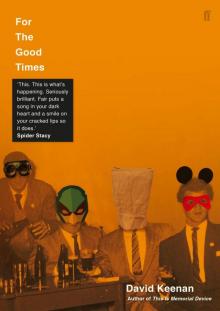
Monument Maker, page 57
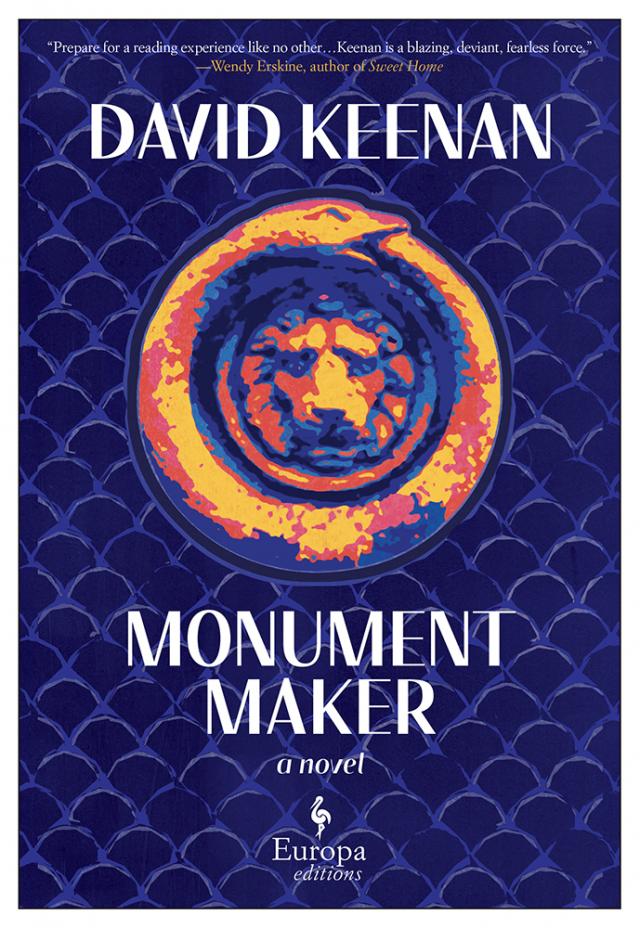


I remember I looked at Column at this point, with this white cube in his arms, and he had an expression of absolute panic on his face. I’m a stooge, he kept saying. I’m a stooge. This was all meant to happen. They’ve played every one of us right from the start.
We made our way across the spaceport in the black shadows of the ruined buildings, shadows that appeared as scorch marks burned into the surface of the moon. The lights of the recon shuttles danced and spun all around us. Militarists in black space suits patrolled the grounds. Through the fences we could see captured protesters forced to stand in lines behind the barbed wire. Of course, many of them never came home. The disappeared, they call them. Firth Column was one of them.
We came to the broken-down fence. The Helpless Clairvoyants’ moon buggy was still there, still loaded with music equipment and supplies for constructing a basic survival dome. I can’t go back, Column said, and he turned and looked at us. I’m not going to play my part. They might have orchestrated it this far, who knows, but no more. What’s in the box? I asked him. It’s singing, he said, and in the glow of the searchlights I thought I saw a tear glisten on his cheek, and in the tear the whole of the moon. Where will you go? Tomnado asked him. Further, he said, and they laughed and embraced each other. Then Column put the box in the back of his buggy and set off north across the Sea of Tranquillity. Do you think he’s heading for the dark side of the moon? The Doom said, and we all laughed, and then stood there, and watched until he was nothing but a pinpoint of black atop a brilliant white cube. Then the soldiers came.
o
Adam Aros took Peter Muldoon to one side. Great speech, he said. But where is it? Where’s what? Muldoon replied. The white cube. You’ve got it, haven’t you? You don’t expect me to believe that crap about the made-up rock group and the dark side of the moon. I didn’t make them up, Muldoon claimed. But they don’t exist, Aros said. I’ve checked the records. There are no recordings, no photographs, no interviews. The interviews were all in German, Muldoon said. Nonsense, Aros replied. Look, why the hell do you think you are here? Do you really think your crappy art and your clichéd hippy drop-out bullshit is of any interest to us up here, at the vanguard of the future, on the edge of the goddamn universe?
I know why I’m here, Muldoon said. He was becoming increasingly frustrated. Come with me, he said, and grabbed Aros by the arm and dragged him out to the observation corridor. They asked for me, he said, and he pointed to the stars. And who’s they? Entities, new configurations, hermaphroditic gods, we don’t know. And who’s we? The SIRK. That’s us, Aros replied. We’re The SIRK.
Did you know that The SIRK have written the whole of the Victory Gardens using a WordPool? Muldoon asked him.
Aros looked at him in horror. Bullshit, he said. That’s insane, that’s unethical, that’s . . . impossible. Well, it’s true. And it asked for me. By name. The real reason I’m here, my friend, is to take over the writing of the story. I’m the new author. Be careful I don’t relegate you to a bit player. Like I did with Robert Scott.
Who’s Robert Scott? Aros asked him. His expression was genuinely blank. You don’t remember him? The machine is running down, Muldoon said. The letters are isappearing. Life is clingling, winling, Aros said. Say that again, Muloon aske him. It’s what the WorPool says. Life is clingling, winling.
Look, Aros says. The white cube is here, the white light. The Luna attacks, the moth creatures, the entities, they are coming for the light. In the box. This isn’t first contact. We know of them.
Who’s we? The SIRK. They are coming in through gaps. Who are? The SIRK? The moths are moving to the light. Think. The attacks only began once you got here. I am The SIRK.
Then remember. I’m trying to. Can you hear music? What’s that song? The one we sang? Where’s the WorPool? It’s here, it’s blank. No, it’s waiting to begin again. Quick, we haven’t much time. Type this in. I am Peter Muloon. Say it. I am Peter Muloon. Say it. I am Peter Muloon. There’s no one left. I am Peter Muloon. o you rea me? o you rea me? Sen help, please sen help. The Victory Garens are uner attack.
ea, ea.
En.
APPENDIX DEACON:
AN ATTEMPTED PAIMON BIBLIOGRAPHY
A SIRK publication © The Flashlight/Token Bob, 1995
Victory Garden (short story, originally published in Plus de Choses Dans le Ciel et la Terre #3, 1982)
Pirates of the Universe Divide (novelisation of an unmade Doctor Who script submitted to Douglas Adams in the summer of 1979, published by Tara, 1983)
Belly of the Fish of Christ, Ship (credited as a “found” text, though textual analysis reveals, we feel, although we are not accredited textual analysts, we are fans, and deep readers, but nevertheless we feel close readings reveal it as a Paimon text, maybe the ur-Paimon text, in a way, maybe the Two Way Mirror of Paimon texts, actually, due to the quality it has of peering in, or peering out, at you and, of course, the opportunities for textual ingress it provides. We are not textual analysts, but we are ingressers, infiltrators. The first of the Holy Books, issued as a limited-edition chapbook with no publication details, though seems likely 1983, self-published)
I am the Lion of Judah (credited as a “channelled” text, though, again, we identify this as a Paimon working, possibly. The second of the Holy Books, issued as a limited-edition letterpress chapbook with no publication details, though, again, seems likely 1983, self-published)
Proceeds From the First Synod of the Church of the Stone of First Witness (a Paimon text, certainly, though perhaps with input from “Frater Jim,” issued as a limited-edition broadside by the press that Paimon set up in Grez-sur-Loing and which was run out of the converted barn/garage that also housed Hildegard von Strophe’s ceramics workshop; the first of the Vanguard! broadsides, 1983)
If Unto the Red Planet, A Traveller (oddly precognitive short story about a man who returns from the first-ever manned expedition to Mars, all his companions left dead across its surface, and his memory wiped, so that he believes himself the first Martian to arrive on earth and writes the book If Unto the Earth, A Traveller about his experiences with an alien race who have mistaken him for one of their own because, he believes, Mars is a mirror planet, in fact all planets are, which is the whole basis of astrology and planetary hours and goetia and the raising of the dead; Vanguard! #2, 1983)
Crossing the Abyss (fictional/real (?!) account of a weekend binge on cocaine where “the author” believed himself to be John the Baptist as he took a ferry across a river and had basically a psychotic episode in public which resulted in, he claims, an encounter with his Holy Guardian Angel, who it turns out is a complete and utter fiction and only there as a pair of armbands to get you to the other side of yourself, which is Abyss, as it turns out, which is the name of your Holy Guardian Angel, buddy, and not fucking Raphael; Vanguard! #3, 1983; nice hand-stitched edition with every copy stamped with the Vanguard! logo, which varied but was mostly based around the letter V on a stem or a pedestal like a cocktail glass with two bars or scores across it, thus: ¥. Edition of 127 copies, and yes, I am packing. 1983, natch)
Mathematics of the Asteroid Belt (short story, elementary potboiler about some educated bozos living in caves on spinning asteroids to hold off the end of the world or such saintly behaviour, and then getting attacked by aliens. The first experiment in “gridlocked” text by Paimon, as we have christened and identified it; also, a quote from Lou Reed in the text, from the song “Some Kinda Love.” Published in Regardez le Ciel #24, 1983, of course)
Cry Me A Way (cut-up text, or one written while nodding off and waking up on horse, just as likely, with words spilled up into phonemes so that the text appears like Braille, or machine code, and printed with upraised letters, too, as if it could be fed into the mouth of a machine as a set of instructions, or enter through the fingertips of a beautiful blind girl sat in the sun, on the steps of her house, in the summertime; a deluxe edition and perhaps the high point of the Vanguard! issues. 1983, summer of, what do you think, edition of 33 copies: #need)
Caress Me A Waterfall (as above; variant)
Cover Mission As Wonderful (as above; variant)
Capable Mirage Age Wakens (as above; variant) (possibly more)
If You Expect the Antithesis of Venus You Are Gifted, That, in the End (another smacked-out/cut-up production, beautifully realised, but now more like text-sound experiments à la Richard Kostelanetz; Vanguard!, 1983. Bob Dylan and Philip K. Dick quotes in acrostics throughout the text—it’s true, have a look—which can’t be accidental, but seems more impossible than any crossword)
Appealing for Calm is the Way of a Mass Catastrophe (privately printed photobook featuring photographs, by Paimon, I think we can safely say, of Hildegard von Strophe, often graphic, and abstract, 1983?)
The Uncollected Escapologist (unpublished manuscript, believed lost, 1983)
Our Original Heavenly Nature is Fire Unsound (the breakthrough book and the first commercially successful Paimon outing, published by Nebula Books, 1983, about Star Gods, warring with ideas, vying to convince each other of their non-existence, until only one Star God remains, who has to start the whole thing again, for fear of loneliness, and an eternity of idle hands, and then his people fall in love with him, his creations, his flock, his church, and he models himself after their love, which means he has to bring all of the arguing Star Gods back again, because he now believes himself to be a loving, merciful, nostalgic and repentant god, as well as all of the normal god attributes, and of course the same old arguments start, and then what happens is an unknown starship turns up that none of the gods can even remember making, that none of them are willing to take credit or responsibility for, and inside the spaceship is a dead body, a dead body of something that has never died before, and the gods are amazed, a first death, out of nothing, is a miracle, even to the gods, they agree, and they are united in wonder, at the infinity of creation that even gods partake of, of the unsoundness of fire, and then it basically turns into a space opera of gods and men and goes downhill from there, in this humble reviewer’s opinion, but still, as with genre in general, it is textually unpoliced and provides multiple exit and entrance points for ingress, which may be a large part of its success, that people could disappear in it, easily)
The Coral of Heaven (deep space as undersea, the sound of seashells, on the seashore, as spaceways; Orizon, 1983)
The Metal-Plated Dream Inc. (robotics in the far future mechanise the dreamspace and lucid dreaming becomes “the fastest-growing market” in technologies, the noumenon is colonised, by advertisers, and becomes a mall, so as imagination must purchase attributes, equipment, and adventure holidays; Orizon, 1983)
Out Lilith! Oil Skin of the Dark! (Follow-up to The Metal-Plated Dream Inc., earth-abound; Orizon, 1983)
A History of Religious Ideas (space opera theatre-of-war grandiosity; Orizon, 1983)
Phantom Our Town, Africa (which is where a mirror planet is found in perfect orbit next to ours and we remodel it so completely, at war, it ends up as the moon; Orizon, 1983)
Imitation of a Shadow (retro 50s noir where the murderer is revealed as a many-tentacled, semi-translucent alien who lives inside our own brain and feeds on our thoughts like a dog with a tapeworm; Orizon, 1983)
Man and Underground Man (essay on “potentialities,” on “directions,” literature as psychic topography; Orizon 1983)
Kazimir is Emerald for Forever (trouble at the court of the gods, as gods dream up new skills with which to assail gods and all of their subjects suffer, classic space opera, really, were it not for the semaphoric lines of punctuation that stand in for the speech of the gods, one of the weirdest successes of the 80s sci-fi “boom” and further proof that reality is for people who can’t handle science fiction; Nebula Books, 1984)
Rot (a sequel to If Unto the Red Planet . . . , in a way, Rot documents an invasion of aliens who are colour itself, and it’s like a parable of when movies went coloured and more fantastic in the 50s and horror and sci-fi benefited the most, you can be sure they did, alongside porn, but also to say there are multiple incomprehensible forms of life that will eradicate you without a single thought of your existence because they simply is, or are; Nebula Books, 1984)
Today is Die Welt Day (alternative-history Nazi sci-fi Third-Reich-as-Atlantis short story, anthologised in the epochal collection edited by Arnaud Pierrepont, L’Age d’Aura, 1984)
Phantom Aros: Dream River: Tia Rio (full textual gridlock; the opening of the channels, the uncovering of the tunnels: still selling, but on this form it can’t last forever. Nebula Books, 1984)
APPENDIX SUBDEACON: PROCEEDS FROM THE FIRST SYNOD OF THE SOCIETY OF IRREGULAR RESEARCH AND KNOWLEDGE (SIRK) 1993
Originally published in Roll Away the Stone (2008)
1. AS ABOVE
We came together through a love for subterranea, for the great mysterious battlements that line the east coast of Scotland and the abandoned complexes beneath; the stone sound mirrors, no longer cupped to the drone of the brave young German fighter pilots as they crossed the water on their way to an assignation with fate, our fate, their fate, God love us both; abandoned railway tracks; old tunnels that ran deep into the past; shortwave patterns decoding the night; the topography of the invisible world; abandoned madhouses; old aircraft hangars; military wrecking yards; lost rivers; dark drains and Victorian sewage systems; air raid shelters; nuclear bunkers; secret command posts where steely generals made their last stands; rooms that were more like suits of armour or tombs, as if they were built to be worn rather than to be lived in; second skins; bandages; anything with a funerary aspect.
We rolled our eyes at Blake, scoffed at Rimbaud, whose deathbed lament for an eternal place in the sun we took as a confession of poetic incontinence. Instead we sought out the dark, surveyed the mausoleums, and felt ourselves truer poets than any of them.
The world seemed fuller then, somehow, less populated by explanations. Now I see it as a lifetime’s worth, a lifetime of love, of loving and of being loved, which I am still, mercifully, unable to explain. Nevertheless, I remain helpless in the face of sentiment or nostalgia for the sublime darkness of our youth, our happy companionship with inhuman scale and our shared commitment to scaring ourselves half to death.
I have long nursed a secret joy in disappointment, the frisson that only perfect failure can supply, a silent satisfaction in defeat. I should like very much to be diagnosed with a fatal illness, a slow death, preferably, so that I may conduct my body like a circus master, like those handsome circus masters of old who would set up tent on the football fields outside Calderbank and who would crack the whip over fierce animals that would eventually, inevitably, decapitate them; dreamy mermaids who would betray their love; midgets who would stab them in their sleep; dogboys that would turn on them in the dead of night. But still to be the master of ceremonies, the very seal of God, which is the seal of fate, on my forehead, the whip in my hand and with the horses long since bolted.
Old age has, however, held out against my fantasy of coasting into twilight on a mutinous vessel, and going by family history I am more likely to be taken down in the night while on lookout duty than to pilot the ship into the depths. And although I believe in reincarnation, I suspect I am about to play my final turn.
Are people markers of time? Is landscape alive like people? Is context conscious? These are the kinds of questions that haunt me in my dotage, me, a man for whom answers were like so much candyfloss, things you gave to children on the beach once a year to shut them up, to fill their idiot cakeholes. To pose a question, to propose any kind of lack or absence, is to get further from the truth. That’s why we always assumed that ghosts were here right now and that even disappearing was present. But now all I have is absence, the absence of my daughter, the lack of my wife, the loss of my dear partner, all, finally, written out. The questions have long since been posed.
If, like Dante, I could walk once again in the fulcrum of my life, and so of history itself, one foot in the morning of my wedding, the other in the night of my ravishing, I would find myself in attendance at the Burntisland Conference, that fateful day, that most auspicious date, 20 April 1993, with my wife still asleep in a hotel along the coast, our beautiful daughter still four months secret, the holidaymakers lining the front in deckchairs and the air so perfectly still.
Anyone who has heard the rumours about Burntisland, the stories of an underground city, the mirror of the one above, built during the Second World War as a war room or a resistance cabinet office or even as a munitions factory, the whole town once reputed to be sitting on enough dynamite to land it on the moon, cannot fail to be spellbound by the atmosphere of the place, all of which points towards some kind of occult construction. There’s something indisputably hollow about the town—no other word will do—as if the buildings are a mere facade, as if you could walk behind them and they would be held up by nothing but wooden planks. The seagulls look as if they have been etched hurriedly into the air and the pavement itself seems to echo, lending even a leisurely early-morning stroll the gravitas of a funeral parade or a wedding march.