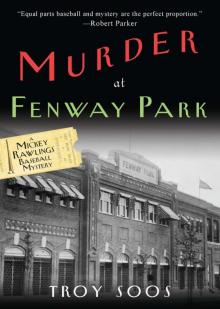
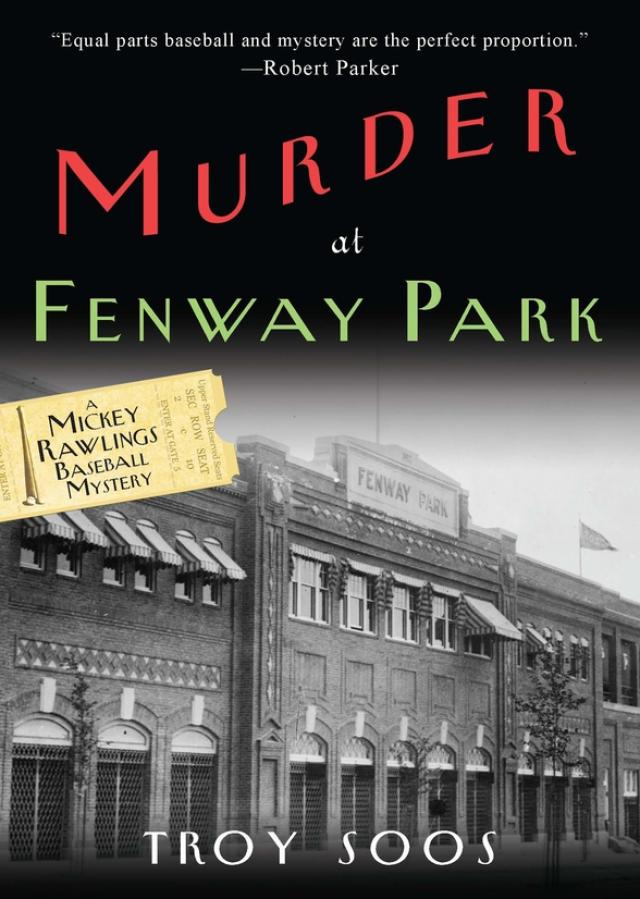
Murder at Fenway Park, page 7
part #1 of A Mickey Rawlings Baseball Mystery Series


The train ride from Boston to Cleveland was a grueling one. I never could sleep in a sleeper car—especially not in the criminally uncomfortable upper berths to which rookies and utility players are assigned. This Pullman was even worse than usual. The heavy curtains of my berth trapped in the odors of all its previous occupants, few of them sufficiently bathed. And a recent occupant apparently tried to mask the smell with a cheap stogie, only adding to the vile stench.
I felt drowsy and sluggish when we arrived at League Park late Monday morning. This was the day when the game scheduled between the Tigers and the Athletics in Philadelphia would not be played. Since Detroit was the next city on our road trip, we didn’t know if we would have any games to play when we got there. When would the Tigers be playing baseball again?
We lost an unmemorable game to Cleveland, with both teams preoccupied with the more interesting contest of Ban Johnson versus the Detroit Tigers.
That evening, the Cleveland Plain Dealer reported the resolution of the Tigers strike. Between Johnson’s typically heavy hand, and uncharacteristic cooperation by Ty Cobb, the Detroit players were convinced to call off their walkout. Johnson threatened the Tigers with banishment from baseball if they didn’t return to the field. Cobb thanked them for their support, and urged his teammates to play again. Johnson then announced that Cobb’s suspension would run ten days more. This was great news for the Red Sox: our series against Detroit was on, and the Tigers would be without the services of Ty Cobb.
With the Tigers situation settled, I paid more attention to our second game against the Naps. Larry Gardner’s ankle was getting better, but not well enough yet to play. I was still filling in for him at third base. In the fourth inning, I suddenly had the eerie feeling that I was in Red Corriden’s shoes when Nap Lajoie dropped a bunt down the third base line. He had it beaten out easily, but I threw anyway, well over Jake Stahl’s head, giving Lajoie an extra base as the ball landed in about the twentieth row of seats. Stahl let loose with some loud cussing, making up fascinating combinations I had never heard before. He left me in for the rest of the game, though—he had no choice, with Gardner as lame as he was.
In the final game, each time Nap Lajoie came up to bat I again had the feeling I was standing in the spikes of a dead man. Somehow I felt connected to Red Corriden though I never even met him. The unnerving sensation made my legs go soft and quivery, and reminded me that my primary mission on this trip was to talk to Jimmy Macullar.
We left Cleveland by boat, my first experience with that evil means of transportation. The choppy waters of Lake Erie left my insides so shaken that I longed for the relative comfort of a Pullman car.
In Detroit, we went on to a three-game sweep over the Cobb-less Tigers. After the series, the trip half over, I told myself that I really should talk to Macullar soon.
I tried to prod myself into action again after we took two out of three from the White Sox in Comiskey Park. Only a few days of the road swing remained.
These western cities must have had plenty of attractions in the nightlife department. Clyde Fletcher didn’t make it back to our hotel room once in the first three cities. He did show up at the ballparks, but not looking very well. In the West, he didn’t even get to recuperate from Saturday night outings, since Sunday baseball was legal here.
I wanted to ask Fletcher if he knew anything about Jimmy Macullar. I thought it might be a little easier to approach Macullar if I had a better feel of what the man was like. I knew that if my roommate could manage to find activities to occupy his nights in Cleveland, I would never see him at our hotel in a wild town like St. Louis.
Before the final game with the White Sox, while the rest of our team was taking batting practice, I approached Fletcher as he sat on the dugout bench looking bleary-eyed. “How’s it going, Fletch?”
Hchoowook. Shptoo. Schplat.
I tried to sound casual. “Say, you know that fellow Jimmy Macullar at all?”
“Who?”
“Jimmy Macullar. He seems to be with Mr. Tyler a lot. I think he’s his assistant or something.”
“Mister Tyler?” Fletcher smiled and spat again. Then he grumbled, “Hell, Bob Tyler ain’t nobody. Used to be a flunky for Ban Johnson, that’s all. That’s how he got where he is now.”
My attention was distracted by shouts from the dugout runway. The echoes of the words made them tough to decipher, but they were definitely angry ones. They grew louder as they neared the dugout, and clearer. One voice was Jake Stahl’s, threatening, “It’s gonna cost yuh fifty if yuh don’t get your ass out there now. ”
“What the hell should I practice for? I been here a month and all I do is sit the goddam bench. I don’t gotta practice sitting!” This voice was a gruff one; I wasn’t sure whose.
“I’ll decide when you play. I never wanted you anyway.”
“Well you got me, so you goddam well better play me.”
“You don’t tell me what I better do. I’m sure as hell not benching Carrigan just to make you happy. Now get out there!”
Billy Neal sullenly plodded out of the runway, his face a picture of angry frustration. He slowly climbed the dugout steps and walked out to the batting cage. He was doing as Stahl told him, but flaunted his unhappiness with each step. I felt sorry for Neal; I could sympathize with wanting to play but being blocked by better players. It was a situation that was very familiar to me.
I nudged Fletcher, and nodded out to the field. It didn’t seem a good idea to let Stahl see us sitting down. We were on the infield grass before Stahl came out of the dugout.
I got back to asking Fletcher, “What about Jimmy Macullar?”
“Hmm? Oh, yeah. I guess now Tyler’s got a flunky of his own. Don’t really know him, though. Why?”
“I don’t know... no reason... guess I was just wondering. He always seems to be around, but I wasn’t sure what he does.”
“Probably just a charity case. Heard he used to be a ball player once. Hmmph—musta been about a hundred years ago. Got washed up, so now he hangs around doin’ errands and whatever. Hope I never got to kiss the ass of somebody like Tyler to get by.” Hchoowook. Shptoo. Schplat.
Fletcher hadn’t told me much, but what little there was didn’t encourage me. If Macullar’s livelihood depended on the good graces of Bob Tyler, he might not want to tell me anything that Tyler could object to. But I’d see when we got to St. Louis.
The series against the Browns turned out to be another easy one for us as we swept them without one close game. I had a pretty successful road trip, playing every inning of every game. I knew my performance wasn’t good enough for me to keep the position when Gardner’s ankle got better, though. I’d need to boost my batting average by a good fifty points to have a shot at his starting job.
The trip wasn’t quite over yet. Before getting back to Fenway Park, we had a two-day train ride ahead of us. Only two more days to talk to Jimmy Macullar.
Lurching my way down the aisle of a sparsely occupied club car, as our train passed through Pennsylvania farmland, I spotted Jimmy Macullar alone in a window seat staring quietly out through the pane. This was it: my best chance so far, and possibly the last one I would have before reaching Boston.
I approached his seat without him noticing me. He seemed absorbed in either his thoughts or the passing cornfields.
“Mr. Macullar?” I had to repeat his name once more before he heard me.
“Oh. Hello, Mickey.”
“Is anyone sitting here?”
“No. Would you like to?” He sounded vague and distracted.
“Uh, thanks.” I sat down next to him and he smiled at me vacantly.
I tried to start off the conversation with a safe subject. “I heard you used to be a pretty good baseball player,” I said. Fletcher had mentioned nothing of Macullar’s skill level, so that was my own embellishment. I figured it couldn’t hurt.
Macullar seemed flattered. “Oh, I don’t know if I was good. But I wasn’t bad.” His voice faded as he added, “My, that was a long time ago.” Then he turned his gaze back to the window.
I tried to bring him to what I was hoping would be a conversation. “You were in the majors?”
He turned to me again. “Hmm? The majors? Oh, yes. I played six seasons in the big leagues.” He added with a smile, “That was just after there was a major league to play in.” He paused, and then somewhat more animatedly asked, “You know who the first team was I played for?”
I shook my head no.
“Syracuse. Syracuse had a big-league club. Eighteen hundred and seventy-nine that was.” Macullar’s head now faced forward, tilted slightly up, his eyes focusing on sights that were history by the time I was born. The array of wrinkles that fanned out from his eyelids seemed to perk up at the view. He talked on, steadily and softly. “The Syracuse Stars. One year in the National League and that was it. A one-year franchise, and now it’s forgotten....
“It was different back then. All this fuss now about statistics, RBIs. There was no such thing as an RBI when I was playing. And stolen bases—nobody kept track of them.
“The game was played different, too. Take pitching. I remember this: when I was with the Stars, the pitcher’s hand had to go below his bett—they weren’t even allowed to throw sidearm. It all had to be down underhand... I saw one pitcher get around that, though—he had his pants cut extra long so his belt was up across his chest. He looked like a clown, but he beat the rule—seems there’s always somebody who thinks he’s better than any rules or laws.”
Macullar paused, and I prodded him along in his reverie, “What position did you play?”
“Oh, we used to play wherever they needed us pretty much. Usually a team only had one extra player. Mostly I played shortstop, and a fair amount of outfield.”
“Where did you go after Syracuse?”
“Nowhere for a while. I was out of the big leagues ’eighty and ’eighty-one. Longest years of my life. I thought I’d never get picked up again. Seemed like my life would be over if I didn’t get back in the big leagues. I played semipro those two years. It was still baseball, and I did love to play the game, but it’s just not the same after you’ve had a taste of the major leagues. Then I got lucky. They started the American Association, and I got signed by Cincinnati. I was a big-league baseball player again. Five more years. Two with Cincinnati and three with Baltimore.”
I felt guilty about interrupting his memories—especially since I enjoyed hearing them—but I had to bring him around to the present eventually, so after a sufficient silence I asked, “How did you come to be working for the Red Sox?”
The expression on Macullar’s face became grimmer as he responded, “Well, playing baseball doesn’t leave you with a lot of useful skills when your career is over. From the first time I picked up a ball and bat, all I ever wanted to do was play baseball. Then when they started paying ball players, that’s what I wanted my career to be. It didn’t much matter what would happen afterward, so I never gave any thought to it—didn’t plan for anything else.” Macullar sighed. “But, I had my time in the big leagues and I was satisfied. I felt like I got to live a dream playing baseball with the greatest players in the game.
“I was born in Boston, so I moved back there after Baltimore let me go. I picked up work with semipro teams wherever I could. Each year, I got older and it got harder to find a spot as a player. Then when Boston started an American League team, I took a job as a gate attendant. That’s when we were still at the Huntington Avenue Grounds. I’ve been with the club ever since. And now I work for Mr. Tyler.” With his last sentence, Macullar grimaced slightly.
Okay, time for the big question: “You remember when I first came to Fenway?”
Macullar nodded, but didn’t face me.
“Well, I was wondering what happened. The police never asked me any more questions. And I haven’t seen anything at all in the papers or anything. Did they find out who the dead man was? Did they catch who did it?”
Macullar sat silently, still staring straight ahead. Eventually he answered, slowly and carefully, “As far as I am aware, the case has not yet been solved.” Then he looked at me and asked, “Have you spoken to anyone else about this?”
I didn’t want to mention Peggy, so I came up with an answer that was partly true. “No, you’re the first man I’ve talked to about it.” I quickly went on, “It’s just that Mr. Tyler told me I was a suspect. I was getting worried... I’d just like to know what’s going on.”
Macullar looked thoughtful and then said matter-of-factly, “You don’t have anything to worry about. Not from the police.”
“I don’t?”
“No.”
We both sat in silence for a while, neither looking at the other. Then he spoke up again, “That—what happened at Fenway Park—it never happened.”
“Huh?”
“Well... You are not going to discuss this with anyone else. Anyone. Right?”
“Okay.”
“Well... you have to understand that the Red Sox’s financial situation is not very strong. Mr. Tyler and his partners are not millionaires. And they put a lot of money into the new ballpark. If attendance isn’t good, they could be out of business—”
“But the stands are filled. We’re in first place. ”
Macullar held a hand up and shook his head at my interruption. “Yes. Everything is going our way right now. People are coming to the games... Mayor Fitzgerald and the Royal Rooters have adopted us ... we should be on our way to the World Series. But what do you think would happen if there was publicity about a fan being killed at a game? There’d be a scandal... people would think it wasn’t safe to come to the ballpark... attendance would drop... the city would be embarrassed....”
I couldn’t help interrupting again. “But it did happen.”
Patiently, Macullar answered, “No, not officially. Officially, nothing happened at Fenway Park.” Then, with a low, flat voice, he said, “The body was moved. To another part of town. Dorchester. It was found there. So ... officially, nobody was killed at Fenway Park.”
“The body was moved?”
Macullar turned his head to look back out the window. His response was barely audible. “I moved him. The police officer and I moved him. We put him under a railroad bridge. Mr. Tyler said to. He said it couldn’t matter to the dead man where his body was found—it wouldn’t bring him back to life. But if people knew it was at Fenway Park, that would. matter, and it wouldn’t be good for anyone.”
I was speechless.
Then I made the connection, and gasped out, “The dead man was Red Corriden!”
Macullar shook his head, “We didn’t know that at the time. Nobody knew it was a ball player. We all assumed some fan got into a fight or got robbed... there are some rough sporting types who come to the games—and after nine innings of beer, they can be trouble. We didn’t know who it was until after he was found in Dorchester.”
“Jeez. That was Red Corriden.” I felt queasy thinking of what his face looked like when I found him.
I had expected that learning something about the nameless man I discovered would make me feel better somehow. It didn’t. Attaching an identity to him made it worse. Hell, he was a ball player. A rookie baseball player. It could have been me. I suddenly felt a tingly spasm shoot through my legs.
Neither Jimmy Macullar nor I said another word. After I recovered enough from the shock to get to my feet, I walked off to another car to sit alone. And suddenly wondered, what did he mean, Not from the police?
Chapter Ten
The day after the Red Sox returned from the West, I went to see Peggy to report on my talk with Jimmy Macullar. She was again out of town, but had left a note for me at the theater. Helen handed it to me saying, “Peggy’s down on the Cape. Her aunt took sick, so she went right down to take care of her. Wonderful girl that Peggy is.”
“Mmm,” I agreed.
“Make a mighty fine wife for some lucky fellah.”
“Uh. Did she say when she’ll be back?”
“No... I suppose it depends on when her aunt gets better. Why don’t you read the note? Maybe she says there.”
There was no additional information in the note. Peggy did include her aunt’s address in Hyannis, however. Was that supposed to be some kind of hint?
Unable to tell Peggy what I’d found out about Red Corriden, was left to pursue my own thoughts on the matter. They were muddled conjectures, and I couldn’t assess what was realistic and what was farfetched. I felt I needed to bounce my ideas off somebody if only to hear them spoken and see them take shape. By myself, I couldn’t get a grasp on the ramifications of Macullar’s information.
His revelation had one surprising effect on me. For six weeks, I’d been trying to forget the sight of the facial remnants I had seen in Fenway Park. But once I knew whose face it was, I had an inexplicable impulse to revisit the tunnel under the park. To look at the place where Corriden had been killed, and bring the vision back before me. Perhaps there was something I had seen or heard that hadn’t registered before. As much as I dreaded reliving the experience, I decided to check out the scene of Red Corriden’s death.
But I’d have to be careful. I didn’t want anyone to see me wandering under the ballpark. Certainly not Tyler. Nor his minions—Macuttar, the stadium cop, whoever else might be in his command... Besides, it was like paying respects at a gravesite, the sort of thing that should be done alone.
After a game against the White Sox, I claimed a sore shoulder and had the team trainer give me a rubdown while my teammates showered and changed. Then a long shower of my own, shivering in the cold water that was left me, and when I’d finished the clubhouse was empty. There would still be stragglers and cleaning people in the park, so I dressed in my street clothes and ducked into the equipment room to bide some more time. I sat amid the bats and balls and bases for about an hour, until I figured everyone would be gone.