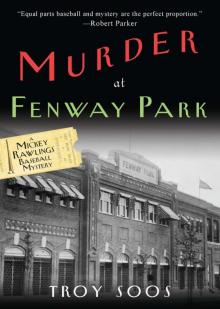
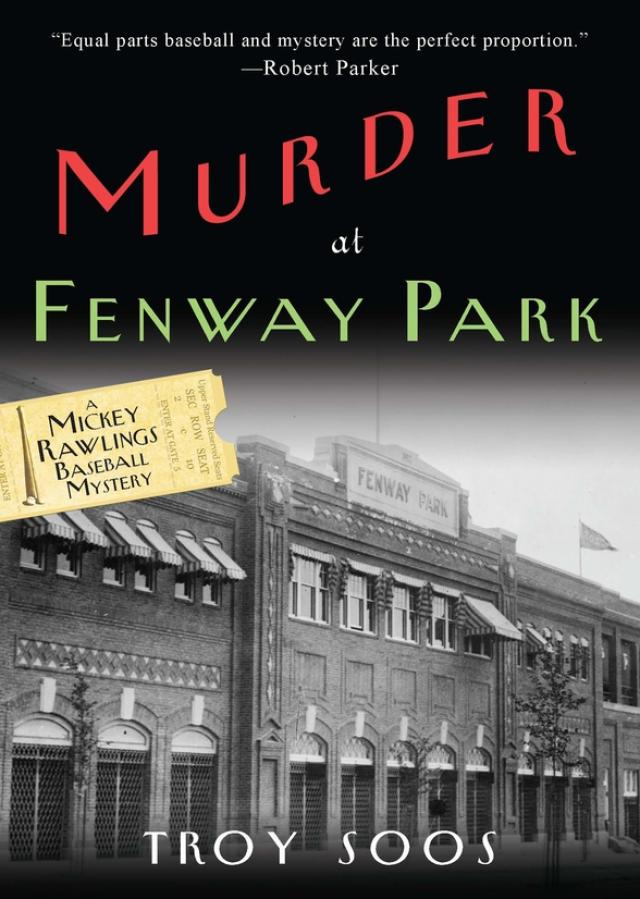
Murder at Fenway Park, page 2
part #1 of A Mickey Rawlings Baseball Mystery Series


Sudden visceral activity finally caused me to do something. I threw up. Before my external parts could function, a searing torrent of vomit expelled itself. Right on the dead man’s chest.
The convulsions in my stomach continued and I doubled over with the pain. At least I was able to turn away enough to avoid further offense to the corpse. Crippled with stomach pain and weak in the legs, I dropped to my knees and crawled across the hallway thinking I was about to faint.
When I reached the far wall, still on hands and knees, I closed my eyes and rested the top of my head against the wall. I inhaled slowly and deeply and tried to compose myself.
Eventually the volcanic activity in my stomach subsided, and I could breathe more easily. I forced my eyes open, and found myself looking down at a baseball bat laying where the floor met the wall. The head of the bat was streaked with fresh blood. Some of it had seeped into the wood, darkening and widening the lines of the grain.
I could clearly see two small pieces of shiny white material embedded in the wood. I spent some minutes puzzling over what they were. It was a relief to have something to occupy my mind, if only briefly. Then I realized they were bone fragments, previously facial features of the man slumped behind me. I slammed my eyes shut and erupted into a vicious bout of the dry heaves.
Perhaps minutes, perhaps hours, seemingly days elapsed while I remained conscious but literally senseless. My tightly clenched eyelids shut out the hideous sight behind me; the heavy pulsing of my heart left a pounding in my ears that blocked all external sounds; gulping air through only my mouth let no smells past my nose; the only sense of feel that I had was of the spastic constrictions in my belly.
A heavy hand suddenly clutched my shoulder and a loud “Hey!” penetrated the drumbeats in my ears. I was jerked to my feet and roughly turned around.
I faced three very different-looking men. One was the stadium attendant I met earlier. Next to him was a portly man in a gray business suit who kept glancing down at the dead man from the corner of his eye. The hand that had shaken me belonged to a helmeted member of Boston’s finest.
The red-faced cop stepped to within inches of my nose, and belligerently demanded, “What the hell’s going on here?”
“I don’t know,” I croaked softly.
“What! Speak up!”
“I don’t know. I just found—him, ” I said, pointing to the body. It was still in the strange sitting position on the floor.
“What are you doing here?”
“Looking for the manager. I’m supposed to report to him. To play ball.”
The attendant cleared his throat and quietly said, “This is Mickey Rawlings. He played for the Braves some last year. I let him in about twenty minutes ago and told him how to get to Stahl’s office.” He frowned at me slightly as he concluded his statement.
The cop glared at the attendant. I think he wanted to get answers directly from me, preferably through a vigorous third degree.
The portly man also looked at the attendant and spoke for the first time. “The kid doesn’t follow directions so good, does he?” The deep booming voice sounded like an umpire’s; it conflicted sharply with his bankerlike appearance. He turned to me, and with a wry look on his face said, “So you’re Rawlings. Welcome to Fenway, kid.”
The cop let him speak without interruption or hostile looks, so I assumed the man had a position of authority. He quickly proved me right by barking some commands. He ordered the attendant, “Call Captain Tom O’Malley at the Walpole Street a. Tell him—uh, tell him what we have here. And I want him to handle it personally. Bring him to my office when he gets here.” He directed the policeman: “You stay here until O’Malley shows up and tells you what to do.” To me he said, “Come along with me,” and firmly pushed my elbow to get me started. I followed him through a course of passages without trying to keep track of the turns.
We arrived at a door that had ROBERT F. TYLER painted on it in gold letters. My companion unlocked the door, and we stepped into an office that was large in size, but seemed cramped from all the ornate dark wood furniture that filled it. He moved as if the office was his, so I took it that my escort was the advertised Robert F. Tyler. I watched as he closed the door behind us and silently walked over to a sideboard. Tyler wasn’t as soft as he first appeared. There was a power to his movements that indicated an athletic past. He did have a prominent belly, but that was a sign of prosperity that no self-respecting executive would be without.
Tyler filled a shot glass with amber liquid from a decanter and gulped it down. Emitting a satisfied sigh, he picked up another glass, filled it to the brim, and brought it to where I was still standing just inside the door. “Drink this. It will do you good.”
I took the glass, tentatively took a sip, and shuddered at the taste.
“All of it. Drink it right down.”
I tilted my head back and obeyed. My first attempt at drinking liquor, when I was about twelve, had made me sick. This second attempt had the same result. I did make it to a cuspidor though, and I did feel somewhat rejuvenated by the liquid fire that poured in and out of me.
Meanwhile, Tyler moved behind his desk and into a high-backed leather chair. When I looked as if I’d safely finished with the spittoon, he told me to have a seat. I sank into an armchair on the other side of his broad desk.
I had the feeling we weren’t alone. I looked around and noticed three pairs of eyes staring at me—the dead glassy eyes of one moose and two deer whose heads were mounted on the walls.
Tyler took a neatly folded white handkerchief from his pocket, wiped his forehead, and finally introduced himself, “I’m Robert Tyler. I’m one of the owners of the Red Sox. Officially, I’m the treasurer.” He didn’t extend his hand, and I didn’t offer mine. I suppose meeting over a corpse allows for dropping some of the social graces.
My new boss went on, “I handle most of the business activities of the ball club. Ticket sales, player contracts, travel arrangements.” He thought for a moment, then suggested, “Why don’t we take care of some business now, and try to forget about that situation out there until the police get here. I have your contract somewhere ... Yes, here it is. You need to sign at the X.” He slid the paper to me, pulled a gold fountain pen from a desk drawer, and slid that to me, too. He didn’t say how much I’d be paid, but I saw on the contract that it would be $1,400 a year—more than a hundred dollars a month!
While I quickly signed, Tyler continued, “Everybody knows what a terrific outfield we have, but we can use some shoring up in the infield right now. Injuries. A week into the season, and we already got injuries. Jake saw you with the Braves last year, said you looked pretty good, figured you could help us.
“We could use another pitcher, too. And maybe somebody to give Jake some time off at first—he’s not getting any younger. We’ll get whoever we need. I don’t plan to come up short at the end of the year because of bad luck at the start.”
I pushed the signed contract back to him.
He settled deeper in his chair, and muttered mostly to himself, “New ballpark ... best outfield in baseball ... Honey Fitz is crazy about us ... we should be all set.” Tyler was no longer looking at me; his thoughts were obviously elsewhere. I wondered what a “Honey Fitz” was.
Three delicate raps joggled the door, and the attendant stuck his head in. Before he could speak, an overweight policeman wearing captain’s insignia elbowed past him into the room.
The officer and Tyler exchanged nods of recognition and curt greetings.
“Bob.”
“Tom.”
The captain turned to face me and asked, “Is this the suspect?”
Suspect? Me? I was too astonished at the question to say anything.
Tyler answered, “This is Mickey Rawlings. He just joined the club today. He found the body.”
O’Malley grunted in response and squinted hard at me, trying to make his eyes look penetrating. “Was he dead when you found him?” he demanded.
“Yes,” I answered. “I think so ... I’m sure he was. I didn’t really check him. I mean, he was so ... He must have been dead. I yelled at him but he didn’t answer. He was dead.”
“Do you know who he was?”
“No. Who was he?”
“I’m asking the questions!” the captain bellowed angrily. “Did you see anyone?”
My first impulse was to answer that I hadn’t. But after a moment’s thought, I wasn’t so sure. Once I set eyes on the dead man’s face, I was oblivious to all else. Perhaps there was someone there, and I just hadn’t noticed. I answered, “I don’t think so.”
O’Malley rolled his eyes. “Did you hear anything?”
“No—well, yes. I mean I heard a noise—like something fell, but that was before I went in the hallway.”
“Like something fell,” the officer repeated. “Did you hear footsteps? Somebody running away? Anything else?”
“No, I don’t think so.”
“Didn’t see anything. Didn’t hear anything. That’s a lot of help.”
I shrugged in apology.
Tyler spoke up again. “Do you need Rawlings for anything else?”
“Not right now,” O’Malley answered, but as a final note he warned me, “Don’t leave town.”
Tyler overruled him. “He has to leave town. We start a road trip tomorrow.” O’Malley scowled, but silently capitulated. Ignoring the captain, Tyler swiveled toward me. “You’ve had a helluva day, and we’re leaving for New York in the morning.” He scribbled on some stationery. “Take this to the Copley Plaza Hotel. Get yourself a good night’s sleep and make sure you’re at South Station by ten sharp.” He held out the note, and with a token attempt at a smile said, “See you in the morning.”
I stepped around the glowering O’Malley and took the paper without returning the smile. Mumbling, “Thank you,” I picked up my bags and stepped out of the office.
The attendant was waiting outside the office door. Without exchanging a word, he escorted me all the way to the stadium exit.
Chapter Three
The whitecaps of Mystic Seaport sparkled through the window to my left; less than twenty-four hours ago, I’d admired them through a window to the right. Since Boston and New York both prohibited Sunday baseball, today was used for travel, with the entire Red Sox team on the train heading to Grand Central Station.
Tyler’s generosity in putting me up at Boston’s newest hotel had been wasted. Last night was a sleepless one—every time I closed my eyes, I was jolted awake by the full-color image of a viciously battered face. Exhausted from yesterday’s catastrophes and drowsy from lack of sleep, I dozed off after boarding the train and napped until the sunlight skimming off the water penetrated my eyelids.
Before leaving the hotel this morning, I had stopped at the newsstand for a paper. The lobby had been surprisingly tranquil—I’d expected to encounter newsboys shrieking lurid headlines, “Murder at Fenway Park! Red Sox Rookie Stumbles on Stiff! Read all about it!”
I now scanned Page One of the Boston American and saw that the crime didn’t make the front-page news. Most of the articles were still about the Titanic, although it had been two weeks since it sank. The death toll was up to fifteen hundred, but I was unaffected by the enormity of that tragedy. I was concerned with just one death, one victim who had lain shattered before my own eyes.
I turned the pages, puzzled to find no mention of the crime. Eventually, a small item headed GRISLY DISCOVERY caught my eye. But the story turned out to be about a robbery victim who had been found beaten to death in Dorchester. There was nothing about the body at Fenway Park.
I felt a need to know something about the man I’d found. I wasn’t looking for a particular piece of information, just something that would humanize him: his name, where he lived, his work. Anything would do. If I could associate him with some other aspect of his identity, then maybe when he entered my thoughts—and I was sure he would on many nights to come—I could envision him in some way other than as that shockingly mutilated face.
Until I could picture him differently, I would just have to try to avoid thinking about him at all.
With some effort, I gradually prodded my thoughts away from the dead man.
And there were indeed more agreeable musings available to occupy me. For despite the disturbing start to my association with the Red Sox, I had every reason to look forward to what was ahead. Particularly to our immediate destinations: my first appearances in New York and Philadelphia as a major-league baseball player.
I grew up in Raritan, New Jersey. It was perfect for seeing major-league baseball, even though the state itself didn’t have a single team. In a journey of less than two hours I could reach the home grounds of any one of five big league clubs: the Giants in upper Manhattan, the Highlanders—or Yankees as some papers called them—in the Bronx, the Brooklyn Dodgers, and the Phillies and Athletics in Philadelphia.
I was raised by my aunt and uncle. Uncle Matt ran a general store in town and taught me baseball. And he gave those tasks about equal priority. My earliest memories are of playing catch with him in the backyard.
My uncle took me to major-league games whenever he could, usually to the Athletics’ Columbia Park, where I could cheer for my favorite player: Rube Waddell, a hard-throwing eccentric pitcher who spent his off-time wrestling alligators and chasing fire engines.
As I was growing up, I worked hard to polish the baseball skills I had and learn the ones I didn’t have. I rarely attended school, finding it useful only for rounding up enough other boys to play a full-scale ball game. I tried to get into every baseball game that the boys would organize, though I dreaded the choosing-up-sides ritual. Not once was I the first boy picked. I was smaller than most of the other kids, and despite all my practice, there was always one boy who could throw harder than I could, another who could run faster, and many more who could hit the ball farther. But I was usually the best fielder and best place hitter, so I was never the last picked either.
When I was fourteen, my aunt died after a brief illness. Uncle Matt didn’t feel like playing catch or doing anything else anymore. With my aunt gone, my uncle totally withdrawn, and school holding no interest for me, I was on my own.
I always knew that my career would be in baseball. I also knew that I would never be a star. But I figured I could have a pretty good career as a journeyman ball player and then go on to coaching and maybe managing.
The first teams that paid me to play were factory teams. Many companies would give jobs to men or boys who could play on the firms’ baseball teams. I worked and played for a variety of industries across the Northeast, including a snuff factory in New Jersey and a shipyard in Connecticut. I once took a job with a cotton mill in Rhode Island, but quit after just three days. Most of my coworkers in the mill were children, as young as ten. They labored sixty hours a week for forty cents a day, breathing air that was foggy with lint. I was getting twelve dollars a week to play baseball. My conscience couldn’t reconcile itself with the unfairness, so I left. I knew my departure didn’t help those kids any, but I liked to think that it hurt their employer by weakening the company team.
During those semipro years, I sharpened my playing skills, learned to get along with different kinds of people, and picked up the rudiments of a dozen industrial trades. My only book-learning came from what I read while killing time in railroad depots: dime novels, The Police Gazette, and The Sporting News.
I made it to the minors a year ago, and played most of the season with Providence until the Braves bought my contract. To my delight, old hurler Cy Young was on the team, playing his last season after more than twenty years and five hundred victories. The highlight of my stint with the Braves was that someday I could tell my grandchildren that I had been a teammate of Cy Young.
I had always assumed that once I made it to the majors, I would stay there. It didn’t occur to me that I could head down the system as well as up, and I was devastated when the Braves released me after the season. At age nineteen, I thought my career was over.
But now the Red Sox were giving me another shot at the big leagues, and I intended to make the most of it.
A sharp cough snapped my mind to attention. I looked up to see the stadium attendant I met yesterday standing next to my seat. He wore a navy suit almost identical to his uniform, with a red polka dot bow tie protruding from a high tight collar. I was startled to see him on the train—surely the Highlanders and Athletics had ushers for their own ballparks.
“I don’t believe I ever introduced myself,” he said, extending his hand. “My name is Jimmy Macullar.” I took his grip. “Mind if I sit down?” I shook my head, and he gently settled into the seat next to me.
In a low voice Macullar said, “I was feeling badly about yesterday.” The bumping train caused his words to rattle softly through his teeth. “It’s a terrible thing that happened. You must have been very shaken up.” He looked at me sympathetically as I murmured agreement. Considering my embarrassing physical reaction to the situation, I thought him gracious in understating my condition as “shaken up.”
“One way or another, I’ve been in baseball more than forty years,” he said. “I don’t go back quite as far as Abner Doubleday, but I’ve seen just about everything in the game since then. I want you to know that I’ve never been as excited about any team as I am about the 1912 Red Sox. Even before the season started, it seemed like everything was coming together for us. We already had the players, and now the new owners have taken care of everything else.
“Stop me if you like, but I thought you might want to know something about the ball club.” I didn’t stop him, so he went on. “A new group of owners bought the team last year. Some of them had been players, some managers—all of them have a solid baseball background. They know the game on every level.
“You met Bob Tyler. He’s the treasurer and general manager—handles all the day-to-day business decisions. I’m his assistant and sometimes I help out at the gate or do odd jobs. Mr. Tyler used to work for Ban Johnson—”