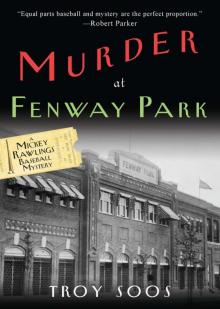
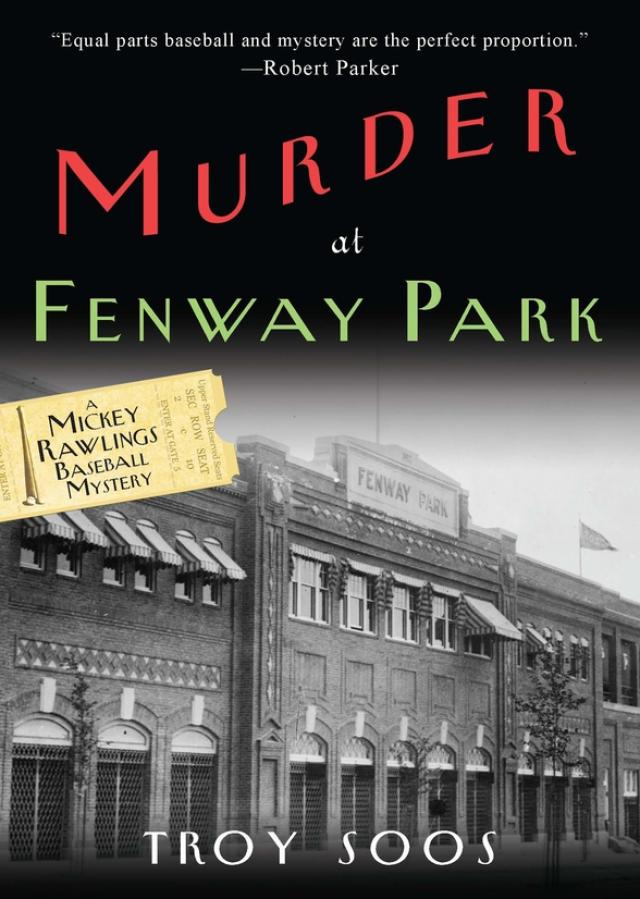
Murder at Fenway Park, page 6
part #1 of A Mickey Rawlings Baseball Mystery Series


In everything I did while awake, and every night when I tried to sleep, the nagging fears and questions tugged and grabbed at my thoughts and dreams.
These worries no longer affected my play on the ball field, but that was no consolation. I had no chance to play, because Jake Stahl still had me benched.
After the move he made in Tuesday’s contest, I started to wonder if Stahl had given up on me. We were down three runs in the bottom of the ninth, when our third baseman Larry Gardner doubled. He hurt himself sliding into second, and looked like he’d have to come out of the game. I stretched my legs, assuming I would pinch run for him. I almost fell down when Stahl sent in Clyde Fletcher instead. Sure, I’d started to take a liking to Fletch, and didn’t begrudge him a chance for some playing time, but how the hell could Stahl put in a guy who’s fat and slow instead of me? Fletcher didn’t get beyond second base (he’d have been thrown out had he tried to steal third), and Charlie Strickler took the loss for the Sox.
Feeling stymied in my desire to learn what had really happened in the tunnels of Fenway Park, and worried about a baseball future that was looking increasingly bleak, I decided to try the one thing I was sure would help: a moving picture show.
Less meticulous this time about my appearance, I again headed to the Comique Theatre in Scollay Square. I didn’t know what movies were playing, and it didn’t matter. I intended to be fully caught up by whatever stories appeared on the screen.
Half a block from the theater, I slowed and looked behind me. Anybody from the Sox around?
I wasn’t sure, but I thought somebody ducked into a doorway. A man, but an unidentifiable one—he’d lowered his head so his cap blocked his face.
I backed behind the protective bulk of a cigar store Indian and waited, watching. Nobody came out. What the hell, it could have been my imagination—the square was pretty crowded.
I scooted out from behind the wood statue. I quickly walked to the Comique as if I was going to pass by, then took a sharp turn inside.
When I entered the theater, I suddenly wished that I had paid more attention to my attire. At the ticket booth were the same hair and eyes that had appeared so regularly in this past winter’s dreams. I was at first indecisive, torn between my eagerness to be near her and the need I felt to go home and put on a cleaner collar. I saw that she spotted me, too, so the choice was made for me, and I slowly approached her.
I drank in the sight of her, working my eyes from the ticket counter upward. Peggy’s blouse was sparkling white, with a ruffled front and sleeves puffed at the shoulders. Around her throat, setting off her fair skin, was a black ribbon choker with a small silver and black cameo on the front. Her honey-blond hair was piled into a high wide bun. Long wisps of it had come loose at her temples and waved down, framing her slender face. A fine spray of freckles, not much darker than her hair, dotted the bridge of her nose.
Peggy’s eyes, green and sparkling, had a smiling look of glad recognition, but her voice was controlled and chilly as she said, “Hello, Mr. Rawlings. It’s good to see you again.” Those were the words she used, but what I heard in the tone was “You didn’t write like you promised.”
I decided not to return her use of formality. “Hello, Peggy. It’s nice to see you, too.”
Her voice was just slightly warmer when, after a pause, she said, “I think you’ll like today’s pictures.” With an amused smile she added, “No Mary Pickford, though, I’m afraid.”
I could think of nothing else to say, but was saved from embarrassment by a flock of matrons lined up behind me. They pressed me into the theater, where I selected a seat near the center. I ended up spending more than four hours in it.
I paid no attention to the pictures. Instead, I wondered to myself if I was mistaken about what Peggy and I had last year. Was it a romance—or the prelude to a romance? Or by reviewing its highlights over and over, had I magnified it in my thoughts beyond what it had actually been?
Then, as the movie program was repeated for the evening audience, the piano began to tinkle gracefully. Like the first time I saw her there, my gaze remained fixed on the nape of Peggy Shaw’s neck.
After the last strip of celluloid had been run for the night, the house lights came up and the rest of the audience trickled out. I remained immobile in my chair while Peggy closed the cover over the piano keys and put her sheet music away.
She smiled at me when she turned around and saw me waiting for her. I felt from her smile that she knew I would still be there.
I extricated myself from the seat and, ignoring the dull cramps in my legs, walked over to her. She looked more inviting now, her initial coldness gone—or at least not visible.
I asked, “Uh ... Would you care to go for a walk... If you have the time... Tonight?” To my ears, I sounded stilted, and I felt flushed and shaky.
Peggy smiled and nodded. “I’d like that.”
She had a few things to take care of in the theater office, then we were off toward the Boston Common. She seemed excited, and I flattered myself by assuming that it was because of seeing me again. I wondered what dreams she’d had last winter.
“I came to the theater Sunday. I thought you would be there,” I began, then added in a quieter tone, “I was kind of disappointed when you weren’t.”
“This past Sunday?”
“Uh-huh.”
“I was in New York for the weekend. Didn’t Helen tell you?”
“Uh... no. Well, I didn’t think to ask. When I didn’t see you there, I guess I just figured you weren’t at the theater anymore.”
Peggy smiled. “I went to Manhattan to march in the suffrage parade.”
It was seldom that I knew anything of the various social movements, and eager to show that I knew something of this one, I piped up with a quip I had once come across, “Suffragette: One who has ceased to be a lady and not yet become a gentleman.” Peggy’s eyes made it immediately clear that I had said something wrong. My body fluids seemed to vaporize under her fiery glare, and I lamely tried to diminish the damage, mumbling, “I read that someplace.”
After letting me stew in her silent reprimand for a few moments, Peggy continued about the big march in New York City, “It was wonderful. Women from all over the country joined together to march down Fifth Avenue. Fifteen thousand. And John Dewey led a men’s contingent. And the crowd cheered us this year. The New York Times said half a million people watched the parade. It was a great feeling. Invigorating. It felt like being part of history.”
As she talked about the march, I realized that her excitement wasn’t about being with me. She was still bubbling over with residual enthusiasm from the weekend.
“We actually had our own cavalry! Fifty women led the parade on horseback. Inez Milholland was one of them. She looked so fresh and lovely on her white horse, and she seemed to charm everybody. A lot of people seem to think that suffragettes aren’t feminine. I suppose Inez is our best answer to that argument.”
There was a sudden gap in Peggy’s report of the march. I think I just missed a cue to say something.
Then she picked up with her story again and was regaling me with more details of the parade.
I wanted to talk to her about everything that happened to me since I arrived in Boston. She was so enthusiastic about her weekend in New York, though, that I couldn’t bring myself to be that selfish. I squelched the desire to spill out everything that was troubling me, and instead relaxed and tried to share her excitement. After I succeeded in putting my own urges on hold, I easily found it satisfying enough just to look at her as she spoke.
We walked for almost an hour, slowly and circuitously, before reaching her town house on Beacon Hill.
I left Peggy at her door. Although I hadn’t unburdened myself to her, I felt almost as relieved as if I had. Just being with her again was a comfort that made any situation bearable.
I slept peacefully that night, my dreams refreshingly free of any visions of mangled faces or bloodied baseball bats.
The next afternoon, Jake Stahl gave me the happy news that Larry Gardner’s ankle was severely sprained. I bit my inner lip to keep from grinning as he told me I would be starting at third base until he recovered.
I played all of Wednesday’s game against the White Sox with no errors. I also got two singles to bring my season average over .250.
Before Thursday’s game, the clubhouse talk was about Ty Cobb. As I was changing out of my street clothes, Clyde Fletcher yelled at me, “Hey, kid! Yuh hear? Cobb went into the stands at Hilltop. Beat up some crank who was giving him the business.” I was grateful to Fletcher for bringing me into the exchange. It was his way of letting the other players know I was okay.
I quickly took advantage of the opening to give my opinion, “Great! It’s about time somebody stood up for himself.” All ball players have been subjected to vicious verbal abuse—and sometimes projectiles—from spectators at one time or other, and it was thrilling to hear that one of the rowdies got his comeuppance. My teammates voiced a variety of loud, unreserved agreements.
When I read the rest of the story in the paper that night, the thrill turned to disgust. The man Cobb went after was a cripple. As Cobb pummeled the heckler, other fans tried to pull him off, screaming at Cobb that he was punching a man with no hands to defend himself. Cobb yelled back, “I don’t care if he has no feet!”
The Georgia Peach defended his action to reporters, claiming he had been grievously provoked by the fan. Cobb was quoted as saying, “When a spectator calls me half-colored I think it is about time to fight.”
Unfortunately for Cobb, Ban Johnson was in a field box at the game and witnessed the episode. The league president announced that Ty Cobb was suspended indefinitely.
On Friday, the locker room was still buzzing about the Ty Cobb incident. The Tigers were now saying they wouldn’t play unless Cobb’s suspension was lifted. The furor about Ty Cobb assaulting a crippled fan became overshadowed by arguments over his teammates’ threatened strike. Everyone from politicians to labor leaders to the press had strong opinions either condemning or encouraging the Detroit ball players.
I stepped out of the clubhouse shower to hear Fletcher ask Charlie Strickler, “Whadda yuh think, Strick? Your old pals really gonna sit out a game?”
Strickler shrugged and snapped, “How the hell should I know? I don’t give a damn what they do.” A former star on the downhill side of his career can be as ornery as a cantankerous old dog.
Bucky O’Brien tried our other ex-Tiger. “Billy! How ’bout you? What do you say? Tigers gonna strike?”
Billy Neal answered without hesitation. “Not a chance. Ain’t one guy on that team who’ll give Cobb the time of day. They sure as hell ain’t gonna lose their jobs for him.”
On Saturday afternoon, Neal was proved wrong. With Ban Johnson still not giving in to the Tigers’ demands that Cobb be reinstated, the team carried out its threat. The Tigers went on strike, refusing to play Philadelphia.
The Tiger management was prepared: to avoid paying a fine to the league for failing to field a team, nine local amateurs were recruited to represent Detroit. In the farce that followed, the Athletics hitters fattened up their batting averages, teeing off for twenty-four runs against the sham “Tigers.”
An outraged Ban Johnson canceled the Tigers next game.
To me, the world seemed to have gone slightly crazy. Baseball players on strike? In support of Ty Cobb?
I played poorly in our Saturday game at Fenway, my head filled with a perplexing jumble of bewilderments. The baseball world was the one that had always made sense to me. I understood the game and every nuance of its strategies. And, until now, I knew what ball players thought and felt. Even under suspicion of murder, I had been able to find a small haven of stability on the baseball field. But with Ball-dom now beginning to resemble Oz, I could find no respite anywhere.
The Sox were scheduled to leave for a western road trip on Sunday. This would mean two weeks without seeing Peggy, a separation I didn’t look forward to right now. Even if no romance would bloom, I still felt a need for her friendship.
After the game, I decided that I had to talk to Peggy and tell her all that had happened.
I rushed to the theater, and ran up to Peggy at the ticket booth. “I really need to talk to you tonight. I have to leave for a road trip in the morning. Can I come back here after the show is over?”
Peggy looked taken aback, but she nodded and said, “Yes, certainly.”
“Okay, great. I’ll be back later.” With that, I bolted from the theater.
I returned two hours later, after eating a fast supper and packing my bags. A chilly drizzle had begun outside, so instead of leaving the theater for a walk, we stayed inside, sitting next to each other in two front-row chairs.
I kept my eyes fixed straight ahead, staring blankly at the stark white screen in front of me. By not looking at Peggy, I was less self-conscious, and the words poured out of me in an uninterrupted torrent.
I quickly recounted the off-season I had spent playing winter ball and pickup games. To help excuse my failure to write, I tried to make my activities since last fall sound especially hectic.
With a deep breath, I proceeded to detail my arrival at Fenway Park, the horrid experience of finding the body, the questioning by the police captain, Bob Tyler’s warning not to talk, and the nearly unremitted distress and confusion I felt ever since I came across the murdered man. I told her, too, of the death of Red Corriden, and my suspicion that the killings might be related, possibly part of a series.
Finally, I turned my head to look into Peggy’s eyes, and confessed, “I don’t know what to make of all this. I just know I feel terrible. I feel I have to find out what happened—or what’s happening. But the police think I’m a suspect, so if I start asking questions they may think I’m trying to cover myself somehow.”
Peggy looked thoughtful, not at all shocked, as she absorbed all I said. She seemed to take my strange tale in stride, and I admired—and envied—her composure. After minutes of silence, she spoke slowly and calmly, “Well, first off, I don’t think you’re in any real trouble. If the police considered you a suspect, I doubt they’d leave you alone. They would have questioned you again by now.”
“Maybe Tyler has the police holding off. He told me the day after it happened that he didn’t believe I had anything to do with it. And he did seem to have a lot of influence over the cops who were at the park.”
“Do you think Mr. Tyler meant it about believing you, or was he just trying to sound supportive?”
I was ashamed, but I filled in a detail I had previously omitted. “Well, I, uh, I got sick when I found the body. Tyler said a murderer wouldn’t throw up”—I decided I didn’t have to be completely detailed and skipped the fact that I vomited on the corpse—“at the scene of the crime.”
I quickly looked at Peggy to see how she would react. There was no sign of amusement on her face. She said, “Oh. Well, he probably does believe you’re innocent then.”
She fell silent and her brow furrowed a little—and I couldn’t help noticing that her frown looked very endearing. After some more minutes, she said, “I suppose you’re going to have to find out what happened somehow. But I don’t know how. Can I think about it, and we’ll talk when you get back?”
“Yes, sure. I didn’t really know what I thought you could do. But just telling you about it helps.”
I walked Peggy home through a light steady rain, neither of us saying much. She kissed me on the cheek when we got to her door, and I went home feeling much better that at least someone else was sharing my worries.
But I hadn’t told Peggy everything. I didn’t tell her about the bat left on my pillow. I didn’t tell her that being considered a suspect wasn’t my only worry.
Chapter Nine
The weather cleared by early Sunday morning. It looked as if it would be a beautiful day for a picnic or a walk through the Arnold Arboretum. I wished that I could spend the day with Peggy in one of those deliciously genteel pursuits. Instead I was on my way to South Station to join my extremely nongenteel teammates for our long western road trip. And I was on my way to finding out what happened to the murdered man at Fenway Park.
I’d decided that I would have to take some initiative and find out what occurred that first day I entered the Red Sox ballpark. I was going to start asking some questions. But what questions? And who would have answers?
Should I look into the Fenway murder by itself or should I start with Red Corriden’s death and try to find the connection to the other man. Were their deaths necessarily connected?
It could have been coincidence. Corriden was a likely enough mugging candidate: a young fellow in what was probably an unfamiliar city. He easily could have wandered into a rough part of town and stood out as an inviting robbery target. As for the dead man at Fenway Park, he was in a stadium that had just been filled with thousands of people including drunks, gamblers, and pickpockets. In the hectic congestion that followed the game, almost anything could have happened. He could have been pulled aside to be robbed, or maybe he met someone for a fight. After all, as much as I distrusted him, Bob Tyler was truthful about one thing: Boston is a big city with its share of violent crimes.
Robert F. Tyler... I’d thought about his warnings to me, and concluded they were mostly scare tactics. It was obvious that he was lying when he pretended to be so concerned with protecting me, and I’d started to think—and hope—that maybe he wasn’t honest with me when he claimed I was Captain O’Malley’s leading suspect.
Then there’s Jimmy Macullar. I didn’t have a clear read on him, but he seemed a decent enough man. The only strike against him was that he worked for Bob Tyler. Macullar could be my best bet for answering questions. He might not know much, but I had a feeling he was aware of a lot more than Tyler would want him to know.
I decided I would talk with Jimmy Macullar on this road trip and see what I could find out. And then—I wasn’t sure.