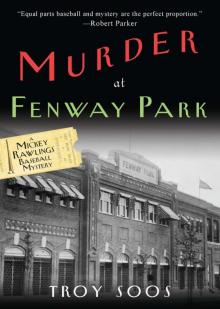
Murder at Fenway Park, page 12
part #1 of A Mickey Rawlings Baseball Mystery Series


It seemed farfetched on the surface, but I had to look at it from Cobb’s point of view. Ty Cobb—a man who feels justified jumping into the stands in midgame to attack a cripple. Would he have any qualms about going after a man who, in his view, almost cost him a batting championship and a valuable automobile?
The more I thought about it, the more my Cobb theory seemed to make sense. Maybe just plain meanness should be added to the standard list of possible motives, a contribution from Ty Cobb.
As I became confident that I was correct about Ty Cobb, I became more sure of myself in this whole investigating business. Perhaps I wasn’t as methodical as Peggy or Landfors would be, but I did seem to have an instinct for crime-solving.
I began to entertain myself with highly satisfying daydreams, envisioning Peggy’s proud reaction to my success and Landfors’ outrage at being shown up by a mere ball player. And the publicity—a famous baseball player nailed for murder, the crime solved by Mickey Rawlings. This will be bigger news than Harry Thaw’s murder of Stanford White!
Then my confidence disintegrated as two other characters injected themselves in my thoughts: Jack O’Connor and Harry Howell. Ty Cobb had a revenge motive, but what about O’Connor and Howell? Cobb almost lost the batting title and the car. O’Connor and Howell did get booted from baseball. Did one—or both—of them blame the banishment on Red Corriden?
Not all of Peggy’s ideas were useless. Following her example, I went to the Sporting News office when we arrived in St. Louis. I talked to an editor of the “Baseball Bible” who was delighted to let a ball player use their research library—he said I was the first. I pored through the last five years of Reach Baseball Guides, and found that Bobby Wallace had been with the Browns when O’Connor and Howell were with the club. I hoped he might have an idea of where O’Connor and Howell were now.
Before the second game of the series in Sportsman’s Park, I spotted Bobby Wallace playing a fast-paced pepper game behind third base with four other Browns. When we came to St. Louis in May, Wallace was managing the club; he’d looked weary and his talents seemed to have faded. Then, a month into the season, he gave up the managing chores. Now his skills seemed restored, and he was clearly loving the renewal. He fielded more deftly, and laughed more loudly than his teammates. Managing makes a fellow be an adult, it makes baseball a job. Bobby Wallace was back to being a boy again and playing a game.
I drew closer to the pepper players, enjoying the spectacle and waiting for the game to end. When the players broke to take batting practice, I approached Wallace. It was almost like walking toward a mirror; we had the same infielder build, the same lean facial structure. Other than his hair being darker, he could have been my older brother.
“Hey, Bobby,” I called. “I’m Mickey Rawlings. I’ve seen you play for a long time. It’s good to be on the same field with you.” Flattery always helps.
“How you doing, Mickey.”
“I was wondering... since you’ve been here quite a while I thought you might know... I’ve been trying to find Jack O’Connor and Harry Howell. You have any idea where they went after they left the Browns?”
“You a friend of theirs?”
“No, never met either of ’em. We, uh, we have a mutual friend. Promised him I’d try to look them up if they’re still around.”
Wallace looked like he was seriously searching his memory. “Howell may still be around. He liked St. Louis, I don’t think he’d have left. Haven’t seen him since he left the team, though. Oh! You might try the Everleigh Club. He spent a lot of time there, I seem to remember.”
“Everleigh Club? Where’s that?”
“On Market Street. Shouldn’t be hard to find.”
“How ’bout Jack O’Connor?”
“You got me there.”
“That’s okay. If I can find Howell, maybe he’ll know. Thanks.”
As a visiting player, I had a practical appreciation of the facilities at the new ballparks: they all provided dressing rooms for opposing teams. With the older parks, visiting players had to dress in the hotel and show up at the field already in uniform. Then worse, they’d have to leave after a game, sweaty and filthy, with no chance to shower and change until back at the hotel.
So after the morning game, I was able to take a quick shower and slip out of Sportsman’s Park to head directly for the Everleigh Club. The first cabbie I asked said he knew where it was. He drove me to 2200 Market Street where a large two-story white house sat between a pool hall and a closed-up vaudeville theater. The house was farther back from the road than its neighbors, and was partially shielded by four willow trees.
At the front door, I rapped a rose-shaped brass knocker and waited. And waited. I rapped again, louder, with diminishing patience. Then I grabbed firm hold of the rosebud and hammered the wood forcefully.
I finally heard a pit-a-pat of footsteps and the door opened a cautious few inches. A doll-like colored girl in a maid’s outfit looked me up and down, then slowly shook her head. “You is an eager one, isn’t you?” she said, not seeming to expect an answer. And I wouldn’t have known what to answer. I stood frozen, trying to remember why I knocked so hard if I didn’t know what I wanted. “Well,” she said, “you come on in. I’ll fetch Miss Evelyn.” The girl let me in to the entrance hall and walked off to climb a staircase that curved upstairs.
As I waited, I heard soft piano notes coming from the parlor. A tall, lean man with coal-black skin, dressed in the same black and white colors as the piano, sat erect in the piano seat. He played with a minimum of movement, gently laying his long fingers on the keys to sound the notes. It looked as if his dark fingers were trying to mesh with the black keys of the keyboard. He played a quiet march, with an alternating rhythm that started my head swaying back and forth to the tempo.
“Business hours don’t start until four,” a husky female voice said. I looked back at the foot of the staircase. “Why don’t you come back in a couple of hours. I’ll make sure you’re taken real good care of then.” Miss Evelyn stood on the bottom step of the staircase, wearing a dark blue gown over a colossal body. The material cascaded straight down from her immense bosom, cloaking any possible trace of a figure. She looked a little like Clyde Fletcher in a dress. Her left hand rested on the bannister, poised to pull herself back upstairs.
“I only need a couple of minutes,” I said.
She frowned and repeated with distaste, “A couple of minutes?”
I suddenly noticed that the carpeting of the stairs and hallway was red. I glanced back at the parlor, and saw that the chairs, couches, and drapes were all the same scarlet. And I suddenly realized what Everleigh meant, and what kind of club this was.
Blushing and burning, I said, “Uh, I’m not here for uh ... for uh ... I was just looking for a fellow I heard used to come here. He was a baseball player—with the Browns. Harry Howell? Do you know him?”
“Know him!” Miss Evelyn exploded. “That bastard worked here for almost a year. He was broke when he got booted out of baseball, so I took him in—he was always hanging around anyway, even without money to spend. I figured he was strong enough to take care of any customers who got out of hand, so I gave him a job as a bouncer. But he was like a drunk tending bar. Made demands on the girls—unnatural demands. They were going to quit if I didn’t get rid of him, so I fired the bastard.” She squinted at me. “You a friend of his?” It sounded like an accusation.
“No, never met him. I was just looking for him to uh ...” I wasn’t exactly sure exactly why I was looking for him. “Uh, do you know where he is now?”
“Don’t know, don’t care. Just as long as he never comes here again. And you—you can show yourself out.” She started back upstairs.
“Are you sure you don’t know where I can find him?” I called to her. She shook her head no as she kept climbing the steps.
Defeated, I turned toward the door. Three fast loud chords from the piano halted me. I turned my head to see the piano player beckon me with a nod.
I warily walked into the parlor as the pianist went back to a slow rippling march. I stood behind him to his right. He didn’t face me, didn’t change the tempo of his playing. He said without emotion, “Harry Howell. He a barber now. Roselli’s Barbershop. Twelfth Street.”
“You sure?”
“Yup.”
“Thanks. Uh ... why? Why tell me where he is?”
“You mean to bring him something bad.”
“What makes you think so?”
“You say you ain’t a friend of his, and I know he didn’t have no kin. So if you trying to track him down, it’s to bring him some trouble. And I like that just fine.”
“Did he do something to you?”
“That girl that let you in. She don’t do no entertaining here, she just do cleaning and such. And she mine. Harry Howell, he tried to force hisself on her when the girls wouldn’t take him no more. You settle your score with him, but leave some for me. I’ll be making Mister Harry Howell a visit sometime.”
I promised to leave some of Harry Howell—and expected to leave all of him—for the piano player.
Roselli’s Barbershop was without customers. The two chairs were both occupied, but one was occupied by a stack of newspapers and the other by the barber. I recognized his face. I’d seen it in Baseball Magazine, and on tobacco cards, and in Hilltop Park. It was Harry Howell. I had seen him pitch for the New York Highlanders back when he was Handsome Harry and his arm was still strong. Now here he was, sacked from a whorehouse, cutting hair for a living.
“You open?” I asked.
Howell groaned and reluctantly pulled himself out of his chair. “Yep.” He gave the seat a token swat with a grimy towel. Flecks of dried shaving cream dislodged from the towel and fluttered in the air.
I climbed into the seat and kept my eyes focused on the mirror ahead of me, looking at Howell’s reflection. His white jacket with the collar buttoned around his throat made him look like a dentist. His hands looked like those of an athlete: large, calloused, and bent. The expression on his face was that of a once-handsome man who’d run out of chances in life and had no plans but to live out his time. Howell tied a sheet around my neck and asked, “How you want it?” He couldn’t have sounded less interested.
“Just a trim.”
Howell went to work with a comb and scissors, nibbling off snips of my hair. I didn’t know what to say to him. How could I ask him about Red Corriden—how could I do it casually?
I decided there was no subtle approach. “You remember Red Corriden?” I blurted.
The metallic clipping noises stopped. “Who?”
I sighed. Why does everyone ask “who” right after I clearly say who? “Red Corriden. He was with you on the Browns.”
“You know who I am?”
“Of course. You’re Harry Howell.”
Howell’s reflection smiled. It is nice to be recognized. “You seen me play?”
“Lots of times. Not with the Browns though. I saw you pitch for the Highlanders when I was a kid.” The smile fell. I should stop telling guys that I saw them play when I was a kid. “You were a helluva pitcher,” I added, trying to get on whatever good side he might have.
Howell smiled wryly. “Yeah, and that was a helluva long time ago.” He went back to snipping my hair. “So what do you want to know about Red Corriden?”
“The last day of the season. Two years ago. Cobb and Lajoie were—”
“They were fighting for the batting title. And we tried to give it to Nap Lajoie.”
“It’s true?”
“Sure it’s true. And it’s nothing I’m ashamed of. We weren’t trying to throw the games. Just give Lajoie some hits. That’s all. We didn’t do nothing wrong.”
“How’d it happen?”
“Well, that batting race went neck and neck all year. The winner was going to get a car, you know.”
“A Chalmers.”
“Yep, that was it. Anyway, it seemed everybody was pulling for Lajoie to win the title and the car. Or pulling for Cobb to tose—mostly that, I guess. Anyway, we decided to give Lajoie some help. Had the third baseman—Corriden—play real deep and let him lay down easy bunts. You want a shave?”
I knew it didn’t need one—and probably wouldn’t for another week—but! I was flattered he asked and said, “Sure.”
Howell lifted a razor and I suddenly wasn’t so sure. I was here because I thought he had a motive for killing Red Corriden. Letting him put a razor to my face didn’t seem like such a good idea. But it was too late. Howell tilted my seat back. With steel tongs, he pulled a steaming hot towel from a can at the base of the chair. “Close your eyes,” he said. I hesitated as the towel dangled over my face, then obeyed. I was suddenly covered by moist heat. And I couldn’t see what Howell was doing. I tried to clench my throat as if bracing it for a punch.
I heard the raspy scrape of the razor being slapped on a leather strap. As Howell sharpened the blade, he picked up the story. “The last day of the season was a doubleheader. Wouldn’t matter in the standings which team won or lost— both teams were out of the pennant race. And remember, it was last day of the year. Strange things happen—you know, the bat boy gets to pinch hit, some fifty-year-old coach gets to pitch a few innings... Keeps the fans interested. Have some fun before going home for winter. Everybody does it.”
My face felt suddenly chilled as the towel was lifted from it. I could see again, and breathe again. Howell began to apply lather to my skin with a brush that was too stiff. “Lajoie went eight for nine in the two games,” he continued. “But it wasn’t enough—the league gave Cobb the batting championship. We split the doubleheader, by the way. Like I said, we weren’t throwing games. But nobody remembers that.”
“You and Jack O’Connor got kicked out of baseball.”
“Yeah, no kidding. Shouldn’t have though.” Howell carefully cut away the lather along with an occasional whisker. “But everybody could see what we were doing. Corriden played third base standing all the way out in left field, for chrissake. There was such a squawk afterward that Ban Johnson decided he should punish somebody. So it was me and O’Connor.”
“It wasn’t Corriden’s idea to play back?”
“Nah. I forget whose idea it was, but O’Connor liked it, and he told Corriden to play deep. The kid was just doing what he was told. But Jack denied it. He said Corriden didn’t know how to play third base in the major leagues.”
“Why were you kicked out?”
“I got kind of caught up in it, I guess. Lajoie was eight for eight, then in his last at bat he hit into a fielder’s choice. So I told the scorekeeper I’d buy him a suit of clothes to change the fielder’s choice to a hit. He told Ban Johnson and Johnson kicked me out.” Howell made it sound as matter-of-fact as if he had been kicked out of a bar instead of banished from baseball.
“Did Jack O’Connor ever admit that he tried to fix the batting race?”
“Yeah. After a while. He didn’t take it real well, though, getting booted out of baseball. He blamed Corriden for it—said the kid ratted on him. He was really pissed that Corriden didn’t get in any trouble. Ban Johnson said Corriden wasn’t guilty of nothing but doing what he was told. That wasn’t what got me pissed though—what got me was that Chalmers gave cars to both Cobb and Lajoie. Said it was worth all the publicity they got.” Howell dabbed the traces of shaving cream from around my jaw and took off the sheet.
I stood and fished in my pocket for change. “You still see Jack O’Connor at all?”
“Nope. He left town after that business with the league office. I heard he went outlaw. California, I think.”
“He’s an outlaw?”
“Outlaw league. You know, not part of organized baseball. Ban Johnson don’t have no authority with an outlaw league.”
“Oh. You know what team?”
“Nah. California State League, I expect, but don’t know which team. I haven’t heard from him in more than a year.”
I shook Howell’s hand. “It was really good talking to you, Harry. Thanks.” I gave him fifty cents for a quarter haircut and shave. His eyes told me I was insulting him with the big tip, and I felt like a heel for offending him. Then he shrugged and pocketed the money.
Harry Howell didn’t seem to carry any lingering grudge against Red Corriden. But maybe he once had. Maybe he’d done something to settle a score. Howell seemed a little too acclimated with what had happened to him. I couldn’t believe he could be that happy with his current lot. And what about O’Connor? Where had he been since leaving baseball? Where was he in April?
And of course there was still Ty Cobb, as good a suspect as ever.
With Strickler and Fletcher gone from the Sox, both Billy Neal and I lost our roommates, so we were paired together on this road trip. Since Neal had been teammates with Cobb on the Tigers, I figured he might be able to give me some firsthand insights into the man.
I’d hardly spent any time at our hotel in St. Louis. Not until we arrived in Chicago did I get to size up my new roommate.
Wearing only shorts, Billy Neal sat at a writing desk playing solitaire and humming a tuneless series of notes. Overall, he looked to be in good shape. He was probably in his early thirties, about the same age as Fletch, but whereas Fletcher’s carousing had put an extra ten years of paunch and sluggishness on his body, Neal appeared as firm and fit as a guy in his midtwenties. He also lacked Fletcher’s apelike appearance—Neat’s curly dark hair was close-cropped and pretty much limited to his head.
What stood out with Billy Neal, was a body that said “catcher.” No other occupation could have produced the features that had developed on him. From his knees to his ankles, Neal’s shins were gnarled with knots and lumps—he’d been catching for years before Roger Bresnahan invented shin guards. And a slight left-hand twist of his nose indicated that he’d caught at least one game without a mask. Most amazing were Neal’s fingers. They were curved and bent and twisted, and some of them looked like they had extra joints broken into them.