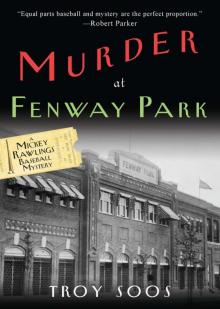
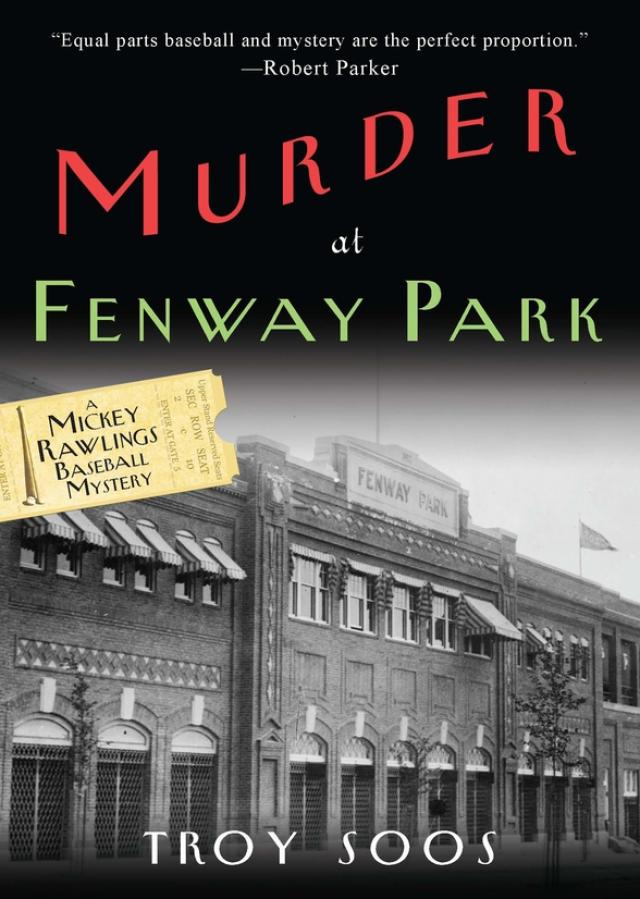
Murder at Fenway Park, page 15
part #1 of A Mickey Rawlings Baseball Mystery Series


“I’d like to help find out what happened to Jimmy... Do you know why anyone might want to, uh—”
“Kill him. Are you a police officer, Mr. Rawlings?” She plucked harder at her shawl.
“No, ma’am.”
“Well, don’t you think finding my brother’s murderer is a job for the police—not a baseball player?”
“Yes, I suppose, but—”
“I appreciate your intentions, Mr. Rawlings, but we can find out what happened to Jimmy.” Her fingers tore through one of the lace loops, and she looked sorrowfully at the damage. She spoke softly at the shawl, “We have friends in this city, more friends than that boss of Jimmy’s has—they’ll let us know what happened to him. And we’ll take care of it. We take care of our own.”
Then she clamped her jaws shut, and sat motionless. She’d talked as if she had a need to say something about her estranged brother, now that she could never say anything to him. My visit was probably her first opportunity to say something about Jimmy.
Mary Macullar looked up slowly and said, “Take my advice, Mr. Rawlings. Go back to your baseball games. Stay out of things you don’t understand. It would be safer that way.” Suddenly she reached up and slapped the massive left hand that rested on the handle of her chair. “My stick,” she ordered. The young man handed her a black twisted cudgel. She clutched it with both hands and pulled herself out of the chair. Fending off an attempt at assistance, she hobbled away without saying goodbye.
As I left, I thought that if I were Jimmy Macullar, I don’t think I’d have gone into the family business either.
Chapter Eighteen
A fairly peaceful week went by with no more murders or enforced visits to police stations. I was tempted a few times—about a hundred... maybe closer to a thousand—to call Peggy, but I resisted. I put her out of mind—almost completely—and divided my attention between baseball and Jimmy Macullar’s murder. Mary Macullar’s warning didn’t deter me. I was tired of people telling me to stay out of things. Especially since it seemed they only wanted me to sit quietly on the side until they decided what to do with me—or to me.
Just over a month was left in the baseball season. The ballpark was no sanctuary for me now; it provided no refuge from thoughts of gallows and electric chairs. I became convinced that my performance on the field was linked to the resolution of the Macullar case. As long as I was an asset to the team and could help Bob Tyler reach the World Series, maybe he would keep Captain O’Malley away from me. If I played poorly, however, he might discard me as he had Clyde Fletcher and Charlie Strickler. Only in my case, I’d be tossed to O’Malley—and then to Joe Flint’s successor. So it seemed that by playing good baseball I was playing for time, time that I would use to find the real killer.
The closing days of August were laying a thick blanket of hazy heat and stifling humidity over the city. The conditions were worse at Fenway Park, where the nearby fens—the swamps that gave the ballpark its name—produced a sickening odor and an inexhaustible legion of mosquitoes.
The deadening heat wave restricted the movements of everything in Boston: every person, every horse, the very air, and even the Red Sox ball players. The Sox were starting to play listlessly, aching from a long season of charley horses and strawberries, wilted from the city heat, and lazy from the lack of a serious challenge for the pennant. The only thing that kept the team from falling into a bona fide slump was the pitching of Joe Wood, who still had his winning streak going.
During a Saturday doubleheader against Chicago, surviving the weather seemed to be a higher priority and a greater challenge than winning the game. It was already nearing one hundred degrees when the morning game of the doubleheader got underway. Both teams played sluggishly throughout the match. The fielders walked slowly to and from their positions between innings, the pitchers took extra time between each delivery to keep from overheating. Despite the low final score, 2—0 in favor of the White Sox, the game ended up a long one—just over two hours.
Rough Carrigan was soaked and exhausted after catching the first game, so Billy Neal went behind the plate for the second. Our shortstop took the second game off, too, allowing me to fill in for him.
Ordinarily I wouldn’t have been optimistic about us winning the second game, what with our regulars out and Big Ed Walsh pitching for the White Sox. But we had Smoky Joe Wood on the mound for us.
The heat didn’t seem to bother Ed Walsh; he blazed his spitball right by us. He worked economically, not wasting a pitch even when he was up no-balls-and-two-strikes in the count. I became two of the strikeouts he rang up in the early innings.
Joe Wood struggled for us, giving up one run to Chicago in the first inning and another in the second.
The heat and humidity were so oppressive, that I almost looked forward to facing Walsh’s spitball in the early innings—I imagined the spray might be refreshing. By the seventh inning, though, that image had completely lost its appeal. Liberal dollops of tobacco juice had been applied to the ball throughout the game, making it a brown, soggy, lopsided lump of leather and string.
The score was still 2—0 when I came up to bat with runners on second and third in the bottom of the seventh. To save whatever strength the heat hadn’t sapped from me, I decided to follow Walsh’s example of economy during this at bat. Instead of picking out a location where I wanted the first pitch, I set my sights on the spot where Walsh liked to deliver most of his pitches: high and tight.
Okay, it’ll be a hard spitter inside. Try to pull it.
I pulled it. Clouted it. Tagged it. Clear over the left field fence! My first major-league home run. A real one, out of the ballpark, not a triple that somebody misplayed into an inside-the-parker. I wasn’t sure how that mushy ball managed to plow through the gooey air and carry over the fence. It might have been due more to some strange atmospheric phenomenon than to sheer strength on my part, but whatever the cause, I’d take it.
I relished every second of my home run trot around the bases. Like every other place-hitter who claims that he prefers to bunt and just poke at the ball—because the strategy is more interesting, and requires more intelligence—I’d get an especially powerful thrill on those rare occasions when I’d hit a long ball. But the run was too brief. As I crossed the plate, I was out of breath and my squishing flannels felt like they’d sponged up gallons of sweat. I’d run much faster than I needed to. Next home run I’d have to go slower and savor it.
My homer gave us a 3—2 lead in the game, and those players who had the energy slapped me on the back with congratulations when I returned to the dugout. On the bench, I wondered to myself if the ball would be picked up by some lucky kid, or would it just lie there on Lansdowne Street, a disgusting brown lump indistinguishable from the horse droppings that surrounded it.
The score held, and Smoky Joe Wood chalked up another win. He also won another fan immediately after the contest, when he made a point of thanking me for the game-winning home run. It had always struck me as somewhat unfair that pitchers get credit for the wins even though they seldom drive in the runs. Wood’s gratitude seemed more than adequate compensation for this inequity in the box score.
Most of the afterglow of the home run washed away along with the dirt and sweat that I showered off me. I still carried in the back of my mind the notion that I wanted to tell Peggy about everything I did, and it gave me a pang of loss each time I remembered that we were no longer seeing each other. This was such a time—there didn’t seem to be much glory in hitting a home run with no one I cared for to listen to me brag about it.
I had almost finished dressing when Jake Stahl quietly told me, “Bob Tyler wants to see you in his office.” Here we go again. Who’s dead this time?
I found Tyler’s office by myself. “Come in!” was barked in answer to my knock. I opened the door slowly and involuntarily scanned the floor. No corpses.
“Come on in, Mickey. Have a seat.” I did as ordered, then swung my head to look behind me. “No, Captain O’Malley isn’t here. Just the two of us.” I relaxed only slightly. Tyler’s voice dropped to a soothing tone. “That was quite a performance today,” he said. “Your first home run, wasn’t it?”
“First in the majors. I’ve hit a couple in the minors.”
“I hope you’ll have a chance to hit many more.” If Tyler’s voice was any indication, it wasn’t a particularly fervent hope of his.
Having scolded myself for my belligerent behavior in O’Malley’s station house, I was determined to be more discreet and mature. But it wouldn’t be easy to hide my distaste for Tyler—especially knowing that he took payoffs from gamblers. After my initial hostility toward Karl Landfors faded, I had come to realize that he was telling the truth about Tyler. Landfors knew too little about baseball to lie convincingly. What he said about Hal Chase throwing games was true—I knew that for sure—so I figured he was right about Tyler and Arnold Rothstein. And there were those sporting friends of Chase at the Fourth of July doubleheader; they had to know somebody in the Red Sox front office to get that box—and Bob Tyler was in charge of the team’s ticket sales.
Tyler announced benevolently, “I’d like to be able to intercede on your behalf with Captain O’Malley. I want to see you keep playing ball.”
“You’ve already helped. If you hadn’t vouched for me, O’Malley would already have me in jail.” Diplomacy—it made my stomach curdle.
With a wave of his ringed fingers, Tyler dismissed my gratitude. “I think I can do a lot more for you. In fact, I might be able to get you off completely.”
“How?”
“If you remember, O’Malley thinks you killed Jimmy because of something to do with that body you found here. And of course he still thinks you might have been responsible for that.” Tyler paused. I held my tongue. “I was disappointed that you didn’t take my earlier advice about not discussing the matter. I know you talked to Jimmy about it. Maybe you argued with him—that’s what O’Malley seems to think. Now, if you were to tell me exactly what you and Jimmy said, then maybe I could convince O’Malley that it was just a harmless conversation.”
I hesitated. Tyler tried to convince me with an unconvincing fatherly tone. “Mickey, I know we don’t know each other very well, but I can assure you, I am the best friend you could possibly have right now.” Still dejected from the realization that I would have no one to tell about my home run, I found his claim to being my “best friend” depressingly near to being true.
Okay, here’s the story. “I’m sorry. I didn’t know I wasn’t supposed to talk to Jimmy at all—he already knew what happened, so I thought it was all right. He didn’t say much about it. I asked him if anything developed—did they catch who did it or were there any suspects, and he said not as far as he knew. Then he went on and on about when he was a player... with Syracuse and Baltimore, he said... he seemed to like to talk about his playing days, and I liked hearing about them—reminded me of the stories my uncle used to tell me about the old days. Let’s see, Jimmy talked about the different rules back when he played, and some of the players he knew... That was pretty much it. So, yeah, I asked him if there was any news about the dead guy I found, but we didn’t really talk about it. I didn’t much want to—I was just worried about still being a suspect.” There, now try to look witless and see if Tyler bought it.
He didn’t. “Very well, Mickey. I’ll pass that on to Captain O’Malley,” Tyler said. Then he leaned forward and hissed, “Maybe he’s more gullible than I am.”
“I don’t know—”
“Shut up. Look, I know you’ve been poking around in things that are none of your business.”
“But I—”
“I said shut up!” Tyler slammed his cane on the floor in emphasis and glared at me with narrowed eyes. “What I can’t figure,” he growled, “is how such a smart ball player can be such a stupid man.” I knew he meant me. And I knew I wasn’t supposed to give him an answer. Tyler stared at me with a mixture of rage and bewilderment. “We pay you a good salary. We take you to more cities than most people see in a lifetime, and we put you up in hotels and give you meal money for restaurants. And we build a ballpark where thousands of hard-working people come to watch you play a game. There’s a million guys in this country who’d give their left nut to be in your shoes!” Tyler shook his head. “And you want to throw it away because you can’t learn to mind your own business.”
I tried to looked ashamed.
Wagging a threatening finger, Tyler concluded, “From now till the end of the year, all you do is play baseball. When you’re not at the ballpark, you stay home. If we’re on the road, you stay in the hotel. You don’t even go to any of your goddam movie shows. You understand?”
I nodded.
“Now get the hell out of my sight.”
I did.
When I got home, I tried to salvage some sense of triumph from the game. With forced gusto, I told Mrs. O’Brien about my home run. She sounded happy for me, but it wasn’t the same. She was no Peggy Shaw.
Bob Tyler did put a scare into me. But he also told me a few things.
He really wanted to find out how much I knew, how much Macullar told me. Maybe to assure himself—or Captain O’Malley—that it was safe for them to leave me free until the end of the season. It could be that there was some difference of opinion between Tyler and O’Malley, with O’Malley not interested in whether or not I played out the year for the Red Sox.
Perhaps O’Malley felt Tyler was being unfair. O’Malley did Tyler a favor, helping him clean up his mess at Fenway Park by moving Corriden’s body out. Now O’Malley was left with a problem: an unsolved murder in his division. O’Malley could want a quick resolution, even if it means framing me, and Tyler might be holding him back.
It was also clear from what Tyler said that somebody was giving him reports on me: that I had spoken with Jimmy Macullar, that I went to the movies, that I was still poking around for information. Somebody had been following me.
Whatever was going on, I had one thing in my favor that should keep Tyler and O’Malley from coming down on me prematurely: they didn’t know that Macullar told me about Corriden’s body being moved out of Fenway Park. I was sure they wouldn’t let me remain free if they realized I was aware of their cover-up. They’d try to silence me immediately, perhaps permanently. Still, this advantage would expire at the end of the season. It was good only for giving me some time. It was enough to postpone their move perhaps, but not to cancel it.
Chapter Ninenteen
“Mickey! Telephone!” For a small woman, Mrs. O’Brien could bellow louder than an umpire.
I raced downstairs. Fletcher? Or a Fletcher impersonator?
“Mickey? This is Peggy.” The whisper wasn’t Fletch’s, but it didn’t sound like Peggy either.
“Yeah?” I asked cautiously.
“I need to see you,” the soft voice breathed. “It’s urgent. I’m at the Majestic Theater—next to Jacob Wirth’s. Do you know where that is?”
I still wasn’t sure of the caller’s identity. And I wasn’t going to be set up again. “Who’s my favorite movie actress?” I asked.
“What?” blurted into my ear. The whisper was gone, blown away in astonishment at my question. Then I heard giggling, and Peggy answered as if giving a secret password, “Mary Pickford.”
“I know where the Majestic is. I’ll be right there.”
Back to an urgent whispering, she said, “I’m in the lobby. Hurry!”
Without a thought to changing my clothes or combing my hair, I ran straight to the front door. But just before yanking it open, I remembered that somebody had been spying on me for Bob Tyler. I didn’t want any more trouble from Tyler, and I sure didn’t want to lead anyone to Peggy. I spun around, and flying past a startled Mrs. O’Brien, went out the kitchen door instead.
Staying off the street, I assaulted the backyard barriers of our neighbors, fighting my way around bushes and squeezing through hedgerows. I came out on Columbus Avenue, certain that I had eluded any observers.
It took five minutes of hard sprinting for me to reach the Majestic Theater. My hair was plastered across my forehead and rivulets of sweat trickled down my neck. I was wheezing for air as I entered the lobby.
Peggy was standing just inside, looking out the glass door. She grabbed my elbow and turned me around to face the door. “Over there,” she whispered, pointing out the pane. She showed no signs of returning to normal behavior.
“Where?” I whispered back. “And why are we whispering?”
“The restaurant. Mr. Tyler is in there.”
“Then he can’t hear us, can he?”
“You never know who’s around. Look. ”
There was nothing to see that I could tell, but I looked across the street at Jacob Wirth’s restaurant. “What is it I’m supposed to be looking at?”
“Just watch the door. Mr. Tyler’s in there with another man. You need to see what he looks like.”
We stood side by side staring out the glass, talking earnestly at the door. We must have looked ridiculous.
“Why do I need to see this guy?”
“I think he’s—shhh! Here they are.”
Tyler came out of the restaurant working a toothpick through his teeth with one hand and swinging his cane with the other. Behind him came a man who stood a head taller than Tyler—six foot six, easy. It wasn’t his height that struck me, though. It was his outfit: checked lime green suit, vest open, yellow cap slung low over his eyes. He bit the end off a stout black cigar and spat it out. This was the man Hal Chase had been talking to in the box seats at Fenway.
“Do you know him?” Peggy asked.
I hesitated. “Uh, why? Should I?”
“I don’t know. It’s too bad his hat is covering his eyes. Do you think you could recognize him if you saw him again.”
“I think so.” I was sure I could, even if he wore different clothes and shaved his mustache. I clearly remembered his face from Fenway Park. And now I’d seen how tall he was.