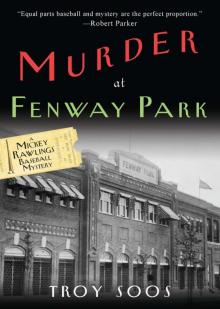
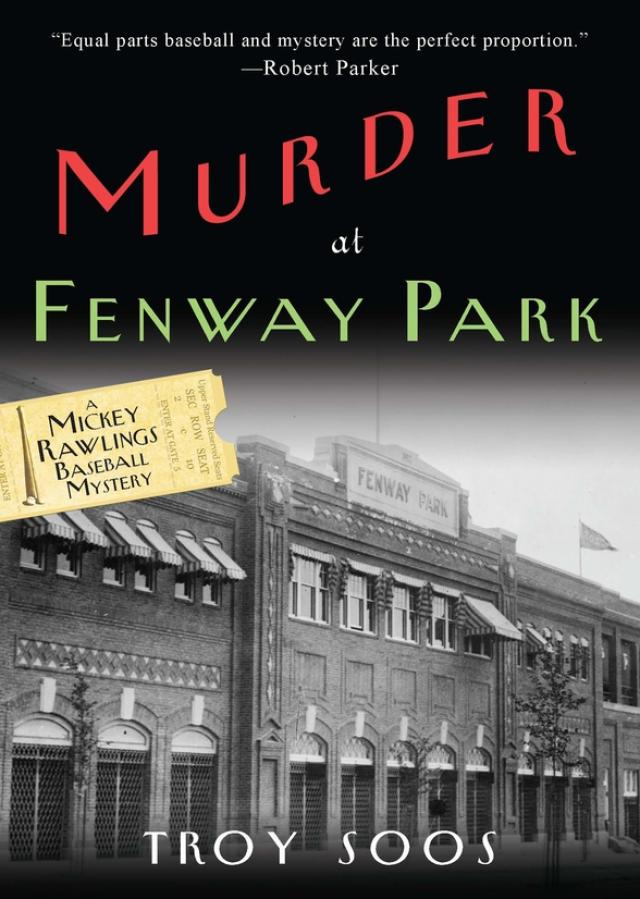
Murder at Fenway Park, page 13
part #1 of A Mickey Rawlings Baseball Mystery Series


The atmosphere of the room seemed odd. Then I realized it was the sound. Gone was Fletch’s juicy Hchoowook, Shptoo, Ping! The slow regular Snap... Snap... Snap of Neal crisply turning over each card had taken its place.
I suddenly missed Fletcher and wondered what would become of him. “Billy, you think Fletch will get picked up by another club?”
“Could be. Maybe end of the season, somebody could use him. Can’t beat experience when it comes down to the wire.”
“I was wondering what happens to guys like Fletch and Strickler. What if nobody does pick them up? What do guys like that do after baseball?”
“After baseball? What do you mean after? You can always play ball. Back in the minors or semipro... Hell, I’d even play for a factory team. Got to keep playing ball.”
“Huh. I saw Harry Howell back in St. Louis.”
“You saw Harry Howell?”
“Yeah, remember him?”
“Sure... pretty good pitcher for a few years.”
I remembered from the Reach Baseball Guides that Neal’s name appeared on the St. Louis 1910 roster. “Was he still pitching when you were with the Browns?”
“Nah. His arm was dead. He just scouted for us.”
“Well, guess what he’s doing now.”
Neal shrugged. “Beats me.”
“He’s a barber. Got fired from a whorehouse, so now he’s a barber.”
“Well, you don’t gotta worry about Clyde Fletcher turning out like that.”
“No?”
“Uh-uh. Fletch ever got himself a job in a whorehouse, he’d make sure to hang on to it.”
“Hah!” I agreed with him there.
Neal went back to his solitaire game. I watched in fascination as his mutilated fingers nimbly maneuvered the cards.
I finally brought up the Tigers, intending to work my way around to Cobb. “How long were you with the Tigers, Billy?”
“Not long. Joined them last June—or July was it? July.”
“Get into many games?”
“Nah, not many. More than I am now though. Caught some, played a couple games in the outfield.”
“How did you break into that outfield? They’re almost as good as ours.”
“Maybe better, I dunno. They been together longer... But sometimes Cobb would be pissed off at Crawford or Jones, and he wouldn’t play if they were out there. That’s when I got in. Usually I’d take the place of whichever one he was mad at, but sometimes he’d be mad at both of ’em—then I took Cobb’s place.” Neal smiled wryly. “That usually seemed to be when he was in a batting slump. He didn’t like to play when he wasn’t hitting.”
“I heard Cobb was tough to get along with. You have any trouble with him?”
“Nah, not really. Mostly I stayed out of his way.”
“Huh. From what I hear, that’s about the only way to stay on his good side.”
“You hear right.” Neal put down his cards, and with wonderment in his voice said, “The guy carries a helluva big chip on his shoulder. But it don’t really seem personal. He just hates everybody—opponents, teammates, fans... everybody. It’s like he has a devil inside makes him act that way. Gotta give him his due, though: he’s some ball player. Ain’t nobody like him when he’s on the base paths.”
Picking up the cards again, Neal smiled and recalled, “Oh yeah, I guess I did have one run-in with Cobb. You probably heard about him filing sharp edges on his spikes?” I nodded. “Well, once we were playing in Chicago. And before the game, as usual, Cobb is sitting on the bench making a big show out of filing his spikes. Then just before the game’s gonna start, I see that the web on my mitt is torn, so I go in the clubhouse for another glove. And there’s Cobb. He’s putting on another pair of spikes—regular ones, not sharpened. He sees that I caught him, and he tells me you can’t get good traction with razor-sharp spikes. Says he just does the filing for show... scare the opposition... they’ll think of it every time he slides into base. Then he says, if I tell anyone, he’ll kill me.”
“Kill you?”
“Yeah, calm and cool, said he’d kill me. Have no idea if he meant it. Wouldn’t surprise me though. A few years ago, when I was with Cleveland, the Tigers were in town for a series. But Cobb only played in the first game. Turns out he stabbed some guy in a hotel and had to jump town. The rest of the year when Detroit came in, they were without Cobb. He couldn’t come into Ohio—the cops were waiting to arrest him.”
“Jeez.”
“Yeah, that man does have a demon in him.”
Oh, that’s right... Bob Tyler mentioned something about that Cleveland business being hushed up. I wondered if the man lived... Could a murder be hushed up?
Chapter Sixteen
On our return to Boston, Joe Wood was slated to pitch the homestand opener against Detroit. He was going for ten wins in a row, and the overriding interest in the game was whether Smoky Joe could manage to chalk up another victory. I was probably the only one at Fenway Park who didn’t share that concern. The opposition is what had me interested. Ty Cobb was in town.
This was the first time I had seen Cobb all season, the first time I had ever been on the same field with him.
Although I was starting at second base, I ducked pregame practice. Instead, I focused my attention on Ty Cobb as he warmed up. From the Red Sox dugout, I watched every move he made. I’d gotten the idea into my head—perhaps from watching too many movies with manic-eyed desperadoes—that a killer would look different from everyone else. I stared intently at Cobb, unable to really see his eyes, but occasionally picking out his facial expressions. He looked intense, fierce, driven, determined. The face of a murderer? I couldn’t tell.
The fourth inning of the game brought my first personal contact with Ty Cobb. He was on first base after dragging a bunt single. Our shortstop pointed his finger at me, indicating I was to take the throw on a steat—he must have believed my legs were more expendable than his. Cobb yelled to me, “Watch yourself, busher! Ah’m comin’ down!” Was that supposed to be news? He was always coming down. At least I felt less anxious about it, knowing he didn’t really have razor-sharp spikes.
Keeping his word, Cobb took off on the first pitch. Rough Carrigan’s throw to second came in a little high. I snagged it and brought my glove down fast hoping to still nail Cobb. I did—deliciously hard—right in his face. I tensed, expecting him to spring up fighting. But he just rose slowly and brushed himself off calmly. Then his ice-blue eyes locked on to mine and he softly drawled, “Ah’ll be seein’ you again, busher.” Those weren’t the wild villainous eyes I expected. They looked far deadlier. Cold, steady, lethal.
In the seventh, Cobb pulled off a play that only he could. He had again singled, and was taking a bold lead off first. My legs were telling me to be careful. Then the next Tiger batter dropped a bunt to move him to second—but Cobb didn’t stop at second base. While the batter was thrown out at first, Cobb kept running. With a hook slide, he scraped safely into third. And on the next pitch he stole home.
A shameful doubt began to flicker through my mind: even if I could prove that Ty Cobb killed Red Corriden, would I do anything about it? If Cobb went to prison who could ever replace him on the baseball field? There was no one like him. It would be a devastating loss for the fans and the game if Ty Cobb could no longer plunder the base paths. A criminal should pay for his crime, I knew. But many of them hadn’t, and what difference would it make if one more crime went unsolved?
After the game—despite Cobb’s heroics, another win for Joe Wood—I waited outside the players’ entrance to the park. Ty Cobb came out first, wearing an expensive charcoal gray business suit and a black homburg. He walked to the side of the entrance and stopped, apparently waiting.
Other Detroit players left the stadium in groups of two and three, making plans for dinner or entertainment. They ignored Cobb, who stood alone, his face with an expression of such haughty arrogance that it ensured a loneliness I could almost pity. A chauffeured Cadillac pulled up, and Ty Cobb drove off with only his enormous pride for company.
I went back to Mrs. O’Brien’s for supper, planning to go to the Tigers’ hotel afterward. I intended to question some of the Detroit players about both Cobb and Corriden. I’d decided that I would find out if Ty Cobb was guilty. And then I would try to do what’s right.
As I entered the house, I was greeted by the smells of singed pot roast and fresh-baked rolls. I started upstairs to wash, when I was halted by Mrs. O’Brien calling out to me, “Mickey! You had a telephone call!”
Peggy? I ran into the dining room as Mrs. O’Brien brought in the soup. “Who was it?”
“A gentleman. Give his name as Flitcher. Said he wanted to talk to you about a Mr. Corrydin.”
I followed her back into the kitchen. “Red Corriden?”
“I believe he did say Red Corrydin. I wrote it down.” She picked up a scrap of brown butcher’s paper from the kitchen table. “Here we are. Yes, Red Corrydin,” she read. “And Mr. Flitcher said he wants you to meet him right away at the same saloon”—Mrs. O’Brien glanced up at me disapprovingly—“ where you used to go.”
I reluctantly made a quick decision to pass up dinner. “Thanks, Mrs. O’Brien. I better skip supper and go see what’s up. Sorry.”
Walking through the hallway to the front door, I heard Mrs. O’Brien cluck and mutter, “A nice boy like that going to saloons.” She sounded disillusioned with me.
It would be good to see Fletch again, but a social beer wasn’t what I was looking forward to.
As I got within a few blocks of Fenway Park, I realized that I had absolutely no idea which saloon we had visited. I never noticed the name of the place when we went in, and I was too drunk to notice anything else about it shortly thereafter.
I knew it was near the ballpark, so I started to walk the streets around Fenway. I stuck my head into every tavern I passed. They all seemed the same. I didn’t recognize any of the surroundings, and scanning the occupants I didn’t see Clyde Fletcher.
I expanded the circle of my search to no avail and eventually gave it up. I returned home puzzled. Did Mrs. O’Brien get the message wrong? Was it another night I was supposed to meet him? Did she forget to tell me the name of the bar?
I walked into the house, started to call out, “Mrs. O—,” and abruptly stopped with my mouth still open.
Two uniformed police officers were stiffly seated in the parlor. Both of them rose, and the shorter of the two demanded, “Mickey Rawlings?” I nodded, and the men approached me. “Captain O’Malley asked us to bring you in for some questions.”
“About what?”
“He’ll tell you when you get there.”
“Okay.” The demeanor of the officers indicated that I had no choice. What’s going on now?
As the two cops ushered me out the door, I turned my head and could see Mrs. O’Brien watching us through the kitchen door. First saloons and now the police. My image was really starting to take a beating.
The officers wordlessly walked me the short distance to Walpole Street. Several blocks ahead, I could see the familiar twin spires of the Braves’ South End Grounds where I had played last year. I pointlessly wished that that were our destination instead.
With no helpful communication from my escorts, I tried to guess the reason for my summons. I’d had only one encounter with O’Malley before, and that was at Fenway Park. Is he planning to dredge up the notion that I’m a suspect in Corriden’s death? If he is, he won’t get very far. I know better now, thanks to Jimmy Macullar. Oh—but I can’t let him know that Macullar told me about Corriden’s body being moved. Well, if O’Malley wants to go on about me being a suspect, I’ll just let him. Let him wonder why I won’t quake in fear.
The policeman on my left poked me in the ribs to prompt a right turn up the steep steps of a narrow red brick building. Two large round light bulbs above the door had POLICE stenciled on them in official black letters. The same lettering on the door read DIVISION TWELVE.
We entered the station house, where a brawny sergeant behind a high front desk looked down at me with contempt. The expression seemed to be one that he wore as routinely and comfortably as his uniform.
The officers prodded me through a dingy hallway populated by indolent policemen who chatted among themselves, frantic civilians who were trying to register complaints, and an assortment of seedy individuals who seemed to serve no purpose other than to occupy the few available seats.
My escorts pushed me into a small plain room with a bare table near one end. There were three armless wooden chairs in the room. One of these was in the corner and supported the posterior of Bob Tyler; he looked stern, hands clasped tightly over the head of his cane. Captain O’Malley was in the second chair, seated behind the table. The two policemen each grabbed one of my elbows and jerked me down into the third seat. They then moved to stand on either side of the door with their arms folded across their chests.
I was in the center of the room, facing O’Malley. Tyler was behind me to my right; I couldn’t see him without twisting my head. The exposed position was clearly arranged to maximize my discomfort.
If the intent was to make me submissive, it didn’t work. I did feel uncomfortable and vulnerable, but I also felt angry. I didn’t like being in this place, and I especially didn’t like the men who were in it with me. A liberating feeling of calm defiance simmered within me.
O’Malley was the first to speak. “You know why you’re here?” he demanded.
“Because those two gentlemen brought me here.”
Wrong answer. “Don’t be a smartaleck,” O’Malley snapped. “You’re in real trouble here, and you better learn some respect.” O’Malley nodded at one of the cops who mechanically walked over to me, and without any expression whatever, backhanded me across the face.
“Where were you between seven and eight tonight?”
“Why?”
Tyler spoke from behind me for the first time. “That’s not a cooperative attitude, Mickey. Tell Captain O’Malley what he wants to know.”
O’Malley took it from there. We weren’t in Fenway Park now. We were on his turf, and he was in charge. He nodded again, and the second cop repeated the first’s assault on my face. Like the first, I found it annoying, but not particularly painful.
“Again: Where were you between seven and eight tonight?”
“I went for a walk.”
“Where?”
“Around Fenway.”
“Anybody with you?”
“No.”
“Anybody see you?”
“Yeah. Other people who were out. Nobody I know though.”
“So you can’t prove where you were.”
“I don’t know... I guess not.”
O’Malley seemed pleased. “No alibi, huh? That’s tough.”
I wanted to ask why, but was now wholly determined to show no interest. I wouldn’t give O’Malley any satisfaction.
“How well do you know Jimmy Macullar?”
“Macullar?”
“Macullar! Jimmy Macullar! How well do you know him?” O’Malley was barking now.
“I don’t know. He works for the team, for Mr. Tyler I guess. I don’t really know him.”
“When’s the last time you saw him?”
“I don’t know...” I wasn’t being evasive; I really didn’t know. Macullar had a personality that made it seem he was just barely there even when he was in full view.
“Goddam it! I never met nobody who knows less than you do!” O’Malley was losing patience with me.
Tyler lost patience with both of us. His voice came from over my right shoulder again and got right to the point. “Jimmy Macullar was murdered this evening.”
Damn!
O’Malley settled down to take command again, and filled in some details. “Somebody shot him. Out behind Hanratty’s Pub. Familiar with the place, Mickey?”
I shook my head.
“It’s about two blocks from Fenway Park. Isn’t that where you said you were walking?”
“Yeah, around there.”
“With nobody who can say exactly where you went ‘around there’.”
“Not that I know of.”
“You own a gun, Mickey?”
“No.”
“Know how to use one?”
“Yeah, you aim and pull the trigger.” I couldn’t resist that; I figured it was worth another slap to aggravate O’Malley. I got it—harder this time—and immediately developed a preference that it be the last. No more wisecracks. But I still won’t be cooperative.
O’Malley tried a new tack. “You know, Joe Flint would have done a good job on you.” He paused and stared at me expectantly. I was supposed to ask who Joe Flint was, but I refused to give O’Malley the moral victory of playing along. He continued, his annoyance at my obstinacy giving an added edge to his voice. “Joe was the Commonwealth’s executioner for—well, far back as I can remember. Finest hangman in New England. He’d tie the neatest knot, position it just right behind the ear, drop the trap, and snap, clean as a whistle.” O’Malley’s voice fell. “But then Joe took to drinking, and his hands didn’t do such elegant work no more. Not nice and clean. He’d hang a guy, and the neck wouldn’t break—the guy would just hang there, twitching and jerking every which way... his face’d be turning purple and his mouth’d be opening and closing like a fish out of water ... and then he’d finally strangle to death. Ten, maybe fifteen minutes later.”
O’Malley made a show of looking me over. “You got a good neck. Scrawny. Real easy to find where the knot should go. Yeah, even in his later days, Joe woulda done a real fine job on you.
“Of course they electrocute murderers now.” O’Malley sounded disappointed with this innovation. “Yeah, they set up one of them chairs in the Charlestown Jail a few years ago. Old Joe did the first one. Didn’t like it though, so he quit. Said it didn’t take real talent like a good old-fashioned hanging did. All he had to do is throw a switch—then after the guy sizzled, scrape the burnt skin off the chair. What do you think it smells like when a guy gets fried?”