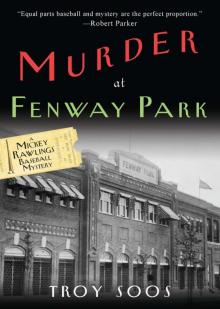
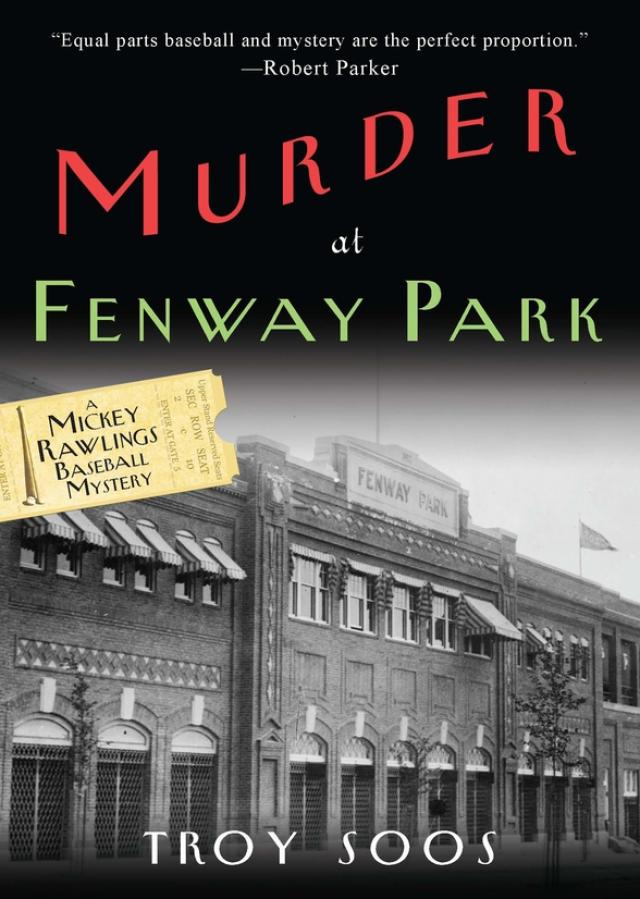
Murder at Fenway Park, page 11
part #1 of A Mickey Rawlings Baseball Mystery Series


The second game continued where the first left off. Bucky O’Brien was now the beneficiary of the Highlanders’ lackluster play and the Red Sox’s scoring barrage. After three innings, we already led 7—0. The commanding lead and the hellish heat prompted Jake Stahl to give the bench-warmers some playing time.
I took over at shortstop, Billy Neal finally went in for Carrigan behind the plate, and to the delight of all the Sox players, Clyde Fletcher trotted out to substitute for Duffy Lewis in left field.
I was eager to see how Fletch would handle the wall. But O’Brien was on a roll, striking out a string of Highlander hitters, so neither Fletcher nor I had a fielding chance in our first two innings.
In the bottom of the fifth, with the bases loaded, Fletcher came up to bat against Jack Warhop. Down the left field line of the ballpark, next to the scoreboard above the fence, was a huge billboard that read:
MUMM’S
EXTRA RYE
WHISKEY
Taking a hopeful rip at Warhop’s first pitch, Fletcher tagged a screamer right up the line. It was still rising when it struck the word RYE—just inside fair territory—for a grand slam home run. It was Fletcher’s first hit of the season, but he trotted around the bases as nonchalantly as if he hit a homer every day.
I ran from the on-deck circle and joined the scoring runners in greeting Fletcher on his triumphant arrival at the plate. I teased him that the whiskey sign was just his kind of target.
I then took my place in the batter’s box knowing full well that I was going up as a target for Warhop’s wrath. Sure enough, his first throw—he didn’t even pretend it was a pitch—came straight for my head and I hit the dirt to avoid it.
Then he threw again and caught me by surprise, almost nailing me in the neck. One duster is expected, but two is out of line. My teammates moved to the front of the Sox dugout, yelling curses and threats at Warhop. Undeterred by their yells, his third pitch plunked me in the ribs. With tempers already shortened by the heat, the Red Sox stormed the field, Jake Stahl leading the charge. Both benches emptied, and fights broke out all over the field.
I noticed that Clyde Fletcher ran directly toward Hal Chase, dodging more reachable opponents to get to him. I figured Fletch was going to administer a payback for Chase cheating him at cards. Chase spotted him, and ran to face him head on. Maybe heat waves affected my vision, because the two of them looked like that scene from the movies—the one where lovers lope across a meadow in slow motion to meet in the middle and embrace.
I grappled with the Highlander catcher. We wrestled a while to no decision, he impeded by his catching gear, I in pain from my bruised side, and both of us wilted from the sun and the exertion.
Like most baseball fights, the scuffles subsided after lots of pushing and shoving and few good punches. Umpire Silk O’Loughlin then tossed Stahl and Warhop out of the game. Warhop looked relieved to be leaving the field.
I trotted to first base with an affected limp, trying to look as if I was in too much pain to run well.
Since Warhop’s replacement was brought into the game after a ruckus on the field, I figured it would take him awhile to get settled. So on his first pitch I swiped second base in a clean steal. Some of the New York players, Hal Chase especially, started yelling at me for trying to show them up. Everybody knows you don’t rub your opponents’ noses in it by stealing bases when you’re up by a bushel of runs. Well, that’s just too bad if they don’t like it; you don’t throw at a guy three straight pitches, either.
I hadn’t exacted enough of a revenge yet, so on the next pitch I stole third base. I slid safely under the third baseman’s tag, then felt fresh pains as he jumped on top of me and started punching. Again both benches emptied. This time it took longer to restore order, with the Highlander third baseman the only player banished by O’Loughlin.
Before leaving the field and dugout, Stahl had appointed Bill Carrigan acting manager—then continued to call the shots from the dugout runway out of sight of O’Loughlin. Since O’Brien had gone the five innings he needed to get credit for what should soon be a win, Stahl—via Carrigan—sent Charlie Strickler to the mound to mop up.
The next three innings went by without incident.
The score was 14—0, with two outs in the top of the ninth, when Hal Chase lifted a high fly deep to left field. I turned around and ran onto the outfield grass in case I’d have to take a cutoff throw. I saw that Clyde Fletcher had already taken off and was lumbering back toward the fence. As he approached the hill, I muttered inaudible encouragement, “C’mon, Fletch. You can do it. C’mon ... That’s it ...”
Fletcher kept his head down, eyes on the tricky ground, and successfully made his way to the top of the slope. Not until then did he look up for the ball, only to find that he’d misjudged it—the ball wasn’t carrying all the way to the fence. I saw him freeze momentarily, a look of panic on his face. Then he put his legs in gear to run back in.
About his fourth stride down the hill, Fletcher stumbled and belly-flopped onto the ground. He just lay there, face down, arms and legs splayed.
I raced out to field the ball while Tris Speaker ran over from center field. The ball struck the slope about ten feet from Fletcher’s outstretched body. It took one bounce to the wall and then caromed back in my direction. I reached it before Speaker could, and wheeled around to throw to Larry Gardner. He relayed it to Billy Neal in time to nail Chase at the plate. That ended the game with the shutout intact.
I waited a moment until I saw Fletcher getting up under his own power, then I ran off the field to join my teammates in the clubhouse.
The players were raucous with good humor. There’s nothing like slaughtering the opposition to put ball players in a good mood.
More than one of my teammates slapped me on the back with congratulations on saving the shutout. This, and the fact that they had twice come out fighting in my defense, made me awfully proud.
Clyde Fletcher finally shuffled into the locker room looking red-faced and flustered. Before we could rib him about his nosedive into the outfield turf, he took the offensive, yelling to the room in general, “Goddam sons of bitches! Every goddam one of you puts in his two bits telling me how to get up that goddam hill, and not one of you got sense enough to tell me how to get back down!”
That out of his system, Fletcher exposed his stained brown teeth and joined in the clubhouse revelry. For the first time, I felt that we were both really part of this team.
The next morning, I bought copies of most of the Boston newspapers, and eagerly turned to the sports sections. Just as I hoped: both Clyde Fletcher and I were prominently mentioned in the stories of the Fenway doubleheader. Usually when I got into a ball game, my performance garnered me no more than a plain line in the box score. It was a rare thrill to see my name in the text of the articles, and it felt a special treat to appear there with my roomie.
Before clipping out the articles, I noticed that in Detroit’s game against the Browns Ty Cobb celebrated the holiday by stealing his way around the bases. Second, third, and then home. That Ty Cobb sure knew how to demoralize the opposition. Jeez, why did all that talent have to end up in the world’s meanest human?
Two days after Clyde Fletcher drilled his Fourth of July grand slam, Bob Tyler released him. Fletch wasn’t even traded for another player—just dropped from the team. Discarded like a broken bat.
The news came after the closing game of the series with New York. Most of the team was still showering or changing in the locker room.
Fletcher seemed to take his dismissal in stride, but I was shaken by it. I was upset enough, in fact, to surprise myself by blurting out an uncharacteristic proposition. “Hey, Fletch, what do you say to a beer? My treat.”
Fletcher looked startled by the offer but he accepted. “Sure, kid, sounds good.”
We left the ballpark, and I deferred to Fletcher to recommend a saloon. He picked one out readily enough, and we went in. A haze of cigar smoke and the stench of stale beer filled the room. I gagged on the first mouthful of air, and had to consciously give extra power to my lungs to continue inhaling the dense bitter vapor. It wasn’t an inviting atmosphere, but it seemed exactly the right atmosphere for mourning Fletcher’s dismissal.
Walking up to the bar, I laid a ten-cent piece on it, and the saloon keeper set us up with two big drafts. The thick yellow head of foam in front of me looked delicious. I scooped up a clump of it with my finger and stuck it in my mouth.
Fletcher didn’t approve of my drinking technique. “That ain’t an ice cream soda, kid.”
“Yeah, I know. I like the foam.”
“Suit yourself.” Fletcher downed half his glass in one big swallow.
I gave up on eating the foam and followed his example, gulping most of what was in my glass. I was surprised at how nicely it went down. It seemed the best thing in the world to pour down one’s throat after a hot dusty ball game. About a minute after guzzling the brew, a soothing warmth slowly rippled up through my stomach. I like this stuff.
“I tell yuh, kid, you oughta do this more often. Might improve your hitting.”
“Beer will improve my hitting?”
“I said ‘might.’ Then again, might not. But look at it this way: you don’t really drink, you don’t smoke, don’t chew, don’t chase broads, and don’t gamble—and you still can’t hit over .250! I tell yuh, kid, you’re the kind of guy gives clean living a bad name. Take it from me, do some more drinking now and then, run around a little—it’ll loosen you up. Put another twenty points on your batting average. Maybe.”
I was pretty skeptical, but then after my third draft it didn’t seem out of the question that a few beers now and again could enhance my hitting skills.
Into my fourth beer, I started to get maudlin. “Jeez, Fletch, I’m really gonna miss you. How the hell can Stahl let you go after that home run?”
“Don’t worry ’bout it, kid. It ain’t the first time. At least I got a chance to get that hit. Sure got Warhop’s goat didn’t it? Jake said they were gonna release me anyway, but he wanted me to get in a game first. Hell, I got no hard feelings against Jake.”
“Still, it don’t seem right. What do you think you’re gonna do?”
“I’ll get picked up by somebody. If not, what the hell, I’ll play semipro or something. Don’t worry ’bout me.”
“I’ll be right back.”
“Again? What are you? A goddam sieve?” His amazement at my frequent trips to the toilet was exceeded only by my own astonishment at his not going at all. Where the hell was he storing it?
After I arrived back at the bar stool, Fletcher asked, “Hey, kid, you know why beer goes through you so fast?”
I shook my head no, and lifted a fifth glass to my lips.
“Because it don’t have to stop to change color! Hah!”
Tingly beer shot out through my nose as I burst into laughter. It seemed the most hilarious thing I’d ever heard.
“That one has whiskers on it, Fletch.” Billy Neal’s voice came from over my shoulder. I looked behind me to see Neal along with Charlie Strickler and Bucky O’Brien. Except for Bucky, this was turning into a bench-warmers convention.
Neal suggested we all get a table together. He gave us the news that Strickler had just joined Fletcher among the ranks of former Red Sox. This would be a goodbye party for both of them.
But before I’d toast Charlie Strickler, I had something to get straight with him. Fletcher and I got off our bar stools, but instead of walking to a table I tapped Strickler’s arm and said, “Lemme ask you something.”
He stayed back from the others with me, asking, “Yeah? What?”
“You’re a liar.”
“You’re drunk. And watch who you’re calling a liar.”
“You told me you didn’t know Red Corriden.”
Strickler smiled. “Oh, that.”
“Then I found out you and him were roomies. You lied.”
“Yeah, I guess I did at that. Look, kid, when you asked me about him I figured you were a friend of his. So I figured you were one of them. ”
“What them?”
“Bible-thumpers. That kid was always preaching at me ’bout what a sinner I was. Just ’cause I take a drink now and then, or maybe play a little cards. Goddam kid drove me nuts. Judging from your breath, I guess I was wrong about you being a pal of his. Let me buy you a beer.”
We joined the others at a table, and I let Strickler buy me the beer. I made it my last. Bidding Fletcher an affectionate goodbye, I left him with the other Sox and staggered home alone.
I snuck back into my room, careful not to make any noise. I hoped that I wouldn’t encounter Mrs. O’Brien. She didn’t seem the type of landlady who would tolerate drunken boarders.
I felt euphoric after my outing with Fletcher, not least of all because of the newly discovered fact that I could down half a dozen beers and keep them down.
After wrestling off my clothes, I fell heavily into bed. Maybe the beer had me energized somehow, because I couldn’t seem to lie still. Then I realized I was still, but everything else was moving. The bed swayed and bobbed as if it were on springs, the walls of the room rotated like a panorama, and my pillow quivered as if it were made of jelly. Feeling that I might be tossed out of the bed, I spread my arms to brace myself against the motion.
Eventually the various movements of the room subsided. I started to drift in and out of a fitful doze punctuated by disjointed thoughts and bizarre fragments of dreams.
Suddenly, amid the strange and convoluted images passing through my pickled mind, an inspired thought jumped to the forefront. It told me who killed Red Corriden.
I still retained enough rational thought to realize that I wouldn’t remember the murderer’s name in the morning. I needed to write it down. With intense effort, I pulled myself out of bed. As I stood, the bobbing sensation returned. With my equilibrium all but gone, I groped my way around the room until I felt a pencil stub on top of the writing table. I felt around and grabbed one of the articles I had clipped out after the holiday doubleheader. Unable to see what I was writing, I carefully formed the name of the killer near the edge of the clipping and stumbled back to bed.
I awoke late in the morning, convinced that either my eyeballs had grown during the night or their sockets had shrunk. My eyes felt tightly gripped, and throbbed with pain from the pressure around them.
I tried hard to remember what happened last night. I believed that I had a good time, but if I did, why did I feel so wretched now?
I tried to retrace last night’s activities and conversations in my mind. As I worked my way through the muddled recollections and vague impressions, I remembered that at some point I lit on the identity of Corriden’s killer. Did I really, or did I just think it came to me? And if it did, who was it?
I had a feeling that I wrote down the name. Painfully, I pulled myself out of bed. After my legs started to feel as if they had enough rigidity to keep me erect, I began a labored tour of the room. Sure enough, on my writing desk was one of my clippings with a name scribbled in the margin: Cobbb.
The handwriting was shaky—or my eyes were blurry—but that’s what it said. Cobbb. As in Ty Cobb.
Jeez, I must have been drunk.
So, according to this scrap of paper, Ty Cobb was the killer. This “solution” promptly raised more questions than it answered. Why was it Cobb? Or why did I know it was Cobb? Or why did I think I knew it was Cobb?
Perhaps it was just wishful thinking on my part. A murderer has to be nasty, and who was nastier than Ty Cobb? But this wasn’t really a solution. There wasn’t any evidence, just the ramblings of a drunken mind.
I put the clipping in a drawer and decided that I might think about it after my head cleared up—optimisticaHy hoping, but not entirely sure, that it would someday again be clear.
Chapter Fifteen
I could really be on to something here. It seemed unlikely that a credible idea could emerge from the random wanderings of an alcohol-abetted imagination, but maybe it was so. Maybe Ty Cobb did murder Red Corriden.
The Red Sox team was journeying West for a short road trip to St. Louis and Chicago. I had tried to shake off my crazy Ty Cobb dream or hunch or whatever it was, but it kept coming back to me, each time stronger and more insistent. Finally I figured, what the hell, it’s a long enough train ride. I’d let myself consider this Ty Cobb idea, and just let the notion play itself out. But once I dropped the restraints on Cobb and let him loose in my thoughts, the idea that he was the killer of Red Corriden moved beyond the realm of drunken rambling and turned into a compelling theory.
I looked at the situation analytically, as I knew Peggy would. Means, motive, and opportunity.
First, means and opportunity: Ty Cobb fit both of these requirements. He was in Fenway Park with Corriden, he had access to baseball bats, and he certainly had the strength and temper to put a bat to violent use.
Then motive. Why would anyone want to murder a young baseball player from Indiana? According to Peggy, husbands and wives often killed each other, but she’d found out that Corriden wasn’t married, so that possibility was out. Money was a popular motive, but a rookie ball player was unlikely to be rich. Of course, he could have been killed for his pocket money—but then we’re back to it being a mugging.
Revenge then? Revenge for what? Did Red Corriden ever do something so terrible that it warranted such severe retaliation? Perhaps... to one man’s point of view.
As far as I knew, the only suspicious activity that ever involved Red Corriden was the final day of the 1910 baseball season, when he played out of position to let Nap Lajoie lay down cheap bunt singles. It almost cost Ty Cobb the batting title. The league exonerated Corriden, but did Cobb? Ty Cobb seemed to have his own view of right and wrong. He also seemed to find no shortage of people who had wronged him.