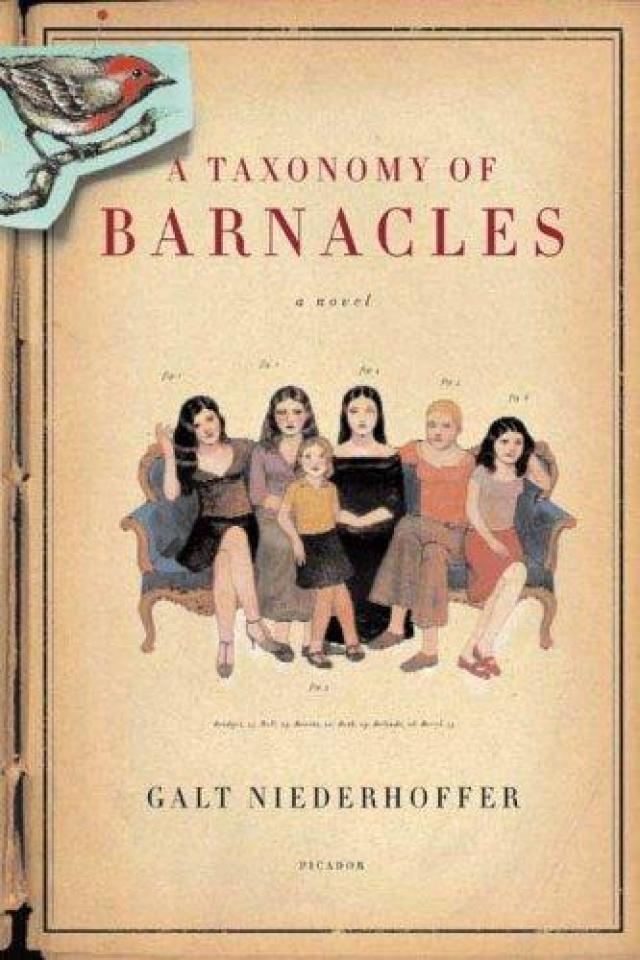
A Taxonomy of Barnacles, page 8


Thinking fast, Benita screamed at such a high decibel that Trot was forced to turn his head, if only on reflex. However, just before he turned, he caught another glimpse of the extra foot, or rather an indistinguishable blur that resembled a girl’s leg. Desperate now, Benita resorted to bullying tactics, grabbing Trot’s wrist and trying in vain to drag him out of the piano room. But, newly confident, Trot held fast and stationed his feet on the ground.
“Would you mind if I played a minute?” he asked.
“We really should get back,” Benita said. “Dinner’s almost ready.”
Trot ignored Benita, wriggling out of her grasp and walking to the piano. He took a seat at the bench, cracked his knuckles theatrically, and competently played the opening chords of Beethoven’s madcap, if melodramatic, Fifth symphony.
“How did you know that?” Benita demanded.
“Gosh,” said Trot. “I don’t know.” He paused to play the first four notes again, the opening da-da-da-dum. “This is how destiny knocks on the door,” he said instructively.
Benita stared at Trot, confused.
“That’s how Beethoven described the beginning of his symphony. Those first four notes were meant to sound like someone knocking at a door.” Trot played the da-da-da-dum again to reaffirm his point. “See,” he said. “Doesn’t it sound like destiny knocking?”
But before Benita could respond, another point of view made itself known. “So pocht das schiksel on die forte,” said the piano bench.
Trot scanned the room with feigned confusion.
The piano bench sighed wearily. “That’s German for ‘This is how destiny knocks on the door.’ The piece is considered Beethoven’s masterpiece because he played with both form and time signature. It’s considered the quintessential romantic symphony because of its clear narrative arc. Still, the piece is something of a mystery. Some say the music tells the story of a war, the French versus the Germans, fate versus free will, man versus heredity. Others say it’s a rhapsody, a love letter to the world written by a deaf man. Others say it’s an elegy, a dirge for the funeral of sound.”
Trot listened deliberately while the piano bench spoke, one ear tilted toward the ceiling as though he were trying to find the source of a leak.
Finally, Beryl extended her head from under the piano bench. “But, in my father’s opinion,” she concluded, “musical scholars have got it wrong. The first four notes are the sound of man knocking at destiny’s door, not the other way around.”
“I see,” said Trot. “I stand corrected.” He nodded, smiled politely, then stood from the bench and headed for the door as though this last exchange were the most normal thing in the world, as though piano benches conversed with him all the time.
As soon as Trot was gone, Ben dropped to the ground and widened her eyes at Beryl. Beryl acknowledged her deference for Trot with a nod of resignation. Beryl later claimed she had seen Trot and Benita coming, had sensed their approach long before they arrived. She had hidden, Beryl insisted, to test her family’s love and intelligence respectively, to see how hard they searched for her and how long the search took. Slowly, she gathered her accumulated belongings—a stockpile of books, snacks, and flashlight—and, using her clothes as a sort of sled, she slid out from under the piano into the room. Without a word to Benita, she stood and departed, leaving her sister to realize, once it was too late to poke fun, that Beryl’s black sweater was, in fact, a black cape.
Beryl, the fifth and most sensitive sister, often wondered if she’d been adopted. It was as though she knew she’d been conceived in a test tube in a clinic in Switzerland. After Belinda, Barry had begged Bella to give science a shot. Unfortunately, heredity hates meddlers and, in defiance, produced another girl, a child completely unlike her sisters at the level of the soul. Beryl’s angelically sweet disposition and her inherent disdain for her siblings caused many to wonder if she had a different genetic code. The most naturally artistic of the six, Beryl could entertain herself for hours, humming, painting, playing the piano, or rearranging her dolls and acting out elaborate plots with the fervency of a madwoman. As a result, her sisters accused Beryl of being part alien. Beryl only compounded their persecution by making the claim, early in life, that she possessed psychic powers.
Her sisters, of course, dismissed this notion, attributing any correct predictions Beryl made to accident. But Beryl refused to be discouraged, claiming her sensitivity was so acute that she could smell the future like garlic in a frying pan. She could detect a phone call seconds before the phone rang, a cruel sentiment from her sisters before it was expressed, and throbbing pain in her foot before she stubbed her toe. But her powers were most accurate, she argued, in the presence of love. For this reason, when it came to her sisters, Beryl’s signals were weak. They were, on the other hand, extremely attuned when it came to her adopted brother. She and Latrell shared a bond that was much stronger than blood. Often, when Latrell ran away, Beryl knew where he was hiding. But this proved nothing to her sisters. Latrell, they explained, simply told Beryl his plans before he left the house. Lacking definitive proof of her talent, Beryl resorted to glancing meaningfully out of windows, saying cryptic, portentous things, and sporadically warning her sisters of their imminent demise.
In addition to this alleged talent, Beryl was a truly gifted musician and so suffered the brunt of her father’s vicarious musical aspirations. She spent hours playing the piano on her own and during Barry’s regimented hours. The other girls, though relieved to be spared the burden of practicing the piano themselves, were annoyed by the noise Beryl produced nonetheless and urged her to cultivate quieter forms of expression. To this end, she set up an easel in her room and taught herself to paint, using fruit from the kitchen. Gradually, she moved from still lifes to anatomical drawing, and then to portraiture, completing the renderings of the family that hung in the gallery. When she wasn’t painting or playing the piano, Beryl could be found sitting in her room, writing poetry, scribbling thoughts in her journal, or just staring into space.
“Wait.” Benita ran to catch up with Trot before he reached the end of the hall. When she caught up with him, he was steps away from the living room. “There’s something else you should know,” she panted. “My father only likes people who are very bizarre.”
“Is that right?” Trot asked, humoring her.
“Oh, yes,” Benita said, “the weirder the better. But what he really loves is to be insulted.”
“Hmm,” said Trot, maintaining his pace. “Direct attacks or just gentle barbs?”
“Really nasty stuff,” Benita said, narrowing her eyes authoritatively.
“Good to know,” Trot said. “Thanks again for the tour. I feel much better equipped.”
Eager to return to adult company, Trot hurried into the living room. Benita grabbed his forearm frantically just before he entered.
“Stop,” she said. “I owe you an apology. There’s something I should have told you.”
“What’s that?” Trot asked. He was back on his feet. Nothing could throw him now.
“Bridget’s been lying to you,” Benita announced.
“You are a savage little brat,” said Trot.
“Ask her,” said Benita. “I’m telling the truth. They had dinner together last week.”
Bridget instinctively stiffened at the sound of Trot’s voice. But stiffening only made it harder to stand from her position on the floor. As a result, Trot entered the living room in time to find Bridget kneeling in front of Billy. He stood for a moment, looking from Bridget to Benita as though unsure of which one to blame. Wisely, Bridget decided that citing a proposal would do little to explain her compromised position. Instead, she hoisted herself from the ground and assumed a haughty look. As though on cue, Billy stood and walked to the kitchen.
“Reminiscing?” Trot asked. “Something from childhood or dinner last week?”
Without a word or change in expression, Bridget walked to Benita and grabbed her by the back of her neck.
“Monster!” Bridget shouted. “We’re not related.”
“What?” Benita screeched, wriggling out of Bridget’s grasp. “You never said I couldn’t mention that.”
4
Excellent Peripheral Vision
There is no Jewish holiday on which a girl is more aware of her subordinate status to boys than Passover. The seder is, in essence, a tribute to a generation of Jewish sons. Even at the Barnacles’, despite its large female population, the Passover seder was still an ode to boys. The inherent favoritism of the holiday was made all the worse by Bunny, who colonized the occasion when she discovered kabbalah. To her credit, Bunny had not allowed Judaism to eclipse her other passions. She was also devoted to maintaining her hair, torturing Bella, monitoring Barry’s finances, and, despite the conflict of interest, spending Barry’s money. All of the girls disliked Bunny, except for Belinda; Belinda hated Bunny with all of her heart. If Bunny’s demeanor was not enough reason to inspire hatred, her nickname sealed her fate. Every so often, an old friend of hers would call the house asking for Bubbles, the name Bunny had been given during college due to her proclivity for champagne and one infamous night involving the Rugby team and a Jacuzzi.
Despite the excesses of her college years, Bunny had grown up in a very religious family that conducted their seder in the ancient language. And though her father had passed away, Bunny insisted that the Barnacle seder be conducted in Hebrew as a memorial to her father. As a result the Barnacle girls, who neither spoke nor read Hebrew, had to smile and make awkward eye contact for the duration of the service, while Bunny belted out her favorite Hebrew songs, enhancing the inherent melancholy of the minor chords with a vibrato learned during singing lessons. Whenever anyone was unfortunate enough to catch her eye, Bunny frowned disdainfully and mouthed the word “sing.” She construed any request to skip a song—requests that were motivated both by the desire to quiet her nasal singing voice and by the aching hunger experienced during the third hour of the service—as attacks on her deceased father. Thus, the Passover seder, already a night devoted to sons, evolved into a duel of the dads. The girls liked to joke that their family seder should be renamed the “eleventh plague.”
When Barry announced his plans to marry Bunny, the Barnacle girls had done everything in their power to sabotage the union. For the months leading up to the date, the girls lobbied their father to reconsider. At the ceremony, they made one last-ditch effort, creating so much noise that the rabbi had to start the service over three times. When the rabbi surveyed the guests for dissenters, the girls elbowed each other madly. Benita emitted a perfectly timed, if slightly overrehearsed gagging fit at which point, amidst nauseous heaving sounds, Belinda and Beth rushed her down the aisle and out of the synagogue.
“I’m ready,” Bunny sang out from the kitchen. “Everyone, please sit down.” Everything Bunny said, even the rare pleasantry, was braided with bitterness. This constant confusion of anger and sweetness produced a maddening effect, forcing those around her to brace for attack, particularly when she was nicest. “Girls, Barry, everyone,” she called again. And then, as though cordiality had an undertow, she added, shrill and indignant, “I hope you don’t expect me to wait for Bell.”
Bunny wore a short, black wool sheath that was way too sexy for the occasion, the hemline of which was closer to her waist than her knees.
Grumbling, Belinda and Beth headed toward the table.
“Gross,” Belinda said. “I hope she doesn’t get her hair in our food.”
“Why not?” Beth quipped. “It might make it taste better.”
Trot approached the dining room cautiously, tabling his annoyance for the time being. He would put on a good face for the rest of the night, he decided. He would show Bridget, by living comparison, the difference between a gentleman and a buffoon. But as Trot headed toward the table, Barry intercepted again, ushering Trot, by way of an ominous nod, into the nearest bathroom. Trot waited anxiously while Barry cleared his throat. He could only assume Barry was insistent on hearing Trot’s intentions with Bridget. Though Trot had planned to ask for Bridget’s hand in a more traditional manner and place, he respected Barry’s preemptive move and prepared himself for the task.
“See this,” Barry said, gesturing toward the commode.
Trot followed Barry’s hand to the toilet seat and waited for clarification. Suddenly, Barry clapped loudly. Trot flinched femininely at the sound. The toilet seat dropped from its upright position to snap violently closed.
Barry beamed at his invention.
Trot smiled hesitantly.
“I thought you would like it,” Barry said. “Since you’re creative.”
Trot mumbled an assent and thanked Barry for the compliment. He was pleased by one thing at least. This was already, by leaps and bounds, the longest conversation he and Barry had ever had.
Barry stared at the toilet as though in a reverie, grunted proudly, then, with a quick perfunctory nod, he left Trot alone in the bathroom to contemplate creative solutions to his current plight.
* * *
The Barnacle seder always began with the Haggadah’s prescribed list of questions and answers. This year, Belinda, sixteen and certain of her convictions, felt these questions raised more important questions that she didn’t hesitate to point out. Torah question: Why were Jews encouraged to invite non-Jews to the Passover meal? Torah answer: To share Jewish heritage with others and to work against the religious persecution Jews had historically suffered. Belinda’s answer: To torture as many people as possible with the arduous ritual. Torah question: Why did the seder claim to celebrate family when the meal invariably ended with a terrible brawl? Torah answer: Because the seder commemorated the hardship of one loyal family. Belinda’s answer: To torture every member of the family, even though most of these people agreed that religion was evil and corrupt.
As Belinda offered her interpretation of the traditional questions, Benita raised her hand and waved it aggressively. “I have a question,” she shouted, panting breathlessly.
“Yes,” Barry nodded. “What is your question?”
“What is the Jewish mafia?” Benita asked.
“One of many terms,” Barry replied, “anti-Semites use to denigrate successful Jews.”
“Oops,” said Benita, covering her mouth in a manner designed to convey a lack, as opposed to an excess, of remorse.
“Don’t ask her why,” Beth said.
But it was too late. Barry wanted a detailed explanation of how she’d come to hear the expression and Benita was happy to supply it. Benita’s classmate, Mary Talbot had told the class that Barry was in the Jewish mafia. Benita suspected that Mary was jealous that she had won the Chapin School talent show last year and would likely win it again. Still, Benita wanted to know if Barry had ever killed a man, put a dead canary on a doorstep, or cut off the head of his enemy’s horse.
“Remember when your second-grade teacher said that you would chew glass to win?” Barry asked. At the time, this comment had enraged Barry and caused him, in turn, to chew out the teacher. “Whenever someone tells you you’re too competitive,” he explained, “they’re making an anti-Semitic slur. Ignore all of these people. They’re just jealous of you.”
Just like this, Benita was encouraged to continue ignoring her teachers and striving to win at any cost. The subject was quickly dropped and the ritual continued.
The table was more crowded than usual this year. The entire Barnacle family was in attendance: Barry, Bunny, Trot, the Finch twins, Bella, though she hadn’t arrived yet, and every Barnacle sister with the exception of Bell. The dining room table had been extended with the help of prosthetic desks to accommodate the guests.
“What I don’t understand,” Beryl said to no one in particular, “is why we have to eat all this terrible food.”
“Think of it like reading,” Beth said dryly, “except you get to eat the pages.”
Beryl and Latrell sat next to each other. Closest in age and preoccupation, they were allies at all such events.
“Billy,” Benita whined, “will you sit next to me?”
Trot scanned the table and quickly calculated that this would place Billy next to Bridget. He rushed to intervene while doing his best to maintain an air of nonchalance.
“Benita,” Trot said, “sit between Billy and me. That way you can tell me what everything means.”
Benita accepted the invitation as a challenge. She was, even at her tender age, a sucker for flattery.
“Thank you, Belinda,” Trot said coyly, settling into his seat. Then, feigning horror, he covered his mouth and said, “Sorry, I meant Benita.”
The meal began with a commotion of information. Belinda insisted on providing the guests with a glossary to the meal to ensure that everyone was eating from the same translation.
She held up a piece of matzoh like a bored salesclerk. “These tasteless crackers symbolize bread that didn’t have time to rise when the Jews had to escape to save their sons. This mush,” she went on, scooping up some charoset and dangling a spoonful precariously close to Beth’s face, “symbolizes the mortar Jewish sons used to build pyramids.”
Beth and Beryl smiled approvingly. Typically, they would have quieted her by now, but it was clear from Belinda’s performance that she was attempting something ambitious.
Barry spent Passover intermittently reading and dozing at the head of the table. When he did emerge from his narcoleptic state, startled by singing, squabbling, or Bunny’s nudge, he did so to engage in his strange eating ritual, which involved stabbing at his plate, inhaling large chunks of food, hiccupping loudly as he chewed, and thereby rendering digestion impossible for anyone nearby. When he remained conscious long enough to apprehend the service, his boredom spurred him to expedite the meal.