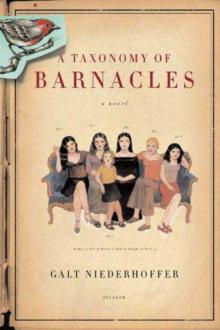
A Taxonomy of Barnacles, page 28


“First of all,” Benita said, “don’t shoot the messenger. Second of all.” She paused for effect. “I never said it was Trot.”
“Who was it then?” Billy shouted, abandoning all self-restraint.
Benita said nothing and wrinkled her brow in an impersonation of concern. “I just assumed it was you,” she said. “Must have been your dead ringer.”
Billy said nothing. He stood very still, immobilized by rage, bile coursing through every vein as though he had been injected. Surely, Benita could not be trusted. Her mission in life was to provoke. Surely, this could be ruled out as a bold-faced fabrication. In all these years, it had never occurred to him to suspect his brother. Blaine would never stoop so low, to such biblical proportions. And yet Billy knew somehow he couldn’t rule out the possibility. This would certainly explain Blaine’s behavior of late, his odd advice on the tennis court, his attempt to delay the proposal. Was it possible, after all these years, that a woman had come between them? Was it possible that Bridget would be the deciding match in their rivalry? Enraged, Billy left Benita without further discussion and hurried back to his apartment to have a word with his brother.
Unfortunately, anger had no chance to be cooled by time or reason. Billy found Blaine in the living room, languishing on the sofa, alternating his gaze between a magazine and the television.
“Where did you spend the night?” Billy demanded. He walked to the center of the room, deliberately obscuring Blaine’s line of vision.
But Blaine simply shifted his gaze from the television to his magazine and completed his current paragraph before looking up. “Isn’t it obvious,” Blaine lied. “I spent the night with Bell.”
“But I…” Billy said. “But you…” For a moment, clarity came to him but only for a brief moment. Within seconds, he sank back into a vortex of confusion.
“Oh no,” said Blaine. “Did something happen? I told you to take a night off.”
“Nothing happened,” Billy snapped. Then, anxious to save face, he lied, “Bridget and I had a great time.”
“Oh, Billy.” Blaine smiled condescendingly. “You don’t have to pretend with me. I happen to know for a fact that you weren’t with Bridget last night.”
“How do you know that?” Billy demanded.
Blaine smiled. “Twin’s intuition.”
Blaine checked Billy’s eyes quickly for signs of discovery then, assured of Billy’s confusion, turned back to his magazine.
Billy felt ten different emotions before settling into despair.
Finally, Blaine took pity on Billy and offered him his full attention. “How about some tennis?” he suggested. “I’m in the mood to beat you.”
“What makes you think that would happen?” asked Billy.
“Statistics,” Blaine replied.
“You’re not better,” Billy insisted. “We just have different strengths.”
“All right, I’ll give you that,” Blaine teased. “Clearly, women like me better.”
18
Telepathy
After his conversation with Blaine, Billy felt near madness. His brain did not feel like a solid object, but rather a porous substance. Every thought that entered his head bubbled to the surface for a moment then, before he could make sense of it, sunk back down as though pulled by the force of so much swirling liquid. In the hopes that fresh air would revive his spirits, he left the apartment, walked through Central Park and then hopped on the 1 train at Columbus Circle and rode to the West Village. He emerged from the train at Fourteenth Street, headed south down Eighth to Bleecker, picked up his pace to a confident stride as he passed Jane Street and headed for the Magnolia Bakery. The shop, a beloved powder pink hovel on Bleecker and West Eleventh, was notorious for its luscious and creamy cupcakes and accordingly charged its customers obscene amounts for the delicacy. But the overpriced and, Billy felt, overhyped baked goods only added to the mystique. At all hours, the shop was obscured by a line that circled the block, the patrons even more fabulous than the pastries in the windows. When Billy arrived, the bakery was just closing up. He paused across the street and remained there for a moment, peering through the window at Trot. Indeed, for all his professed hatred, Billy secretly admired Trot. Trot was so seamless, so effortlessly authentic. He was, for all intents and purposes, everything Billy was not.
Trot’s height and admirable lankiness made Billy feel portly and stout. Trot, though he was in Billy’s estimation insufferably self-righteous, was something Billy was not: a living emblem of an artist, slovenly dressed, tortured by his work, arguably hungry, if not “starving,” and actually impoverished. Now, for the first time in his life, Billy acknowledged his entitlement. Money had never factored into his sense of himself. If anything, growing up, his parents’ fortune had seemed embarrassingly modest compared to some of the people in their circle. But now Billy glimpsed the full scope and abundance of his privilege and instead of feeling gratitude for his good fortune, he found himself wondering if these gifts had, in some way, cost him.
The bakery was annoyingly picturesque, painted three different shades of pastel and populated by a staff of impossibly hip young adults. Each one was outfitted in expensive jeans and T-shirts made to look like they’d been wrangled from the trash. As they cleaned and closed up, they listened to obsure underground techno music with sporadic precious “oldies” thrown in for good measure. As Billy watched, Trot wiped down the counters and glass cases with almost religious concentration. He mussed his hair and untucked his shirt in efforts to distance himself from the Upper East Side. Then, ignoring a CLOSED sign in the window, he crossed the street and entered the bakery.
“Trot, what a pleasure,” Billy said, forcing a cheery smile.
Trot stiffened at the sight of Billy but managed a polite nod. Billy should have worn his bow tie, Trot thought. The polka dots would have complimented the cupcakes.
Billy scanned the store, and found it confirmed his earlier assessment. What fun it must be to work, Billy thought. He imagined all the frivolity and laughter, the impromptu dance parties, the spontaneous food fights, the delving literary conversations. Finally, one of the girls on the staff noticed Billy and ushered him out.
Trot stopped her, nodding his consent.
“I need a cake,” Billy declared.
Trot returned the smile with the minimum effort.
Billy leaned on the counter, Trot thought, as though it belonged to him.
“That could be tough,” Trot said. “Unfortunately, we’re sold out.”
Billy frowned and nodded toward a shelf just above Trot’s head. It was cluttered with a luxurious assortment of cakes, each one decadently smothered with frosting. “What about those?” he demanded.
“Those were special-ordered,” Trot said.
Billy assumed his most accommodating look.
“Sorry,” Trot said. “Store policy.”
Refusing to admit defeat, Billy tried a more aggressive tack. “I’m willing to pay double,” he said. “It’s for a special occasion.”
Again, Trot mustered a pleasant smile and began to shake his head.
Billy preempted his dissent, produced a fifty-dollar bill, and flapped it like a sail.
“Sorry,” said Trot. He inhaled deeply in the hopes of suppressing his temper. “I don’t know what to tell you. We don’t make exceptions.”
Refusing to accept defeat, Billy forced a smile. Was it possible that Trot knew the recipient of the cake and wanted to sabotage Billy’s chances?
But Trot held fast, crossing his arms with new authority. Unfortunately, not everyone on the staff shared Trot’s high standards.
“I’ll help you out,” someone volunteered.
Trot turned to locate the traitor. A girl on the staff shrugged apologetically, then rushed to accept Billy’s cash offer.
“Thank you so much,” Billy told the girl. He smiled triumphantly.
“My pleasure,” she said. She extended her hand for the bill then hurried to the back of the store to fill Billy’s order.
Trot stared at Billy, agape, forgetting his manners for the moment. Then he turned to follow his coworker, concerned he might punch Billy out if he didn’t put some distance between them.
Billy rode the subway back uptown, cradling the cake box. He felt positively nauseated as he sat on the train, overwrought with the special havoc that accompanies a very long and drawn-out courtship. It was as though his heart had been removed from his chest while he was sleeping. Fortunately, the movement of the train lulled him back toward lucidity. Tonight, he would try the most traditional proposal, drawing on a time-tested cliché. Tonight, he would pay Trot the ultimate insult, using the very instrument of his torture to win Bridget’s heart.
To be sure, it was slightly counterintuitive to obscure his grandmother’s impressive rock in a mound of pink frosting. But he felt this brazen act bore the mark of all great proposals; it could be easily condensed to a one-liner and therefore retold endlessly. Energized, he sprinted from the subway station back to his parents’ apartment, nearly knocking over his mother’s housekeeper as he set off to procure his grandmother’s ring. The jewel itself, even without such a presentation, could likely convince the coyest of women because it surpassed in size and lineage every ring in the history of proposing. The diamond was less like a rock and more like an article of clothing and sat in its setting like a queen on a throne, as though to remind viewers of the prestige of the owner’s family. The round stone, like all cushion-cut diamonds, was cut like a prism. This gave it the distinct illusion that one was not so much looking at a ring as looking into infinity. The fourteen-carat diamond was graced with absolutely no inclusions and bore, in addition to its inherent weight, the heaviness of its surrounding facets.
The setting was a row of forty round one-carat diamonds that orbited the central diamond. The band continued this same pattern, matching the size and quality of the diamonds on the setting, as though the ring was too perfect to sit atop an orb of mere gold, but rather required a carriage comprised of its own perfect constitution. The gem, like all truly great diamonds, cast an unmistakably white light, and boasted the added luminescence of a sparkling history, its length and detail a precise function of the family’s venerable generations. According to legend, Bisbe Finch, the son of a daughter of the Mayflower, had ransacked the globe for this particular stone, trying and failing with six similar specimens before finally flying to Africa himself to supervise its purchase.
Thankfully, Mrs. Finch cooperated with Billy’s plan, having decided upon giving birth to her twins that the just beneficiary of her engagement ring would not be decided by merit or age, but rather by circumstance. The first boy who required the ring for a proposal would be granted the privilege of offering it, so long as Mrs. Finch approved of the intended recipient. Blaine, of course, had staked his claim as soon as he met Alice, requesting the rock for his young bride and, due to her auspicious ancestry, procuring it without objection. The ring had quickly resumed residence in the Finch family when Alice, despite her friends’ and parents’ exhortations, had returned the ring to Blaine, or rather hurled it at him. (Alice, though torn between the desire for erasure and remuneration, was finally convinced by her mother’s snide assessment that, despite the ring’s formidable size, it was really just cocktail attire.)
Luckily, Mrs. Finch’s appraiser was far more objective than the Appleton family and wisely took the opportunity of Blaine’s divorce to repossess the diamond. She had it cleaned and then placed it in her jewelry box for safe keeping so that it might have time to regain its shine and polish in time for its second coming. As a result, Billy was granted the ring on slightly more rigorous conditions. Not only did his intended need to receive Mrs. Finch’s stringent seal of approval but, in the event of a less than amicable parting, she must resist the urge to throw the heirloom and thus risk depreciation. Should the lucky new owner fail to polish it regularly, Mrs. Finch made Billy swear to her he would take on this duty himself. And though Bridget Barnacle was not exactly Mrs. Finch’s ideal candidate, she did offer a suitable dowry of her own and therefore, in some way, an equal and opposite capital contribution to offset the clumsiness of her name.
Once assured of privacy, Billy placed the glittering ring on the cake, adding to its ample frosting a shiny centerpiece. He was filled with a swell of confidence as he sat at the kitchen table, appraising his masterpiece, the glittering gem nearly but not completely obscured in its cushion of sugary paste. The cake was the perfect gift-wrapping, at once an ironic trivialization of the costliness of the gift—in keeping with WASP tradition—and a pointed jab at those meager men who actually had to work for a living. Moreover, it provided the perfect emblem of the cake’s recipient. Bridget was the most demanding girl in the world. It made perfect sense that she should require a dinner of diamonds. And, even better, the cake was a jab at her soon-to-be ex-boyfriend.
Armed with this new potent weapon and the fragile cake, Billy left just after midnight, carrying his gift from the Finch kitchen to the Barnacles’ apartment. Finding it open as usual, he took the liberty of letting himself in, and crept down the hall toward Bell and Bridget’s bedroom, his heart threatening to burst from his chest. Sadly, neither foresight nor prescience were Billy’s strong suit. Within seconds, he encountered an unexpected problem; the cake was not easily hidden. In fact, obscuring the cake behind his back as one might a bouquet of flowers, producing it with gallant nonchalance on sight of Bridget, would surely cause the cake to topple to the ground, hurling ring from frosting and frosting from cake, thereby ruining the surprise and botching the whole plan. Kicking himself for his foolishness, Billy scanned the foyer frantically but, failing to find an inconspicuous nook, set the cake box just outside Bridget’s door and hoped for the best.
Unfortunately, love conquers all including common sense; Billy was way too anxious to take the necessary precautions. Charles, despite his age and infirmity, was still a pup at heart and perked whenever foodstuff of any sort was within a two-mile radius. As a result, he detected the cake as soon as frosting touched floorboard, and stood from his perch in the living room to follow the scent to its source. Charles, however, was only one of three complications. At the time, Billy was still wearing Blaine’s lavender shirt and, because he lacked his baseball cap, looked decidedly foppish. This, paired with an enthusiastic smile that bordered on the edge of dopey, caused Billy, in some ways to his great credit, to look rather unlike himself. And to make the matter exponentially more complex, Billy was sighted by Bunny as he entered Bell and Bridget’s room. Glimpsing only his lavender shirt, she incorrectly deduced that Billy was Blaine and, having just run into Bell in the hall, filed away the transgression should she ever need the leverage.
Bridget sat up in bed on sound of her visitor. “Hello,” she said. “Is someone there?”
Billy paused at the threshold, seriously considered turning back then, inhaling deeply, he entered the room, taking tentative steps. “Hi, Bridget. It’s me,” he said.
Bridget deflated noticeably. “Oh,” she said, then remembering her manners, “You missed her by a second.”
Billy offered Bridget a pleading smile and took another step toward her bed. “Come on,” he said. “Can’t I still come in? Don’t tell me you’re still upset.”
“I suppose,” said Bridget. She pulled up her sheets to achieve a more modest pose. “But I really don’t see the point. Bell will probably be out all night and I was just falling asleep.”
Billy looked up suddenly as though he’d caught a whiff of a strange scent. Could Bridget possibly think he was Blaine? If she did, what did that say about the strength of her affection? And yet, despite his misgivings, Billy suddenly heartened. In an instant, he glimpsed a new side of himself, a new world of possibilities. Would it make him just as insidious as Blaine if he let her go on thinking it? Would it tarnish their romance in any way if he played along for a minute, just long enough for a reconnaissance mission? Deciding his good intentions excused the betrayal in advance, he silenced his conscience for the moment and perpetuated the deception.
“That’s all right,” Billy replied, curling his lips into Blaine’s smirk. “You and I haven’t caught up in a while. Mind if I stay for a bit?”
Bridget shrugged and nodded with a half-hearted smile then, satisfied that she’d communicated indifference, she said, “No, Blaine. Suit yourself.”
On instinct, Billy fought the reflex culled over years of being addressed incorrectly, biting his tongue to prevent himself from uttering the familiar phrase, “Oh no, I’m afraid you’ve confused me with my brother. That’s Blaine; I’m Billy.” Instead, he took the chance to hone his latent acting skills and, ignoring his better judgment, launched into his best Blaine impersonation. “So, how’s life in the trenches?” he said, simulating Blaine’s easy good cheer.
“Fine, I guess,” sighed Bridget. “A little confusing of late.”
Then, without asking Bridget’s permission, Billy took a seat on her bed. Surprised by this familiar move, Bridget’s cheeks flushed to pink. She shifted her position slightly so as to put more inches between them.
Concerned he’d just betrayed himself, Billy stood up suddenly. As a cover, he made an unintelligible excuse about the unseasonable heat and sat down on Bell’s bed. He sat in silence for a moment, pretending to look out the window. But he bolstered himself and attempted to up the ante. “Bridget,” he said. “I have a confession. There’s something I need to tell you.”
Bridget displayed the palm of her hand with patronizing ennui. “Blaine, don’t say another word. That’s between you and Bell. I’m sure it’s none of my business.”
Billy paused but persevered. “No, Bridget,” he tried again.
“Seriously,” said Bridget. “I don’t want to know.”