A Taxonomy of Barnacles, page 14


“Mom, what’s wrong?” Bell asked, matter-of-fact. Spontaneous weeping no longer elicited her concern.
“Nothing,” Bella sniffled. “I’m sorry. I know I promised. It’s just that I’m so scared for you.”
“Mom,” Bell said haughtily. “I’m fine.” She stressed the word “I’m” as though to imply that Bella, on the other hand, was not.
“Oh Bell, don’t pretend,” Bella snorted. “I see what you are … how you used to be … oh, Bell, it’s so awful. You’re just like me.”
Mothers and daughters fight a war of attrition. This was something Bell had come to understand. Mothers have the advantage of wisdom. Daughters have the advantage of youth. Mothers have the disadvantage of age; daughters, inexperience. Therefore, the two camps are equally matched. But daughters will eventually win, Bell concluded, as long as they fight to the death. Still, for some reason, when Bell and Bella fought, both were incapacitated.
Bella blew her nose with an exaggerated honk.
Bell waited for silence and, assuming a neutral tone, changed the subject. “So,” she said, “how is Latrell?”
“Latrell,” Bella sneered, “has not been here since yesterday.”
“Is he staying with a friend?” Bell asked casually, refusing to acknowledge her mother’s loaded look.
“How would I know?” Bella sniffed. “I’m only his mother.”
Only a hustler, Bell thought, could couple such vulnerability with such strength. She attempted to prevent her mother from sighing by picking up the conversation’s pace. “The apartment looks good,” she lied. “You must be almost finished.”
“Oh, I don’t want them to finish,” Bella said. “Then, who would I talk to?”
“This food is delicious,” Bell tried, inserting a bite in her mouth with her spoon.
Bella sighed, refusing to take Bell’s bait.
“Seriously,” said Bell. “Where is Latrell?”
“I’m the wrong person to ask,” Bella whispered.
“Seriously, Mom. What’s the deal? Is he hiding under his bed?”
Bella said nothing. She was too distracted by the task of feeding herself. Awkwardly, she maneuvered an impracticably large piece of chicken with her forefinger and her spoon.
Finally, impulse overwhelmed. Bell thrust her hand across the table and snatched the chicken from her mother’s hand.
“What on earth has gotten into you?” Bella whispered. “Give that back right now.”
But Bell was now quite possessed by her emotions. “How can you live with so much food and not a single fork?”
Bella’s eyes narrowed to mere slits. For the first time since sitting down to lunch, she straightened her back. “Every time Latrell runs away,” she confessed, “he takes a couple with him. I don’t know what he does with them. Either he’s having a very civilized picnic or selling them for pocket money.”
Bell knew her mother well enough to understand that this was a ploy, but she refused to let pity weaken her resolve. “Maybe if you kept better track of your belongings, you’d know where your son was right now.”
“How dare you come into my house,” Bella gasped, “and criticize my mothering.”
“Am I to blame,” Bell asked smugly, “that you can’t find my brother?”
“Your brother!” Bella shouted. “Your brother? You didn’t even know he was missing.”
“Wasn’t it enough to lose your own children?” Bell watched her mother’s eyes for signs of weakening but they were bright and fierce.
“I am a very good mother,” Bella said calmly. “Look how well your sisters turned out.”
Bell’s pulse accelerated. Her eyes throbbed. Her sense of smell became horribly acute. This must be how it felt, Bell thought, to be trapped in my mother’s womb for nine months. “You don’t even know where your forks are,” Bell scoffed.
“You are a disgrace,” Bella said, replacing ferocity with feebleness.
“I give up,” Bell said, standing abruptly.
“You gave up a long time ago,” Bella mumbled.
“And you,” Bell shouted, “what have you done?” She began the treacherous journey down the hall. “Where is your husband?” Bell flailed at a piece of plastic obstructing her path. As she reached the top of the spiral staircase, she paused to administer the fatal blow. “Where are your goddamn forks?”
Bella refused to admit defeat. She rushed down the hall to catch up. “I know where my forks are!” she yelled.
“Oh,” Bell said. “Where are they?”
Bella took a long grand pause and then, as though declaring the most obvious truth—that green was composed of yellow and blue, that butter melted in a frying pan, that human beings needed oxygen to breathe—she stopped and announced majestically, “The forks are in the living room.”
Finding this precluded most logical responses, Bell proceeded down the spiral staircase. Once downstairs, she rushed down the hall, entered her bedroom, and slammed the door with sufficient force and speed to prevent the flow of remorse.
By the time Bella reached the top of the stairs, both apartments were silent. She stood frozen, leaning over the railing like a dog at an electric fence. She remained like this for a while, one hand raised as though proving a point, the other holding a fistful of forks. Finally, after several moments, she turned back toward her room. But first, she threw her forks at the ground like an impetuous bride disposing of an ugly bouquet. Downstairs, Bell jumped, startled by the sound of metal striking metal.
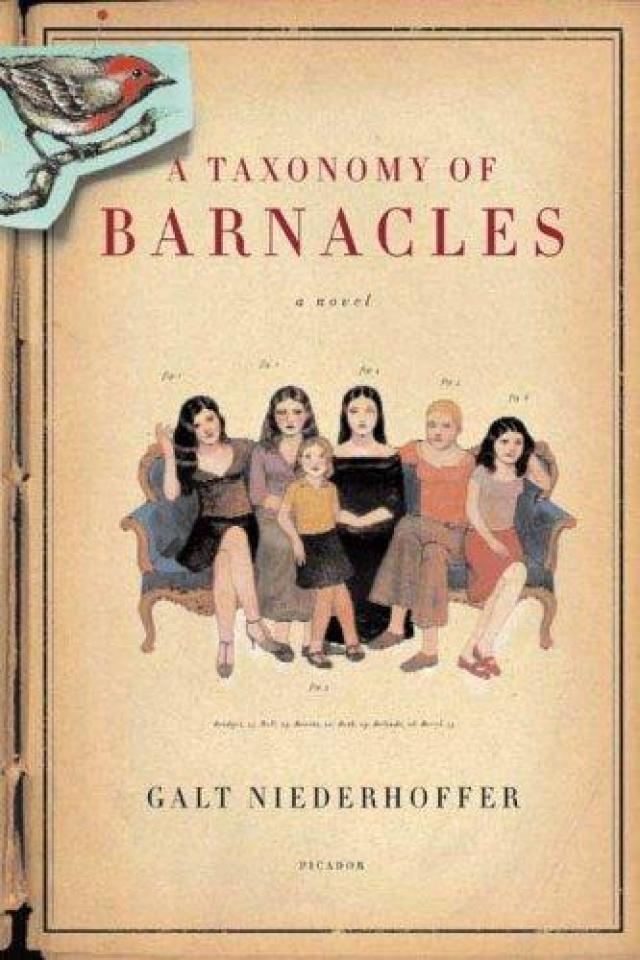
And so evolution jerked to a start in the Barnacle house. Each girl’s response to her father’s challenge could be called an adaptation. Benita, the best athlete, was ready and eager to take down anyone in her path. Beryl, the most gifted musician, paired grace with discipline. Beth, the scientist, applied logic, calculating the odds. Belinda clearly intended to aggravate her sisters until they surrendered. Bridget drew on her powers of manipulation. Bell, despite her seeming disadvantage, could still outsmart her younger sisters, if not outrun them.
Day one of competition ended much as it began. Barry anxiously paced the halls, cursed with insomnia.
In Benita and Beryl’s room, both girls lay on their beds facing away from each other. Beryl studied a map intently. Benita recited the first scene of King Lear from memory.
In Beth and Belinda’s room, Beth bolted the window in anticipation of Belinda’s return. Belinda slept peacefully, if such snoring could be called peaceful, on the living room sofa.
Bell lay awake in her childhood bed, eyes pinned wide as though with toothpicks.
Several blocks downtown, Bridget tossed fitfully in bed, hitting Trot square in the jaw and, though she didn’t succeed in waking him, jolting herself into noisy consciousness so that she, too, much like Bell, lay sleepless and panicked.
8
Hearing Better Than Some Wolves
Despite the warmth he felt for the Barnacles, Latrell was more than slightly relieved to be out of the Barnacle house. Bella, though loving, could be overbearing, the girls were a constant drain on his nerves, and Barry created in Latrell the strange and disconcerting feeling that he had done something wrong even before opening his mouth. Nor did Latrell feel particularly serene at Buckley Boys School. He couldn’t help but feel that these boys viewed him as a novelty, seeing him as a curious extension of their parents’ interest in philanthropy. As a result, he spent most of the school day haunted by the suspicion that he was being stared at and did his best to catch people in the act by tracking them in his peripheral vision, then whipping his head around to issue a threatening look.
Sometimes, Latrell missed his previous abode. Having spent the first ten years of his life in a family of forty boys, even the raucous Barnacle household sometimes seemed quiet and dull. The Bronx Boys’ Home, a state-funded group residence for orphans and runaways, was one of the only remaining institutions in the city that provided a viable alternative to foster care. Though it was intermittently rough, noisy, and lonely, the Home was ultimately a nurturing place, a progressive shelter that funneled its residents into a nearby charter school, armed with a staff of caretakers who treated their charges like sons. But the noise and squabbling was only one aspect of Latrell’s hankering. He missed old friends, even old enemies as anyone misses the fixtures of youth. But more than this, he missed the simple fact of familiarity. His increasing distance from his past created an odd confusion of emotions. He felt equal parts relieved to have moved on and guilty for leaving his past behind. At times, he was unsure which was the greater betrayal, leaving the shelter in the first place or liking the place where he’d ended up.
Luckily, he found respite in one reliable source: Playing or listening to music afforded a momentary reprieve from this constant drift. Accordingly, he sought out any chance to participate in either activity, spending hours in his room staring at his stereo, playing and replaying songs until he’d deciphered their chord progressions. He exhausted every cent of his allowance on music purchases and then went on to round out his archives with files downloaded off the Web. Over time, he had amassed a respectable collection, impressive both in size and organization. It was laid out in such a way that Latrell could locate files by various reference cues, artist’s last name, genre of music, or year of recording. His tastes ran wide and eclectic, from rap to romantic. But his appreciation of music only ignited his desire to participate in its creation. He dreamed, one day, to make the transformation from mere mortal to musician.
As a result, Latrell had found a haven in the most improbable place: Bemelmans, the ritzy piano bar of the nearby Carlyle Hotel provided an odd and unexpected oasis just ten blocks north of the Barnacles’. The musicians who played at Bemelmans were unique in their aspirations, touring singers and pianists who had chosen it over other local venues, rarely headliners but often virtuosos, backup players or partners to the flashier crooners who played in New York’s larger halls. The bartender was a forgiving soul with a soft spot for sad sacks and artists who, recognizing both things in Latrell, allowed him to sit in a booth in the back and enjoy the weekly entertainment without paying the astronomical cover charge required of more moneyed patrons. Provided he remained inconspicuous, Latrell was basically left alone, allowed to enjoy unlimited cashews, and occasionally treated to a complimentary ginger ale.
The environment lived up its musicians, assuming the costume and history of a neighborhood haunt. The space was peppered with small round tables, each one lit with white candles and a tray of delicacies designed, it seemed, to incite an insatiable thirst for martinis. The effect was an ambience of such warmth and intimacy that two complete strangers seated at nearby tables often found themselves in the throes of romance and couples who were trapped in long courtships invariably got engaged by the end of the night. According to legend, the mural on the walls was painted by a patron as an after-the-fact negotiation for an untenable bar bill. Several weeks before a musician began his stint, his picture circulated in the bar, folded atop the tables like name placards at a dinner party. This promotional device was meant to inspire patrons to plan their next trip to the bar and to remind them of the price of a bottle of champagne.
Since his first visit to Bemelmans, Latrell had made a habit of pocketing these folded cards, squirreling them back to the apartment without being blamed for the theft. Over time, he had amassed an impressive collection, a wide assortment of chanteuses and pianists that he displayed on the walls of his bedroom as other boys did baseball cards. The collection was extensive and meticulously archived, each musician’s picture mounted with copious amounts of gummy adhesive and arranged on the wall in a manner that only Latrell could decipher. Blossom Dearie, Jackie Martin, Montgomery Brown, Freddie Monk, and Cecilia Jerome were among the glossy portraits that adorned the wall. The latest addition, that of a pianist named Loston Harris, hung just above Latrell’s desk, a position that resulted in frequent viewing, pulling Latrell’s gaze easily during study hours.
It was with some curiosity that Latrell examined his latest lift. Loston, dressed in a double-breasted pinstriped suit, looked no older than forty-five despite the fact that his clothes referred to the turn of the century. In the picture, his eyebrows were raised and his head was tipped back with certain unflappable effervescence, as though life was a song composed especially for him. But despite Latrell’s unrivaled knowledge of the music scene, Loston was an enigma. He had never seen or heard of Loston Harris, neither on the lists of touring musicians in the local newspapers nor in the endnotes of the albums he stored. And, even more curiously, Latrell was increasingly certain with every moment of staring at the picture that he and Loston looked very much alike. Their eyes were both almond-shaped, widening toward the ears. Their mouths were both weighted by a full lower lip. But Loston’s brazen attitude was the final tip-off; Latrell could form the exact same expression when he posed in front of the mirror. He had only to close his eyes halfway, tilt his head back, and form a half-sneer, half-smile. Indeed, within one afternoon, Latrell was completely convinced: The photograph was clear and irrefutable evidence of shared heredity.
In honor of the occasion, Latrell had worn his birthday gift, a navy blue single-breasted Brooks Brothers suit that Bella gave him when he turned thirteen, the purchase of which was made all the more momentous by the unforgettably prickly visit with the tailor in the back of the store. Though Latrell refused to admit it at the time, he agreed with Bella’s dewy-eyed claim that he looked impossibly handsome in the outfit, especially when he completed it with the pale blue liberty-print tie Bella slipped into the box. The costume made Latrell look at least five years older, accentuating the shine in his serious eyes and hinting at a fine jawbone still obscured by baby fat. Perhaps, it was a touch serious for an unplanned meeting. But, it was only fitting that he dress formally. A boy had only so many opportunities to meet his biological father.
Spurred by the warm spring air, Latrell headed north on Madison, deeming proximity to the Barnacles worth the risk in this one case. Within seconds of arriving at Bemelmans, his suspicions were confirmed. Loston was already well into his set, luxuriating in the last arpeggio of a Chet Baker standard. As he finished the climb to the top of the keys, he tipped back his head as he did in the photo, ending the song with a rhythmic shaking of his head that made him appear to be affirming a question. As he struck the last note, he closed his eyes and tipped his head farther back, giving the impression that he might soon tip from his chair. He remained like this for several seconds, long after the strings had stopped vibrating, suspending the entire audience in a state of silent reverie. Finally, he opened his eyes, resumed contact with his audience, breaking their trance by excusing himself for a short intermission.
Latrell stiffened immediately, recognizing his moment. He had only been in the bar for ten minutes, not nearly long enough to feel the effects of his first ginger ale. Still, he forced himself to act. Breathing deeply, he stood from his seat and crossed the bar to the piano. But by the time he arrived, Loston was already surrounded. A bevy of Upper East Side women formed a semicircle around him. This traffic placed Latrell so close to Loston as to reveal all the freckles and marks on his face. Several times, he felt and fought the urge to return to his seat. But he ground his teeth and forced his face into a smile. Finally, the crowd let up and Latrell seized his chance.
“Excuse me, sir,” said Latrell.
Another woman inched toward Loston. She held up a napkin and pen and gestured for him to sign.
Latrell took another step toward Loston, intercepting the fan. “Excuse me,” he said again.
On instinct, Loston shook his sleeve, preparing to sign an autograph.
“Oh no,” said Latrell.
Loston stopped, pen poised, and looked at Latrell questioningly.
“I’m Latrell,” he clarified. He nodded with strained conviction. “I’m your long-lost son.”
Loston tilted his head slightly, now fully perplexed.
Latrell hesitated for a moment, fighting disillusionment. Perhaps, Latrell was not his birth name and this man knew him as something else. “I’m your son,” he tried again. He straightened his mouth as though to submit his features for inspection. “Don’t you remember me?”
Loston said nothing, only scanned Latrell’s face, alternating his gaze from left to right. Finally, he lurched forward and broke into a smile. “Nice one, kid. You had me for a second.” He peered past Latrell into the bar. “All right. Joke’s over. Who put you up to this?”
“No,” Latrell managed. “No one … I’m…” He trailed off then forced himself to press on. “I’m Latrell. Don’t you remember?”
Loston continued to stare at Latrell, scanning his face for the next cue. Finally, he perceived Latrell’s desperation and changed his tone mercifully. “I’m sorry, kid,” he said, lowering his voice. He placed a hand on Latrell’s shoulder. “I’m sure I would remember you. You must be thinking of someone else.”
Gravity would have pulled Latrell to the floor had he not fought it so hard. In a moment, all sound faded from the bar but for the clinking of glass. Images drained of color. Weight sapped from his hands. Luckily, pride rushed to his aid. He nodded curtly, apologized for the mistake, then hurried from the bar onto Madison Avenue, hopeful that fresh air would do its part to slow his speeding pulse.
* * *
There is no hatred that rivals the loathing the insomniac feels for the person sleeping nearby. Indeed, that hatred is multiplied tenfold when the sleeper is, in any way, responsible for the insomniac’s tormented state. And Trot was, in part, responsible for Bridget’s restlessness because he had, as he did every night, managed to usurp the better part of the comforter, leaving Bridget with nothing to warm her but a meager sliver of blanket and a cruelly inaccessible mound of tangled sheet. Four such hours of desperate awake-ness had passed by three o’clock in the morning. And now, as Bridget stared at her slumbering boyfriend, she realized that she detested him. “Your ears are huge,” she said out loud. “Your nose is pointy,” she continued the critique. I do not love you, she thought. And then out loud, “I hate you, Trot.”