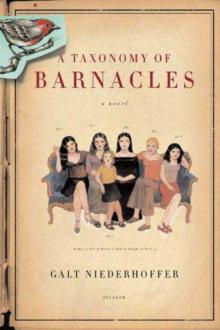
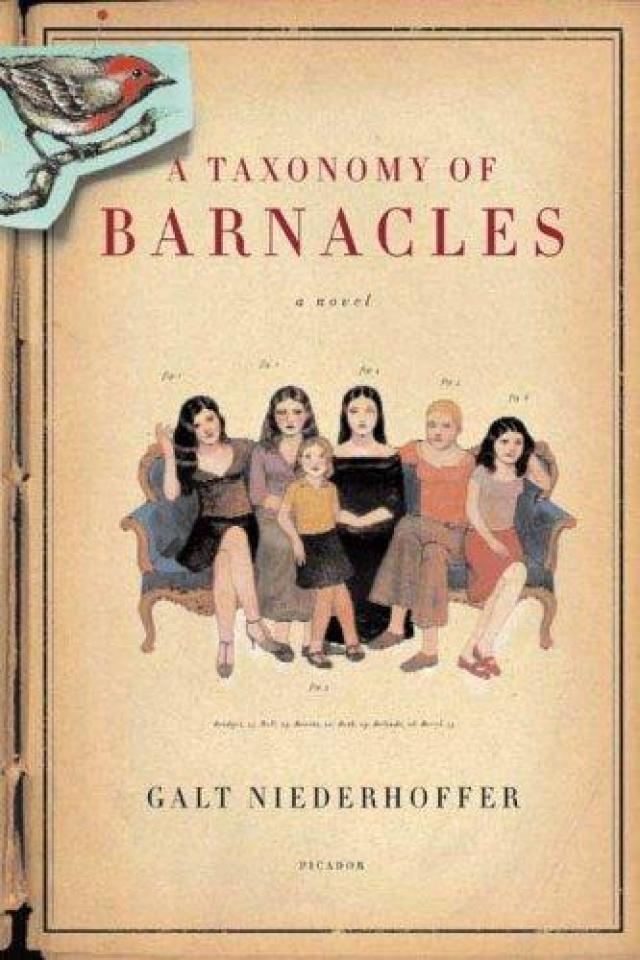
A Taxonomy of Barnacles, page 5


“Trot, you remember Latrell,” Bridget said. She motioned for Trot to sit on the piano bench with a bossy flick of the wrist.
Trot smiled and extended his hand, relieved to be in the presence finally of hospitable male company.
Latrell said nothing, only examined Trot’s eyes, and nodded slightly. The salutation was so subtle and begrudging that Trot had trouble discerning whether Latrell had, in fact, nodded or merely shifted to scratch an itch. Lacking further proof of their alliance, Trot stood, staring for a moment. The boy’s round face, his beatific smile, his kinky hair, and sizable paunch made him look something like an overweight angel. A thin film of grime on his face further contributed to his beatific glow, bestowing a rugged shine that foretold his deep aversion to taking showers. His adopted sisters enjoyed teasing Latrell about this; like most teenage boys, he took a secret, perverse pleasure in the scent of his own armpits.
His gaze betrayed kindness and distance at once, a detachment from his surroundings more fitting of an older teen. His eyes, which scanned Trot mechanically, conveyed an odd mixture of wonder and fatigue. Following Latrell’s hand to the piano keys, Trot noticed a peculiar birthmark, a long, curling shape with darker pigmentation than the rest of Latrell’s hand that resembled, from this angle, the musical notation of a treble cleft. The mark was among Latrell’s favorite things about himself. Since he was very young, he had been told that he shared the mark with his biological father. As a result, when they found each other, recognition would be mutual and immediate. The birthmark would function like a broken locket, proving their genetic and emotional bond the moment the two were reunited.
“Latrell, you remember Trot,” Bridget said.
Latrell offered a grudging assent and, for perhaps the first time in hours, Bridget relaxed her face to a smile.
Latrell was not technically a Barnacle, but he still used the surname. Bella gave him her married name in part because his adoption papers were completed before her divorce and in part to spite her ex-husband. Sadly, after twenty years, Barry and Bella had parted ways, acknowledging their opposing views on nature and nurture amounted to irreconcilable differences. For years, they divided on these lines, engaging in Barry’s favorite debate, fighting for their sides with the same fervor with which other couples discussed politics. Bella was a card-carrying believer in nature while Barry supported nurture to the end. Bella, who had been a beautiful and tempestuous girl, knew nature was a blessing and a curse. Hers arrived like clockwork on the first Thursday of the month. But Barry’s moon had no such pull; he had a stronger centrifugal force. Born to immigrants, he was, since birth, subject to the force of hard work. He simply could not imagine an environment in which he could not improve.
Sadly, Barry and Bella parted ways before Barry found his best evidence. By the time they divorced, Barry had succeeded in instilling new traits in Bella. He taught her paranoia by seducing Bunny a month after Beryl was born. He ingrained patience by subjecting Bella to a long covert affair; spite by marrying Bunny less than a week after they divorced; resourcefulness, or so it seemed when Bella demanded, in the settlement, that Barry buy her the apartment upstairs and pay for her renovations. Arguably, Barry even had a hand in Bella’s alcoholism and depression. And his tenacity seemed to have rubbed off on Bella when, upon receipt of the title to her real estate, she gutted her new apartment, drilled a hole in her floor, and built a connecting spiral staircase to afford her easy access to her girls. Still, one could never know for sure whether Bella’s taste for revenge was innate or learned. The night before Bunny moved in, Bella called her local grocer for a special delivery then snuck into the apartment and hid twenty-four individual sardines in beds, sofas, and bookshelves, one for every year of her marriage.
And yet, the most striking proof of Barry’s influence on Bella was her decision to adopt. Frustrated by her marriage, she turned her attention to the beautification of the Bronx, picking an organization at random to which to devote her time. She found a worthy venue in the yellow pages and took a volunteer position in a shelter for teenage runaways. For a while, this pastime provided the perfect antidote to her torpor. An adopted child, Bella quickly realized, was, after twins, Barry’s ultimate subject. An adopted son, she therefore decided, was the perfect revenge. Enthused, Bella chose the runaway whose eyes revealed the most loneliness and, without asking her daughters’ opinion, went to volunteer one morning and returned with a ten-year-old boy that night. She parented Latrell fiercely if not perfectly, privileging him with slightly favored treatment. He might as well have been a new Jaguar. To Bella, he was a trophy and a prize.
Trot and Latrell’s conversation was interrupted by the return of three Barnacle sisters. As he scanned them, Trot struggled to discern whether these were entirely new sisters or simply the same sisters after a change of clothes. Each girl, Trot noted, caused the air quality in the room to change. It was not unlike being in an airplane and ascending into the atmosphere.
“Lovely, isn’t it?” said Belinda.
Confused by Belinda’s odd syntax, Trot fumbled for an appropriate response. “Nice hair,” he stammered. And he meant it genuinely, but Belinda mistook his sincerity for sarcasm and responded with a chilled smile.
Anxious to spare Trot further discomfort, Bridget struggled to change the subject. “So, what’s the word on Bell?” she asked.
At this, all sisters heaved a collective sigh and assumed a look of exhausted expertise.
“She’s not coming,” said Belinda. “I got an e-mail. She said she loves us but she needs to disown us for a while.”
“Wrong,” said Beth. “I spoke to her and she said she’d be here.”
“She’s just in a bad mood because she got fired,” Benita suggested.
“Shut up,” said Belinda. “She’s had it with men so she’s boycotting them for a while.”
Bridget sighed with genuine concern as a new debate commenced. Her older sister was younger in so many ways.
“Anyway, she’s to be ignored. I bet you she’ll come,” said Beth.
“Wanna bet?” asked Belinda.
“Fine,” said Beth.
They cemented the transaction with a hateful sneer.
Bridget looked at Trot and, for the first time all night, imagined things from his perspective. Surveying the room from his vantage point, things seemed uncomfortably bizarre. Why were there so many paintings on the floor? What caused the wallpaper to bubble up in patches? How had the sofas’ floral chintz come to resemble a thicket of wild thorns? Finally and more importantly where, in God’s name, was Beryl?
“Missing,” sighed Beth.
“Seriously?” asked Bridget.
“Ever since Bunny started cooking,” Belinda corroborated.
“She feels Bunny’s become too Zionist,” Beth whispered. “Beryl’s a vegetarian now.”
“It’s blatantly obvious, isn’t it?” said Belinda.
“You mean patently obvious,” sneered Beth.
Bridget wrinkled her nose in confusion. “What is obvious?”
Belinda sighed. “The disappearing act, the whole ‘tortured artist’ thing. It’s blatantly obvious,” she said, glaring at Beth, “that Beryl’s trying to be like Bell.”
“Maybe she’s locked herself in her room,” Beth suggested.
“Guys, it’s not rocket science,” Benita blurted out. “It’s probably the same as Trot right here. She just wants to miss the meal.”
Bridget did her best to distinguish between good information and bad. “Belinda,” she said with forced frivolity, “why don’t you take Trot on a tour and on the way you can look for Beryl?”
“We’ve searched the house,” Beth said gravely. “She’s definitely not here.”
“I’ll give him a tour,” Benita offered, nudging Belinda conspicuously.
“No thanks,” Bridget said, noting the nudge.
“Why not?” asked Belinda. “What harm can it do?”
“No thank you,” Bridget repeated, adding spite to her frustrated look.
But the debate was suddenly interrupted as the doorbell rang. The younger girls raced to evacuate as Bridget hurried toward the door. Benita took advantage of the chaos, grabbing Trot’s hand and violently dragging him into the next room.
“Don’t worry about Billy,” Benita confided once she and Trot were out of Bridget’s earshot. “He’s not in love with Bridget anymore.”
“Good to know,” Trot said officiously and released his arm from Benita’s grasp.
“Unfortunately, she’s still in love with him.”
Trot ignored Benita and walked down the hall, noting that it was, in fact, possible to feel hatred for a child.
3
Blue Eyes
The Barnacles’ was not a typical apartment. It was more of a manse. Over the years, Barry had bought and conjoined two six-room apartments in order to satisfy the steady expansion of his family. At first, the apartment had grown horizontally, widening at the waist, but due to Bella’s addition after the divorce, the property had grown toward the sky as though the Barnacle family needed its very own skyscraper. Each individual apartment boasted the layout known among New Yorkers as a “classic six.” As a result, after the purchase of the second apartment and the floor above for Bella, the holdings had essentially tripled into a “classic eighteen.” Shaped like a river with tributaries, each apartment emanated from a long, central hall. The rooms themselves were large and airy with high ceilings and wide windows that creaked when you opened them and revealed the age of the apartment with the layers of paint that flaked off when this attempt was made. The hallway itself pulsed with a certain inert noise, causing anyone strolling down to wonder if a wild animal were trapped inside, ready to pounce and leap into the hall should one hazard to open the wrong door.
As Trot passed the kitchen, his senses were overwhelmed by an odd combination of smells. The nutty mist of baking turkey blended with the acrid punch of Passover wine. Baking sweet potatoes added the warmth of butter to the mix. A faint smell of apples offered the most refreshing aspect to the mélange, a reminder of the arduous peeling process required for the Passover charoset. Frying eggs provided the final dissonant note. Trot paused for a moment in the hall, trying to indentify the various smells. But he was distracted by new, more pressing sensory demands as Benita yelled at him to hurry while grasping his forearm with an alarmingly tight grip for such a little girl.
“This is Daddy’s indoor jungle,” she began. “He built it in honor of Charles Darwin. Daddy wanted to build it on the roof, but Mom said he could do it over her dead body or when he married a more submissive woman than her.”
“Than she,” Trot corrected.
Benita bristled, torn between indignation and respect.
Trot peered cautiously into a room filled with bright petals and leaves and found himself unexpectedly pleased by the faint murmur of animals and birds. The indoor jungle, Benita explained, was initially built as an annex to Barry’s aquarium, a passion that began with a single fish tank stowed in a spare room. Like all collections in the house, this one multiplied exponentially as a function of Barry’s attention. Quickly, the population of the tank tripled as Barry bought new companions for his garden-variety goldfish, as though providing an only child with siblings. Then came a flood of more exotic fish, neon yellow, fluorescent minnows, a bright red lion fish, an electric eel that actually sparked, and a silver Japanese fighting fish. The latter was safely sequestered in a separate but adjacent tank, allowing the various species to enjoy the appearance of cohabitation without the danger of predation. Unfortunately, Barry’s inexperience obscured one critical fact. It was the lion fish, not the Japanese fighting fish that required such precautions. This realization occurred sadly too late: Barry arrived for a morning feeding and found the entire population of the tank wiped out but for the belligerent victor.
Gradually, the amateur hobbyist yearned for expertise. Refusing to make the same mistake twice, Barry purchased a total of four tanks: one for freshwater species, one for saltwater, one for the pugnacious lion fish, and one for future acquisitions. He had outgrown pink gravel and plastic corral. Soon enough, he commanded a second room in the house for his collection, filling it slowly with animals bought from stores and special catalogs. Thus, he was finally released from his reliance on the local fish store and became the favorite customer of a new pet store. The store sold everything from minnows to macaques and was called appropriately “Monkey Business.”
Slowly, the indoor jungle blossomed from a modest garden to a small rain forest. The foundations of the room—turn-of-the-century molding, picture panels, and fine, wide planked floors—had long since been obscured by vegetation. Swirling green vines and broad shiny leaves wound their ways up the walls, meeting in the middle of the ceiling to form a canopy. Bamboo trees with delicate trunks stood at every corner, sprouting extravagantly at the top like Corinthian columns. Birds as bright as tropical fruit fluttered in and out of view. A three-toed sloth, a nocturnal animal, allegedly slept in a hidden nook. A low hooting sound in the base register revealed the presence of an owl and provided a stark instrumental contrast to the sporadic high-pitched screeches of what Trot could only assume were bats.
Despite the exotic beauty of this unusual place, there was something disturbing about the room, something decidedly off-putting about seeing this flora and fauna so far from their natural habitats. Once again, high-pitched screeching interupted Trot’s musing.
“Is that a monkey?” he asked casually.
“Of course not,” Benita scoffed. “Harry ran away years ago.”
“Who?” Trot asked.
“Daddy’s macaque,” Benita clarified. She rolled her eyes as though elaborating was a horrible inconvenience.
“I see,” said Trot, though he did not. He wondered idly if his friends experienced anything like this when visiting their girlfriends’ parents.
Benita lowered her voice as though sharing a classified government secret. “Everyone has different theories on the subject. Beryl thinks Mom sold him back to the pet store because she got sick of the mess. Harry used to smash bananas into the wallpaper and throw his feces at guests.” Here, she paused to check Trot for her effect and, detecting discomfort, continued her pitch. “I think he got sick of our family and walked across Fifth Avenue to be with his at the Central Park Zoo. Mom insists Harry had enemies in the building. She blames Mr. Finch. Bridget thinks Harry saw Bell sneak out so much he figured it out for himself. Bell claims Mom tied him to the back stairs during a dinner party, and that later, when Dad went to untie him, Harry was hanging from a noose.”
“My God,” said Trot, wincing noticeably.
“But no one believes that for a second. You can’t make a noose without making a slipknot,” said Benita. “And, of course, you can’t make a slipknot without opposable thumbs.”
Despite the contentious nature of this debate, one of Benita’s claims was true. The missing macaque bore an uncanny resemblance to a monkey in captivity at the Central Park Zoo. This monkey was endowed with the same gray and black speckled fur, the same deeply inset eyes, the same stumped tail, the same pink toes, the same face of a little old man, shrunken perfectly to scale. As a result, Benita could not be dissuaded from her theory of the crime. Harry, she believed, had simply relocated from one side of Fifth Avenue to the other. As a result of this conviction, every Sunday, without fail, she walked across the avenue to the zoo and gazed at the macaques’ cage for ten minutes, occasionally whispering promises to Harry—or rather the monkey she had decided was Harry—to bring him back home one day soon.
Trot said nothing. He merely nodded and resolved to ignore Benita. To this end, he focused on a clump of red birds assembled atop a miniature palm tree.
“Those,” said Benita, “are Galápagos finches, descendants of Darwin’s famous birds. Dad used to call us his little finches, which was often very confusing since the Finches live right next door.”
This, unlike most of Benita’s claims, was true. According to Barry, barnacles proved Darwin’s theory better than the famous finches. No doubt, his sentiment had something to do with science’s notorious contest and the barnacle species’ not-so-famous eleventh-hour defeat. Barry was haunted by the incongruities in Darwin’s biography. In 1839, precisely twenty years before the scientist would publish his famous treatise, his notebooks reveal his theory of evolution was already intact. And yet instead of publishing, he spent the next twenty years dissecting barnacles in his basement. He compiled these findings in a book entitled, A Taxonomy of Barnacles, a book that was read, despite its merits, by approximately ten people. However, when it came time to write On the Origin of Species, a book that changed the course of Western thought, Darwin made nary a mention of barnacles. Instead, he featured the finch.
For obvious reasons, Barry was obsessed by this fact. He simply could not understand why Darwin traded in his old friend for a more photogenic face. Barnacles, Barry claimed, provided just as elegant an example. Barnacles competed for survival. Barnacles adapted. Barnacles diverged. Barnacles proved evolution, too. Thus, Barry felt it simply was not fitting and the pun was most definitely intended, that finches got to prove the survival of the fittest, earning a page in the annals of history while barnacles fell through the cracks. There was some foul play, Barry was sure of it. Why else would Darwin doom the humble barnacle to huddle forever on the bottoms of boats while the finch soared to greater heights? No, history had no accidents. In this situation, someone got screwed. It was prejudice, Barry insisted, discrimination. In his mind, the rivalry between finches and barnacles was nothing less than a war between Christians and Jews.