A Taxonomy of Barnacles, page 6
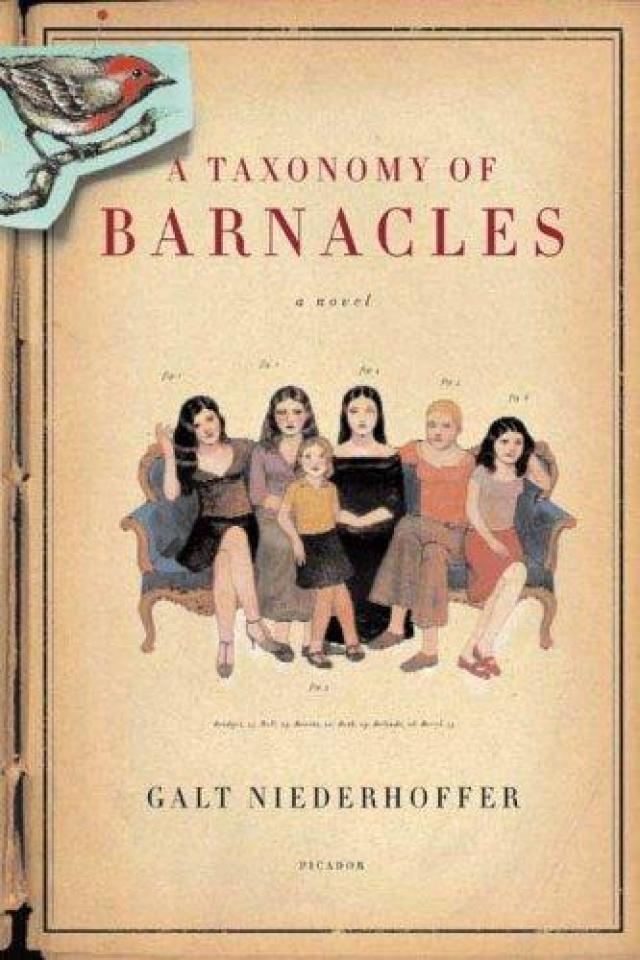


Everyone in the family espoused a different theory for Darwin’s delay, each one revealing more about the theorist than the mystery itself. Bell believed in the feminist argument, that Darwin delayed publication at the request of his religious wife. Bridget believed in the Freudian argument, that Darwin subconsciously repressed his desire to succeed. Beth felt there was good scientific evidence for the delay: Finches simply offered a better example of variation. Belinda abstained from the argument. Did they have to talk about this every night? Beryl was convinced of a conspiracy. Someone, or rather some organization, had impinged on Darwin’s freedom of speech. Benita entertained a more Machiavellian approach. Darwin deferred his announcement until he was close to death so as to avoid the wrath of the church during his lifetime. Bella saw it from a Hollywood perspective: Barnacles lacked a clear storyline. Finches had an easy hook, a high-concept plot. But despite the merits of these arguments, Barry was resolute. In his mind, there was no room for doubt. Anti-Semitism was at play. Ultimately though, the Barnacle girls dismissed their father. They felt they understood Darwin’s choice: The Finches were a phylum for the masses, a less eccentric family.
“These are Peruvian violets,” Benita continued, circling the room with the quick, competent movements of a stewardess. “Daddy wanted to buy more but Mother said it was obscene to buy a plant that costs more than a car.”
Trot leaned over, pretending to admire a patch of low-slung lavender flowers that seemed, for all he could tell, to sprout from a hole in the floor. As he looked, he considered Benita’s verbiage. As far as he could remember, Bridget called her mother “mom.”
“Over there,” she said, gesturing grandly in the direction of nothing in particular, “that’s where the hollyhock bloom in the summer.”
Trot nodded, feigning rapt interest.
“They’re terribly pretty,” Benita said. “Too bad you won’t be around to see them.”
Upon delivery of this last insult, Benita glanced quickly at Trot. She stood like this, watching for several moments, waiting for him to digest her meaning. Unfortunately, the full effect of the insult was weakened by a new interruption. As though on cue, a large purple leaf fell from a nearby tree, landing on Trot’s head and leaving a sticky adhesive trail. Swatting wildly, Trot managed to detach the leaf. But, patting his hair, he found that the leaf had already left a thick residue.
“Beware,” said Benita, “those are poisonous.”
Trot patted frantically at his hair. Already unnerved, he jumped and squealed when a feather grazed his right ear. “What the hell?” he said, swatting wildly. He crouched and braced for another attack.
“Don’t be scared.” Benita laughed. “It’s just a little bat.”
“My God,” Trot said. “That thing was huge.”
Benita stepped into the hall and paused to consider Trot’s claim. Then, dismissing his point of view, she sniffed, “I’ve seen bigger.”
Trot made a resolution as his pulse returned to its normal rate: from this moment on, he would consider Benita an adversary and an adult.
Benita did not start the tour in the indoor jungle because it was the best way to intimidate guests. It truly was her favorite room in the entire house. It had not grown out of grand aspirations, but rather grown into them. It was a tribute to a time when indoor jungles were as common as drawing rooms, a time when curiosity was common, when science was approached with wonder. And though the association with the Victorian era was perhaps a strange one for a Jew from Brooklyn, it did make some sense. The era may have been associated with collars and corsets, but it was arguably the moment at which feudal law suffered its fatal blow, when women, though still expected to marry, began the long march to property rights. Bell, of course, had amassed a series of passionate objections to the whole affiliation, armed at college with a host of post-Modern, neo-Feminist meta-revisionist theories. The Victorian novel began with a tour, the author a vendor showing off her wares. The problem was that these wares were usually women.
Trot lingered in the jungle, admiring a rubber plant.
“Hurry up, slowpoke,” Benita called down the hall.
And then, for no better reason than to quell his mounting anger, Trot plucked a leaf from the rubber tree and slipped it into his pocket. “Where are you? I think I’m lost,” he said, though he knew exactly where he was.
“I’m in Bridget’s bedroom,” Benita called. “Don’t you want to see where she and Billy used to make out?”
Environment maps the geography of the mind. Indeed, the floor plan of the apartment illuminated the psyches of its residents. Despite their vocal protests, the six Barnacle girls were made to pair up, sleeping two to a room in a total of three separate rooms. The apartment, of course, had ample room for each sister to enjoy her own room. But Barry hoped the layout would serve another purpose, encouraging his daughters to engage in constant competition. The arrangement also left three additional rooms available for the storage and display of his collections. In each of the girls’ bedrooms, the headboards of two twin beds were adjoined at the top so that the beds formed a stripe across the back of the room, extending parallel to the windows like dominoes laid out back to back. This layout provided a blueprint for the girls’ view of the world, creating the sense that the Barnacle sisters formed a balustrade against the world. It also caused each separate pair of roommates to develop either strong emotional bonds or rabid aversions to one another and spurred them to divide and conquer into three teams of two in most family disputes.
The decor of each room differed as drastically as the various daughters. For a time, Bella had taunted the girls with promises of wallpaper, accumulating a tantalizing stack of swatches from the best design houses in New York. Each tableau of flowers and ribbons threatened to turn their boudoirs into palaces of femininity. Finally, however, Bella opted for paint, claiming it allowed each girl, or rather each pair of girls, to personalize their living quarters. These choices, which were made when the eldest were still under the age of thirteen, transformed the apartment into a museum, preserving the antiquated tastes of much younger girls and freezing the apartment at the moment in time just before Barry and Bella’s marriage had dissolved.
Bell and Bridget chose a bubblegum pink, swayed by an early and overwrought interest in princess narratives. Belinda and Beth failed to come to an agreement and so bisected the room and painted it two different colors. Belinda’s side was a lavender hue whose gauzy innocence had long since been obscured by lewd tear-outs from teen magazines and menacing rock posters. Beth’s was a deep undulating purple that transformed her side of the room into a tidal pool and caused half of the room to be bathed in black by dusk. Beryl and Benita painted their room an awkward shade of burgundy, a literal compromise between the girls’ two preferences. Unable to agree on a single color, they had simply mixed their two favorites, light blue and crimson red, a marriage that resulted in the very same purple shade that graced the walls of their favorite Chinese restaurant. Of all the Barnacle women’s rooms, Bella’s provided the most apt representation of its inhabitant’s interior state. Papered in a busy pale yellow chintz with lavender and green accents, it evoked the very style and mood of a nineteenth century ladies’ sanitarium.
The bathroom situation at the Barnacles’ was as telling as the bedrooms. Despite the home’s otherwise grand appointments, it was built, like all turn-of-the-century apartments, with six specific rooms in mind, a master bedroom, a living room, three bedrooms for children, and one for a governess or maid. The original apartment had a total of three bathrooms, one adjoining to the master bedroom, one for guests between the living room and kitchen, and one for the children. Of course, doubling the square footage of the apartment should have doubled the amenities therein but the spare space had been put to uses other than practical ones, such as the annex to the indoor jungle, the addendum to Bunny’s exercise room, and Beth’s lab. As a result, the six sisters had been cursed to share the one facility, a major defect in spatial planning that resulted in long lines, frequent accidents, and an infinite amount of yelling.
As Trot stood at the door of Bridget’s bedroom, he struggled to keep these statistics straight. What an odd way to sleep, he thought. No wonder Bridget’s an insomniac.
“I’m so glad Billy’s moving back,” said Benita, interrupting Trot’s thoughts once again. She performed what appeared to be a victory dance, twirling several times, jumping up and down, and stamping her feet triumphantly.
“Why’d he decide to do that?” Trot asked, doing his best to simulate a carefree tone.
“He ran out of money,” Benita said. She said this as though it was the most common thing in the world, as though boys of all ages ran out of money and then, rather than pound the pavement for a job, simply moved back home.
“Wow,” said Trot. “That’s nice of his parents … to support him at this age.”
“I guess,” said Benita, “but if you want my opinion, I don’t think Billy’s broke.” She closed her mouth and covered her eyes as though her secret might escape through one of the two orifices.
“What’s your opinion?” Trot demanded.
Benita smiled in slow motion, as though Trot had requested that she display the anatomy of a smile. Finally, she answered with another question. “What do you think?”
* * *
Bridget sat down on the living room sofa and smiled at Billy carefully. Glancing down, she realized that her hands were folded on her lap, their slightly clenched position betraying an unattractive amount of unease. Consciously taking deeper breaths, she unclasped her hands and rearranged them, ironically, with some force into a more relaxed position. For a moment, she debated rescuing Trot. By now, Benita had likely coerced him to play another game of Ping-Pong or tackled him and pinned him to the ground, demanding he empty his pockets. But, deciding that she craved and deserved a moment alone with Billy, Bridget willfully thrust the thought from her head and left Trot to fend for himself while she settled into the sofa. I am sinister, Bridget thought. No, she changed her mind quickly. One deserves to be sure.
As was custom, Billy greeted Bridget with a marriage proposal. “Since the first day I met you, I knew you were the one,” he began with a solemn look. His speech, for effect, was halting and nervous, as though he were, in fact, a timid suitor.
“Set the scene,” Bridget demanded. She made a show of sinking yet deeper into the sofa to make it clear she was finally ready to be entertained.
“Traditional. Dinner. Cipriani’s in Rome. Kneeling. Champagne. Et cetera.”
It was convention, after delivering the prelude to the proposal, to name and classify its type, to state whether there had been kneeling or none and, of course, to leave the question in question blank. Thus, the two friends slowly compiled a taxonomy of proposals.
“No, no, no,” Billy changed his mind. “High Romance. Banks of the Seine. Distant saxophone.”
“Kneeling?” Bridget asked.
“Of course,” snapped Billy. “Now, please don’t interrupt.”
“Forgive me,” Bridget said with mock seriousness.
Billy closed his eyes like an impassioned conductor and assumed a supercilious smirk, instantly transforming himself into a dumb jock. “Since the first day I met you, I knew you were the one. The way you flipped your hair in my fraternity. The way you kissed me … oh my God. And then when you … well, you remember … I knew I couldn’t live without that…”
Bridget smiled with due deference, offered Billy a token round of applause, then, after racking her brain for the right opening, launched into her own. “The beach behind the family house. The Vineyard. Sunset.”
“Ah,” said Billy. “Au naturel.”
“Yes,” said Bridget, “très wholesome.” She paused to simulate a gag then lowered her voice to better mimic the boy posing the question. “As you know, I’ve wanted to have sex with you for a very long time. But, as you have made clear time and again, you’re not comfortable living in sin.”
“Of course,” Billy cheered. “The Negotiation.”
“I’ve been hedging my bets and dragging my feet for … what, is it already ten years? All of our friends are convinced I’m gay. But ever since your mother showed up at my door and foisted your grandmother’s ring on me, I’ve known I had no choice…”
“Not bad,” said Billy.
Bridget raised her eyebrow. “Not bad?” she asked, smiling flirtatiously. “Let’s see you do better.”
It was true that Bridget and Billy were happiest in one another’s presence. But the two were never more delighted than when they were proposing to each other. To anyone nearby, they seemed to be enmeshed in a captivating dialogue. But, in truth, they were engaged in a duel of impersonations. For Bridget and Billy, proposing was a reliable thrill. Words, even when they have lost their meaning, somehow manage to retain the power of their vestigial limbs.
“All right,” said Billy. “The Jane Austen Special. Height of the Victorian era. An ugly cousin arrives for dinner, willing to take any of six sisters. If none accepts, they lose their fortune and their beloved estate.”
“Primogeniture,” said Bridget, “is so nineteenth century.”
“Milady,” Billy sighed, mock-annoyed, “are you going to allow me to propose or not?”
Bridget nodded ceremoniously.
Billy kneeled on the ground.
“Miss Barnacle, I’ve come in my handsome white carriage driven by my handsome white horse in order to make you, my handsome second cousin, an offer you can’t refuse. Bear in mind, of course, that if you reject me your entire family will be penniless, generations of status will go to pot, and you, my dear, will be tarnished and condemned to the life of a lonely spinster.” At this, he paused to clear his throat. “As I was saying, ever since the day we met, I knew you were the one…” Here, he paused to allow Bridget to air a hearty fit of laughter.
The proposal, though a universal monologue, was something of an inside joke for these two. Billy claimed the marriage proposal was a form with no less variation than the sonnet. (He got away with saying things like this occasionally because he had done two years toward an English PhD.) Bridget agreed wholeheartedly, her familiarity with the genre the result of a lifelong study of her social circle, a population obsessed not only with marriage but with every ritual surrounding it. Both friends agreed that the whole wretched tradition degraded everyone involved. Still, it was obvious to those who knew them that their distaste was a mask for their fascination with the institution.
Still, the two friends derived endless amusement from hording the anecdotes of friends and acquaintances and parroting the ridiculous ceremony in private. Over the years, they did this in ever more elaborate language, with ever more vivid description and exacting measurements. Extra points were awarded for number of clichés, original venues, sharp verbiage, and other innovations, while due deference was also paid to well-drawn imagery. The whole pastime had evolved dramatically and suddenly when, during one particularly odd New York nuptial season, no one they knew got engaged, a dry spell that forced Billy and Bridget to invent their own. Thus they began proposing to each other for pure entertainment. It began as a joke, became a compulsion, and was now something of a hobby.
Slowly, the collection had become a running contest. Now, they were experts and aficionados, veritable curators of the marriage proposal. Sometimes Bridget would call Billy from work after hearing of a deliciously feeble attempt. Other times, Billy would call Bridget at home and leave an ornate one on her answering machine. (The practice was, of course, outlawed as soon as Bridget and Trot moved in together, though Billy was often tempted to keep up the ruse just to torture Trot.) They proposed, Billy was sure, by way of substitute, because they were hopelessly in love. In Bridget’s opinion, it was purely for amusement. Either way, they did it all the time, during lulls in conversations, on walks in Central Park, when they were drunk over dinner, or over the phone as though they were not exchanging words of love, but rather, barbed insults or hilarious jokes.
And yet, despite the cynicism of the game, the two insisted on one sacred rule: The question itself was not to be uttered. The actual “will you marry me?” part was strictly off-limits. Accordingly, when they were proposing to each other, they always left the end blank, instinctively realizing that voicing the question would serve to weaken the very thing they needed to remain intact. Indeed, a proposal ranks among those few phrases in the English language, what Billy’s English professors liked to call “performative words”—among them, “you’re fired,” “you’re out,” and “you’re under arrest”—whose very utterance enacts the thing they describe. One need only voice such a phrase for it to become a fact, and, in the case of a marriage proposal, to become a binding agreement. Thus, Billy and Bridget never touched the will-you part of the proposal. It was understood, though never discussed, that the question, when spoken, could not be reversed.
“The Walk-Off Home Run,” Billy said, wrapping up. “Tie game. Bottom of the ninth. The home team is at the plate.”
“How many strikes?” Bridget demanded.
“Three balls and two strikes.”
“But which does she love more,” Bridget interrupted, “her boyfriend or baseball?”
“My dear,” Billy chided, “she’s a Sox fan. What do you think?” Billy rolled his eyes in a dramatic show of ennui, then continued. “As you know, a walk-off home run is one of the great events in baseball, not only because one swing ends a tied game but because it is the home team that wins, causing the visitors to walk off the field, usually quite dejectedly.”