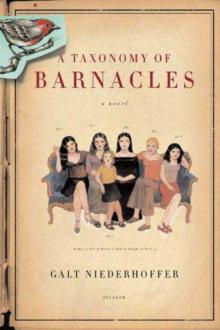
A Taxonomy of Barnacles, page 3



“I wish,” said Trot.
Bridget shook her head like a put-upon princess then stamped her foot like a child. “What in God’s name are you doing out here?”
“Admiring the wallpaper,” Trot tried.
Bridget rolled her eyes and pointed to the wall. The foyer was painted brown. “Don’t you want to spend time with my family?” she asked.
“If it’s all the same to you,” Trot said politely, “I’m having a fine time out here.”
“Thanks for being such a good sport,” Bridget hissed.
“You’re welcome,” Trot said. “Believe it or not this is not my idea of a fun Friday night.”
For some reason, this insult struck Bridget as previous ones had not. “Trot,” she sighed. “It’s not Friday yet. It’s Thursday.”
Humbled, Trot recalibrated, looking to the ground. “God,” he sniffed haughtily, “why do you always have to be so technical?”
Bridget regarded her boyfriend with new disillusionment. Rational debate was impossible with Trot, not unlike trying to decide on the exact color of the sky with a color-blind person. Acknowledging its futility, Bridget changed her tack. She forced her voice to resemble sweetness. “Don’t you want to see my sisters?” she asked.
Trot paused to consider this in earnest then seemed to make a decision. “No,” he said, “but they can find me out here if they want to challenge me to anything.”
Bridget widened her eyes theatrically then opened the front door. Trot inhaled deeply, clenched his hands, and reluctantly followed Bridget inside. When they returned, two new sisters, Belinda and Beth, had congregated in the living room. Beth stared at Trot unapologetically, her arms folded across her chest. Still, Trot found her the warmest sister. Beth’s scrutiny was, at the very least, evidence of her consideration. Just remain calm, he told himself. Children can smell fear.
Beth, nineteen and already a senior in college, was congratulated for looking impressively old. Born third, she was privy to the family’s increasing novelty, her arrival bringing the family one girl closer to eligibility for a sideshow. As a result, Beth was blessed with a wry sense of humor and accordingly fixed her eyebrows into a permanent smirk. Her personality was so unique as to defy traditional adjectives. When called upon to describe her, one was tempted to invent words like “Beth-ism” or “Beth-like.” It was Beth’s idea, several years ago, to kidnap Benita and hold her ransom. It was Beth’s idea to paint her mother’s bedroom black when Bella claimed light depressed her. She even dressed for comic effect, wearing black, brown, and blue so as to resemble a bruise; she claimed this was the true state of her inner self. Still, despite Beth’s fashion faux pas, her sisters were grateful she’d come. Beth’s migraines acted up unless she took frequent naps and one such episode had threatened to preclude her attendance.
At the moment, Beth wore brown leggings, a dark blue sweater, and heavy black eyeliner, choosing Goth attire as an equal and opposite antidote to her sisters’ insufferable girliness. All of this dark and baggy clothing functioned much like insect repellant, causing her sisters to shun Beth as a rule and to warn her routinely that she would grow up to be a lesbian. The prophecy had come true but only for a month during her sophomore year at college, when Beth dated a woman. She preferred not to be called a lesbian, deeming it an arcane and arbitrary category. She had fallen in love with a person, she claimed, not a gender. “Sexuality” was an obsolete word, as primitive and extinct as the dodo bird. And anyway, it was now a moot point since she and the girl were no longer speaking. With the phase in her past, Beth had receded back into ostensible asexuality, eschewing both boys and girls in favor of science textbooks.
An odd and introspective child, she had always confounded her sisters with her long silences, her strange attire, and, her sisters felt justified in saying, her more alarming than impressive array of creepy looks. The least social of the bunch, she had few friends throughout elementary school, even fewer in high school, and the ones she did were, in her sisters’ humble opinion, garden-variety geeks. Most of these geeks were female, though one could not always tell their gender by their odd, androgynous dress and their unanimous consensus that makeup was a worldwide conspiracy. But any debate on the subject of Beth’s peculiarity was immediately quelled in adolescence when Beth’s childhood love of animals turned into an unholy fascination. It was one thing, her sisters claimed, for a child to be attached to dogs, cats, and the odd guinea pig. But Beth’s interest was far less innocent than most; it was downright morbid. Indeed, she had little interest in cuddling or cooing at furry animals, but rather in breeding, killing, and collecting the various species of the animal kingdom.
The obsession began as a passing interest in home-reared butterflies. Born in a box, these creatures had little hope of surviving in nature. They fared poorly when Beth tested their ability to fly by hurling them out her bedroom window. Discouraged but not dissuaded, Beth moved on to more mundane subjects, availing herself of Central Park’s varied flora and fauna. Hours were spent teasing pollen from stamens, coaxing bees from blossom to bud, inserting tweezers and eyedroppers in anything that bore fruit. At age twelve, during a routine dig in the sandbox at the Seventy-second Street playground, she discovered an odd, unfamiliar worm and removed it from the sandbox to examine it more rigorously. Under the microscope, the worm revealed truly unusual properties, proving to be a new species of earthworm and earning Beth first place at the New York Regional Science Fair as well as the attention of the CIA. This discovery, combined with Beth’s history-making ERB scores, gave her the option of attending college as an eighth-grader. But finding her research at home too promising, she deferred admission several years and devoted herself to a more concerted study of evolutionary biology.
But soon this presentable pastime blossomed a mutant leaf as Beth sought new subjects for her microscope. Worms, beetles, even kitchen cockroaches were all fair prey for her lens. All were hoarded and hacked up in a makeshift lab she created in her bedroom to the great distress of her roommate, Belinda. So it was with justified concern that the Barnacle girls witnessed Beth’s first major abduction when she returned from a stroll in Central Park with two New York City pigeons. Like all fledgling scientists, Beth was torn between affection and curiosity. Finally, the latter won out, enabling her to stomach the gore required of truly stringent study. By high school, she had perfected the art of skeletonizing insects and mice along with dissection procedures usually reserved for college classrooms. With chilling detachment, she suffocated baby pigeons under large salad bowls, using both hands to contain their struggle, shuddering only slightly during their last seizures of life. Her sisters protested vocally, repulsed by Beth’s morbid practices—Belinda in the form of her frequent claim that Beth should be hospitalized for mental illness and Beryl with more than one desperate call to the ASPCA.
The fourth girl, Belinda, was born belligerent. She was convinced her older sisters were guilty of diminishing valuable resources owed to her. Even at the age of sixteen, she resented the three girls born before her for sapping her wedding fund. Luckily, she learned during puberty to redirect her anger toward her father. In turn, she learned at boarding school to redirect this anger toward teenage boys. She also learned how to make bongs out of oranges, how to sneak out of her dormitory window wearing a skirt, how to cheat on exams without getting caught, and how to dress like a hippie while still retaining a timely consciousness of designer labels. Belinda loved to combine filthy-looking Tibetan prints and overpriced accessories bearing designer insignias. Sometimes, she would accent the whole dreadful ensemble with an unfortunate bright red scarf. Her latest egregious fashion faux pas occurred at the hairline. She had finally completed her transformation into the black, or in this case the green sheep of the family by shaving her head to a neat military buzz then dyeing the remaining spikes a distinct lime green.
At boarding school, Belinda had become highly evolved. During the fall semester, she had adopted a new language, a hodgepodge of slang and an affectation that resembled the Queen’s English. Instead of “yes,” Belinda now pursed her lips and said “mmm.” She said “mates” instead of “sisters,” “carry on” instead of “what’s up?” She used “fancy” as a verb and said “quite” all the time, causing bland statements to sound more emphatic than they were and, sometimes, more interesting. She often ended declarations with questions as was the fashion in England, causing her to say, “It’s awfully cold, isn’t it?” instead of just, “It’s awfully cold.” This produced the illusion that Belinda had posed a thoughtful question when, in fact, regarding other people’s opinions, Belinda could have cared less.
Unfortunately, Belinda had eschewed most of the traditional facets of boarding school life, namely attending class, completing homework, and competing on sports teams. With the exception of a fall semester commitment to the girls’ junior varsity field hockey team, a concession made only due to the team uniform, a very attractive plaid skirt, Belinda had made a policy of abstaining from typical activities. She had, however, devoted herself to one pastime throughout: getting to know upperclassmen one dormitory at a time.
“So, what’s the body count now?” asked Beth.
“A lady never tells,” sniffed Belinda.
“What’s his name?” Benita pressed.
“Their names, isn’t it?” Belinda corrected.
“Their names,” Beth said.
“Tom, Dick, Harry…” Belinda trailed off carelessly, applying this musing dreamy tone to imply she’d quite forgotten. “Harry,” she added, “proposed over dinner. But I told him I would never marry before twenty-five. Besides which and far more importantly, dinner is so cliché. Isn’t it?”
“No, it’s not,” Beth said, mistaking Belinda’s rhetorical question for an actual one. “Dinner’s not that bad. It’s not as contrived as proposing on a ski lift or the banks of the Seine.”
“The worst is without a ring,” said Benita. “At least, that’s what Bridget thinks.”
Trot smiled hatefully at Bridget. Bridget, this time, did not so much as offer a shrug of apology.
Everyone disagreed on the merits of proposing in a girl’s childhood bedroom.
“I think it’s romantic,” said Bridget.
“I think it’s creepy,” said Beth.
“Believe it or not, I agree with Beth,” said Belinda. “The point of getting married is to escape your family, not crawl back into the womb.”
The symbolic proposal, all the girls agreed, was more trouble than it was worth.
“Why do guys think they’re suddenly transformed into poets when they propose?” Belinda said. “If you think you’re a poet, write me a sonnet. Don’t put a ring in my food.”
“Talk about mixed metaphor,” Bridget agreed. “If a guy ever tried that on me, I’d swallow it whole just to teach him.”
“Ouch,” said Beth.
“Ouch,” agreed Belinda.
Benita joined her sisters in the act of imagining the digestion of such a snack and snickered knowingly.
“Or you could do what Mom and Dad did. I think that’s romantic,” said Beryl.
“Yeah,” scoffed Belinda. “The perfect way to ensure your marriage ends in a bitter divorce.”
Trot looked from sister to sister while the debate gained steam. As he did, he was reminded of the distinct sensation of playing Ping-Pong and losing. Attempting to quell this feeling, he opened his mouth to request further elaboration on the story of Bella and Barry’s proposal, but a new and contentious thread of discussion was introduced before he could get in a word.
“I’d take a piece of twine any day to some obnoxious ring,” said Beryl.
While Beryl was defied to defend this claim, a final method was introduced.
“The only thing worse,” Beth agreed, “is a sporting event. Who wants to share life’s most intimate moment with all of Yankee Stadium?”
Finally, the girls reached consensus. Every Barnacle lowered her head and murmured her assent.
“Mmm, quite,” said Belinda, though it was anyone’s guess to whom or what she was responding.
“If a guy ever asked me at a baseball game,” said Bridget, “I’d dump him on the spot. It’s tacky to turn something so private into a public spectacle.”
“Worse than that,” scoffed Beth, “it’s totally distracting.” She pumped the air with her fist. “Why don’t guys understand the stadium is a sacred space?”
Bridget lowered her voice to indicate upcoming sensitive information. “I knew someone whose boyfriend proposed during the ’eighty-six World Series. So the Mets are down at the bottom of the ninth, and this girl is a big Mets fan, when all of the sudden, she looks up at the stadium screen and who should she see staring back but herself and her corny boyfriend.”
“I assume she declined,” Beth sniffed haughtily.
“Of course.” Bridget pursed her lips. “He almost caused her to miss Garcia’s game-winning throw.”
“Honestly,” said Beth. “Can you think of anything worse?”
“Actually, I can,” said Belinda. She sealed her mouth mysteriously. “Without a doubt, the single worst way to propose is right after sex.”
Bridget turned suddenly to Belinda. “And how would you know?”
Belinda offered Bridget her most innocent look, batting her eyelashes furiously, and effectively ending the debate.
Throughout this exchange, Trot avoided making eye contact with any of the girls and did his best to appear as though he were lost in his own thoughts. And yet he was painfully conscious of his observer. Benita stared unapologetically, leaning gradually closer to him as though honing in on a fly. Finally, a memory jolted her from her trance. “I played you left-handed,” she announced. “I remember now. I played you left-handed,” she repeated. “That’s the only reason you won.”
Already unnerved by the proposal debate, Trot prepared to respond to Benita with equal and opposite force. But before another dispute could erupt, Bridget inquired as to the state of their mother’s mental health and all four sisters adjourned to a bedroom to discuss the matter in private, leaving Trot blessedly alone.
2
Well-Defined Lips
Again, Trot felt and fought the urge to hide under the sofa. Anxious for some, any ally in this endeavor, he walked to the bookshelf that lined the living room and stared at its odd, incongruous contents: books peppered with large, lustrous seashells. Intrigued, he removed a spiral conch then held it to his ear as though straining to hear advice. Fortunately, the doorbell rang, triggering both the traditional bell sound and a chorus of screams from deep within the apartment. Trot jumped at the opportunity to serve a purpose and rushed to open the door for arriving guests. For a moment, he feared he was seeing double, but he had no such luck. He quickly realized there were, in fact, two identical boys at the door with two identical, hideous, self-congratulatory grins. Bad qualities in the Finch twins, Trot decided, were not multiplied by two, but squared.
“New butler?” asked Blaine.
“Blaine,” Billy scolded. He turned to Trot with disingenuous decorum. “Please forgive my brother,” he said. “During his two-year marriage, his wife made all of his small talk for him.”
“That’s funny,” Blaine quipped with a droll nod. “That was the very reason she supplied when she told me she wanted a divorce.”
“Pleased to meet you,” the boys said in unison. Both extended their hands at the same time, then, when they realized their tandem gesture, turned to one another, rolled their eyes, and dropped their hands to their sides with a unison slap.
“Don’t mind us,” Billy confided, “we’re always doing eerie twin things. We say the same thing at the exact same time, crave the same foods, excel at the same subjects, we even have the same tennis game.”
“Except Billy is hopeless to my killer backhand,” said Blaine.
“And my serve is superior to Blaine’s,” said Billy.
“When we were younger,” Blaine jumped in, as though to prove they also finished each other’s sentences, “we even had crushes on the same girls. Once,” Blaine paused to steal a devious glance, “we fell for a pair of sisters—”
“Just last night,” Billy interrupted, anxious to silence his brother, “I was on the way to the phone to call Blaine but it rang before I picked it up.” Billy shook his head and shrugged. “It was Blaine calling me, of course.”
“Ignore Billy,” Blaine whispered. “He’s prone to exaggeration. First off, his serve is extremely erratic. I was always the stronger student. And I fare much better with women.” He paused and leaned in toward Trot like a football coach cementing a play. “I was born four minutes earlier. That’s four minutes of critical oxygen.” He flashed a vaudevillian smile. “So though we may look similar, in fact, we’re polar opposites. I’m the one you want on your side. Billy’s my evil twin.”
Even without this glowing introduction, Trot recognized the twins immediately. He had seen Billy’s picture on the mantel, was already on high alert, and the two boys were, of course, easily identifiable as identical twins. Out of habit and as a courtesy to confused strangers, the boys sported different baseball hats, Blaine’s boasting the blue and white Yankees insignia and Billy’s the more audacious white and red of the Sox. Both wore almost the same outfit: faded Levi’s jeans dressed up with an oxford shirt—light pink for Blaine and faded gingham for Billy—and a Brooks Brothers blazer. Blaine, as though to distinguish himself from his brother, had completed his ensemble (Trot could barely believe the audacity) with a light yellow bow tie. Both had long, thick eyelashes that made them look impossibly sensitive. Both had full, well-defined, one could almost say womanly, lips. On both, their chipper demeanor registered as chilling smugness. On both, their careless good looks did not seem careless in the least. On both, their skin was translucent in the way that only regular ten-hour sleep affords. Clearly, Trot decided, neither boy had worked a day in his life.
Trot could already tell that he hated Billy. Billy was the reason words like “whiffenpoof” were coined, the type of guy who had both a favorite drink and a favorite toast, the type who could tell, by the spelling of your last name, where you summered and to which country club you belonged, if you belonged at all. Even his smug, anxious smile betrayed his insufferable entitlement. Blaine was equally reprehensible, but at least he came at it honestly. His bone structure, which was slightly sharper than Billy’s, belied his clearly insidious intent; his eyes, a darker shade, hinted at the presence of inner plotting. His clothes were far less wrinkled than his brother’s, tight in all the right places, and appeared to have been pressed moments before his arrival. Blaine seemed to try concertedly to counteract these subtleties, accenting the boys’ shared rosy cheeks with a disingenuous saccharine smile.