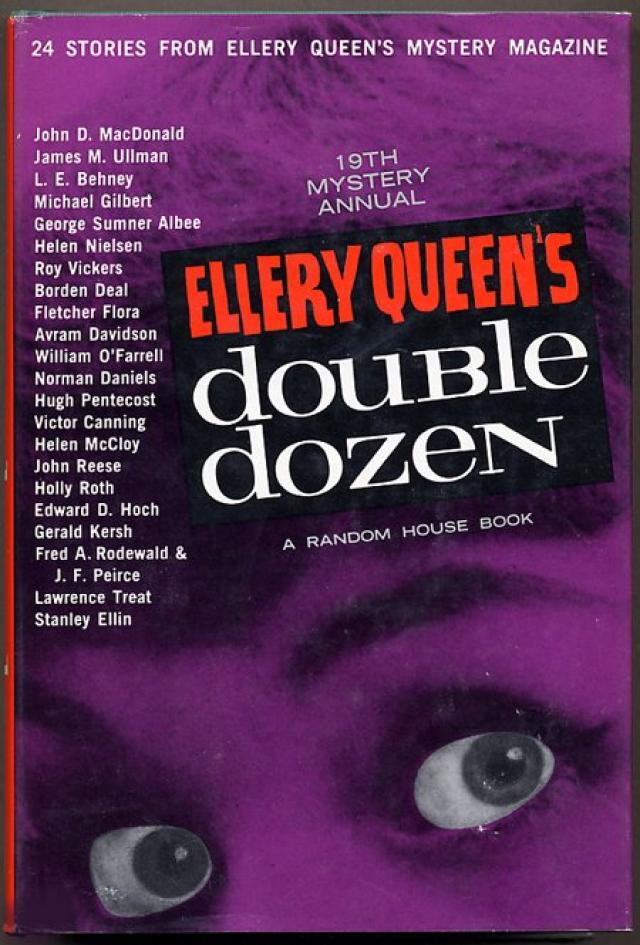
Ellery Queen's Double Dozen, page 8


“I was sorry, in a way, to saddle the boy with it, but I hadn’t any choice.”
“He took your shot as the echo of his?”
“Apparently. Anyway, he went on shooting.”
“You contemplated that he would find the body—either then or later.”
“Certainly.”
“And would assume that he had been responsible—accidentally, of course.”
“I think that he should receive a good deal of sympathy. He had a perfect right to shoot rabbits—the area belongs to the School of Artillery. The woman was trespassing on War Department Property. Indeed, the police will be in some difficulty concluding why she was there at all.”
“I expect they would have been,” said Mr. Fortescue, “if her body had ever been discovered.” Mr. Calder looked at him.
“You mean,” he said at last, “that no one has been near the barn in the last four days?”
“On the contrary. One of the troops of the Seventeenth Field Regiment, to which your intrusive subaltern belongs, visited the barn only two days later. It was their gun position. The barn itself was the troop command post.”
“Either,” said Mr. Calder, “they were very unobservant soldiers, or one is driven to the conclusion that the body had been moved.”
“I was able,” said Mr. Fortescue, “through my influence with the army, to attend the firing as an additional umpire, in uniform. I had plenty of time on my hands and was able to make a thorough search of the area.”
“I see,” said Mr. Calder. “Yes. It opens up an interesting field of speculation, doesn’t it?”
“Very interesting,” said Mr. Fortescue. “In-er-one or two different directions.”
“Have you discovered the name of the officer who was out shooting?”
“He is a National Service boy—a Lieutenant Blaikie. He is in temporary command of C Troop of A Battery—it would normally be a Captain, but they are short of officers. His Colonel thinks very highly of him. He says that he is a boy of great initiative.”
“There I agree,” said Mr. Calder. “I wonder if the army could find me a suit of battledress.”
“I see you as a Major,” said Mr. Fortescue. “With a 1918 Victory Medal and a 1939 defense medal.”
“The Africa Star,” said Mr. Calder firmly.
One week later Mr. Calder, wearing a Service dress hat half a size too large for him and a battledress blouse which met with some difficulty round the waist, was walking up the path which led to the barn. It was ten o’clock, dusk had just fallen, and around the farm there was a scene of considerable activity as F Troop, B Battery of the Seventeenth Field Regiment settled down for the night.
Four guns were in position, two in front of and two behind the barn. The gun teams were digging slit trenches. Two storm lanterns hung in the barn. A sentry on the path saluted Mr. Calder, who inquired where he would find the Troop Commander.
“He’s got his bivvy up there, sir,” said the sentry.
Peering through the dusk Mr. Calder saw a truck parked on a flat space, beyond the barn, and enclosed by scattered bushes. Attached to the back of the truck, and forming an ex tension of it, was a sheet of canvas, pegged down as a tent.
Mr. Calder circled the site cautiously. It seemed to him to be just the right distance from the barn and to have the right amount of cover. It was the place he would have chosen himself. He edged up to the opening of the tent and looked inside.
A young subaltern was seated on his bedroll, examining a map. His webbing equipment was hanging on a hook on the back of the truck.
Mr. Calder stooped and entered. The young man frowned, drawing his thick eyebrows together; then he recognized Mr. Calder and smiled.
“You’re one of our umpires, aren’t you, sir,” he said. “Come in.”
“Thank you,” said Mr. Calder. “May I squat on the bedroll?”
“I expect you’ve been round the gun position, sir. I was a bit uncertain about the A.A. defenses myself. I’ve put the sentry slap on top of Slay Down, but he’s out of touch.”
“I must confess,” said Mr. Calder, “that I haven’t examined your dispositions. It was something—well, something rather more personal that I wanted a little chat about.”
“Yes, sir?”
“When you buried her”—Mr. Calder scraped the turf with his heel—“how deep did you put the body?”
There was silence in the tiny tent, which was lit by a single bulb from the dashboard of the truck. The two men might have been on a raft, alone, in the middle of the ocean.
The thing which occurred next did not surprise Mr. Calder. Lieutenant Blaikie’s right hand made a very slight movement outward, checked, and fell to his side again.
“Four feet, into the chalk,” he said quietly. “How long did it take you?”
“Two hours.”
“Quick work,” said Mr. Calder. “It must have been a shock to you when a night exercise was ordered exactly on this spot, with special emphasis on the digging of slit trenches and gun pits.”
“It would have worried me more if I hadn’t been in command of the exercise,” said Lieutenant Blaikie. “I reckoned if I pitched my own tent exactly here, no one would dig a trench or a gun-pit inside it. By the way—who are you?”
Mr. Calder was particularly pleased to notice that Lieutenant Blaikie’s voice was under firm control.
He told him who he was, and he made a proposal to him.
“He was due out of the army in a couple of months time,” said Mr. Calder to Mr. Behrens, when the latter came up for a game of backgammon. “Fortescue saw him, and thought him very promising. I was very pleased with his behavior in the tent that night. When I sprung it on him, his first reaction was to reach for the revolver in his webbing holster. It was hanging on the back of his truck. He realized that he wouldn’t be able to get it out in time, and decided to come clean. I think that showed decision and balance, don’t you?”
“Decision and balance are most important,” agreed Mr. Behrens. “Your throw.”
GEORGE SUMNER ALBEE
Foreign Agent
Michael Gilbert’s “The Future of the Service” and George Sumner Albee’s “Foreign Agent”—we simply couldn’t resist the impulse to couple two counterespionage stories, both by outstanding authors. You will find the contrast interesting—indeed, we found it fascinating—the contrast between British and American intelligence ops at work, one at home, the other in a foreign land, and each playing a deadly serious, if not a desperate, game of wits at high, tremendously high, stakes. . .
Algiers is pronounced not Algiers but El Jay; the Sahara is spelt with a Z and looks more like Texas range-land than it does the dune-breasted desert you see in the movies; and there are other things in North Africa about which we Americans have unreal istic notions. But there are things, also, about which we are quite realistic.
The young Arab who stepped down at Bou Zanna from an old Chevrolet truck piled high with canned tomatoes and slab codfish wore scuffed slippers with tire-tread soles, an under garment like a rayon nightgown, a burnoose of whitish wool to reflect the sun and keep him cool, and a pale blue turban. Not having bathed for nine weeks, he stank, but in the dry air not too badly—something like a bunch of over-ripe bananas. His skin was dark, his eyes were darker. He came from Sioux Falls and his name was Warren Tate.
The truck bustled on southward toward Ghardaya, over the good road the French had laid down in safer times for luxurious P.L.M. buses, and Warren balanced his cheap fiber suitcase on his turban and walked splay-footed into the village. The Arab walk was not hard to mimic—not in such shoes.
Bou Zanna was a cluster of mud-brick huts the color of cocoa. There was a fonduk, a corral good for half a dozen dromedaries at most; there was a dusty public square in which the owner of an ambulatory restaurant was broiling chunks of fresh-killed mutton over charcoal.
“Peace,” said Warren Tate. “I seek my Great-Uncle, Ahmed ben Ahbes.”
“The two-story house at the end of the street,” said the restaurateur, his arms gloved with blood and flies. “You will see his horses with their heads out of the windows on the ground floor. Beauties.”
Ahmed the son of Ahbes was a powerful, dignified man of forty-odd with a square beard, dyed blackest black, and lime-green eyes far handsomer than those of the women who, peering and tittering, gathered behind him.
“Good evening, Uncle,” said Warren. “I’m Sellim.”
“You are expected.” Ahmed eyed wives and daughters with no great enthusiasm. “Hens cackle,” he said. “Leave your suit case. We will promenade ourselves.” He used the French expression.
They passed some ragged boys playing with a hoop who, touching fingertips to forehead, lip, and breast, saluted them respectfully because Ahmed was a man of substance. Under dusty palms, barefoot women hoisted water from Bou Zanna’s only well. Fifty meters farther along they stepped onto open desert. With the sun setting, it was the color of a ripe apricot, every ledge casting its long purple shadow. The clearness of the air was beyond belief; pebbles, cobblestones looked as if they had been scrubbed clean and thrust beneath a magnifying glass; each foot-high shrub threw golden sparks. An expanse of black pumice a mile away shone like a reef of coal.
“Your Arabic is very good,” commented Ahmed.
“I learned it at a United States Army language school,” replied Warren. “But I’ve been in Algeria six months, and I have a good ear.”
“You’re the first American I’ve seen since tourist days,” lamented Ahmed. “I used to rent horses to Americans, and sell them sand roses—vous savez, the little crystalline flowers made by the heat of the sun. Tell me, what do your fellow Americans think of this mess of ours?”
“We admire you. Ten, twenty Moslems a day murdered since the cease-fire, and you take it with restraint. These last few months you’ve won over not only America but the whole free world to your side.”
“We’re behaving like good Christians, eh?” Ahmed smiled wryly. “Alors, De Gaulle behaved honorably, he gave us hope, and we can understand the last few colons hanging on—we Arabs don’t like change, either.”
“You bring me to my reason for visiting you,” said Warren. “Since the army blasted Bab-el-Oued last March, the colons and their piedsnoirs, their gutter riffraff, know they’re beaten. But there are still shootings every day. Someone is paying for them, someone is coordinating them—and he isn’t a rebel general, and he isn’t in Algiers.”
Ahmed combed his dyed beard with strong, broad-tipped fingers. His nails were orange-brown with henna. “I must say this is a possibility that has not occurred to me.”
“He could be in a submarine off your coast, but I doubt it. I think he’s here on the desert—near enough to get his commands into the city, but far enough away to keep from being picked up by the army patrols.”
“But surely the police know all foreigners. They have to fill out police cards. And if a man came ashore illegally, or slipped across the border, he couldn’t go into a village for so much as a handful of dates without having his papers verified.”
“Nobody has checked mine,” said Warren, “and if an American agent can dye his skin and learn Arabic, so can a Russian. But the police are doing a good job of looking for the dyed Russian. My assignment is to have a look at foreigners with valid reasons for being on the North Sahara. I’ve checked out Dutchmen drilling water wells, Englishmen looking for oil, Hindus, Syrians—is every Syrian a salesman? Now I want a German in a Volkswagen bus, last seen near Bou Zanna.”
“Last seen when I glanced at him two seconds ago,” said Ahmed, deadpan but relishing his surprise. He pointed. Out toward the expanse of black pumice, smoke rose straight into the air like a magician’s rope. “He sleeps in his automobile and cooks his own food.”
“Dog-son-of-a-dog!” exclaimed Warren. “On his passport his name is Herwarts and he’s an anthropologist. What’s he doing?”
“He has a machine that spins little plastic wheels,” replied Ahmed with a shrug. Islam finds machinery unimpressive. “He pays people to sing for him, then he records what they sing on a ribbon.”
“Folk music! What a cover, for mass murder!”
“Now that you suggest it, yes,” said Ahmed. He cursed.
“It looks as if I’ll be here a few days. Can you let me have a room? I’ll pay.”
“Do not speak of paying, to a patriot,” said Ahmed. “Any how, you are a relative by marriage, we must remember. I’ll just throw out one of the women, preferably an old one.”
The clay walls of the tiny room gave off the dry, spicy fragrance of an old Spanish mission church. After prayers to ward Mecca and kous-kous, Warren made a quick count of his tools. He had very few along: a spool of fine, insulated wire of unusual tensile strength, a knife, a transistor radio, a longish automatic that fired soft-nosed g-millimeter cartridges without flash or noise, a dozen boxes of cough drops that might be sales man’s samples, a packet of franc notes, and a bottle of anisette that looked and smelled like liquor but that stained skin and hair. Taking only the automatic, he locked away everything else, using not only the visible lock on the suitcase but the secret one under the flap.
“Come to the café,” said Ahmed. “You must meet my friends.”
Hand in hand according to custom, they walked to the café, a mud hut like any other except that its walls were lime washed blue and it had a few deal tables and crude benches. Formally, under the gasoline lamps swinging from the sapling ceiling, Ahmed presented the sporting set of Bou Zanna: jaunty teenagers with sprigs of mint up one nostril, a cavalryman in Spahi bloomers and leather stirrup cuffs, the tailor, the teacher, an aged farmer blinded by glaucoma. Salutations and compliments were exchanged. So far as Warren could tell, nobody suspected him. Arab families are so ramified that stray relatives arouse no great curiosity. Leaving the others to their gossip, which could have borne the title Notable Horses of the Past Thousand Years, he and Ahmed ordered mint tea and took a table by themselves.
“If it’s this Germanized Russian,” asked Ahmed, “why are you waiting? Why don’t we just go out there and blow off his head?”
In spite of himself, Warren laughed. “For one thing,” he explained, “I’m not sure he’s my man. And even if he is, I want to find out how he’s getting his murder orders into Algiers when we’re reasonably sure he doesn’t have a radio transmitter.”
“Hélas, you Americans are squeamish. Wait until your population explosion kills a million of you a year from starvation, and you won’t put so much value on human life. Let’s kill him tonight. If the murders in Algiers stop, we’ll know he was the right man.”
“I’ll work as fast as I can,” promised Warren. “Every hour I delay means more bodies on the sidewalks in the city, I know that. Pretty soon you Moslems are going to get sick of it and start rioting again—who could blame you?—and then everything De Gaulle has accomplished will go down the drain, and there’ll be dancing in Red Square.”
“How can I aid you?”
“The murders are still selective. Unless Herwarts has a detailed timetable, pharmacists on Tuesday, bus drivers on Thursday, something like that. His orders for today’s executions had to leave yesterday—leave here, I mean—yesterday or the day before. How is he managing it? Telephone? Telegraph? Homing pigeons? Couriers?”
Ahmed called over a slim boy with a fastidiously trimmed, down-turned mustache. “This is Djalil, my sixth son, the post master. Djalil, our relation has certain questions,” he said.
“Has this Herwarts used the telephone or sent a wire, yesterday or the day before?” Warren asked the boy.
“No.”
“Did he send a letter?”
“Herwarts”—Djalil pronounced the name perfectly, since Arabic is as throaty a language as German—“sends no letters. Only packages, addressed to himself.”
“To himself?”
“To his own name, Rue de Joinville, Algiers.”
“What sort of packages?”
The young chef des postes touched a saucer on the table.
“This size.”
“Tapes. And tapes are as good as letters,” said Warren. “Did one go off yesterday?”
“Yes, and another today.”
With the father and son, Warren walked to the Postes et Telegraphes, under stars that were like Christmas tree ornaments. He put through a call to Chardin, the Deuxieme Bureau chief in the city, reaching him at a restaurant.
“Herwarts is recording native music. There should be a reel of tape in your central Algiers post office right now,” he said, in English. “Look for a package about eight centimeters square with his name on it. Play the recording for an expert, will you, and find out if the music is authentic? Then put a cipher man on it.”
“Do I let the package go through, afterwards?”
“It’s a hell of a choice,” said Warren. “If you do, and I’m right, it means more deaths tomorrow. But it may be our best chance of stopping them the day after.”
“D’accord, it’s a nasty choice. . .Our cryptographer is painstaking—this is going to take all night. I’ll report to you in the morning,” said Chardin. “How do I reach you?”
“Phone me. The postmaster here is loyal—I’m with him now. Call me at eight,” directed Warren.
The blasting sunlight of the desert woke him at 5:30. Through an old brass telescope which was Ahmed’s most treasured possession other than his horses, he studied the camp out toward the black lava. A lone man moved about a fire—presumably, Herwarts breakfasting.
Warren helped Ahmed to feed and water the gray stallion and the matching mare. Then, a little before 8:00, he strolled to the Postes et Telegraphes. The priority call came through promptly.
“The music is authentic, all right,” reported Chardin. “The only thing about it that might be fishy is that it’s commonplace stuff that was recorded twenty years ago on disks. But maybe your East-German doesn’t know that, or maybe he wants it re-recorded in high fidelity. There are three ballads, and one instrumental passage with a nose flute, a reed horn, and a drum. Neither the words nor the notes show recurrent patterns. Our cipher chap insists they’re clean.”