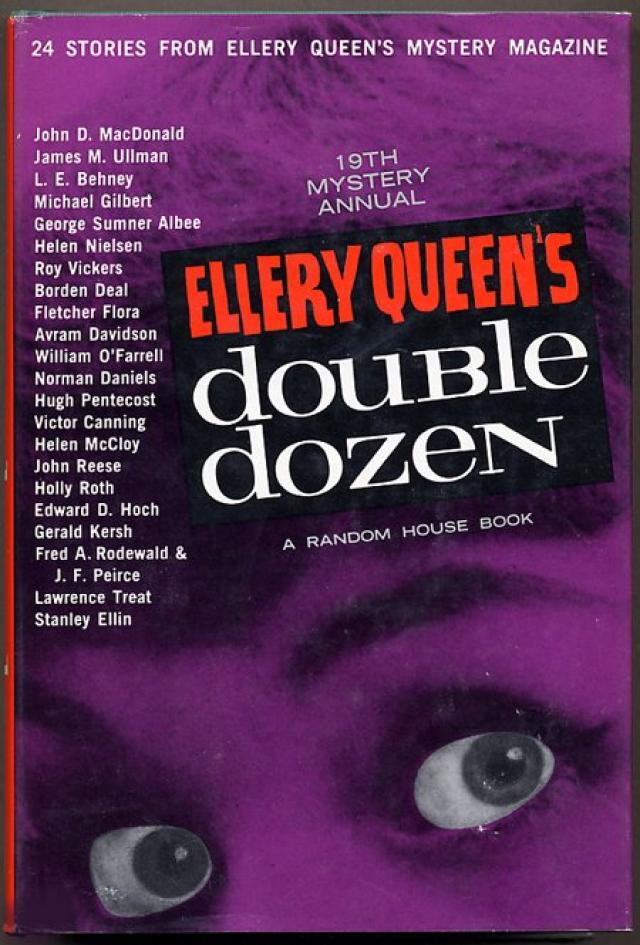
Ellery Queen's Double Dozen, page 3


“Secrecy isn’t as much of a consideration,” Allen explained, “when we buy widely held blue chips like AT&T or Jersey Standard. But it’s a prime consideration when we buy into a lesser-known company which we think may become a blue chip in the future. And it’s that class of stock, incidentally, which The Happy Days Club has been buying into with us.”
“So you believe,” Bennett said, “that The Happy Days Club has a pipeline into the innermost circles of the Gibraltar Fund.”
“Exactly,” Clark said. “We’re not so concerned that these fifteen Iowans are stealing our judgment, so to speak, as we are with the fact there is a leak in our organization. If word of our decisions reaches many people before we announce them, the price of every smaller company we start buying into will be bid up to the moon. What’s more, we’re one of the big funds in the country. If the story ever got out that a little investment club was able to steal information from us, we’d be held up to ridicule. Someone might even investigate us. You know how things are these days.”
James fingered the clipping. “Any of these names—the fifteen club members—strike a responsive chord?”
“None whatsoever.”
“Well,” James concluded, “I’d say the way to begin would be for Bennett, here, to go right to the source and find out how The Happy Days Club arrives at their decisions. Meanwhile, I’ll have Barney, my sound man, see if your phones are being tapped or anything. And I’ll run a check on the backgrounds of everyone involved in your stock transactions.”
“We don’t want to alarm those people in Iowa,” Allen said. “Don’t worry,” Bennett said. “Bennett will appear in appropriate disguise.”
A day later Bennett flew to Chicago, took another plane to Davenport, and then rented a car. He drove south along the Mississippi, reaching Canfield, a river town of some 20,000 population, as dusk fell. He checked in at a motel, wolfed a paper plate of fried chicken at a drive-in, and returned to his room for a good night’s sleep.
In the morning he drove to downtown Canfield. He breakfasted on tomato juice and toast, stopped at a news agency for a Wall Street Journal, and then, Journal and an attaché case in hand, entered the offices of the Canfield Savings and Loan Association. The newspaper clipping had identified the president of The Happy Days Club as Robert Gordon, a loan officer at the institution.
Gordon, a genial, portly man in his fifties, greeted Bennett with a puzzled smile.
“You say you’re from New York? Are you buying real estate in our town, Mr. Bennett?”
“No,” Bennett said, shaking Gordon’s hand and taking a chair, “I’m a writer. Free-lance. I’m working up a magazine piece on investment clubs.”
“You’ve come a long way for that.”
“I know,” Bennett explained, “but that’s the point. I want to get away from the usual slick big-city and fancy suburban crowd—advertising men and sales executives and all that. I want a good part of my article to deal with the way an investment club works in small-town America, the folks right across the street.” He pulled a photostat of the clipping from his pocket. “I’ve had a clipping service send me everything they could find on small-town investment clubs. And as soon as I read about The Happy Days Club in the Gazette, I knew it was the club I wanted to feature in my article.”
“I’m flattered,” Gordon said. “I’m sure the whole club will be flattered. In what magazine will your story appear?”
“I have a tentative commission from the editors of View,” Bennett said, handing Gordon a faked letter written on View stationery. “But if they decide they don’t want it, I don’t expect to have much trouble selling it elsewhere.”
“Will there be pictures?”
“Of course. I have my camera at my motel.”
“Well, won’t that be nice,” Gordon said, beaming and returning the faked letter. “Tell you what. Meet me for lunch at the American Café around the corner. Meanwhile, I’ll phone the members and try to set up a special meeting as soon as possible.”
Bennett walked to the Canfield Gazette building. He told the managing editor the same story he had told Gordon and got permission to use the newspaper’s library for background material on the club and its members.
He spent two hours going over the Gazette’s clipping files. When at last he left the building, a police car slowly followed him around the corner and down the block to the American Café. Bennett tried without much success to pretend it wasn’t there.
“All our members have been contacted,” Gordon announced over coffee. “Most of them can make it at my house tomorrow night. They’ll be there at eight. But I wish you’d drop in tonight and have dinner with my family.”
“Delighted,” Bennett said. “By the way, who makes the buying and selling decisions for your club?”
“We have a three-man selection committee—Cromie, Hubbard, and Price. When anyone has a suggestion for a stock to buy or a reason to sell a stock we hold, it’s forwarded to the committee. When we were first organized, the whole membership used to vote on what purchases or sales to make. But recently we’ve let the committee make the actual decisions, since they say timing may be important.”
“Who’s chairman of the committee?”
“We have no chairman. Just the three men. But the selections they’re been making lately have been doing so well that we haven’t changed members of the committee in nearly a year. Before that we had an awful lot of losers.”
Bennett had almost reached his car when the police car pulled up behind him and stopped. A tall, husky man in uniform emerged.
“Sir,” the officer said cordially, “would you mind coming with us?”
“What’s the trouble?”
“No trouble. The Chief wants a word with you.”
Bennett shrugged and climbed into the back of the police car. He flipped through his Wall Street Journal as they rode to the station in silence.
The Chief of Police, a huge, crew-cutted man of about Bennett’s age, late thirties, smiled and nodded toward a chair.
“Sit down, Mr. Bennett. I understand you’re a writer.”
“That’s correct,” Bennett said. He put his attaché case and the Journal on a radiator under the window and sat do. Inwardly, he debated whether to volunteer to show the Chief the faked View letter. Something about the Chief made him decide not to.
“What magazine do you write for?”
“I may do this story for View.”
“Would you mind naming some other magazines where your work has appeared?”
Bennett rattled off the names of several nationally circulated publications. He felt much as he had one day in 1944, when a German officer asked why a French farm laborer who stubbed a toe should know so many American obscenities. That had been a bad day too.
The Chief wrote the names on a pad. “I don’t suppose you’d mind,” the Chief asked, “if we checked these out.”
“Not at all,” Bennett replied. “And now I’d like to know why you’ve taken such a sudden interest in me.”
“Well, it’s funny,” the Chief explained, “but a lot of people from the big city think we’re kind of slow out here. They try to sell our citizens traps for mortar mice and all sorts of things. And this morning one of our citizens called me and said there was a man in town from View who wanted to meet the members of The Happy Days Club. He said he was suspicious because he’d heard of confidence men approaching investment clubs in one disguise or another, for the very good reason that people in investment clubs have money to invest. He didn’t say you were a confidence man, understand. He just asked us to check and make sure you’re a writer.”
“Who was this called?”
“I’d rather not tell you.”
“You asked me in here on the basis of that?”
“Not entirely,” the Chief said. “We’ve had writers around here before, Mr. Bennett. A year ago, when a farmer outside of town chopped up two mail-order brides and buried them in an onion patch, a lot of writers came down. I called one of those boys—he works out of New York too—and he said he never heard of you. So far nobody else he’s asked ever heard of you either—including, by the way, the editor of View. And the librarian here has been going through the Reader’s Guide and she can’t find any record of where you ever had anything published. Maybe if you’d tell me the dates where some of your stuff ran, she could look it up, and we could both forget the whole thing.”
“At the moment,” Bennett said blandly, “I just don’t remember.”
The Chief considered this. “Well, that’s too bad,” he said. “Now, you haven’t done anything illegal I know of yet, so I can’t charge you and put you in jail. Your name is Theodore Bennett—we know because you showed identification when you rented that car in Davenport. We checked. We’re great respecters of the law out here. We don’t push people around because they’re strangers. But the way it is, though, I’m afraid there’ll be a squad car or a police officer at your elbow every second you’re inside the city limits until I’m satisfied you are a writer. So if you want to operate under those conditions, you go right ahead.”
Bennett managed a weak grin. “Well,” he said, “I’m not going to argue. It’s ridiculous. But on the other hand, I’m not going to waste my time giving Canfield and The Happy Days Club national publicity if this is the treatment I receive here.” He rose. “I saw a pay phone near the sergeant’s desk on my way in. I’ll telephone Gordon and call the whole thing off.”
“Use my phone.”
“Wouldn’t think of it. I don’t want to waste a cent of your taxpayers’ money.”
Bennett left the Chiefs office. He fumbled clumsily through a telephone book for Gordon’s number, taking plenty of time. Then he called Gordon and abruptly informed him he was leaving town and wouldn’t write a story about The Happy Days Club after all. He hung up, leaving Gordon in mid-sentence, and returned to the Chief’s office for his attaché case and Wall Street Journal.
“A couple of my boys,” the Chief said genially, “will go with you to your motel and see to it you get packed proper and on the right road back to Davenport. If you drive fast, you might reach there before dark.”
Two uniformed officers drove Bennett to where he had parked the rented car, then followed him to the motel. Bennett packed in five minutes and checked out. They stayed with him to the city limits, pulling to the curb and watching as Bennett gunned the motor and roared out of sight over a hill.
Bennett drove at high speed for about five miles. In the future, he vowed, he’d provide himself with a solid cover story and appropriate supporting documents no matter how innocuous the assignment seemed. Apparently he had vastly under estimated the sophistication of Iowa investment clubs—and of the Iowa police.
When Bennett came to a strip of roadside stores and drive-ins he bounced to a stop in a gravel parking area. He hauled his attaché case from the back seat and opened it, exposing a transistorized tape recorder built into the bottom. Bennett had activated the recorder just before placing the attaché case on the radiator in the Chiefs office. No matter how the conversation went, it had seemed a good idea.
Quickly Bennett reversed the tape, pushed the playback button, and lit a cigarette, listening to a recording of their conversation, to the point where the Chief had said, “Use my phone.”
“Wouldn’t think of it. I don’t want to waste a cent of your taxpayers’ money.”
Then he heard the door close as he left the Chief’s office to telephone Gordon. And then the Chief did what Bennett had hoped he would do. He picked up his own telephone and dialed a number.
“Hello, Mrs. Price? Chief Waner. Your husband home? Hello, Frank. You were right. He must be some kind of swindler, although I never heard of this investment club approach before. But he sure isn’t a writer. Don’t worry. We had a little talk and he’s leaving Canfield this afternoon. He seemed sensible enough not to try to come back. Thanks. Glad you put me on to this guy before he did any damage.”
The Chief hung up.
Frank Price, Bennett knew without having to check his list, was a member of The Happy Days Club. What’s more, he was one of the three men on the stock selection committee.
Bennett turned the recorder off and looked around. What he needed now was a woman.
He found her behind a counter in a diner. She was reason ably articulate and, from the way she talked back to truck drivers, she seemed to have plenty of nerve. Bennett had to drink two cups of coffee before the place cleared out and he was alone with her. The cook in the back was engrossed in a telecast of a baseball game.
“Miss,” Bennett asked, “can you dial Canfield direct on that pay phone?”
“Yes, sir.”
“Well,” Bennett said, “I’ll give you twenty bucks if you make a call for me. It will take you less than five minutes.”
“You’re crazy,” she said.
He pulled twenty dollars from his wallet and pushed it across the counter. “There it is. No fooling. In fact, I’ll make it thirty.” He extracted another ten.
“I don’t want to get in trouble,” the girl said. “You won’t.”
“Why don’t you call?”
“Because I want someone to impersonate a telephone operator.”
“That sounds illegal.” She advanced and fingered the bills. “It is a little illegal,” Bennett admitted, “but there’ll be no risk for you. You’ve heard of private investigators, haven’t you? I can’t tell you any more than that. But if you make the call and hang up, nobody will be able to trace it. And even if they did trace it, you could always say some woman came into the diner and used the phone.”
“What do you want me to say?”
“Say, This is the long-distance operator. The charge on your call to San Diego is twenty-eight dollars and nineteen cents.’ I have reason to believe this party just made a long distance call, although probably not to San Diego. The party will probably be so mad at you that he’ll volunteer information about any long-distance calls he did make this afternoon. If he doesn’t, ask him if he made any long-distance calls, and to where. Get the out-of-town number if you possibly can. If you can’t get any information after a minute or two, say, ‘This is Albany 4-5634, isn’t it?’ He’ll say no, because his number is Albany 4-5624. Then say you’re sorry you made the error and hang up.”
“Albany 4-5634,” she repeated, reaching for the thirty dollars. “Okay, hon. I’ll go along. Got a dime?”
Twenty minutes later Bennett climbed into his car and drove to the next river town. There he turned right and crossed a bridge over the Mississippi into Illinois. The road wound down the river’s foothills and then flattened out into farm country. It was dark when Bennett checked in at an eight-unit motel in a tiny junction called Blackford.
There was a telephone booth in the parking lot and Ben nett called James from there.
“Where’ve you been?” James demanded. In the background, the roar of guns from a television set mingled with youthful screams. “I got a pack of Cub Scouts in my living room and can hardly hear you.”
“I got chased out of Canfield.” Bennett reported, “by the Chief of Police. He knows I’m not a writer and he thinks I’m a confidence man.”
“Some industrial espionage agent you are,” James said sarcastically. “What happened? Your false mustache fall off?”
“Wait a minute,” Bennett said. “The Chief didn’t think this up on his own. He was tipped by a club member named Frank Price. Frank Price is also a member of a three-man committee that decides what stocks the club will buy and sell.”
A moment of silence ensued.
“Are you thinking,” James asked slowly, “what I’m thinking?”
“It occurred to me at the time,” Bennett said, “but I figured it was just one chance in a million.”
“Well, the odds are shortening. I’ll have Barney work on that angle first thing tomorrow. Where are you now?”
“Blackford, Illinois. I’m going to sack in here tonight.”
“You’ll never get back to New York the route you’re taking. Drive to some place with an airport and catch a plane. I’ll send another agent to Canfield with a better cover.”
“I’m at Blackford because I had a girl call Price to find out if he placed any long-distance calls after I was run out of town. She pretended to be a long-distance operator. And Price did make a long-distance call this afternoon. To Eaton, Illinois, which is twelve miles from Blackford.”
“It’s probably a waste of time.”
“Maybe. The girl couldn’t get the Eaton number that Price called. But Price has a brother, William, who lives in Eaton. I learned that from some social notes about him in the Canfield Gazette morgue. It will only take a day to check the brother out and see if he has any connection with the Gibraltar Fund.”
“Since you’re there anyhow, go ahead. I’ll hold up on that other agent. Come to think of it, Price called that Chief of Police so fast when he heard you were in town it’s like someone pushed a button. He must have known you were coming. I got a hunch that by this time tomorrow we’ll both have arrived at the same conclusion.”
In the morning Bennett drove to Eaton and parked on a side street. He walked a block to the business district, entered a drug store, bought a Wall Street Journal, and stepped into a telephone booth. He flipped through the book to PRICE, WILLIAM J. and dialed the number.
A woman answered.
“Good morning,” Bennett said. “Is your husband there?”
“He’s asleep. He’s always sleeping at this hour. He doesn’t get in until three.”