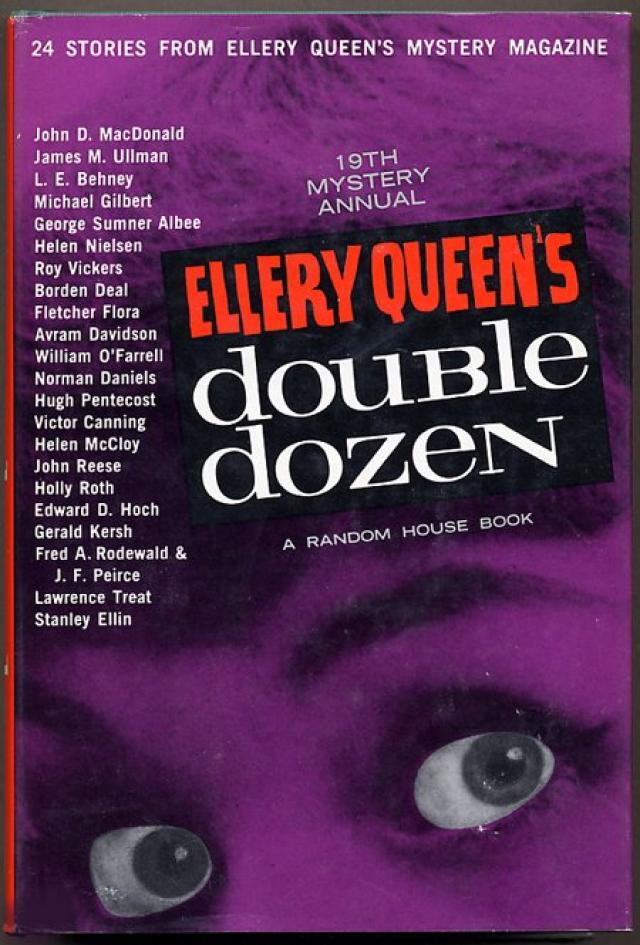
Ellery Queen's Double Dozen, page 32


Adobe dwellings of different shapes and sizes were be coming more and more frequent. They were now in what would be the city limits of Rio Escondido. There appeared to be a municipal building of some sort down one of the side streets, but for the most part there were only adobe houses and places of business, nearly all of them cantinas.
The only signs of life were an old dog lying under a wringer type washing machine tilted against the side of a house and two half-naked children playing at bullfighting in the afternoon sun. One boy, his hands tight against his head, two fingers projecting outward like horns, charged a mincing torero, who called, “Huh, huh, toro! Huh, toro!” then executed a perfect verónica with a faded rebozo as the bull swept past.
But at the sight of the old man and the convertible, the torero and the bull became children again and followed them down the street calling, as near as Mike could make out, “Hey, Pepe! Hey! Give us a ride in your station wagon!”
They passed what looked to Mike like the village market, but except for a listless wave from one of the attendants, they went unnoticed.
It was a quiet town.
Mike stuck his head out of the car and called back, “Hey, old man, where do you get your gasoline?”
Still clutching the chain, the old man lifted both hands and pointed down the street. “El Perro Negro!”
Mike followed the gesture with his eyes and saw the words painted in orange and blue on the side of an adobe cantina.
El Perro Negro. The Black Dog. What a wonderful name for a bar! Like most Spanish names, it lost nothing in translation.
Mike braked the convertible to a stop in front of the cantina. Cutting his engine, he got out and walked back to the old man. “Well, we made it,” he said. “Let’s unfasten the chain.” He took the chain, and the old man let go. Disengaging the hook from the bumper of the convertible, Mike threw the chain into the trunk compartment. The old man didn’t move.
“Isn’t this where you get your gas?” Mike asked.
“Sí.”
“I get it—you’re waiting for service. Who waits on you?”
“Juan.”
“Okay, I’ll send him out mucho pronto.”
“Gracias, señor. Gracias!”
Mike crossed the unpaved street toward the batwing doors of El Perro Negro, but stopped just short of the board sidewalk. “Well, I’ll be damned!” he said and put a hand on a shiny, new parking meter stuck in the loose dirt. Looking along the street he saw two rows of parking meters, but not a single car—nor could he remember having seen one since entering the village. But why hadn’t he noticed the parking meters before?
Probably because he was too busy looking out for the old man.
And what the hell were parking meters doing in a town too poor to afford pavement? Or street lights, for that matter?
“Damn!” he said under his breath and stepped through the batwings of El Perro Negro. Pausing just inside, he let his eyes adjust to the gloom. He could make out a bar on the right, and he crossed the room toward it, stumbling over a chair, but man aging to catch it before it hit the floor. Reaching the bar, he sat down near a large man in uniform.
A fat man with a towel tied around his waist was behind the bar, and Mike addressed him. “¿Habla usted inglés, señor?”
The bartender nodded and pulled at his walrus mustache. “You are Juan?” Mike asked.
“I am Juan,” the bartender answered.
“There’s a station wagon out front that needs gas, and I need some coins for the meter.”
“Did you hear, Carlos?” Juan said to the man in uniform.
“It is Pepe!”
Carlos. That would be the official who wouldn’t give the old man a license.
Carlos shrugged his massive shoulders. “Sí,” he said, “it is Pepe.”
The bartender took a bottle of tequila from behind the bar and was almost to the door when Carlos’ voice stopped him. “You should not, my friend Juan,” he said. “You should not give Pepe gasoline. He is no station wagon.”
Juan turned without speaking and stepped through the bat wings into the glare of the street.
Carlos sighed heavily and looked at the tequila bottle in front of him. With his heavy right arm he swept a saltcellar and a small bowl of cut limes into position beside the bottle.
“What’s wrong with the old man?” Mike asked.
Carlos licked the top of his left hand below the first joint of the thumb and poured salt on it. “Old Pepe?” he said. “Five years ago he was hit by a station wagon in Monterrey. Now he is a station wagon.”
“And everyone believes him?”
“Sí. They say he has been touched by the hand of God.”
“And you? Do you believe he is a station wagon?”
Carlos licked the salt, drank from the bottle of tequila, bit and sucked the lime. “Me? I believe that he was hit by a station wagon. It is wrong to let him believe he is a vehicle. It does him no good. But the people will not understand. It is different in your country. But here the people believe in such things.”
“How does he live? Who takes care of him?”
“The people. Juan gives him tequila. Others, food and clothing. I tear up his traffic tickets. He has a shack. He calls it a garage. He is happy, but he could be happy without being a station wagon.”
Coughing and sputtering sounds issued from the street out side, then gave way to loud honks and beeps that faded off down the street.
“He is disturbing the siesta again,” Carlos said, shaking his head as Juan returned to the cantina. “I told you to keep him quiet on the street. Now I will have to give him another ticket for honking his horn. It is a terrible horn. It is the loudest horn in all Mexico.”
“Pepe means no harm,” Juan said, “and the people do not care.”
He raised his hand and pulled at his mustache. As he did, a piece of cardboard approximately five inches deep and a foot wide slipped from beneath his “apron” and fell to the floor. The cardboard had numbers and letters penciled heavily across its face. Juan picked it up hurriedly.
“What is that, my friend?” Carlos asked.
Juan looked away. “The license for Pepe,” he said.
Carlos jumped to his feet. “You have no right to give it to him!” he shouted. “It is no license! It is wrong to give it to him!”
“It’s only cardboard,” Mike said. “What’s the harm if it makes the old man happy?”
“It is wrong!” Carlos shouted. “It is not official!”
“Sí. It is not official,” Juan said. “Pepe, too, said it is not official. He would not take it. Only Carlos can make it official. It is a paper license. It cost nothing. But it could make Pepe happy if you gave it to him. Only you can make Pepe official. Carlos, you must! Please, I beg of you.”
Carlos made no reply, and Juan pulled with both hands at his mustache. The two men glared at each other.
“Look,” Mike said, and ran his fingers through his hair, “how about me buying the two of you a drink? I could use a cold beer.”
Juan quit pulling at his mustache and leaned his hands on the bar. “We have beer,” he said, “but it is not cold.”
“Not cold?”
“There is no ice. We have no electricity in Rio Escondido.”
“No electricity? But—You can’t be serious! You don’t have electricity, you don’t have pavement, but you do have parking meters, don’t you?”
“Sí.”
“For cat’s sake, why?”
“We are a poor village,” Juan said. “We cannot afford these things. Our government told us that electricity is too expensive; they could not give it to us. They told us they would sell us the meters to make the money to pay for the electricity.”
“But where are the cars?”
Carlos threw up his hands. “We have three—all government vehicles. And they do not pay.”
Mike whistled. “Well, I’ll be damned!” he said. “You’ve been taken—and by some A-one con men. Which reminds me, I need some coins for the meter.”
“No, my friend,” Carlos said, “the meters are forever free to the first to use them. We have waited seven weeks. You are the first.”
“We told the government there were no vehicles,” Juan said, “but they told us if we had meters we would have many touristas. You are the first. The others will soon follow.”
“But this place is nothing! Nowhere! You won’t get any tourists here.”
Juan shrugged. “The government told us.”
Carlos pounded the bar. “Sí, the government told you, but the government was wrong. You would not listen to me. You never listen! I, Carlos Rodriguez, told you that it was not so. But you would not listen.”
Coughing and sputtering noises could be heard approaching along the street outside. In front of El Perro Negro they stopped and gave way to loud honks and beeps.
“Pepe needs more gasoline,” Juan said. He reached for the tequila, but Carlos took it from him.
“No,” Carlos said, “Pepe is no station wagon—he is a man. He does not need gasoline—he needs tequila. I will take it to him.”
At the batwings Carlos stopped and turned to Juan. “You are all Pepes in this town. You are children. Foolish children. You believe when Pepe tells you he is a station wagon. And Pepe is no station wagon. You believe when the government tells you there will be rich touristas, that there will be much money if you have parking meters. And there are no touristas. There is no money. Sí. You are all Pepes. You have spent your pesetas, and for nothing!”
Carlos strode through the batwings and Mike turned to Juan. “What’s his story?” Mike asked.
“He is the village conscience.”
“Why isn’t he like the rest?”
“A woman.”
“It figures.”
“He no longer believes. He would not hurt Pepe. But he cannot believe. He is a good man. His heart tells him that Pepe should have the license, but not his head. So he cannot give it to him.”
A stream of high, staccato Spanish exploded like a string of firecrackers outside. Mike could understand none of it—it was hardly high-school Spanish, but it was obvious that Carlos was very angry. It was impossible to hear Pepe’s calm replies.
Then all was quiet—a quiet broken at last by Pepe starting his engine and chugging and sputtering down the street.
Moments later a dirty, half-naked boy entered carrying the tequila.
Mike recognized the boy who had played the bull.
The boy handed Juan the bottle, and the two spoke rapidly, Juan pulling at his mustache.
Mike caught the words “Pepe” and “cárcel.” The latter word was repeated several times, but he could not recall its meaning. Juan and the boy finished talking, and Juan fished a coin from his pocket and tossed it to the boy, who once again became a bull. With head lowered and horns pointing outward, he went charging through the cape-like doors.
Juan unfastened the towel from around his middle and turned to Mike, his manner quite serious. “Carlos has taken Pepe to jail.”
“This is something new?”
“Sí. It has never happened before.”
“What will happen?”
“I do not know, but we must help Pepe.” He paused as if realizing it was none of Mike’s affair. “You will help,” he said. It was a statement, not a question.
“Of course. If I can.”
Juan took the cardboard license from behind the bar and stuffed it under his shirt, then hurried outside.
Mike followed him into the street and was again struck by the suddenness of the heat, the brightness of the sun.
Carlos and Pepe were nowhere in sight. All was quiet. It was still the siesta.
Juan led the way along the dusty, unpaved streets till they came at last to a squat, adobe building with Estación de Policía in neat black letters above the door.
They entered a bare, cheerless room containing a desk and two straight-backed chairs.
Carlos glared at them from behind the desk as they entered. “How is Pepe?” Juan asked.
“He is loco!” Carlos said, waving his arms. “That is how he is! He is loco, loco, loco! He will not understand he is no station wagon!”
“Maybe he is a station wagon,” Mike said.
“What? You say this? No, my friend, you think as I do. You cannot believe him. He is loco!”
“How do you know Pepe is loco?” Mike asked. “How do you know he is not a station wagon?”
“Because he is no vehicle,” Carlos answered, turning away as if not wanting to discuss it.
“Our friend Juan here,” Mike said, “is he a bartender?”
“Sí.”
“Why is he a bartender? What makes him a bartender?”
“He serves tequila.”
“If you come to my home and I serve you tequila, am I a bartender?”
“It is not the same thing, my friend. Pepe is human—he can not be a vehicle.”
Juan could contain himself no longer. “What have you done with Pepe?” he demanded.
“Pepe! Pepe! Pepe!” Carlos shouted, waving his arms. “Why will you not understand? Pepe is no station wagon. I say to him, ‘Pepe, where are your wheels?’ and he tells me he is a station wagon.”
“You have put him in jail?” Juan asked.
“He would not go to jail!” Carlos shouted. He pounded on his desk. “I gave him parking tickets! I gave him tickets for honking his horn! I gave him tickets for disturbing the siesta! I told him for this he must go to jail. But he said he could not go to jail because a station wagon cannot fit into a jail, that a jail is for people.”
“What have you done with him?”
“I have impounded him.”
“You’ve what?”
“I have impounded him! He would not go to jail, so I chained him to one of the government vehicles. I had to! I had to do it! He would not go to jail! So I impounded him as I would a stolen vehicle. Oh, he is a bad station wagon, that Pepe!”
Mike smiled. “Then you do believe that Pepe’s a station wagon?” he said. He tried to visualize the little old man standing off Carlos—Carlos with his heavy arms and broad shoulders.
“Eh? No! He is not a station wagon!” Carlos said.
“But don’t you see that he really is?” Mike said. “He’s as much a station wagon as Juan is a bartender. Juan is a bartender because everyone agrees that he’s a bartender. And Pepe is a station wagon because everyone agrees that he’s a station wagon—except you.”
Carlos shook his head.
“Oh, I know he isn’t official, that he doesn’t have a license. But would you deny Juan a license if he needed it to tend bar?”
Carlos again shook his head, and Mike continued.
“You said, ‘Oh, he is a bad station wagon, that Pepe!’ So you must believe him.”
“I said it only because I was angry.”
“You gave him parking tickets?”
“Sí, I gave him parking tickets.”
“Do you give parking tickets to pedestrians?”
“No. But Pepe is different.”
“Of course he’s different. He’s a station wagon! You gave him tickets for honking his horn, for disturbing the siesta?”
“Sí,” Carlos said and shrugged.
“Do you do this to the others? No, because they don’t have horns.”
“But Pepe’s horn is so loud—it is the loudest horn in all Mexico!”
“But he does have a horn—you have just admitted it. The others, do they have horns?”
“No,” Carlos said. He sighed heavily.
“Of course they don’t. And now you have impounded him. Can you impound a citizen? No! What do you do with citizens who break the law?”
“I put them in jail.”
“But you didn’t put Pepe in jail, even though you are bigger, stronger than he is. You impounded him! You impounded him because he’s a station wagon, because in spite of everything, you believe he’s a station wagon.”
Carlos shrugged imperceptibly. His normal gestures were violent, sweeping, and the two men, who had been following his every move, sensed that this was his moment of truth and were silent.
Carlos studied his strong, brown hands. It was as if he were aware of his hands suddenly for the first time. His expression might have been the same if he were considering cleaning his nails or cutting his hands off at the wrists.
“’Sta bien,” he said at last, avoiding their gaze, “give me the license.”
Juan took the license from beneath his shirt and put it into the hand that Carlos held out to him.
Carlos straightened himself to his full height. Then, assuming his most official manner, he strode into the street.
Mike waited with Juan in the comparative cool of the office, but hearing the station wagon start up, the two men rushed to the door in time to see Pepe come charging around the corner of the building. He was bent forward stiffly from the waist. His hands were pressed tight against his forehead, two gnarled fingers projected forward, forming a bumper.
Mike caught a remembered glimpse of the children playing in the sun—and understood.
The station wagon stopped at the sight of them and honked happily. Then with feet churning the dust, Pepe went honking and beeping down the street, his license plate wired to the seat of his pants.
By then Carlos had rejoined them. “Who’ll pay for the tickets?” he asked.
“Wasn’t he the first to use the meters?” Mike asked.
“Sí. It is so.”
Carlos turned to Mike and again assumed his most official manner. “I am sorry, señor,” he said, “but I must give you the ticket for illegal parking. But for you I will make it easy, very easy—only ten pesos.”
“But you said—” like began, then broke into a grin and took out the dollar bill he had offered Pepe. “Hell, for eighty cents it’s not worth it. Besides I knew it was going to cost me when I listened to the old man; I just didn’t know how much.”
LAWRENCE TREAT
L As in Loot
It is not generally known, or if known, not generally recognized, that Lawrence Treat was the important pioneer in the origin and development of the contemporary procedural detective novel—the novel of what might be called the “public eye.” Of course, in their own times, many famous fictional characters operated as procedural detectives; for examples: Gaboriau’s Lecoq, in his own (and by today’s standards, primitive) way; the various detectives whose exploits (chiefly imagined) were chronicled by Allan Pinkerton; R. Austin Freeman’s Dr. Thorndyke, with his scientific (and still sound) methods; and Freeman Wills Crofts’ Inspector French cases which surely emphasized legwork and painstaking investigation.