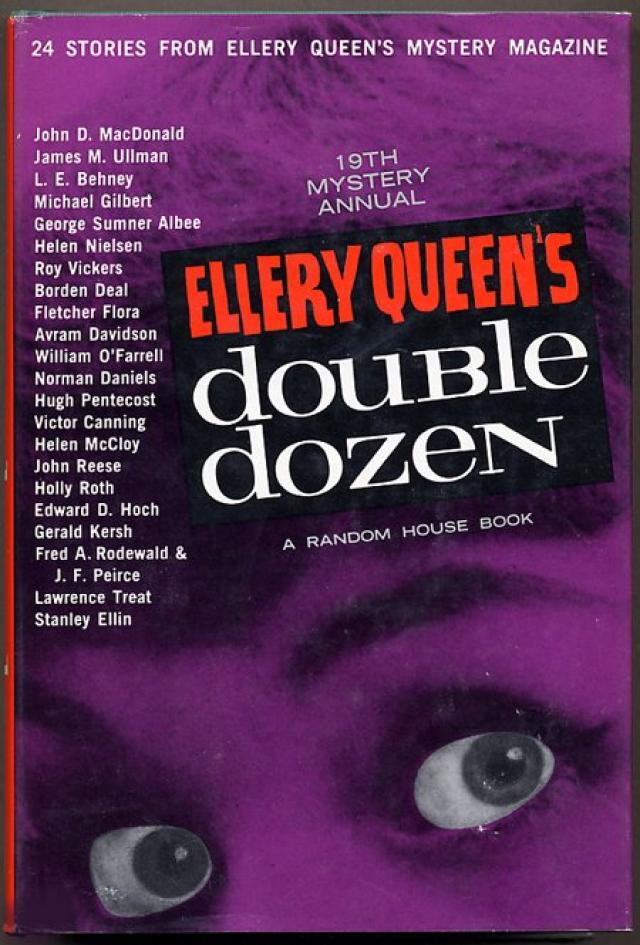
Ellery Queen's Double Dozen, page 30


They took time for a smoke, and Contrell said, “You didn’t have to kill that Gook, Willy.”
“No? What was I supposed to do, let them all climb aboard and get us all killed? Go on, report it if you want to. I know my military law and I know my moral law. It’s like the over crowded lifeboat.”
“I think you just like to kill.”
“What soldier doesn’t?”
“Me.”
“Hell! Then what’d you re-up for? Fun and games?”
“I thought I might do something to keep the world at peace.”
“Only way to keep the world at peace is to kill all the troublemakers.”
“That Gook back there was a troublemaker?”
“To me he was. Just then.”
“But you enjoyed it. I could almost see it in your face. It was like North Africa all over again.”
Major Grove turned away, averting his face. “I got a medal for North Africa, buddy. It helped me become a major.”
Contrell nodded sadly. “They do give medals for killing. And I guess sometimes they don’t ask for too many details.”
Someone called an order and Grove stubbed out the cigarette. “Come on, boy. Don’t brood over it. We’re moving on.”
Contrell nodded and followed him. Once, just once, he looked back the way they’d come. . .
24 August 1961
Major Contrell had been in Berlin only three hours when he heard Willy Grove’s name mentioned in a barside conversation at the Officers’ Club. The speaker was a slightly drunk captain who liked to sound as if he’d been defending Berlin from the Russians single-handed since the war.
“Grove,” he said with a little bit of awe in his voice. “Colonel Willoughby McSwing Grove. That’s his name! They say he’ll make general before the year is out. If you coulda seen the way he stood up to those Russians last week, if you coulda seen it!”
“I’d heard he was in Berlin,” Contrell said noncommittally.
“I know him from the old days.”
“Korea?”
Contrell nodded. “And North Africa nearly twenty years ago. “When we were all a lot younger.”
“I didn’t know he fought in World War II.”
“That was before we were officers.”
The captain snorted. “It’s hard to imagine old Grove before he was an officer. You shoulda seen him last week—he stood there, watching them put up that damned wall, and pretty soon he walked right up to the line. This Russian officer was there too, and they stood like that, only inches apart, just like they were daring each other to make a move. Pretty soon the Russian turned his back and walked away, and damned if old Grove didn’t take out his .45! We all thought for a minute he was going to blast that Commie down in his track, and I think we’d all have been with him if he did. You know, you go through this business long enough—this building up and relaxing of tensions—and after a while you just wish somebody like Colonel Grove would pull a trigger or push a button and get us down to the business once and for all.”
“The business of killing?”
“What else is there, for a soldier?”
Contrell downed his drink without answering. Instead, he asked, “Where is Grove staying? Is he married now?”
“If he is, there’s no sign of a wife. He lives in the BOQ over at the air base.”
“Thanks.” Contrell laid a wrinkled bill on the bar. “The drinks were on me. I enjoyed our conversation.”
He found Colonel Grove after another hour’s searching, not at his quarters but at the office overlooking the main thorough fare of West Berlin. His hair was a bit whiter, his manner a bit more brisk, but it was still the same Willy Grove. A man in his forties. A soldier.
“Contrell! Welcome to Berlin! I heard you were being as signed here.”
They shook hands like old friends, and Contrell said, “I understand you’ve got the situation pretty well in hand over here.”
“I did have until they started building that damned wall last week. I almost shot a Russian officer.”
“I heard. “Why didn’t you?”
Colonel Grove smiled. “You know me better than to expect lies, Major. We’ve been through some things together. You’re the one who always said I had a weakness for killing.”
“Weakness isn’t exactly the word for it.”
“Well, whatever. Anyway, you probably know better than anyone else my feelings at that moment. But I kept them under control. There’s talk of making me a general, boy, and I’m keeping my nose clean these days. No controversy.”
“And I’m still a major. Guess I don’t live right.”
“You don’t have the killer instinct, Contrell. Never did have it.”
Major Contrell lit a cigarette, very carefully. “I don’t think a soldier needs to have a killer instinct these days, Willy. But then, we’ve been debating this same question for nearly twenty years now, off and on.”
“Haven’t we, though.” Willy Grove smiled. “I’m sorry I don’t have somebody I can kill for you this time.”
“What would you have ever done in civilian life, Willy?”
“I don’t know. Never thought about it much.”
“A hundred years ago you’d have been a Western gunman probably. Or forty years ago, a Chicago bootlegger with a tommy gun. Now there’s just the army left to you.”
Grove’s smile hardened, but he didn’t lose it. Instead, he rose from behind the desk and walked over to the window. Looking down at the busy street, he said, “Maybe you’re right, I really don’t know. I do know that I’ve killed fifty—two men so far in my lifetime, which is a pretty good average. Most of them I looked right in the eye before I shot them. A few others got it in the back, like that Russian nearly did last week.”
“You could have started a war.”
“Yes. And some day perhaps I will. If I had the power to. . .” He let the sentence go unfinished.
“They’re not all like you,” Contrell said. “Thank God.”
“But I have enough of them on my side. Enough of them who know that army means war and war means death. You can’t escape it, no matter how hard you try.”
He looked at the white-haired colonel and remembered the captain he’d spoken with in the bar earlier that afternoon. Perhaps they were right. Perhaps he was the one who was wrong. Had he wasted away his whole life pursuing an impossible dream of an army without war or killing?
“I’ll still do it my way,” he said.
“Good luck, Major.”
A week later Contrell heard that a Russian guard had been killed at the wall in an exchange of gunfire with West Berlin police. One story had it that an American officer had fired the fatal shot personally, but Contrell was unable to verify this rumor.
5 April 1969
It was the day before Easter in Washington, a city expectant under a warm spring sun. The corridors of the Pentagon were more deserted than usual for a Saturday, and only in one office on the west side was there any activity. General Willoughby McSwing Grove, newly appointed Chairman of the Joint Chiefs of Staff, was moving into his suite of offices.
Colonel Contrell found him bent over a desk drawer, distributing the contents of a bulging brief case to their proper places. He looked up, a bit surprised, at his Saturday visitor. “Well. . .Contrell, isn’t it? Haven’t seen you in years. Colonel? You’re coming along.”
“Not as fast as you, General.”
Grove smiled a bit, accepting the comment as a sort of congratulation. “I’m at the top now. Good place to be for a man of my age. The hair’s all white, but I feel good. Do I look the same, Colonel?”
“I’d know you anywhere, General.”
“There’s a lot to be done, a damned lot. I’ve waited and worked all my life for this spot, and now I’ve got it. Our new President has promised me free reins in dealing with the international situation.”
“I thought he would,” Contrell said quietly. “Do you have any plans yet?”
“I’ve had plans all my life.” He wheeled around in his swivel chair and stared hard out the window at the distant city. “I’m going to show them what an army is for.”
Colonel Contrell cleared his throat. “You know, Willy, it took the better part of a lifetime, but you finally convinced me that killing can be necessary at times.”
“Well, I’m pleased to know that you’ve come around to. . .” General Grove started to turn back in his chair and Contrell shot him once in the left temple.
For a time after he’d done it, Contrell stood staring at the body, hardly aware that the weight of the gun had slipped from his fingers. There was only one thought that crowded all the others from his mind. How would he ever explain it all at the court-martial?
GERALD KERSH
The Persian Bedspread
@ Copyright, 1963, by Gerald Kersh
As odd a tale as you’ve ever read—about the smoothest, slickest rug and tapestry dealer you’ve ever met in print a story with a curiously haunting quality. . .
In the trade, some sinister similes were applied to Mr. Hadad he evoked images of danger. “A coiled spring wrapped in fat, such as the Eskimos use for catching bears,” said one. Another said, “Dealing with Hadad is like feeling for a double-edged razor blade on a slippery floor in the dark.”
But in the discreet light of his shop, which was the shyest of all those shops off Fifth Avenue where sensitive tradesmen seem to hide for fear of customers, Mrs. Gourock saw only a plump, creamy-skinned, spaniel-eyed little man, forlorn in posture, smiling wistfully. Mrs. Gourock was a woman who knew what she wanted, and had the wherewithal to buy it.
“I want a rug for my husband’s study,” she said. “How much is the thing in the window?”
The jeweler in that street exhibited one pearl, the milliner one hat, and Hadad one rug.
“Oh, that?” said Hadad, thinking that some women’s egos need inflating, others invite a pinprick. “The silk Bijar? Oh, say twelve thousand dollars.”
Taken aback, she said, “It’s for my husband’s study. Twelve thousand dollars!”
“Ah,” said Hadad, “for your husband’s study. You have in mind something less costly. First, pray be seated, and let me offer you a cup of coffee.—Oh, Dikran, coffee, please.”
And he said to himself: If a woman like this one buys her husband gifts, she is up to some hanky-panky. She is a payer of payments, not a giver of gifts.
“Perhaps a Bijar is too blazing a blue for the seclusion of a study; it is hard to read on a Bijar,” he told her. “On the other hand, there is something gently hypnotic about a Sarafan. I love a Sarafan. But such as I have here would perhaps cost more than you would be prepared to spend, just for a study.”
“What’s that one up there?” she asked, pointing to the wall behind Hadad. “Is it a rug? Or a tapestry? And why is it framed?”
“So many questions all in one breath!” said Hadad, laughing. “It is framed, dear lady, because I had it framed. And its history is not for ladies to hear—”
“Do you take me for a child?”
Hadad shook his head, and surmised: about thirty-nine years and six months old, you—without counting your teeth. “In any case, it is a sort of curiosity, ma’am, which you wouldn’t care to buy even if it were for sale,” he said. “Why? How d’you know?”
“Ah, coffee,” said Hadad. His assistant drew up a low table and set down a tray.
“I can’t eat that Turkish delight,” said Mrs. Gourock.
Hadad said, “Other rahat lakoum you cannot eat. This you will eat. Now let me think what would be nice for your husband’s study. He is a quiet, reserved man, I think?”
“How d’you know?”
Because, Hadad decided, wordlessly, it is generally the gentle ones that get grabbed in marriage by great brassy women like you, who would have your cake and eat it too. Also, I think he has a controlled devil of a temper, and the money is all his or why should you be all of a sudden so considerate of him in his study?
Meanwhile, he murmured, “I have Mosul, Kir Shehr, and sumptuous Teherans. I have Kirman, Shiraz, and silken Tabriz. I have Bergama, Fereghan, Khorosan—”
“I want you to tell me what that is in the frame.”
“Well,” said Hadad, smiling, “it is not something you can get at Mejjid’s Auction Rooms in Atlantic City, where—unless my memory deceives me, which it never does—you bought for $300 a pair of Chinese vases worth, alas, about $40.” He added, “June 29th, 1950.”
Then his voice faded, his lips parted, his eyelids drooped, and Mrs. Gourock was reminded of Peter Lorre in a murder movie: Hadad had just that lost, sick, hopeless look.
He forestalled her inevitable “How d’you know?” by saying, “It happens that I was there at the time, and I never forget a face. You were bidding against an old lady in an immense straw hat. Her name was Kitty. She was a shill.”
“I like auctions,” said Mrs. Gourock. “I didn’t want the vases. I’ve paid more—oh, so much more—than $300 for two hours’ entertainment. . .” She was surprised to catch herself making excuses. “What’s a shill?”
“You know,” said Hadad, “that if anyone is running a so called game of chance at a fair, somebody must appear to win pour encourager les autres. Thus, at a pea-and-thimble game, a seemingly silly farmer will win $100 while the audience is gathering. He is a shill, employed by the thimble-rigger, and he is not paid in real money.
“Conversely, at a certain type of auction sale, somebody must get an obvious bargain to excite the on-lookers.
“Thus, the attics and thrift shops of the nation are full of Mejjid’s stuff, all bought by people who cannot for the life of them say just what made them blurt out that last silly bid before the auctioneer cried ‘Gone!’ It’s no disgrace to you; it is like feeding a slot machine with silver dollars, but warmer, less impersonal—only, once in ten thousand tries, a slot machine will disgorge a jackpot, and Mejjid will never disgorge any thing.”
Dogged as a spoiled child, Mrs. Gourock persisted. “I want you to tell me about that thing in the frame.”
Hadad seemed not to have heard her; he went right on. “You know how it is, dear lady. You look in—only for fun, mind. No harm in that, eh? The auctioneer is about to give away a cut-glass lemonade set, free of charge. He doesn’t want to personally, he’d cherish such a lemonade set, make an heirloom of it. But he’s paid (sigh) to give things away. However, first things first; and here’s a Moorish coffee table. Everybody nudges everybody else as the auction room fills up; everybody is there to kill time. Nobody’s going to buy anything at all. The joke’s on Mejjid, eh? Poor old Mejjid!
“And so some joker bids fifty cents for the coffee table, and there is a titter when a grim old lady in inappropriate shorts calls out seventy-five. Then it’s a dollar. ‘—And four bits,’ says a fat man with a cigar. ‘—And a quarter,’ you say, just to keep the ball rolling. It really is fun, no? All you have to do is keep saying ‘—And a quarter,’ and sit back and watch your neighbors making fools of themselves. The bidding is up to $13, let us say. ‘—And a quarter,’ you call, waiting for the inevitable. It doesn’t happen.
“All of a sudden you are the loneliest person in the world, for it is, ‘Gone to the lady for $13.25!’”
Mrs. Gourock said, “About that hanging, or whatever it is, in the frame. . .”
“Yes, yes,” said Hadad, offering her a cigarette. “Now once upon a time—no, never mind. . .A rug for a study, eh?”
“Once upon a time what?”
With a helpless gesture Hadad said, “You are a very dangerous lady. You must know everything. Once upon a time, driven by necessity, I worked as a shill for Mejjid.”
“Yes, but what about that?” She pointed to the framed tapestry.
“Madam, are you determined to drive me frantic?” cried Hadad, clutching his head. “I will tell you about it, since you are so insistent. Did you ever hear of the Mighty Mektoub? No, I think not. But you have heard of Casanova? Of Don Juan? Naturally, everybody has. Well, Mektoub was the Syrian Casa nova; only Casanova was a mere sower of wild oats, and Don Juan nothing but a juvenile delinquent, compared with Mektoub. His exploits were put into verse by one Shams-ud-Din, in the seventeenth century, but it would take an epic poet like Firdausi, or Homer, to do justice to him as a fighter, a hunter, and, above all, as a lover.”
She was all excitement. “I’d like to read it. Where can I get a copy?”
“Dear lady, you cannot—the only known copy of that poem is in the possession of King Farouk. The tapestry you see was Mektoub’s bedspread, and it is supposed to convey to its owner some of Mektoub’s remarkable powers—”
“And does it? It doesn’t!” said Mrs. Gourock. “Does it?”
“Let me proceed,” said Hadad. “I say. I was one of Mejjid’s shills—to my eternal shame and sorrow—for I spoke little English at that time, and had an aged father to support And I hated Mejjid, with reason. With excellent reason, but that is private and, in a way, sacred.”
“Why?”
“It was not,” said Hadad, looking reproachfully at her, “it was not that he underpaid me; that was nothing. It was not that—falsely calling himself Mejjid Effendi, a title to which he had no more right than a pig has to the name of Lion—he publicly humiliated me. For I am descended from the Kings of Edom, madam, and cannot be insulted by an inferior. A Hadad would not own a dog with the pedigree of a Mejjid.”
“What was it then?”
Hadad sighed. “I do not know why I tell you this,” he murmured. “Simply, by bringing the force of his money to bear upon her father, he married my fiancée, a girl of sixteen.”
“How old was Mejjid?”
“Sixty-eight. He had outlived four wives,” said Hadad. “Pretty hard on the poor girl,” said Mrs. Gourock.
“It would be cruelty to animals to marry a hyena to the likes of Mejjid. Still, she bore him three daughters, old as he was. Let us not talk of her any more, if you please. I say, I was Mejjid’s shill, and his most trusted one, because he knew that as a gentleman I would die sooner than cheat him. These people make capital out of honor,” said Hadad. “So it was my business to ‘buy in’ the Mektoub bedspread.”