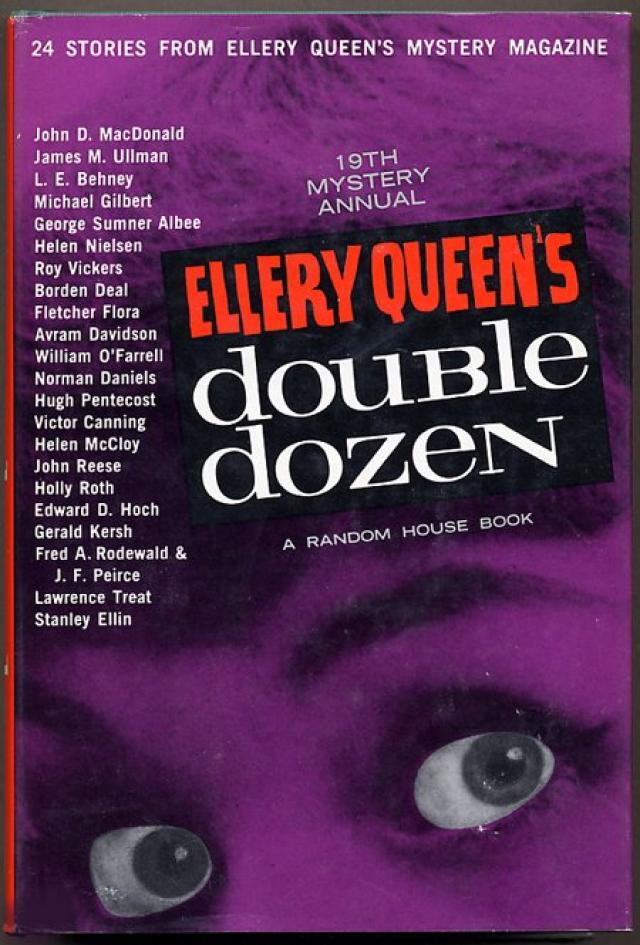
Ellery Queen's Double Dozen, page 20


The cops will find my fingerprints on it, and probably no body else’s—remember, I dug it out of the drainpipe. I’ll say this much for Dorothy—she’s smart. She’s pretty, too, and if you don’t look too close you’d never notice those little lines at the corners of her eyes.
One more thing. Chances are that Mr. Bennett really is in Las Vegas. Anyway, he’s certainly nowhere near Malibu. If there’d been the slightest chance of anybody thinking that he might have done it, Dorothy would never have told me that she’d seen him. Last thing she wants is to have Mr. Bennett put in jail.
And of course she never had any intention of telling the cops the same story she told me. That was going to be something I had just dreamed up. For publicity or something, to drag her name into it when all she was doing was doing me a favor, taking my paper into class.
Wherever Mr. Bennett is, I don’t know whether they’ll find his secretary with him or not. Or care. That’s his business and if the cops want to make it so, it’s theirs. My business is some how to get off the hook. So will you get me off, sir, please?
And how’s about it, Mr. Wurley, do I pass?
IN MEMORIAM—William O’Farrell died on April 11, 1962 at the age of 57. He was a fine novelist and short story writer—his “Over There—Darkness” was awarded the Mystery Writers of America “Edgar” as the best mystery short story published during 1958; and every story by Mr. O’Farrell that has appeared in EQMM has been distinguished. “A Paper for Mr. Wurley” is probably the last short story that William O’Farrell wrote before his death—and it is one of his finest. William O’Farrell will be missed. . .
NORMAN DANIELS
A Funeral for Patrolman Cameron
If this story doesn’t get under your skin, if it doesn’t tug at your heartstrings, if it doesn’t make you feel angry and sad and—yes, proud. . .
Captain McDermott, in charge of Headquarters between the hours of 8:00 A.M. and 4:00 P.M., rarely found moments when he was alone in the big main office behind the long, bar-like desk. His was one of them, and he was idly wondering what to buy Mabel, his wife of twenty-seven years, for her birthday. He liked to give it considerable thought because he never had too much to spend and this year he wanted something special. He heard the sharp, attention-getting cough and looked up.
He could see clear to the open main door and there was nobody in sight; but then, as he kept looking, because he could hear the scuffle of feet, a small blond-topped head slowly raised itself above the level of the desk. A pair of very bright, very serious, and thoroughly unfrightened blue eyes looked across the desk and straight at him in as disconcerting a manner as Mabel could summon when she was angry.
Captain McDermott got up slowly and walked around the desk. The boy had hoisted himself up so that he stood on tiptoe with his chin resting against the edge of the brass rail that protruded from the desk.
“Well, now,” McDermott said, “how can I help you?”
The voice may have been small, but it was firm. “I want to see the Chief of Police.”
“Suppose you tell me why,” McDermott said. “And while you’re at it, come on around so I can see what you look like.” The boy went behind the desk with no hesitation. McDermott guessed his age as about nine. A sturdy, if not large, youngster, clean and well dressed—as well as any boy his age can be. His shoes were scuffed, which was normal; there was a large soiled mark on one sleeve of his coat, but a boy’s arms get into the craziest places; and his hair needed combing though perhaps no comb on earth could have curried that unruly mane. “Now,” McDermott said, “what’s it all about?”
“Officer Clarence Cameron, sir.”
“Cameron?” McDermott wondered what this boy could have to do with an old cop like Cameron, who had died only yesterday.
“Yes, sir. You see, I go to Lakeside School and Officer Cameron—he was the traffic cop there—and I’m on Safety Patrol and I worked with Officer Cameron. Well, my mother told me he died yesterday and I want to know if he’s going to have a big funeral.”
McDermott was no more startled than if he’d been asked how many miles it is to the moon. Which he’d been asked more than once.
“Sit down, son,” he said. “First of all, what’s your name?”
“Jason Palmer, sir.”
“Good. Where do you live and with whom?”
“225 White Street, sir, and I live with my mother. My father’s in the Navy, sir, and he’s been away a long time. I dunno what he’s doing, but it’s got something to do with geo. . .geodetic. . .survey?”
“That might be it. Okay, now we have those details attended to, tell me why you think Officer Cameron is going to have a big funeral.”
“On account of he rates it.”
McDermott nodded. “Undoubtedly. He was a very good friend of mine. Still, I’d like to know how come a funeral—even for a nice guy like Cameron—is of interest to a boy like you.”
“He was my friend too and he did traffic duty at my school for twenty-seven years. He told me, and he said nobody ever got hurt there. Not once.”
“Well, that’s probably true. He was a fine officer.”
“He sure was and that’s why he oughta have an Inspector’s funeral.”
“A what?” McDermott gasped, then caught himself. “Yes. . .yes, I know what you mean. We-ah-don’t have an Inspector’s funeral here, Jason. The department’s not big enough to have an Inspector.”
“What’re you?”
“I’m a Captain.”
“Okay. Is he gonna have a Captain’s funeral?”
“Now, Jason,” McDermott said, “I’m beginning to understand what you’re driving at. You think Cameron was a fine officer and he ought to have a big funeral.”
“Sure. Like all the heroes. In New York a cop shot it out with some bandits. He killed two of them and he got killed himself, so they gave him an Inspector’s funeral.”
“I read about that. He was a very brave man.”
“Sure. And I read about another cop who shot a man who was holding a woman prisoner. Only the cop got killed too.”
“Yes, I remember the case.”
“Does a cop have to kill somebody to be a hero?”
McDermott wondered what ever happened to the kids who were too scared to walk into a police station and whose parents used to make bogeymen out of cops.
“That’s quite a question, Jason. I don’t know. But still. . .those officers were heroes.”
“So was Officer Cameron. He never let anybody get killed or hurt. I guess that makes him a hero. . .kinda. . .I guess he didn’t make much noise like shooting, and he didn’t kill any body, but he was sure a hero.”
“In a way,” McDermott conceded. “Yes, in a quiet sort of way he was a hero, I suppose. But. . .I’m afraid he won’t get an Inspector’s funeral, son. Not even a Captain’s. Oh, it’ll very likely be a big one because he had a lot of friends. . .”
“But all the cops won’t march?”
“No.”
Jason Palmer rubbed one eye with his knuckles and thus smeared some foreign substance on his cheek.
“I wanna see the Chief of Police,” he said.
“But you can’t, Jason. He’s home and he’s sick. He can’t see anyone. Now—about school. . .”
“Okay, okay, I’m not playing hookey. I’ll just be a little late, that’s all.”
“You run along now. I like your ideas, Jason. They’re very kind and unselfish. I wish I could help you.”
“You think Officer Cameron oughta have a Captain’s funeral, sir?”
“Indeed I do.”
“Should I ask the principal of my school? He’s—well, kind of a stinker, I guess, but if I asked him. . .”
“You have the right to ask anyone, Jason. But if you don’t get back to school, there’ll be all sorts of trouble.”
“Yes, sir. Thank you, sir.”
“That’s all right. I’m glad you dropped in.”
The boy walked out carefully, but broke into a run as soon as he reached the street.
“Just like a taxpayer,” McDermott said to himself. “Only he knows what he wants.”
The telephone started a short, busy spurt and it was after two o’clock when the principal of Jason’s school called on the phone.
“Captain McDermott,” he said, “this is Principal Harris of the—”
“I know, Mr. Harris,” McDermott interrupted. “You couldn’t possibly be calling about anyone except a boy named Jason Palmer.”
“He came into my office with the most fantastic idea—”
“What did you actually think of it, Mr. Harris?”
“Impractical, juvenile. . .but interesting. No one but a child could possibly have thought of it. He told me you said it was all right for him to ask me—and that you approve of the idea.”
“I do—but it can’t be done,” McDermott said.
“Cameron wasn’t a—well, a spectacular sort of policeman, was he?”
“Not spectacular in any way except his devotion to duty. No, he didn’t rate any medals and he won’t get a hero’s funeral, but I’ve seen worse cops.”
“I told Jason the faculty would send a floral tribute. He was not impressed.”
“No, he wouldn’t be. But that’s all there’ll be to it, Mr. Harris. Only one small boy has been disillusioned, and he’ll get over it.”
“Yes, I suppose so. Thank you, Captain.”
McDermott hung up and attended to the booking of a drunk carried in on a stretcher. He knew him. He thought he knew all the drunks on earth. After that there were bail bonds to arrange, pedigrees to be taken, reports to be read, beat assignments to be made.
At three the phone rang and Chief Bradley was on the wire, speaking with the croak he always developed when he had a bad cold.
“There’s some kid here says you sent him. Mac, what’s it all about? He talks of Cameron’s funeral, but he doesn’t make much sense to me and anyway I feel so lousy. . .”
“I know the boy,” McDermott said. “He was here. I told him you couldn’t see anyone, but he’s quite a persistent tyke. I’ll ex plain the whole thing when you feel better.”
“Well, he’s camped on my front porch. Kid like him belongs in school. Send a car for him. He walked all the way from the center of town. Imagine that? I used to walk it every night on my beat, but I couldn’t do it now.”
“I’ll send a car,” McDermott said. “I’ll personally take him home and read a mild riot act to him. Tell him to sit tight.”
“I couldn’t pry him off my porch with a crowbar. Send a car right away, before I find myself listening to him and then I’ll be in trouble.”
McDermott rang for a driver and sent him to the Chiefs house with orders to bring the boy back. It would be around four by the time they returned. McDermott decided he’d better put a firm end to Jason’s “idea.”
He had changed to civilian clothes by the time the car brought Jason in. McDermott clambered into the back. Jason sat up front with the driver, somewhat nervously but quite defiantly. He wasn’t beaten.
“Hi, Jason,” McDermott said. “You were wrong in going to see the Chief.”
“Yes, sir. You told me not to, but I went anyhow. My mom says I’m as stubborn as my dad who’s in the Navy and I guess she’s right.”
“I’m going to take you home now and have a little talk with your mother. Do you mind?”
“No, sir. I been trying to make her understand too, but she don’t seem to neither. Nobody does—well, maybe you do. I think you do, but nobody else.”
“I think I do too. In fact, the more I think about Officer Cameron, the more I think you’re right, but—well, I think further than you, Jason, and I see how impossible it is.”
“Why should it be, that’s what I’d like to know. Gosh. . .if a guy has to kill somebody and get killed himself to be a hero, I sure don’t want to be no hero.”
McDermott said, “Do you get the drift of this, Brophy?” The driver shook his head. “No, Captain, I don’t figure it.”
“Keep your ears open and you’ll get an education when Jason is around!”
“Yeah,” Brophy said, “I got two boys of my own. You ain’t telling me something I don’t know. But this kid seems a little deeper somehow.”
The police car pulled up before a neat two-story, one-family house on a street where it was one of a row of two dozen others just like it. The police car drew all the kids in the neighborhood. Jason got out of the car and walked rather proudly, with McDermott towering over him. His mother opened the door and some of Jason’s assurance left him.
“Is he in trouble?” she asked, eying the official car and the uniformed driver.
“No, ma’am,” McDermott said. “I’m Captain McDermott. Jason came to have a little talk about his pal, Officer Cameron. I think your son is a remarkable boy, Mrs. Palmer. That’s why I brought him home myself—to tell you so.”
“Do you really think so, Captain? I try very hard to keep Jason from doing anything wrong—his father’s away so much. . .”
“Let me tell you something, Mrs. Palmer. Jason has ideas that are much wiser than lots of people I know. He believes Officer Cameron was a hero, and he thinks Cameron deserves the send-off of a hero. I agree with him. It’s impossible and maybe even a little—well, absurd. But I agree with your son and I’m very happy he thought enough of his idea to follow it through.”
“Thank you,” she said. She was a rather attractive woman, this mother of Jason. The lad had her eyes and he had the cut of her jaw too. McDermott was glad he didn’t have to argue any point with this woman—not concerning her son, anyway.
“Well, so long, Jason,” McDermott said. “And good luck.”
“Thank you.” Jason suddenly came to life—came out of the lethargy he’d fallen into when his prospects had seemed to dwindle.
Later, McDermott told himself he should have known. To wish good luck to a boy with only one idea on his mind is tantamount to encouraging him to go ahead with it.
The Captain got the phone call around ten thirty the next morning. He was busy—police court had adjourned for the day and all the bookkeeping from that procedure had to be done: two prisoners, each with a mittimus, to be sent to jail; bonds to return; possessions to be given back to those who’d been locked up overnight.
McDermott didn’t like being disturbed with all this routine work on his hands and he usually let Sergeant Anders handle other details. But a call from the Mayor’s office wasn’t a detail.
“This is Loomis, the Mayor’s secretary, Captain.”
“Hello, Mr. Loomis,” McDermott said with forced heartiness. He didn’t like Loomis, and when it came right down to it, he didn’t like the Mayor either. Lots of people didn’t. One of the two daily local newspapers had been blasting the Mayor for months.
Loomis had a nasty edge to his voice. “Do you know a boy named Jason Palmer?”
“Oh, my gosh, don’t tell me. . .”
“He’s here and the Mayor is raising the roof. The boy got in to see him and—well, I’ll explain when you get down here.”
“When I get down there?”
“You heard me. And get here fast. Take this kid off our hands. He won’t budge. He says he’s got certain rights or. . .something. Anyway, come over here and get him. Take him back to school, turn him over to the truant officer—do something!”
“I’ll be right over,” McDermott said.
“You’d better. I don’t like your friends, Captain. This one especially. He bites.”
“Now, listen,” McDermott roared, “if you pushed that boy around. . .”
“Will you get over here? Can’t you get it through your head that the Mayor is your Commander-in-Chief?”
McDermott snorted, but he hung up and buttoned his uniform jacket and got his cap from the locker in his office. It was a short walk to City Hall.
Loomis was a rotund man with a red complexion, but now his face was fiery with rage. Seated beside the secretary’s desk, swinging his feet nonchalantly, sat Jason. He managed a sickly smile for McDermott’s benefit. Spread on Loomis’ desk was another cause for his anger. An early edition of the Globe-Dispatch called the Mayor “a perfection of inefficiency”—part of their long-running campaign against him.
“You get this boy out of here, Captain, and if you ever send anyone like him here again. . .”
“He didn’t send me,” Jason said mildly.
“You keep out of it. You’ve had your say.” The secretary transferred his attention and fury to McDermott. “I tell you, the Mayor is really upset. This boy walked in and sat down be side a ward heeler—I mean,” he hastily corrected himself, “an aspirant for alderman in next month’s election. This man had an appointment with His Honor and when he was called into the office, this boy simply walked in with him. I thought they were father and son—”
“No-o-o,” McDermott said smoothly. “His father’s a naval officer, not a ward heeler. Big difference.”
“No matter. Now take this boy home and lecture his parents. Then notify the principal of his school about what has happened. He really should be arrested.”
“The principal?”
“No, damn it, the boy!”
“What for, Mr. Loomis? Isn’t the Mayor the servant of the people?”
“He is far too busy a man to be bothered with. . .what was it? Some funeral?”
“I’m afraid you wouldn’t understand,” McDermott said. As he spoke, he folded the newspaper idly and held it in his hand. “I doubt the Mayor would and, as you say, he’s too important to talk to a boy. Jason, we’ll be leaving now.”
“Yes, sir,” Jason said. They walked out into the cool, marble walled corridor. “I guess I didn’t do very good, did I?”
“No, it seems you didn’t.”
“I’m sorry. I’ll go home now. Boy, mom’s gonna make a fuss. I played hookey.”
“Well, you did have legitimate business with the Mayor.”
“I sure didn’t get far. I had to tell him three times what I wanted because he couldn’t understand me. I wouldn’t vote for him. He’s kinda dumb.”