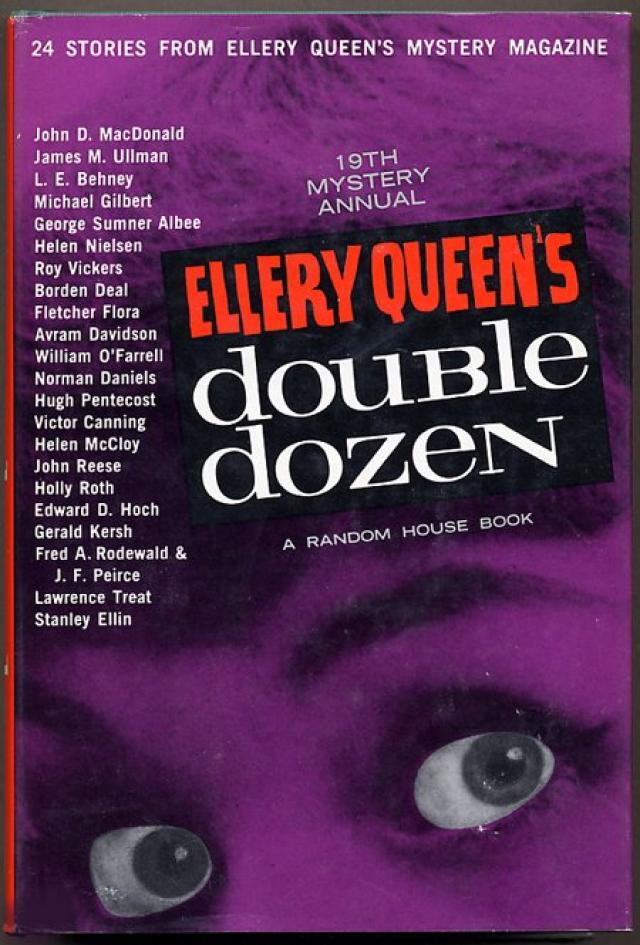
Ellery Queen's Double Dozen, page 11


BEST NEWS: and, most exciting of all, Mr. Vickers has promised that this story will be the first of a new series about the never—say die, elephant-memoried DDE. . .
Welcome back, Department of Dead Ends—welcome home!
It is unreasonable to call a murder successful merely because the murderer cannot be apprehended. No sane man plans a murder only to escape detection. He plans to alter the pattern of his own life—for his own future enjoyment—and the murder is but a troublesome and dangerous preliminary. By a murderer’s scale of values, he owes it to his victim to have a good time on the proceeds.
Harry Finchmoor failed to have a good time even when the money rolled in and the “unsolved mystery” was comfortably tucked away in the Department of Dead Ends—and it was this failure which led to his undoing.
The murder had been occasioned by the victim, John Chester Brendwright, playing dog-in-the-manger with nearly a square mile of poor agricultural land which had suddenly acquired a high industrial value. There was no “dirty work” in the deal. If Brendwright had been as ready as Finchmoor and the rest to make a large and legitimate profit, he would not have been murdered.
The murder, clumsy enough in itself, was covered with some ingenuity, but Finchmoor can hardly be credited with this. He lurched along a path paved by the personality of his victim. It was as if Brendwright had plotted to get himself murdered.
Brendwright was close to seventy, unmarried, his only relation was a niece who lived in London. He was entitled to call himself Colonel but refused because the Army had offended him. For three centuries his family had owned this comparatively poor estate situated at Thaleham, a village some forty miles from the edge of London. A crank and a dreamer, he pictured himself as the ideal landlord, loving the land for its own sake.
A landlord he certainly was, but on a time lease. At the death of his father he had been unable to meet the duties. He was compelled to sell the land—but contrived to cling to it. He sold it below its low value—on the condition that he should remain tenant for life. The purchaser was a London businessman, then resident in the neighborhood—Harry Finchmoor’s father.
When Finchmoor senior died, Harry inherited the family business in London and the title deeds to all the land at Thaleham except the manor house which Brendwright had retained. Harry would step into complete ownership on Brendwright’s death. While Brendwright was alive, neither could sell a square foot of the land without the other’s consent.
When the big chance came, Brendwright refused his consent.
Harry Finchmoor did not know that the big chance had come until the niece, Lorna Brendwright, rang him at his office. “Lorna Brendwright here. Harry, can I talk to you about Uncle John?”
“Lorna!” He was embarrassed. “First, tell me how are you.”
“That’s civil of you, Harry, but it’s about Uncle John. May I come to your office?”
“Lunch would be nicer. What about the Besc Chinar?”
In their teens at Thaleham he had adored her—until she repulsed him and in no gentle manner. There had been no resentment, only a hangfire shock to his self-esteem. He had no craving to see her again. For ten years he preserved the memory of her as she was when she was living with her mother at Rose Cottage—it could not escape that name, there really were roses round the door.
Was she as good-looking as he had thought her? He was still uncertain when they met in the restaurant. He noted that she was dressed with a disciplined femininity that suggested a good office background.
“You still look like a tennis star,” she greeted him. “Why have you avoided me?”
“I was once fool enough to fancy my chances, Lorna.”
Lorna tended to take that kind of remark at its face value.
“You mean that day when we were on a wander? You were showing me an outworked gravel pit when you suddenly grab bed me. I was frightened.”
“Not half as frightened as I was. I’m glad you told me. Now I shall enjoy my lunch.” He added, “Is your uncle ill?”
“I don’t know. He says the doctor told him he can’t live another two years. It’s not the way doctors generally talk.” She spoke with indifference, and then: “Harry! Craun Limited intend to set up a factory at Thaleham. They will want housing for two thousand families. Semi-detached houses with gardens. A square mile of them.”
The Big Chance. Ushered in by Lorna, as if she intended to take charge. He held back the obvious questions until he had ordered lunch.
“Yesterday,” resumed Lorna, “was my birthday. Uncle John always comes up to London and takes me out to dinner. We talk about his land, ignoring the fact that it’s really your land.” Her voice had a pleasing tone but she spoke as if to a younger brother. “He then gives me five pounds which he cannot afford and which I do not need. As we part, he takes me by both hands—very awkward because my bag always gets in the way and reminds me that all that he has will one day be mine—which means the manor house, mortgaged to the hilt, which is all he owns.”
He could barely listen. “Why didn’t they approach me first?”
“Please!” Lorna did not like to be interrupted. “Last night the land talk was wilder. I was offered the story of King George III staying at the manor house to learn about farming from Uncle’s ancestor. In time he told me that a man from the County Council had informed him that the Council intended to welcome the factory and to facilitate the building program. If necessary, the Council would itself step in under the Compulsory Purchase Act.”
“Compulsory Purchase!” Harry repeated. That was a blow and she was playing it up. Her old game of trying to lead him. But he was older now and could take care of himself. “That means his tenancy and my land would be bought at agricultural valuation. And the Council would build the houses for Graun’s.”
“That will happen,” she said, “unless you can give guarantees—within one month—that the houses will be built by private enterprise. The Council will send you a sort of ultimatum in a few days.”
His spirits rose. Lorna, he supposed, knew nothing of the mechanism of high finance. “I can get a financial company to come in and fix the whole thing.”
“But, Harry, you can’t do anything at all to that land with out Uncle’s consent. And he won’t give it. He loves not giving it. He says he’ll be dead before the houses can be built and while he’s alive he intends to be loyal to his land. And I shall get the manor house and the mortgage. You see, I’m not wholly disinterested.”
“Leave it to me, Lorna.” To soften it he added, “Your uncle doesn’t understand that I shall buy back the tenancy from him at a substantial profit to himself.”
She gave him the look that had intimidated him in his teens. “Rose Cottage!” she exclaimed. “It needed repair when we were there. It’s much worse now. Well, he has scraped together fifty pounds to start restoring—”
“Surely, we need not bother about Rose Cottage—”
“Harry! Do you remember the elaborate set-up he ordered for Mother’s funeral? His ‘kinswoman,’ of course. Yesterday he said that as soon as the cottage was restored he wanted Mother and me to live in it again.”
“Momentary absent-mindedness.”
“No. It’s dissociation—it’s been creeping on him for at least a year. He cannot wholly distinguish between his dream of himself and the real life going on around him. I don’t think he fully realizes that he has signed away his ownership of that land.”
“Then I’ll show him his own signature. The title deeds, correspondence, and whatnot are at the Safe Deposit. I’ll get ’em out after lunch. I’ll go down by rail—so’s I can sort out the papers in the train.”
“I hope he will listen to you,” she said, but without conviction. Her doubt of his ability stung him to boastfulness.
“He must. I’ll drench him in money talk—offer him a juicy cut. He can’t be so mad as to throw it away for the love of talking tosh about his ancestors. It’ll be all right, Lorna.”
In the train he was less cocksure of his ability to knock sense into the old man. But the nearest he came to planning murder was to weigh up what the doctor was alleged to have said. If Brendwright could not live for two years, for how much less would he live? Twenty-three months less than two years? Nothing else would be any good.
He opened the deedbox he had brought from the Safe De posit, separated the Thaleham papers from other interests, and put his selections on top. A bundle of stodge, but he would do his best.
His thoughts returned to Lorna. It was tactful of her to say she had been frightened that day when he had grabbed her in the outworked gravel pit and fumbled a kiss. But in fact she had not been frightened. She had been amused. In ten years he had not forgotten her amusement. But now, of course—
At Thaleham the stationmaster-porter greeted him as an old acquaintance and immediately spoke of the proposed factory.
“I hear say that Mr. Brendwright is against it—though he needs the money as much as anybody. It’ll be a shame if Thaleham gets left out again.”
“It isn’t so easy to stop a thing as big as this, Mr. Hawkins.”
“Ah!” Hawkins eyed the deedbox as if it were a doctor’s bag. “I hope you’ve got a cure for his trouble in there, Mr. Harry.”
Very encouraging! The whole countryside wanted the factory. Carrying the deedbox awkwardly by one of the side handles, he stepped out on the five-minute walk through the village, passing Rose Cottage, which now suggested only decay.
As he entered the drive of the manor house he came on Brendwright, pushing a barrow. He had not aged unduly—in fact, he looked good for another ten years, though the barrow was making him puff.
“Ha!” He glared at his visitor. “Don’t tell me. I knew you at once. You’re young Harry Finchmoor.”
“Correct. I hope you are well, Mr. Brendwright.”
“I look well, don’t I!” He drew himself up, posing. “My doctor could tell you a different tale. Never mind that. I expect you’ve heard about this wildcat scheme to turn my land into a filthy slum.”
“My” land! Finchmoor let it pass. His offer to push the barrow to its shed was declined. Brendwright washed his hands at an outside tap, dried them on sacking. He opened the front door with a latchkey of modern type.
The house had the air of having slunk unobserved into the twentieth century, achieving a bedraggled character of its own. It had sixteen rooms but Brendwright had his on the ground floor-assisted, three days a week, by a woman from the next village. In the hall a huge sideboard sustained a telephone and a silver tray on which a single letter awaited posting.
“Miss-is Harbutt!” It was a parade-ground bellow that snarled Finchmoor, but the next words were an ingratiating plea. “Will you please serve tea for two?”
The one-time dining room, now an all-purpose living room, had kept its massive table that could have seated thirty. Beside an eighteenth-century fireplace hung a Victorian bell-rope whose tassel touched an almost-new radio set. A Louis XV escritoire, a set of carved footstools, and a gilt settee cohabited with one arm chair and four cane-backed uprights.
They stood in a bow window, looking over the land that had grown corn, passed to mixed farming, then to market gardening, and now was no more than pasture. The fading light of an October afternoon dealt kindly with the remains of the farm buildings.
“All sorts and conditions of men have stood where we are standing now, Young Harry. Poets—preachers—generals—admirals—statesmen. Why, even royalty—George III had the intelligence to study fanning. Did I ever tell you?”
“I think not, sir. I’d like to hear the yarn if you feel inclined.” Finchmoor was ready to let him blow off steam.
Mrs. Harbutt came in with the tea. She set down the tray, switched on the lights, drew the curtains, then interrupted the story of George III.
“It’s just five now, sir, and I’ll be going if there’s nothing else you want. I’ve made a cottage pie out of what was left of the joint—for your luncheon tomorrow. Remember to light the gas in good time and it’ll be nice and hot. And there’s plenty o’ bits an’ pieces to carry you over to Thursday morning.”
“Thank you, Mrs. Harbutt.” Again the ingratiating tone. “Will you please post the letter on the hall table?” To Finch moor he added, “Rose Cottage. I’ve just written an order to start restoring it.”
Rose Cottage, at worst, was better than George III. After tea Finchmoor managed to reach bedrock. Brendwright took the armchair, and Finchmoor one of the uprights. Between them on the floor was the deedbox. Finchmoor unlocked it and arranged his papers on the inside of the lid.
First was a handwritten letter of several sheets.
“You wrote this to my father, Mr. Brendwright. Your deal with him was based on that letter.”
Brendwright regarded the letter with admiration. “Hand writing firm as a rock. And legible.”
“I’d like you to reread it, please, Mr. Brendwright. It will remind you of your general position in regard to the land. I have brought with me the documents, abstracts, and correspondence.”
“I remember it all as if it were yesterday.” Glowing with good humor he returned the letter. “The general position, as you say. I went into all that with the man from the Council.” He chuckled elaborately. “I was very polite to him, Young Harry. I told him I would give earnest consideration, see my lawyer, and explore every avenue.”
“Splendid.” Finchmoor was puzzled. “There’s nearly a month—”
“Nearly a month? You haven’t heard the rest of it. My lawyer tells me it takes a full year to obtain a compulsory purchase order, even when there’s no opposition. And there’s going to be plenty of opposition. I shall conduct my own case. With one point after another I can keep it hanging about the High Court for two or three years. The factory people can’t wait all that time. They’ll build their precious factory somewhere else.” So that was what the chuckle bad meant. Finchmoor felt himself cornered. By the time he bad paced the room and come to rest on the hearthrug he had decided to damp down on diplomacy.
“In a few days, Mr. Brendwright, that man will approach me—”
“Then he’ll be wasting his time. Nothing can be done with my land as long as my tenancy continues. They’ll have to break that up, first.”
“Suppose we break it up ourselves, Mr. Brendwright? You and I as partners. I could get a financial company to build these houses for Graun’s.”
“I don’t follow you, Young Harry.” It was a growl but Finchmoor ignored it.
“Then we’ll start at the other end. As of today you own this house and garden—marginally. Nothing else of the estate—not even Rose Cottage. Forgive me for suggesting that you must have many financial anxieties. Join hands with me and you will enjoy a comfortable retirement.”
“Retirement from what?” demanded Brendwright.
“From the misery of squeezing a bare living out of this land. For your life tenancy you paid my father two thousand pounds in the form of reduced purchase price. I will pay you two thousand the day you surrender the tenancy to me. Further, I will allot to you one-filth of the shares allotted to me by the financing company. Wait, please!” He broke off as Brendwright rose from his chair. “Tell me your objections when you’ve heard what you’re objecting to. I don’t know what your share will be worth. You can be reasonably certain that it won’t be less than ten thousand pounds and it might well be substantially more. This land has become a little gold mine—”
Finchmoor’s voice sank as he saw that he was getting no where. The big chance was slithering into the mud. He was failing. Lorna would again be amused.
“So I am to hand my land over to the hucksters and take my thirty pieces of silver!” There was hatred in the old man’s eyes—he was goading himself into fury. On the off chance that Mrs. Harbutt might still be available to create a diversion, Finch moor pulled the Victorian bell-rope.
The full length of the bell-rope came away in his hand. “Clown! Get out of my house—d’you hear, get out! And take your lawyer’s bag o’ tricks with you.”
Brendwright kicked the deedbox, spilling the contents. Then he turned his back.
Finchmoor looped the bell-rope.
Little gold mine or not, it was the animal violence of locking the deedbox that had sparked an explosive mixture of emotions in Finchmoor.
The hysteria passed when part of him became certain that Brendwright was dead. Emotionally exhausted, Harry stood erect, stretched himself, and yawned as if waking from sleep.
He dropped into an armchair and lit a cigarette.
I’ve killed a man, ran his thoughts. Lorna was right—hell, Lorna didn’t say I was to kill him. I did it myself and I don’t feel any of the things I ought to feel. I must be a pretty low type, and the most ghastly fool. What’s the next step? Pretend I didn’t do it? How? Who benefits by this man’s death? I do. Where were you at six o’clock yesterday? They wouldn’t need any clues.
Before the cigarette was finished, he was making a sober assessment of his position. If he felt no remorse he certainly felt no panic. Time—place—motive—those were the three rocks. The hour of death could be revealed by the corpse—but not after the lapse of a few days. Therefore he must conceal the corpse for a few days. That would cover “place”—and he need not deny that he was at the manor house at six. So “time” was all right.
Blueprint for getting away with murder.
He might be caught in the act of moving the corpse. But he would certainly be caught if he did not move the corpse. And that would apply to every act. Therefore: take risks cheerfully and bluff that everything was going according to plan.
Bluff everybody—including Lorna. Better to start on Lorna at once, before his nerve failed. He hurried to the telephone in the hall.
“Harry speaking from the manor house. It’s all right, Lorna. Your uncle has accepted the terms I offered and will surrender the tenancy at once—I’m to see the lawyers tomorrow.” He waited while she expressed somewhat guarded congratulations. The bluff must be heated up. “Would you like to say a word to him—tell him you’re please?”