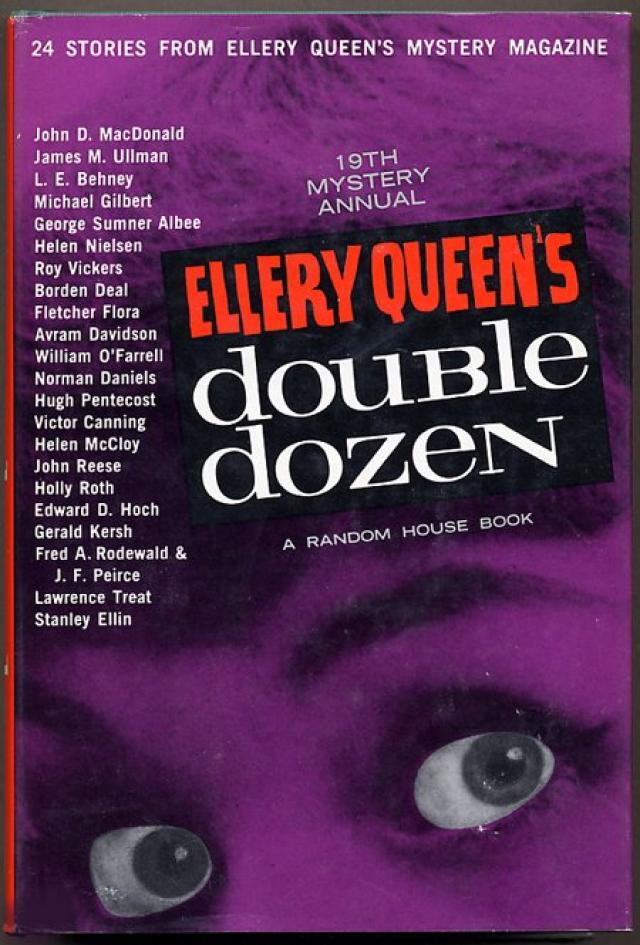
Ellery Queen's Double Dozen, page 33


But it was Lawrence Treat who gave the realistic procedural approach a feeling of substance and unity in a modern sense. His earliest novel in this genre was V As in Victim, published in 1945 (nearly twenty years ago!) which was ten years before J. J. Marric’s (John Creasey’s) first Gideon novel, Gideon’s Day (1955), and eleven years before Ed McBain’s first novel of the 87th Precinct, Cop Hater (1956). Other Lawrence Treat novels were called, in a title pattern all his own, H As in Hunted, Q As in Quick sand, F As in Flight, and T As in Trapped. Anthony Boucher made the historical point clear when he wrote: “The prime pioneer in the naturalistic novel of police procedure was Lawrence Treat whose stories. . .are not only far ahead of their times but admirable in themselves.”
(Note to Anthony Boucher: How would you classify William MacHarg’s The Affairs of O’Malley—short stories which were first published in book form in 1940 but began to appear in magazines much earlier? Wasn’t it William MacHarg, that grand old man, who started the procedural trend?)
But to get back to Lawrence Treat and his major contribution to the form: two characters carry the ball, as a kind of ’tec team, in Mr. Treat’s procedural stories—detective Mitch Taylor and laboratory technician Jub Freeman. (Was it sheer coincidence that Mr. Treat chose the same surname as Dr. Thorndyke’s creator, R. Austin Freeman?) The germ of Mitch Taylor’s character (the germ only) came out of a five-minute interview that Mr. Treat had at a New York City precinct house in the early 1940s, when Mr. Treat and a friend reported some obscene anonymous phone calls. The germ of Jub Freeman came from Mr. Treat’s persistent “hanging around” the New York City technical lab—the perfect place, of course, for Jub Freeman to be born. Other realistic details, of procedure and technique and background, emerged from an unofficial “hitch” with the San Diego police force while Edward Dieckman was Chief of Homicide (Mr. Dieckman has since become a true-crime writer who really “knows his stuff”).
And now Lawrence Treat has begun, especially for Ellery Queen’s Mystery Magazine, a new series of short stories about Jub Freeman, Mitch Taylor, and Taylor’s superior, Lieutenant Decker; and you will find them engrossing tales of the now popular procedural style. But we did want you to realize that in a contemporary sense it was Lawrence Treat who blazed this particular trail—the police procedural novel—and all credit to Mr. Treat for his significant contribution.
It was the middle of the morning when Mitch Taylor drove the patrol car through the archway and into the big courtyard in the center of the municipal building. He parked in the space reserved for police, picked up the hub cap with the bullet hole if it was a bullet hole—and stuck it under his arm.
Mitch Taylor was a stocky guy, of medium height, chesty, with a small-featured face that had enough flesh on it to take an occasional sock without getting hurt. He always looked cheerful enough but you could never tell what he was thinking, because usually it was nothing. Or anyhow, nothing you ought to know. What he was thinking now was, he should have left the thing back there in the junk yard where he’d spotted it. Because he was going on vacation tomorrow—three weeks of it up at the lake—and no new business was going to mess up that vacation.
A couple of hours ago he’d had everything figured out. He still had those summonses to serve, and he’d string those out till afternoon. Then he’d stop in at the garage and tell them there was something wrong with the steering, he didn’t know exactly what, they’d better look it over. He’d hang around while they found nothing, and when it was time to quit, they’d stop kidding themselves and he could go home and start packing.
That’s what life was for. Vacations. Him and Amy and the kids, taking it easy, having a good time. A girl like Amy, she came ahead of everything else. She always had and always would.
Still, when a hub cap starts telling you stuff, you can’t pass it up. You take it up to the lab and find out—from Jub Freeman, who was a wizard at things like that.
Jub, perched on a stool and hunched over a work bench, was studying something under a microscope when Mitch marched into the lab. At the sound of the door Jub swung around, grinned, and ran his hand through what was left of his hair, which was pretty well thinned out from brain-work.
“Hi,” he said energetically. “All set to go?”
“Right after breakfast tomorrow. Bought me a hub cap, too, on account I had one missing.”
Jub glanced at the disk in Mitch’s hand. “That’s the new one?” Jub asked.
Mitch shook his head. “No, I got mine outside. Thought may be you’d want to look this one over.”
Jub took it and examined it carefully. He tilted it so that the light caught it at an angle, then he bent down and squinted at the hole. He ran his finger along the rim, turned the cap around, and studied the inside. After a couple of minutes he put it down on his work bench.
“Chevy,” he said. “Almost brand-new. Not driven in the winter because there’s no corrosion from the salt. No wrench marks, either. Where’d you get it, Mitch?”
“Junk yard,” Mitch answered. He didn’t give any details and Jub didn’t ask for them. Jub merely tapped the disk as if he wanted to test the ring it gave out.
“Brand-new Chevy,” Jub said again. “Are you thinking the same thing I am?”
“Rogan,” Mitch said promptly.
Jub nodded. Rogan was a bank robber who’d broken out of jail the month before and was still on the loose. His picture, on Wanted sheets, was all over the place and showed a squat, heavy-set guy with bulging eyes, a broad bulging forehead, and spread ears. A teller at the Farmers’ Bank had identified him as one of the pair that had held up the bank a week ago and got away with $14,000, after exchanging shots with the guard. They’d been driving a brand-new, stolen Chevy; but they’d ditched it somewhere, switched cars, and smashed their way through a road block, where they’d killed a State Trooper in a gun battle and then escaped in his car. The state car had been found the next day, with the body of one of the bandits in it. But neither Rogan nor the money had showed up.
Jub fingered the hub cap. “Didn’t notice a new Chevy in that junk yard, did you?”
“When I got a vacation coming up?”
Jub got the point. “Look,” he said. “Why don’t you go back there while I check this over? If it’s a bullet, I’ll know it from the trace metals, and I can drive over later and try to spot the Chevy. That way, I’ll turn in the report, not you. Okay?”
Mitch nodded. “Just so I don’t get tagged with a case,” he said.
But out at the junk yard again, Mitch saw he’d taken on too much. There were acres of cars—rusty jalopies, smashed-up wrecks, cars without motors, cars without wheels, cars upside down or lying on their sides. Killer cars—and over-age cars that had been towed here to die a natural death. They were stacked up everywhere and they overflowed into a marshy hollow wild with sumac or something. . .Easy to run a hot car in here, bust it up with an ax, and then seem to abandon it. And maybe with $14,000 in cash, locked up in the trunk. It was possible—a graveyard of old cars was a pretty safe hiding place for loot. Nevertheless Mitch realized he had pulled a boner coming back. Because after a while this Jackson fellow who ran the place would come over and ask Mitch what he was doing. Mitch would say he was just looking, or else he’d say he was doing calisthenics or something, and the guy would get nasty about it and the whole thing would end up with an arrest. Then Mitch would have to hang around tomorrow so he could show up in court.
This Jackson fellow was built like a tackling dummy, except he had muscles instead of cotton wadding inside him. An hour ago he’d told Mitch to fork over fifty cents and go out and find his own hub cap. Tough cookie, this Jackson.
Any other time Mitch would have taken it all in stride and walked in without any worries except maybe was there any poison ivy around. But now he stared at the shack that was supposed to be an office, over there at the other end of the lot. There was no sign of Jackson, so the hell with him.
Mitch had gone about twenty or thirty feet, watching his step so he didn’t trip over the rusty springs and fenders and stuff, when the kid’s voice sounded out. “Boom-boom—you’re dead!”
Mitch swung around and saw this brat with the toy gun. He was maybe six years old, but for a second or two that mug of his had wrinkles and the gun was real, so Mitch froze.
There couldn’t be two faces like that—the same bulging eyes and spread ears and oversized forehead. For that second Mitch felt as if he were seeing Rogan cut down to size. Then the kid’s eyes seemed to get a little smaller, the ears weren’t quite so spread out, and the forehead looked almost normal. Mitch wasn’t sure now, except the impression stuck.
Yes, this was Rogan’s kid. He was sure of it.
Mitch let out a smile, lifted his hands and said, hamming it up, “You got me, kid. Now what?”
The kid stared, bug-eyed. Mitch, real friendly-like, said, “What’s your name, huh?”
The kid didn’t answer.
You can chase a kid in the open and catch him easy, but six-year-olds are slippery and they get through narrow spaces where a grown man can trip and land flat on his puss. And by the time Mitch could get hold of the kid and drag him off, Mitch would have Jackson on his neck, and then what?
So Mitch said, “You know what?” The kid didn’t move.
Mitch lowered his hands and said, “I give up. Now you take me to jail and lock me up.” And trying to make like a crook caught with the goods, he approached the kid.
“Pretend that’s your car over there,” Mitch said softly.
“You bring me over there and make me drive, see? You just keep your gun on me, and I can’t do a thing about it.”
The kid still stood his ground, still didn’t say anything. Maybe he was scared or maybe they’d left the brains out of him and he didn’t have enough sense to scram. Anyhow, all he did was say, “Boom-boom” again, but in a frightened kind of a whisper.
So Mitch put his arm around him, and when the kid tried to pull back, Mitch picked him up and said, “What’s your name, huh? What are you doing here?”
The kid shook his head and dropped the toy gun. Mitch picked it up, stuck it in his pocket, and brought the kid over to the squad car and settled him down on the front seat. Mitch chattered all the way back to headquarters, but the kid didn’t say a word. His vocabulary was boom-boom, and that was it.
He took Mitch’s hand when they got out of the car, and he kept hanging on tight while they walked down the corridor and through the door marked Homicide Squad. There, a couple of the boys were kidding around with the blonde who did secretarial work for the lieutenant.
They stopped talking at the sight of Mitch and the kid.
Bankhart said, “Holy hell—did you make a pinch?”
The blonde smiled and bent down and said to the kid in a soft, sugary voice, “Hello. What’s your name?”
Junior’s face puckered up like a walnut and he burst out crying. Mitch, still holding his hand, said, “He don’t talk much. Lieutenant in?”
The girl nodded. Mitch, dragging this yowling brat along with him, crossed the room, knocked on the lieutenant’s door, and went in.
Lieutenant Decker had the smallest office and the biggest collection of junk in the Police Department. He went in for souvenirs of his cases and for magazines on criminology, and he stacked them up on the filing cabinets and the shelves and the window sill and the extra chair, along with the official reports he was always in the middle of reading. He swung around and looked at Mitch and the kid as if they both belonged in the loony bin, which maybe they did.
“Well?” Decker said. But the kid let out a blast and kept pumping it out, and Decker put his hands over his ears. When the kid finally stopped for breath, Mitch had a chance to say something.
“Take a gander at him,” Mitch said. “What does he look like?”
“Like a damn nuisance,” Decker said. “What’s the idea?” Things weren’t working out exactly the way Mitch had intended. He’d figured the gang outside might be a little slow on the trigger, but the lieutenant ought to be sharper. Still, Mitch had to admit that a six-year-old, with his face screwed up and his heart in shreds on account maybe he wanted his mother, didn’t look much like Public Enemy Number One.
All Mitch said was, “He got lost.”
“Brother!” the lieutenant exclaimed. “You’ve pulled some screwy ones, but this time—wow! Listen, Taylor. In case no body ever told you, the Homicide Squad handles crimes of violence against the person, but there’s a Lost and Found Department and a Juvenile Bureau, and you can classify the kid either way. Use your own judgment.” Decker grinned. “What’s really on your mind?”
Mitch came straight out with it. “He’s Rogan’s kid.” Decker flipped back in his chair and almost dumped over.
“Did he tell you that?”
“No. But when he quits crying, he looks like Rogan.”
“And when does that happen?” Decker asked.
“Lieutenant,” Mitch said, “this looks like a lead. I could be wrong, but do you want to bet on it?”
Decker nodded. “Yes,” he said. “How much?”
Mitch didn’t take the bait. “What I want,” he said, “is we should put the kid’s description on the teletype and on the municipal radio. A kind of appeal. Then somebody comes and picks him up, and we tail whoever it is.”
Decker frowned, searched his soul, and decided to give Mitch a break. “All right,” Decker said. “You’re going on vacation tomorrow, you’ll be out of my hair. Tell the girl to send it out.”
“Thanks,” Mitch said, and went outside.
The kid quieted down a little, but he wasn’t happy. He needed somebody to blow his nose and tie his left shoelace, which the blonde proceeded to do. Meanwhile, Mitch pulled a form from the supply shelf behind the door and began filling out the description: age, color of eyes, color of hair, height, weight, clothing worn, where found, identifying scars or marks, if any, and so on.
He handed the sheets to the blonde and told her what the lieutenant had said. Then Mitch took the kid upstairs to Jub.
Jub turned out to be no smarter than the others. He frowned at the kid and said, “Who’s he?”
“Rogan,” Mitch said. “Doesn’t look like him.”
“You know how kids are,” Mitch said. “They change. They look like one thing one minute, and a couple of minutes later they’re different.”
“All right,” Jub said, smiling. “Make him look like Rogan.”
Mitch perched the kid on a stool, gave it a spin, and turned his back. “What about the hub cap?” he asked.
“A thirty-eight slug, and the car was moving fairly fast when it was hit. What about that Chevy?”
“I found the kid, instead,” Mitch said. “I figure Rogan was hiding out back there and used the kid for a lookout. All the kid had to do was make a nuisance of himself, which he’s good at, and that would warn Rogan so he could beat it I picked up Junior on account somebody has to come around and claim him.”
“Sure,” Jub said. “His mother.”
For the next couple of hours Mitch hung around kind of nursemaiding the kid. Word spread that Taylor had come up with a lulu, and guys from other parts of the building dropped in to see.
Mitch explained cheerfully. “He’s a child prodigy. Going to grow up and be a mental defective. No work, no trouble. State’ll take care of him.”
The kid sat in a corner and played with a busted pinball machine. Mitch almost got to like him, because he was a guarantee against a last-minute assignment. So Mitch was figuring on staying put until five, and then he could blow.
But the kid’s mother walked in, and she had brown, bulging eyes. Her forehead was sort of wide and her ears almost stuck out of her hairdo. She was a dead ringer for the kid.
She gave her name as Mrs. Leonard Jackson and she said her husband ran an automobile junk yard and her child had been playing there when he’d disappeared. And she thought something ought to be done about it.
She was nervous and scared and determined, all at the same time. She threatened to bring a kidnapping charge, but she wouldn’t sign a complaint and nobody could figure out exactly what she was after.
Finally the lieutenant got fed up and gave her a lecture on how she shouldn’t let a six-year-old run around loose in a junk yard where he could hurt himself or get lost or something, and she was lucky they didn’t bring charges against her and her husband for not taking proper care of their child.
She said they wouldn’t dare say that to her husband, they were taking advantage of her because she was a woman, and she up and left. As soon as she was gone, the lieutenant burst out laughing. And the ribbing that Mitch got after that was just a beginning. He figured these wisecracks, they’d still be coming at him three weeks from now, when he got back from the lake. Mitch let them ride him—there was nothing he could do about it; but he kept remembering that hub cap and how the kid had looked like Rogan when he aimed the toy gun. And how maybe that Chevy and the $14,000 in loot were in the junk yard.
And finally, if a kid looked like his mother, why couldn’t he look like his old man, too?
So Mitch, partly because he had this idea in the back of his head and partly because he was sick of being kidded, wanted an excuse to beat it. When he felt the toy gun still there in his pocket, he took the thing out and said maybe he ought to return it. The lieutenant said sure, go ahead, why not?
Before Mitch left, he went upstairs to the lab and told Jub what the score was and asked him to take a trip down to the junk yard. Because, even if Mitch had made a mistake about the kid, that bullet hole was real and there was still a chance of locating the Chevy. So Mitch arranged to meet Jub there and help him look.