Agony of Flies, page 16



One should not rebut oneself. The only decent thing to do: to fall silent.
Did you really think that a war lasting eight years would leave no legacy behind?
S. is that legacy.
If I should yet encounter something truly great, so great that it has kept itself in reserve, if, in addition, I should discover that I am permitted to call it that, then there will be nothing left of me, and I shall know, in calm assurance, that I have lived my life just to approach that greatness.
Nor shall I then be ashamed to use the word “great,” for I have fought all my life against using it when it was impermissible to do so.
Those countries with their language banners, and how merrily they lay into each other!
One who has never been alone meets someone who always was.
All the lost people who have money: buying, buying, buying, until they suffocate.
All the happy people who are able to wish for that which cannot be bought.
Babel’s diaries of the year 1920. We learn from these that Babel was not considered a Jew by those Jews whom he met with Budënny’s cavalry.
The diaries from which the tales derived contain a great deal of the wild and rich life Babel led during the war among the Cossacks. Yet the tales seem more colorful and more immediate. Only remembrance endows experience with such immediacy.
Babel was arrested and shot in 1940 in the Lubyanka prison. I read him first more than sixty years ago. His high standing has not been diminished by anything that I have read since then.
Of all the recent Russian writers, he is the one closest to me. As I can see now, my memory of his deep respect for Gogol and of his admiration for Maupassant did not betray me. He hardly spoke to me of Dostoevski or Tolstoi.
With Babel, that which is seen is his world as it comes into being.
With him, that which is heard is the Jews. The originality of his tales lies in the manner in which what is seen by him mixes with what is heard.
The way he hides from the Jews, to whom he belongs no less than to the Russian Gorki and the Frenchman Maupassant. Nevertheless, he offers the Jews a Jewish mother—a connection which made him totally incomprehensible to them.
Nothing was more alien to Babel’s nature than war. And that is precisely what prompted him to expose himself to it. What was beastly pleasure to the Cossacks was sheer torment to Babel. But he had to see it in all its detail, for to him torment was not an empty phrase.
In the diaries, the seeing is at times too faithful; never so in the tales.
Babel’s feeling of persecution started early as a result of the pogroms. He tried to rid himself of this feeling by participating in the revolution. He got involved in the war, which only brought him closer to the pogroms. What he wrote in his tales provoked the enmity of leading figures in the war. This was the beginning of his downfall at the hands of the revolution’s henchmen. He fought for his life from the first publication of Red Cavalry all the way to his own demise. He fraternized with the thugs who persecuted him and associated with their commanders. He knew what awaited him. And he realized that it would happen because of his writings. His writing became crippled; he tried to disguise his paralysis with pretense and artifice. The fear that must have filled his life is unimaginable. He saw everything with absolute clarity. Even in prison he labored on manuscripts. They are the very words of danger. It is very probable that he would have remained alive if he had not written.
You did not foresee anything. You were happy that the immense danger looming over the earth was averted. You did not think through the consequences of this prevention to their ultimate conclusion, if for no other reason than because you wanted to keep your happiness.
But has anyone foreseen anything? Is it not true that all foresight has become impossible and that we make our plans in blindness?
It is as if nothing that passes through your mind is in any way binding. In a manner of speaking, it only happens to you.
There used to be an open end to all thoughts, and each thought blithely set off looking for others. This might be called the hope of thought. The more decisively I broke off a thought, the more hopefulness it retained. At each touch, it—but secretly!—expanded. There should be a description of the way thoughts grow between people.
But today each thought breaks off in vain. It has lost the desire for others, for the adventure in others. This may be a constant state for systematic thinkers. What to me is the listlessness of old age, to them appears as the legitimation of their thinking.
He has allied himself with the word “anguish” and looks it up in Chinese.
The ravagers of words—what have I got to do with them? What remains of the myths under their knives?
Praise that insults by what it omits.
Tolstoi’s crude conception of sex in his old age: his strength. He is able to chide himself without becoming a windbag. A man who struggles against himself needs to have something against which to struggle. Tolstoi’s evil trait is his greedy passion, against which his wife takes revenge. Both wish to punish themselves for it: she for the rape to which she yielded, and he for the lust which compelled him to commit it.
He who will not be dissuaded from facing death has the strongest religion.
Between the temples of the millennia, the ludicrous runner. He wants everything as a souvenir for himself. The picture of the Pyramids—his funeral monument.
Little remains of youth’s dreams. But how great is the weight of that little!
This last confrontation, the passing of days—now there are only ten left—has destroyed the happiness of this past year. I’m beginning to be ashamed of this happiness as of a childish hope.
In my eyes, the moon has broken up in three pieces.
Death, as a means of power, cannot stop all of a sudden. But it is possible to imagine a process that may lead to that. A year ago, I still could believe that this path was being followed. But that year, that wonderful year, is now a thing of the past and we are back where we were before.
All those futile feelings, like those of animals about to be slaughtered.
The ruler deals with his enemies as he sees fit, one time this way, one time that way. Perhaps it finally will be decided that S. has to go. What will he take with him? Where will he spend the rest of his days? We can imagine him, a hundred years old, gently passing his hand over the brows of young boys.
His exemplary family life. The man who can bear millions of dead, because he put his faith in extermination by gas.
This desire to stay, a kind of bookkeeping.
Would it be better if nothing remained of our lives, nothing at all? If death meant our instant obliteration in the minds of all who have had images of us? Would this be more considerate of those who follow? For it may well be that what remains of us constitutes a claim on them, a burden they are forced to carry. Perhaps human beings are not free because they contain too much of the dead and because this surplus refuses ever to be abolished.
The thirst for forgetting—unquenchable?
There are some who are dead and for whom one never longs. Including some very dear ones.
Wit as bridle. He goads people for so long until they get the better of him. Then he can despise them.
He has more dignity than he can bear. When he takes it off, he crawls.
He wants to be sought, so as to better conceal himself.
His wildest passion: gratitude. It is amazing that it didn’t lead to his breakdown, as a passion for gambling might have done.
He uses old celebrities to make new ones grander. He uses new celebrities to confer recognition on the old ones. He’s in the exchange business.
A certain person doesn’t know a single picture. He has lived without pictures. He never knew that pictures existed.
His first picture.
I find myself first in myth. If something enters me as naturally as breath, I call it myth. If it closes itself off to me, I call it something else. I then put it aside and await the return of its simplicity. Myth is never confusion, even at its most horrifying; myth has direction and strength and, ultimately, meaning—just as long as it isn’t too obvious.
To find a different past, with people in it you have never thought of before.
The past of these three books paralyzes you. It is all too true.
How much they have upset me, those noble leave-takers from life: how much have I tried to defy them, and to dispute what they have experienced personally.
Now I think of them with tenderness. If they were still here—would I still try to persuade them?
Let just a single one come back, just a single one, and I’ll give it up.
But as long as none does, I remain.
They came running to him straight out of the Bible.
True spiritual life consists in rereading.
The great many fates we learn about combine to form a single lost destiny.
I have spent much time lending life a helping hand, so to speak. And this may well have been time lost. But it refuses to have been otherwise. Lightness undoubtedly is happiness. But I bow to heaviness.
By now he consists only of those few words he has repeated too often.
Restriction to merely that which concerns us as individuals? It is precisely both our misery and our glory that we are compelled to query that which does not concern us.
When he says that he does not believe in anything but transformation, this means that he practices a kind of slipping away, fully aware that he himself will not succeed in eluding death—but others, someday others.
Also by Elias Canetti
The Secret Heart of the Clock
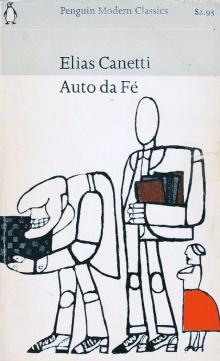
Auto-da-Fé
Crowds and Power
Earwitness: Fifty Characters
The Human Province
The Plays of Elias Canetti
The Tongue Set Free: Remembrance of a European Childhood
The Torch in My Ear
The Voices of Marrakesh: A Record of a Visit
The Play of the Eyes
Essays in Honor of Elias Canetti
About the Author
Elias Canetti (1905-94) was awarded the Nobel Prize in Literature in 1981. His writings include a monumental work of social theory, Crowds and Power, and three volumes of memoirs, The Tongue Set Free, The Torch in My Ear, and The Play of the Eyes. You can sign up for email updates here.
Thank you for buying this
Farrar, Straus and Giroux ebook.
To receive special offers, bonus content,
and info on new releases and other great reads,
sign up for our newsletters.
Or visit us online at
us.macmillan.com/newslettersignup
For email updates on the author, click here.
Contents
Title Page
Copyright Notice
Chapter I
Chapter II
Chapter III
Chapter IV
Chapter V
Chapter VI
Chapter VII
Chapter VIII
Chapter IX
Also by Elias Canetti
About the Author
Copyright
English translation copyright © 1994 by Farrar, Straus and Giroux
First published in German under the title Die Fliegenpein
Copyright © 1992 by Elias Canetti, Zürich
All rights reserved
First American edition, 1994
Published simultaneously in Canada by HarperCollinsCanadaLtd
Published simultaneously in hardcover by Farrar, Straus and Giroux
My deep gratitude is expressed to my editor, Sara Bershtel, for her inspired and thorough suggestions and revisions; she lent wings to my translation.
B. de R.
Our e-books may be purchased in bulk for promotional, educational, or business use. Please contact the Macmillan Corporate and Premium Sales Department at (800) 221-7945, extension 5442, or by e-mail at MacmillanSpecialMarkets@macmillan.com.
eISBN 9780374607746
First eBook edition: 2021
Elias Canetti, Agony of Flies