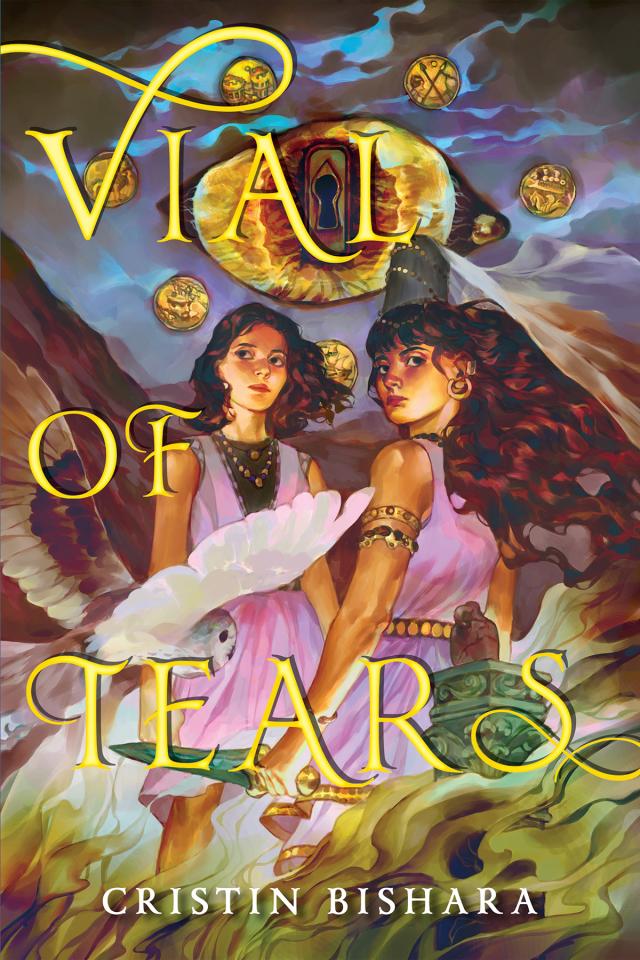
Vial of Tears, page 1


Contents
Cover
Title Page
Copyright Page
Dedication
Epigraph
Prologue
1
2
3
4
5
6
7
8
9
10
11
12
13
14
15
16
17
18
19
20
21
22
23
24
Epilogue
Author’S Note
Food From the Book
My Family in Photographs
Acknowledgments
Copyright © 2021 by Cristin Bishara
Frontispiece art by Syd Mills
All Rights Reserved
HOLIDAY HOUSE is registered in the U.S. Patent and Trademark Office.
Printed and bound in August 2021 at Maple Press, York, PA, USA.
www.holidayhouse.com
First Edition
1 3 5 7 9 10 8 6 4 2
Library of Congress Cataloging-in-Publication Data
Names: Bishara, Cristin, author.
Title: Vial of tears / Cristin Bishara.
Description: First edition. | New York : Holiday House, [2021] | Audience:
Ages 14 up. | Audience: Grades 10–12. | Summary: When Samira receives a
strange vase with some ancient coins, she and her sister Rima are pulled
into Baalbek, a Phoenician underworld where they are caught up in the
struggle between deities, shapeshifters, and ghouls—and Eshmun, who
wants his obol, his burial coin, back.
Identifiers: LCCN 2021014704 | ISBN 9780823446414 (hardcover)
ISBN 9780823450343 (ebook)
Subjects: LCSH: Phoenician antiquities—Juvenile fiction.
Sisters—Juvenile fiction. | Shapeshifting—Juvenile fiction.
Monsters—Juvenile fiction. | Magic—Juvenile fiction. | CYAC:
Phoenician antiquities—Fiction. | Sisters—Fiction.
Shapeshifting—Fiction. | Monsters—Fiction. | Magic—Fiction. | LCGFT:
Fantasy fiction.
Classification: LCC PZ7.B5239 Vi 2021 | DDC [Fic]—dc23
LC record available at https://lccn.loc.gov/2021014704
ISBN: 978-0-8234-4641-4 (hardcover)
For my family,
always close
no matter how far.
Paradise is there, behind that door, in the next room; but
I have lost the key.
Perhaps I have only mislaid it.
—Kahlil Gibran, from Sand and Foam
PROLOGUE
Karm El Mohr, Syria (modern-day Lebanon), 1903
On the night his mother disappeared, the boy had tiptoed to her room to ask for a glass of water.
The moon shone through the windows, casting a glowing walkway across the floor. The air was fragrant with blossoming orange trees. He would tell her that he couldn’t sleep, that lately his dreams had been strange. Had hers been, too?
It was an uncertain time. The Turks had been coming without warning. They galloped through the village taking whatever they wanted—livestock, clothing, jewelry, young men for their army. In his dreams, they rode dragons instead of horses.
He nudged her bedroom door open. Father was not yet home; he was drinking arak and playing backgammon next door at Aami Hanna’s.
Mother stood in the center of the bedroom in her nightgown. Her hair was down, long tangles of black. In her arms she cradled a jug—the one she’d found yesterday while exploring the mountain caves. Over the years, she’d come home with other treasures: a metal spear, the jawbone of a lion, a clay seal, glass beads. Truly, though, she told her son, the most precious thing she found was a bit of solitude.
“Mother,” he whispered. Was she asleep with her eyes open? Behind her, the moonlight glistened on a spiderweb, a hexagon of silken threads. “Shoo saar? Shoo aam b’seer?” What happened? What is happening?
She tilted her head as if she’d heard something beyond his voice. Perhaps it was an animal; wolves sometimes stalked the village at night. He, too, listened so intently that, for a moment, he thought he could hear the spider plucking its legs along the web, perfecting its trap.
He noticed she held something—small and round—between her fingers. “What do you have, immi?” he asked.
And then he saw something strange spreading before his mother’s bare feet: a dark pool, black smoke bubbling up from its center.
Fire!
He tried to scream, but he could hardly breathe. Instead he stumbled backward, bumping into the half-open door, his heart pounding against his ribs. Why was there no burning odor, no heat from the smoke? The air was cold.
“Get back, Mother!” he managed to whisper desperately, shivering.
But she seemed oddly calm—trancelike—as she stood near the cusp of the widening pool, which began to swirl like a pot of soup stirred by an unseen ladle. The boy knew he should cry for help or pull her back, but now he himself was unable to turn away, unable to move.
What was it? What was in there?
What was at the bottom?
Long fingers, tendrils of smoke, beckoned him forward with a shushing noise like a mother soothing a child. Mesmerized, horrified, he stepped closer.
Something was materializing and rising up out of the churning pool. Someone.
A man.
“Give it to me,” the man hissed, shadowed in smoke.
His face was hidden by a beard, his cloak trimmed with fur. He spoke in a foreign tongue, with ancient words—but the boy understood. It was the language of his long-lost ancestors. It was in his blood.
But give what? Perhaps he wanted the jug?
The man glanced at the boy before grabbing his mother by the wrist. Her face collapsed into an expression of pain. The jug fell with a thud.
“Let her go!” the boy begged, frozen.
“Mine,” the man said.
“She is not yours!”
His mother’s eyes snapped into focus. She finally looked at her son—finally saw him standing there—and her face dimmed with terror.
“Go,” she croaked. The ghostly man pulled her toward the pool, which was now a yawning black mouth consuming half of the room.
“You cannot take her!” the boy cried.
“Habibi.” His mother’s voice was nothing more than a thick moan. “Bhebak aatool.”
He reached out to her, the tips of his fingers grazing her nightgown. His balance wavered at the edge of the spiraling chasm.
With a grunt of determination, she pushed the boy away with more strength than he’d known she had, sending him across the room. He landed on his back, hitting his head on the doorframe. Helplessly, he watched as the man wrapped his cloak around his mother, enveloping all but her pale face. Outside, a cloud slid over the moon, turning the light ashen. His mother and the stranger stepped into the bubbling black vortex, which narrowed.
And disappeared.
A final sigh of smoke lingered briefly before it went out like a forgotten campfire.
All was quiet. The bedroom floor was as solid as ever.
But his mother was gone.
He whimpered and pulled himself across the room, lying flat across the spot where she’d been just moments ago. Under his cheek, the floor grew cold and wet with tears. Surely this was only another nightmare—his worst yet—but he could not wake himself up.
I love you, she’d said. Forever.
He picked up the jug and held it to his chest; he rocked back and forth and called for her. Outside the window, an owl responded with a forlorn who-who.
When he finally stumbled next door, frantic and babbling, his father stubbed out his cigarette and cursed. “The Turks!” he cried. He stood and knocked over the backgammon board, scattering pieces everywhere like a fistful of lost coins. “They kidnapped her!”
He tore through the village, his angry shouts waking children from their sleep. A few men mounted horses and went chasing shadows into the night, ready to slit the throats of her captors. Other than a pack of hyenas, they found nothing.
Secretly, no one held out hope. She was too beautiful. She had surely been taken as a bride. After a month, the village priest stopped praying for her return. After a year, no one spoke of it.
“Bayye,” the boy would say to his father, tugging on his pants in their grove of walnut trees. “It was not the Turks.”
He had told and retold his story, but the more he recounted what had truly happened, the less people listened. They patted his head, crossed themselves, and changed the subject.
“There is no such thing as a genie!” his father said finally. “Now stop your talk, once and for all. People are beginning to think you are akhwet.”
But the boy knew what he had seen. He kept the jug hidden and close. He rubbed it every night, making the same unfulfilled wish—Please bring my mother home—until he was an old man ready to die.
1
“No, no, no.” Sam swore under her breath. “Go away.”
She pressed her eyes shut, as if that would make their landlord’s car disappear.
But his ancient Mercedes was still rasping along behind her, its belly low to the ground, slinking like an animal. Sam dipped her head and picked up the pace. Her shoes were tucked under her arm, and the gravel road bit into he
“What’s the rush?” Mr. Koplow called, laughing as he trailed her up the cracked cement driveway.
Sam stopped and steeled herself before turning to face his empty smile and icy blue eyes. His pants hung low underneath his belly; his thinning hair was combed straight back.
“It’s not the first yet,” Sam said, even though she knew they still owed last month’s rent.
Mr. Koplow tipped his chin toward the trailer. “Your mother here?”
“She went to get milk.”
“Milk,” Mr. Koplow repeated.
“And toilet paper,” Sam said, adding to the lie.
“Right. So she’ll be back soon,” Mr. Koplow suggested, reaching into his shirt pocket for a pack of cigarettes. He pulled one out, crooked, and pressed it between his lips.
Sam glanced up at the sky, where the sun was inching its way down. “Sorry, but I really need to get to the lake.” She raised her hand. Goodbye.
Mr. Koplow didn’t move. He let out a curl of smoke. “She wants me to fix the back stoop. I need to take a look, see what happened.”
“Nothing happened. It’s rotten.”
At her feet was an oil stain from her mother’s leaking car, and behind her there was yet another dent in the carport. She knew Mr. Koplow was keeping tabs; they would never get their security deposit back when the time came.
He squinted at her dirty feet, at her chipped green toenail polish. His eyes climbed higher, lingering on her purse, then the stack of bracelets up her arm. “How much did those cost?” he asked as his phone rang.
Three dollars. That was how much she’d paid for her bracelets. Clearance table, plus her employee discount.
“Yeah, this is Alan. Slow down, slow down,” Mr. Koplow said into his cell, his voice rising. “What’s leaking? The toilet on the second floor?” He pointed his cigarette at Sam. “I’ll be back.”
A moment later, his car engine sputtered and caught, and Sam watched as he vanished down the gravel road, a wall of dust rising behind him.
With a sigh, she turned to face the lopsided trailer with its mildew-stained siding and ripped welcome mat. Mr. Koplow had once told Mom that it wasn’t the Taj Mahal and she was no princess, so what did she expect?
Whatever it was, it was home. It was the place of rushed Monday mornings and the smell of Mom’s perfume. It was where Rima had fallen against the coffee table and gotten the scar on her shoulder, where Dad had taught Sam how to cast a net from the top of the picnic table, pretending the backyard was teeming with baitfish. It was the place Dad would come home to, when he finally came home. He could fold his clothes and put them away. His grape soda would take up the top shelf of the fridge. He’d get Outside magazine delivered again. He’d pick up right where he left off.
“See you soon,” he’d said the day he was deployed, ruffling Sam’s hair. “Take care of your mom and baby sister while I’m gone.”
“Yes, sir,” she’d said.
Then he’d stooped down and put his hands on her shoulders. His military boots—which always smelled like motor oil—were tightly laced under his flight suit. His hands were so big. Invincible. He could survive anything.
“Promise me,” he said, his blond eyebrows drawn together. The air had been laced with the sweetness of spring flowers and grass and new leaves, just like today. “Promise me you’ll look out for them until I get back.”
“I will, sir,” Sam had repeated, an uneasy knot in her stomach. “I’ll try to, Dad.”
“Try hard, kiddo. I love you.” That was the last thing he’d said to her.
She could almost feel Dad’s hands on her shoulders now as she jiggled the house key into the rusty lock. Another broken thing that needed to be replaced.
Behind her, brakes squealed and then sighed. She spun around to look. Was it Mr. Koplow again, or Mom finally home, or someone Mom owed money, or a favor?
It was a hulking UPS truck. A man in a brown uniform hopped down with a box in his hands.
“It’s probably for Mrs. Jarvis,” Sam said to the deliveryman as she finally jerked the door open. She pointed down the street at a lawn cluttered with gnomes and metallic balls on pedestals. “QVC addict.”
“Nope,” he said, reading the box. “This is for Samira Clark. That you?”
“It’s just Sam,” she said. “Nobody calls me Samira.”
“Whoever sent this package does. I’ll need a photo ID for this one.”
Sam pulled her wallet from her purse and handed over her driver’s license.
“Wow, your hair,” the deliveryman said as he glanced back and forth between her face and her license. She was sixteen in the photo, almost two years ago. At the time she’d had shoulder-length hair bleached to a brassy shade of blond. Now her black hair hung down to her waist.
“That’s me,” Sam assured him.
He held the electronic clipboard out for her. “Initial here. And put the date right there at the bottom.”
The date. It was Friday. Mom had been gone since Monday. That made four nights. Too long. If she didn’t hear from her by tomorrow, she’d have to call the police.
“Hello?”
“Yeah, sorry,” Sam said, scribbling her signature. “Stressful day, that’s all. Couldn’t remember the date for a second.”
He smiled, took back the board, and handed her the package and her driver’s license. “Hang in there.”
“Thanks,” she said, though he was already jogging back to his truck.
Sam stepped inside, looking at the box. It was lighter than she expected, and it smelled like spices and tobacco. Postage stickers were everywhere, and on the right-hand corner LIBANPOST, BEIRUT was stamped within a rectangle of bright blue ink. The sender had meticulously written The United States of America under Sam’s zip code, and the return address had been perfectly penned, as though a ruler had been held underneath each line. Karm El Mohr, it said, which Sam recognized as the name of her mother’s hometown in Lebanon, a little village in the mountains.
Curiosity tugged at her, but it was getting late. She had to hurry to the lake, or there would be nothing at all for dinner.
“Rima?” Sam called into the house. Their tiny kitchen table, too small for three people, teetered when Sam set the package on top. She tucked her driver’s license away and tossed her purse and shoes into the corner.
“Hello?” she called one more time before peeking into her mother’s bedroom. There was always the slim chance she could be back, and asleep.
But nothing had changed since the last time Sam looked. Mom’s bed was unmade, her floral comforter tangled. The curtains were drawn. On a chair, nestled between two throw pillows, a teddy bear stared at Sam with vacant eyes. MY VALENTINE was stitched across its heart-shaped belly. Sam stared back. Though she’d never asked, she was sure it was a gift from Dad—it had been around a lot longer than any of Mom’s boyfriends.
She closed her mother’s door and went to her own room, where she changed into jeans, a fishing shirt with a dozen little pockets for supplies, and sneakers. Her old Girl Scout sash—loaded with badges for archery, horseback riding, cookie sales—had fallen from its thumbtacks again. She pressed it back into the wall and then tossed a makeup bag and a jacket onto Rima’s upper bunk, which was already piled high with dirty clothes, schoolwork, and at least twenty jars of nail polish. There was only enough space in their windowless room for one dresser, and there was no closet, so the floor was cluttered with semiorganized piles. Picking through them, Sam found everything she needed, making a mental checklist as she went: fishing rod; Dad’s Swiss Army knife in case she needed to cut a line; a cooler. Back in the kitchen she grabbed an ice pack from the freezer and, finally, moldy cheese for bait.
“Go, go, go,” she urged herself.
The winter had been so long and gray. She’d missed Glen Lake’s waters—turquoise blue and crystal clear, a reassurance that not everything in the world was dark and muddy underneath. No matter how many times she pulled her boat out onto the lake, her heart still swelled, as if those Caribbean-looking waters were a gift just for her, and that unexpected beauty was all she needed to carry on.
Her hand was on the door, but at the last moment she glanced back at the UPS package on the table. If Mom came home while she was fishing, she would open the package herself, even though it was addressed to Sam.