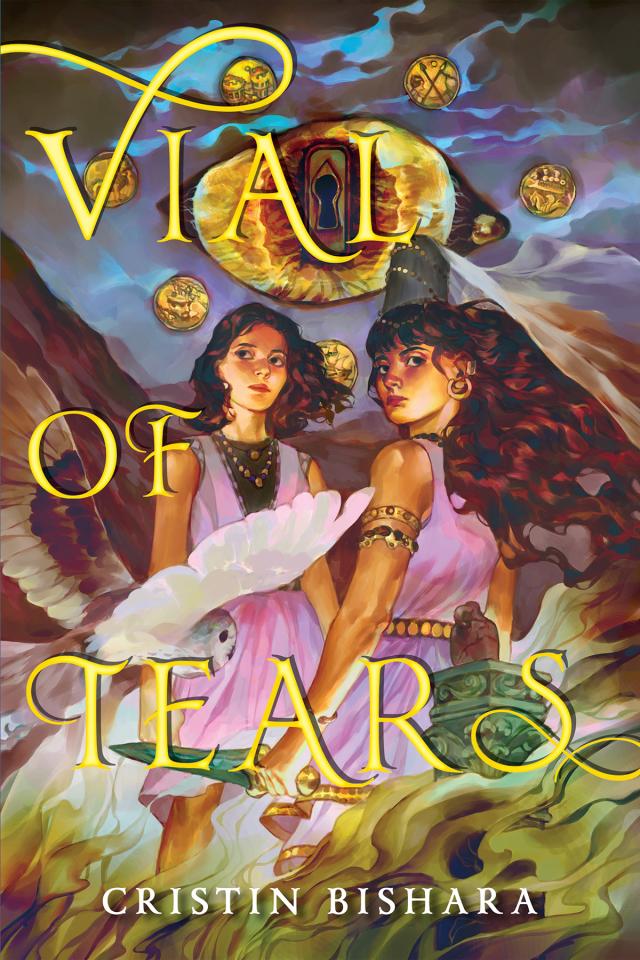
Vial of Tears, page 14


Quietly, hesitantly, she crept out toward the stone railing. The patio floor was also stone, irregular pieces fitted together.
Except for one spot.
Sam knelt and ran her hand across a piece of opaque glass. A panel.
Underneath, something moved. Undulated.
Maybe it was water, the sea lapping under the glass. Or maybe it was a vat full of tears. She hooked a fingertip underneath a notch in the corner and lifted the lid. In an instant she realized what was really inside:
Snakes.
Dozens of them, twining around each other. They licked the fresh air Sam had let in, and coiled to climb out. Their red eyes flashed.
She swallowed a scream before dropping the lid back in place, her entire body shaking.
She took a long trembling breath before standing up again. Still staring at the covered snake pit, she wondered why Eshmun would keep such a horrible thing in his house. Was it protecting something? It had to be. But what? Were his jugs of tears hidden beneath this writhing coven of snakes?
She decidedly couldn’t dig through them to find out. Hot tears welled in her eyes as she headed back inside, still trembling as she approached another doorway. It led into a room she hadn’t explored yet. Could the tears be there? It was possible. They might have nothing to do with the snakes. She couldn’t know unless she looked.
Steeling herself for another surprise, she took a cautious step across the threshold.
Wooden tables ran in rows. On top of some sat stone tablets carved with symbols—at least twenty, set side by side, like the pages of a book laid out to read. On top of others were colorful illustrations drawn on animal skins.
It’s some sort of library, she realized.
The walls were bare, and there were no vials or jars, but anything could be hidden here. As she searched, she kept returning to one of the illustrations laid out on the tables, a hunched man chewing on a human leg. Something about it gave her the strangest sense of déjà vu, but where could she possibly have seen such a gruesome picture before?
She leaned in close, trying to understand.
A half-memory wavered ahead of her like a mirage. She could almost reach it. It had something to do with Mom, something to do with a cave. Mom’s voice came to her: Sometimes things aren’t what they seem.
And then she was suddenly jerked from her thoughts by an angry voice. “Do not move,” the guard said, taking a step closer. “Or I will spear you like a fish.”
12
The guard poked and prodded and cursed at Sam the entire way back to the party. “She claims she was searching for her sister,” the man snarled when they found Eshmun.
Hushed murmurs swept through the crowd. Everyone turned to stare.
Sam was dripping wet, and her cheeks flushed red—though not with embarrassment. She was angry at herself. She’d been in Eshmun’s house but had failed to find any tears. She should have moved faster. She should have been bolder. And now here she was, returned to him once more, as if tethered to him by some invisible thread.
Eshmun looked her up and down as she plucked her wet dress away from her stomach. “After all that effort in Sarepta,” he said. “And where is your hat?”
The party had fallen silent. Sam could feel the crush of people gathering around her. She shrugged.
“I went for a swim,” she said. “The hat did, too.”
To her shock, Eshmun tipped back his head and laughed. It was hard to tell because of his beard, but Sam was almost sure he had dimples.
He thanked the guard and waved him off. Someone draped a blanket around Sam’s shoulders and she used it to towel off her hair. Eshmun urged the onlookers to continue eating and dancing. Reluctantly, they dispersed, and the hum of the party resumed.
“You’re not angry I was snooping around your house?” she asked. She thought about the snakes. Were the tears hidden underneath them? Should she try to go back to find out?
Eshmun shook his head. “If I am to speak honestly, I admire your persistence.”
“Don’t blame Enfeh.”
“The odds were not in his favor,” Eshmun said with a crooked smile. He seemed like a different person in Sidon. Happier. She felt another stab of jealousy. This time it plunged deeper.
“It must be nice to be home,” she said as a basket of bread was passed through the crowd, along with flasks of wine. Food seemed to be coming out of every kitchen in the city: roasted chickpeas spiced with za’atar, braided white cheese speckled with nigella seeds, skewers of grilled vegetables with lemony sumac, dried sardines and fried squid. Sam tried a little of everything, and then she caught sight of a grinning Enfeh, who was feasting on a leg of lamb while dancing with a beautiful girl who could have only been Kawkbā.
“So do you know where Rima is?” Sam asked. “You promised you’d find out. Have your people seen anything?”
“Be patient,” Eshmun said.
“How can I?” Sam asked.
A tapping on her hip made her look down. A little girl peered up at her, her long hair tied back in a ponytail. She had round cheeks and dark eyes, and wore a rose-colored dress.
“Hello,” Sam said, surprised.
The girl scrunched her face. “You speak strangely.”
“I do?”
The girl nodded. She thought for a moment. “You pile your words on top of each other until they tip over.”
Sam smiled. “I have an accent, don’t I?”
Her mind flashed to when she’d first arrived in Baalbek. She wondered now if this was why Eshmun thought she’d had the coin hidden in her mouth. She glanced at him, but he was distracted, speaking with a knot of old men.
“We want to know who you are,” the girl said, still poking Sam’s hip. “Where did you come from?”
“Far, far away.” Sam winked at her. “You’re very brave. I think most everyone else is afraid to talk to me.”
The girl nodded. She tapped her fingers against Sam’s bracelets. “I like your ring,” she said, and trotted off.
Sam watched her ponytail bounce as she disappeared into the crowd, but now there was an old woman approaching her. Staring at her. “Forgive me,” she said when Sam met her hazy eyes. Her ancient skin was the color of tea. “You look strangely familiar.”
“My sister?” Sam asked, a charge running through her heart. “Have you seen her? She’s two years younger than me. Maybe she came through Sidon already? Is she here?” She spun around, scanning the sea of faces.
“A girl? No,” the woman said, shaking her head. She searched Sam’s eyes, much the way Eshmun had done several times now. As if there was something there they couldn’t quite discern. “How did you get here?” she asked. “Where is my obol?”
“Your obol?” Sam asked, flabbergasted.
“Are you not the one who has twice summoned me?”
Sam shook her head. “No, I… no,” she managed. “Who are you?”
“I am Sbartā,” the old woman said. “I am a descendant of Ba’al Saphon, the storm god.”
“I’m sorry, but we’ve never met,” Sam said. Although, now that she looked… the woman was strangely familiar to her, too. How could that be possible? Her hair piled high and sharp on top of her head. Her cloudy eyes. Sam searched her face. “Do I know you?”
“No,” Sbartā said slowly, hesitantly. She continued to study Sam in the same grasping way. “Forgive me for disturbing you. I am mistaken. You are not the one.”
“Wait. What do you remember?” Sam pressed. “About this woman who summoned you?”
“There is a box,” Sbartā said. “There is a man who holds a banner with an eagle and an anchor.”
Sam fumbled for words. “I… I wish I knew what you meant.”
Sbartā pressed her palms together and bowed. She hobbled away, vanishing into the crowd before Sam could say another word.
Meanwhile, a makeshift stage had formed in the middle of the road, where people now took turns singing songs or telling grim stories (all of which seemed to involve a demon or a marauding invader). Sam couldn’t tell if they were invented tales, or if the people were recounting what had happened to them or their ancestors in another lifetime or another world. They began each story with the refrain, “Kan ya ma kan, fi qadim az-zaman.”
It happened or it did not, in the oldness of time.
Sam sat on a barrel and listened, her clothes and hair drying out. A little boy sang about the rising sun and the harvest moon. A woman with hair all the way down to her ankles recited a recipe for sesame seed paste. At first Sam thought it was a love song, the way she called it out with heartfelt joy.
Sam sloughed off her blanket and had just started to look for Eshmun when someone screamed his name.
A woman cradling a small child in her arms rushed toward him, sobbing. “He is dead, my lord!” she wailed. The boy hung limp in her arms. “Is it too late?”
The interruption had diverted the crowd’s attention from the stage. People turned and pressed closer to see, while others pointed toward the sky. Sam looked up and saw the boy’s ruḥā hovering overhead, a dark kite on a string, still attached to the body by a wavering thread.
“Give him to me,” Eshmun said.
The mother handed her child over to Eshmun, who then placed his hands upon his small bare chest. The boy couldn’t have been more than two years old; he was just a baby.
“He is my only child!” the woman cried. “Please. He has been sick. I rocked him to sleep. I only thought he was sleeping!”
“Metḥlem-wā kull kibā,” Eshmun murmured. “In the name of my mother, royal healer, and her father, and her grandmother before, chemists of salves and incantations, I invoke their power, which runs through my veins.”
In the sky above, the boy’s ruḥā twisted into a dark ball of thread, spooling downward. It slid into the child’s mouth.
A white glow spread through his chest and into his small limbs. Sam was speechless.
As tears streamed down Eshmun’s cheeks, an old woman knelt next to him with a piece of curved glass pressed to his face, which channeled his tears into a vial underneath. Sam’s heart jumped.
A vial of tears.
“With ancient prayers, I beseech you,” Eshmun incanted. “Focus your light within me, grant what I need. From you is born the power of life. Etkteb qdim men.”
“Hurry,” the mother said frantically. “He still does not breathe.”
“Be calm,” Eshmun said. He chanted a moment longer, wiping his wet eyelashes and then stroking the boy’s cheeks with his fingertips.
The boy’s eyelids fluttered open.
“He is well,” Eshmun said, and he handed the child back to his mother.
She opened her mouth but said nothing, uncertain, frozen. Finally the boy cooed and pressed his small head into the crook of her arm. The entire crowd sighed with relief, and then erupted into joyful shouts of praise.
“Thank you,” the boy’s mother said, her voice trembling. “My lord, you are truly a worthy god and prince. I am forever in your debt.”
Tears. Sam pressed her fingers to her side, feeling for the vial and the small box, both still secure under her soaking-wet belt. Eshmun had held his fingertips to his eyes as he was healing Rima’s tannîyn wounds, too… and his face had been wet after he’d mended Rima’s ankle, but she’d thought it was only river water. And when he healed Sam’s bruised neck, he’d wiped his face, but she’d thought it was because of the ash in the air.
Whenever he healed someone, he cried.
“Pour the tears into the water jugs,” Eshmun said to the woman who’d collected them. “Everyone will partake of a drop or two.”
His tears healed.
The crowd roared with a collective cheer, and then people returned to their food and conversation. Eshmun’s name rang out through the festivities with notes of celebration and reverence.
“You are staring at me, Samira,” Eshmun noted.
“You… you…” Her voice trailed off. “It’s one thing to heal cuts and bruises, but you… you brought that child back from the dead.”
Sam remembered standing quietly behind Dad once, caught for a moment by the war movie he was watching on TV. The screen was green, the scene shown through the eyes of a soldier wearing thermal goggles. Ahead, there was the body of a man he’d shot, his heat leaving him. The soldier could see it through those goggles, lenses into an invisible reality. That heat rose off the dying man like a mist, escaping into the night.
“I have my limitations,” Eshmun said. “He was nearly beyond my reach. There have been maladies that outwit me, illnesses that defy me.”
“My heart is racing,” Sam admitted. She’d been clutching her dress. She let it go and smoothed out the damp fabric along her thighs.
“As is mine,” Eshmun said, letting his eyes linger on her face. Sam looked away. What is he doing? Is he flirting with me?
On the stage, a group of four men with instruments had started playing. The music reigned now, and the tables were pushed aside to make a larger dance floor. Eshmun bowed and held his open hands forward, an invitation to dance.
“No.” Sam shook her head.
“Do you dislike me so much?” he asked, his hands still open.
“Obviously.”
But she wondered. Mom believed in Fate with a capital F. She believed in signs. And now Sam had begun to ask herself: Had she always been linked to Eshmun somehow? To this world? To the coin?
And Sbartā, the language, and even the gruesome illustration had stirred something deep, like memories so distant they might not be her own—as if she’d inherited them from generations long gone.
“Do you never allow yourself a moment of joy?” Eshmun asked. “I, too, know the weight of constant worry. It will crush you.”
“Is that what happened to you?” she asked, narrowing her eyes. She thought of what Teth had told her in the forest. All the friends and relatives Eshmun had lost along the way. The burden of being the one who would save everyone. In all honesty, she knew how that felt. “You’ve had to bear too much. And that’s why you’re so dark.”
“Some light remains.”
“Do you want to know why I dislike you?” she asked.
“Please,” he said. “Tell me.”
“For starters—I shouldn’t even have to say this—because of the way you’ve treated my sister and me. But there’s more than that.” She took a breath. “Do you not see how much people need you here? They love you. So what if you find your obol? How can you just abandon everyone? What about the tar´ā?”
“My coin has summoned me,” he said, lifting his chin. “It is my destiny.”
“You can make your own destiny,” Sam said. “Leaving is a choice. When we make promises, we should keep them. It’s called duty.”
“Is it my duty to serve the destinies of others until the end of time?” he asked, aggravated. “How long must I wait until I am permitted to pursue my own?”
“Maybe I don’t like you,” Sam said, “but I do understand who you are.”
“Oh yes?” he asked. “Who am I?”
“You’re lost. As empty as a ruḥā. You want to be reunited with your family,” she said. “Just like I do. You want everyone to be together again.”
He gazed at her for a long moment. And then, surprising her, he closed his eyes and nodded solemnly.
They’d been edged closer together by the crowd dancing around them. Tambourines crashed and small flutes whistled like birdcalls, making it harder to hear. Eshmun leaned toward her ear.
“Did you hide my burial obol somewhere along the way?” he asked. “Tell me.”
“What did Teth’s moth say?” Sam countered. “I bet he sent it back along our route to look.”
Eshmun nodded.
“And I’m sure you have other spies and confidants who have been searching Baalbek and elsewhere on your behalf. So, no, I didn’t hide your obol, and you should know that by now.” She stared at him, hard. “Precious things must be guarded.” She spread her arms toward the people of Sidon. “Isn’t this worth guarding?”
“Ah, the words of the seeress. Tell me, do you remember these? Is there another so rare?” he asked, the intensity of his gaze almost too much to bear. His keyhole pupil widened, as if inviting Sam to look inside. “Would you not keep this gift safe and close?”
Sam felt the heat rise in her cheeks. “I’m not a gift,” she said firmly. And Arba`ta`esre was not who she seemed.
He took her arm and turned it over. “You have bled here.”
“From the mountains,” Sam said.
He wiped the scabs away with one swipe, as if clearing nothing more than flecks of dust. “Where else?” he asked, letting the tears run down his cheeks and into his beard.
She showed him the palms of her hands. The blisters from digging in her backyard.
“What has happened here?” he asked, frowning. The black marks on her fingertips had gotten bigger, spreading like an ink stain.
“I don’t know,” she said. “I touched a ruḥā.”
He blinked at her. “Why would you do such a thing?” He shook his head. “One girl, and yet enough acts of foolishness for an entire city-state.”
“I wanted to talk to it.”
“The dead keep their secrets. He used you. He only wanted a taste of life.”
“Maybe I was being brave,” she said. “Sometimes I think you confuse the two. Foolishness and courage. I have to try whatever is possible.”
He held her palm to his and twined his fingers through hers. She closed her eyes as his heat swept through her, her skin tingling with an electric intensity. When he let go, the blisters were healed. But the black marks had only faded. They were still ash gray.
“Why won’t they go away?” Sam asked.
Eshmun seemed confused. “Stubborn,” he said. “Like you.” His expression turned sober. “How long did you hold on to the ruḥā?”
“Not long enough, I guess. I didn’t learn any secrets.”