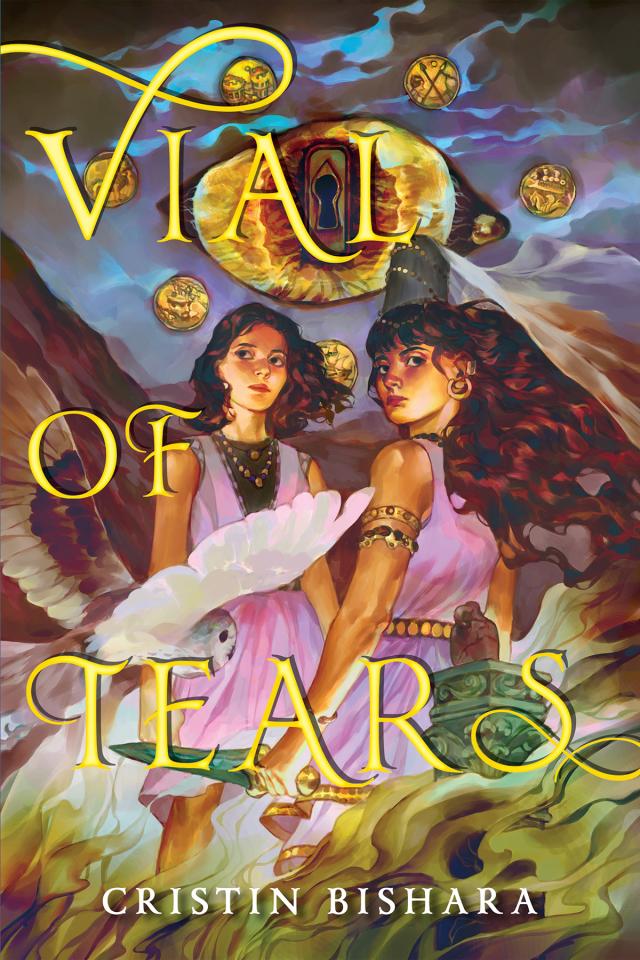
Vial of Tears, page 18


Sam closed her eyes again and summoned up an old favorite. It was a sun-kissed day out on the lake, and he was teaching her how to cast the line. “Flick your wrist,” he said, cupping his big hands over hers. It was the same advice he’d given her about throwing knives. “Like this.” Dad’s soft stubble—blondish red—brushed against her cheek as he leaned over her.
“You’re tickling me!” she remembered squealing.
Dad had thrown his hands up in mock disgust. “You’re scarin’ the fish off,” he’d said. “Stop laughing.” But he was laughing, too.
I’ll keep my promise, she vowed as she ran her fingers across her face, trying to trace the faint spray of freckles that hugged her own cheekbones. Rima had more of them, but nowhere near the number Dad had.
Another memory suddenly sprang to life, and Sam stood up with it. There she was, just like yesterday, nestled on Dad’s lap and trying to count his face confetti. That was what she used to call his freckles. She’d forgotten that. Nineteen, eleven-teen, fifteen, twenty. She must have been three years old. Mom used to say he was the only adult she knew with so much face confetti. Dad would say, “It’s ’cause I’m still a little boy inside.”
Helena’s apartment was quiet; through the windows, distant terse voices trickled in from the streets. Sam rubbed her face, and the emerald ring from Eshmun bumped across the bridge of her nose.
The ring from Eshmun.
No.
All at once, she was filled with certainty and dread. Why hadn’t she put it together sooner, after what Helena had said about the prophecy?
There were those who believed I was the mortal woman.
A young woman delivered into his arms by fate and gold.
They urged Eshmun to marry me, so that we could have a child.
Sam pressed her hands to her chest, as if she could calm her stuttering heart.
She knew what Eshmun intended to do with her now. It was clear why he’d dressed her up, confided in her, healed her. If she didn’t have his obol, then Sam would be his bride, a mortal wife who would bear him a son.
The son who might finally fulfill the prophecy and find a passage to heaven.
A swirl of fear and anger carried her back and forth across the apartment. She stopped to lace up her sandals as her questions turned darker: What if Eshmun believed that Meem had stolen the coin from Sam and Rima? By some bird or butterfly, a ḥayuta messenger, he could have sent word back to Baalbek to have her questioned… or worse. Anything was possible.
Why should I trust you? she had asked Eshmun.
You should not, he’d answered.
He used his healing powers to manipulate, to make people feel grateful and warm, and the realization made her cold inside.
And now she shuddered with another thought:
Helena’s apartment would become her prison if she didn’t leave.
“She must be guarded,” Helena would tell Eshmun. “I will keep her safe for now.” Eshmun would thank her for her wisdom. He would believe this was the fortune Arba`ta`esre had divined.
Sam’s mind raced. Could this all possibly be part of Zayin’s plan? She’d wanted Sam to stay close to Eshmun, forever? So Sam could eternally deliver vials of tears to her, whenever she demanded, meanwhile doling out false hopes and clues about the way back to Earth? Had Zayin and Eshmun actually been working together, for some purpose she couldn’t quite put together yet? Had Zayin and Môt been communicating?
Teth’s voice came back to her:
This world was set with traps before, but now you must calculate every step.
Helena slept soundly on an oxhide mat next to the fireplace while Sam quietly repacked her bag with one of Helena’s wool blankets, Zayin’s empty vial and mother-of-pearl box, a bowl, and a few items of food and water from Helena’s baskets. From Helena’s scrolls, she took the map; from Helena’s sewing supplies, she took a needle; from Helena’s peg, she took an old cloak. She left the heavy copper frying pan on the table in exchange for a knife.
The row of vials lined the windowsill. All were empty except the one Helena had just filled with Eshmun’s tears. Sam took it, silently apologizing. Helena would understand if she knew.
At the door, she paused to look at her great-great-grandmother’s beautiful face, so peaceful and quiet as she slept with Qamar curled into the crook of her arm. She looked happy.
With a silent goodbye, Sam let herself out, into the dusk, alone.
She headed west, winding through the maze of streets, until she found the first stone pathway that led down toward the sea. Below, the water was dotted with rocks, and an anchored fleet of boats went on and on, one after another. Carved figureheads looked over the harbor—horses with nostrils flared, ready to gallop across the waves. At each stern a wooden tail curled up.
From her hiding spot, she watched the buzzing activity on the largest boat. It had purple sails and three galleys of oars, one above the other—a trireme, Helena had called it last night. She’d told Sam that Eshmun had sailed into every cove and port, looking for a gateway to another world. This particular trireme must have required a crew of hundreds.
Sam ducked her head and pulled the cloak’s hood tighter, worried that this was the very ship that Eshmun was readying.
There was no way she could steal a boat from the guarded harbor. Sailors milled all around; there were the turreted watchtowers. But then she remembered the few fishing boats she had seen at the fringes of the city. Those would be easier.
She backtracked until she found a stone stairway curving down to the beach, and it was there that she found the perfect boat. It was banana-shaped, hollowed out like a bathtub. Not quite a canoe and not quite a dinghy, either, but manageable. With a single sail and tiller, she could man it alone.
She unrolled Helena’s map and oriented it along the shoreline, and then dipped the bowl into the seawater, filling it halfway. Next, she magnetized one end of the sewing needle by rubbing it against an orange-colored rock she’d found. A mint leaf she’d plucked from the pot on Helena’s windowsill would make a little raft for the needle. She carefully punctured the leaf, poking a hole at the top and bottom, and left the needle to span the leaf lengthwise.
“Work,” she commanded, setting the needle and leaf to float in the bowl of water. She thought of her room, of how she’d retacked her old Girl Scout sash to the wall. Her CAMPER badge, right in the middle. She’d slept in a tent, made basic survival compasses, had ’smores with her troop. That day in the woods felt like a million years ago.
The needle spun and settled, pointing due north.
She looked at Helena’s map and gauged the direction of Kition. It would be a long sail, a full day or more depending on the wind. She could only hope it was less than a hundred miles—and that she could average five per hour.
She untied her sandals, slipped them off, and tossed them along with her bag into the hull of the boat, where a pair of cedar oars sat at the bottom. She nestled the homemade compass against her belongings and then gave the stern a shove toward the water, pushing until the cool sea lapped against her calves. As she climbed aboard, she hiked up her dress and cloak to keep them dry. It only took a few oar strokes and she was clear of the shallow bottom.
Soon, she found the wind. She pulled the oars back into the hull and set them down. An adjustment of the sail sent her across the water, slowly but steadily.
I’m coming, Rima.
Eshmun’s fleet receded behind her and the wind dried her legs. She took a long breath: She was on a boat, sailing on open water. If she closed her eyes, she could almost believe she was home, out on Glen Lake with an evening of fishing ahead. She’d eaten well in Sidon and slept for what felt like a full night. Eshmun had cured all of her wounds. She felt good; she felt ready.
No more Eshmun.
No more detours.
There was no telling what was ahead, and there was no looking back now. Whatever stood in her way of Rima… she would have to face it, outsmart it, run from it, or thrust a knife into it when the time came.
If she could navigate her family through the rough terrain of their daily lives, if she could nurse the open wound of Dad’s absence, if she could survive rivers, mountains, and forests, then she could handle this, too.
She plunged her oars into the water whenever the wind disappeared, but it was never long before the small sail filled again and sent her flying toward Kition.
Hour after hour slid past. Gradually, her worries mounted. When would she be able to see the island on the horizon? How would she find Rima once she was ashore? Where would she hide her boat? How would she enter the city?
She looked down at her fine clothing. Even with her dress dirty and wrinkled again, she still looked as if she were going to a party. She should have done more than take one old cloak for a disguise. Cut off the rest of her hair. Worn one of Helena’s plain dresses.
She adjusted the tiller and squinted to find the shoreline behind her, but it had long since vanished. Without city lights, and with the clouds pretending to be mountains along the horizon, she could no longer tell if she had any land within sight at all. The sky and the sea were the same color in places.
She carefully stood and scanned every direction, but she’d lost her bearings.
Sitting back down, she found her orange stone, remagnetized her compass needle, and set it to work. With the boat rocking, the needle leaped back and forth. She swore, trying to steady it.
“Come on,” she said, holding the bowl between her knees.
But the needle dipped and sank—and suddenly, small waves began to lap over the gunwales of the boat.
Sam’s head snapped up, and she felt fear rising. Was the boat sinking? How? Since when? She had no life vest.
Worse, when she set the bowl down, she gasped with horror at the sight of her own skin. Her fingertips had turned black again. Frantically, she checked all the other wounds Eshmun had cured—the blisters, the scrapes, the bruises on her throat—but they were all still healed. Only the place where she’d touched the ruḥā persisted. And it was spreading, dark as blood in water. Lines ran down her fingers, tracing a course toward her palm. She flexed her hand. It didn’t hurt; it was progressing silently like a cancer.
A puddle of water sloshed through the hull. Her bag was drenched, and she cursed—she didn’t have to look to know that the food she’d brought from Helena’s was ruined. An imperceptible hole, an invisible crack was letting the sea into her boat, little by little.
Using the bowl, she threw the water out, one small scoop at a time, peering into the sea below her. She was certain there were monsters hiding in the depths—they were everywhere else, after all. She could turn back for Sidon, but which way was that? She thought it might be behind her, but the wind had shifted several times and now she would have to fight it with her oars, and without the compass working. She would just spin herself in circles.
The waves were getting bigger. She bent with the bowl to scoop out more water from the bottom of the boat.
Needles of fear prickled through her.
Dad is dead. Rima is doomed. You are trapped here forever.
Another wave smacked the boat sideways, tilting it onto its side, and in a blink it disappeared from underneath her. She’d been thrown out of the boat and into the sea.
Dark, cold water bubbled across her vision. Funnels and mountain cliffs and hopelessness. All of it wanted her to descend, to fall, to fail.
The bottom of the boat thudded against her head, knocking her down deeper. Her lungs burned and blood rose toward the surface, turning the water ruddy. The metallic taste. She saw torches lighting a hallway, a blackened waterfall. Her own hair, or seaweed, or an eel lashed against her cheek.
It would be so easy… It would only take one breath of seawater and she could forget everything.
And then her vision narrowed into focus and she was suddenly looking through a lock in a door, her eye pressed tight against the keyhole. She saw vignettes of her life: the persistent Easter lilies blooming back home; Mom’s book of Kahlil Gibran poetry highlighted with green marker and exclamation points; Rima’s soccer cleats, her rainbow of nail polishes. A locked velvet box, the one Mom kept hidden in the back of her closet. It opened, revealing its contents: gold bangles, turquoise charms, wishbones, and a few old coins. She could hear Mom’s voice. Don’t you ever touch this box, do you hear me? I have things in here from Lebanon. Sam and Rima, I mean it. Never ever.
And then she could see Rima’s face, her hazel eyes. She led Sam by the hand. Don’t worry, Sam! We’re not lost forever! We’re fine! Dad won’t leave without us! They’d thrown darts at balloons and ridden the teacups. They’d circled the carousel again, searching for Dad. This way. This way quick.
Sam kicked, and Rima was gone. The water seemed thinner, brighter.
Breaking through the surface, she choked down air and vomited seawater. She slapped her way toward the listing boat and struggled back inside. It was flooded with a foot of water. The bowl was gone.
Shivering, she sat for a long time, coughing. Sobbing. Drenched. Cupping her hands together, she threw the sea overboard, one useless handful at a time. The water level rose. It was only a matter of time.
A bank of clouds spooled across the horizon, and a large black dot moved through them. The thud of Sam’s heart seemed to make the entire boat lurch.
She knew what that dot was.
She grabbed her bag, slung it over her shoulder, and then closed her eyes. She pushed all the air out of her chest, calming herself. Then she breathed back in and raised her arms over her head.
There was only one thing to do.
“Tannîyn!” she screamed.
It was too far away. She called for it again and again until she was hoarse. “Tannîyn,” she wheezed, dropping to her knees. The water was up to her elbows. She scanned the horizon for one of Eshmun’s great boats, but there was nothing. There was no one.
The air above her moved.
The shush-shush of flapping wings.
Without looking, she knew the tannîyn was hovering over her. She didn’t want to see its crocodilian face, its black talons. She closed her eyes and braced herself.
“Take me to my sister,” she whispered.
16
They were locked inside Mom’s minuscule closet, piles of shoes and clothes all around them, along with the smell of unwashed laundry. Sam could hardly breathe. She was young, still afraid of the dark. Only slivers of light found their way through the slats in the door. She’d gone into the closet to play dress-up, and Rima had followed, her little shadow. Sam wanted to try on Mom’s shoes, but they were still too big for her.
I can’t do it, Dad. I can’t take care of everyone.
“Go get your sister, will you?” he said through the door, sounding impatient. “She should have been home by now.”
“She’s right here,” Sam said, but when she turned to face Rima, she was gone. Gone! Sam pressed her small fingers through the slats, and from the other side, he touched her fingertips. “Dad!” she cried. “Please! I can’t get out!”
Mom’s forbidden velvet box shook in the corner, as if something alive were trapped inside it. It rattled and skittered toward her. She backed into the darkness of the closet, and then she felt the pain in her shoulders. There was something wrong with them. She touched one and her fingers came away wet. She looked left and then right. Wire hangers were threaded through them. Someone had hung her up in the closet like a garment, ripped and torn.
There is a box, she heard Sbartā’s voice, echoing. There is a man who holds a banner with an eagle and an anchor.
The closet door suddenly opened, and Sam was thrust out into twilight.
There was nothing underneath her feet. She was in midair. Flying.
The tannîyn’s razor talons dug into her. She could feel the blood running hot down her chest and stomach until it dripped from her toes. Below, there was land. A shoreline ahead.
She struggled to reach into her bag, fingers probing until she found Helena’s kitchen knife. Closing her eyes, she searched inside herself, desperate to find one last buried shard of strength. It was there, somewhere, she knew it.
Rima, she thought, and with a swift arcing motion she thrust the knife into the tannîyn’s leg, screaming at the pain in her shoulders as the tannîyn’s shrieks ripped through her eardrums. She twisted the knife.
The tannîyn let go.
Copper rocks, the color of bloodstained teeth.
A bird called out bitterly and the sea slapped against her feet. Sam crawled and turned to lie on her back. Everything inside her was broken. A veil of fog hung over her like a shroud.
“Dad?” she breathed. I’m lost, Dad. I’m so lost.
She turned sideways, the bones in her neck crackling. Her bag. So far away. She stretched her fingers toward it and hooked it with a finger. She pulled. Inside she felt the blanket, the vial of tears. The cork was too tight. She gripped it between her teeth and pulled.
And then she drank every drop. It tasted like salted honey.
Sleep took her for what felt like a thousand years. But when she finally awoke, she could stand up.
Helena’s cloak was gone, her dress stained with dried blood. She pulled the torn fabric aside at the shoulders and rubbed her fingers across healed skin. Helena’s knife was gone, too. She was barefooted and she remembered that her sandals were in the bottom of the boat. The vial of tears was empty.
What have I done? For a moment, she brimmed with regret, but she knew she’d had no choice but to drink it. Otherwise she would have lain down on those rocks to die.
Rima, she reminded herself. I’m here to find Rima.
She unpacked the damp wool blanket and pulled it around her shoulders, leaving the empty vial and her bag on the ground, her fingertips still stained gray. Inside the mother-of-pearl box, Eshmun’s small black hair remained. Sam snapped the box shut and tucked it beneath her belt once again.