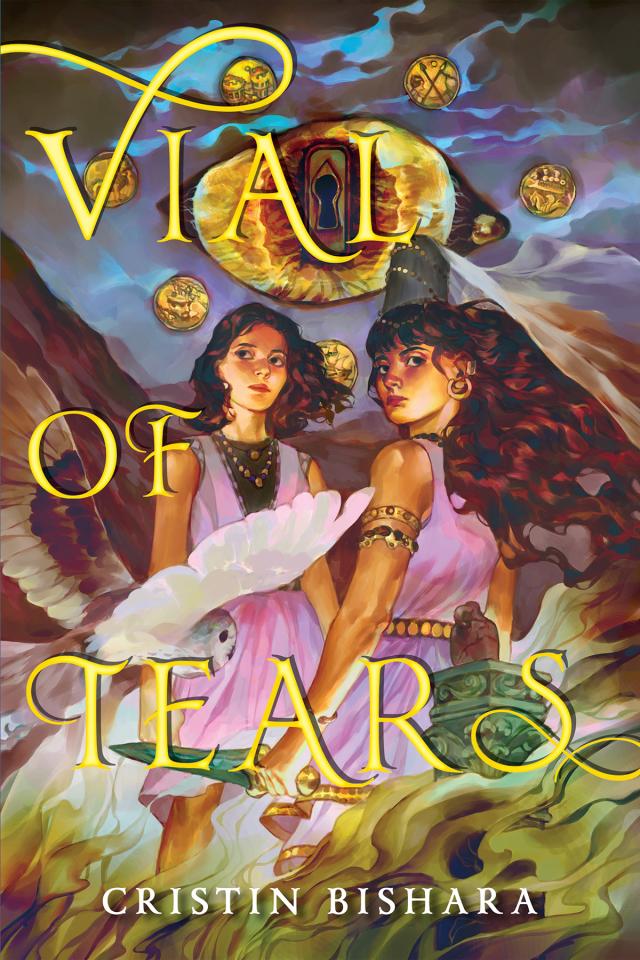
Vial of Tears, page 13


11
Teth kept sneaking glances at Sam with her clean dress, new veil, and haircut. “I have had a feast in Sarepta, but you are one for the eyes,” he finally blurted with a grin, handing her a cookie. “Sesame pastries. Still warm.”
Sam took it but did not eat. Her thoughts churned.
If Rima had been traveling the entire time they’d been in Sarepta, the gap between them had widened. The hours were slippery in this world, and Sam could feel hers running out. She could only imagine how Eshmun had interpreted his own cryptic fortune. Precious things must be guarded.
What was the precious thing? Her? The obol? Zayin had certainly meant to manipulate him somehow, to her favor.
Sam deliberated her choices: Should she tell Eshmun what had just transpired? In the mountains, Zayin had warned her that Eshmun would never let her go, that she couldn’t trust him. He had his own hidden agenda. But what if Zayin had been lying about having bought Rima? What if the jackals still had Rima, and they were still taking her to Môt?
The outskirts of the marketplace behind them, Sam felt something velvety brush her arm, rousing her from her thoughts. Before she could react, the old gray mare had stolen the pastry—right from her fingers.
“Hey!” Sam said, smiling in spite of herself. She patted the horse’s side, the ribs just underneath. “It’s good to see you again.”
“You do not need a horse,” Eshmun said, frowning. “It is a manageable walk from here.”
“I have chicken wings, too,” Teth added, holding up a parcel tied with a knot. “We can eat on the road!”
“I do need her,” Sam said, as the horse chewed on her stolen treat with her big yellow teeth.
“She is not an acceptable specimen,” Eshmun said. “She looks unhealthy. The finer details, you understand.”
“What I understand is that you didn’t heal the blisters on my feet,” Sam said, “which would have been vastly more helpful than buying me a ring.” She squeezed Teth’s arm and motioned for him to help her up. He offered his laced hands, and Sam stepped onto them to mount the horse. Seated, she looked down at Eshmun. “A horse will get me to my sister faster.”
“What did Arba`ta`esre tell you?” Eshmun asked her for the third time.
“She said we have to find Rima,” Sam lied.
He narrowed his eyes at her but said nothing.
Soon, the walled city of Sidon and the breadth of the Mediterranean Sea spread before them.
The water glimmered navy in the dusky light, the same color as Glen Lake on a summer’s night. Palm trees stretched toward the cloud-streaked sky, and a few seashells littered the pathway beneath her horse’s hooves. Sam could smell the tangy sweetness of salt water ahead.
They zigzagged downhill until they reached the massive city wall made of stones, each as big as Teth. Even higher rose the watchtowers and turrets. A great wooden gate was guarded by men armed with spears and crossbows. Across the doors was a carved inscription:
“What does that say?” Sam asked.
Teth put a hand to his chest. “We have built a temple for Eshmun, the holy prince,” he said solemnly, “at the purple-shell river.”
In unison, the guards above bowed to Eshmun, the joy on their faces evident. While some stayed true to their posts, others hollered to each other and pointed, edging closer for a better look. One held a giant conch shell to his lips and blew.
“Welcome home, my lord!” a gate guard said. He gave a signal, and a moment later the doors began to swing open from the inside, pulled by horses.
“Forgive the protocol,” another guard said, stepping forward. He was older than the rest, his face carved with wrinkles. “You must present your hands before entering the city. We cannot be too careful. The Alchemist has been on the prowl.”
“My uncle’s shapeshifter?” Eshmun asked.
The guard nodded, and Teth let out a gruff breath of air. “In the name of Ba’alat Gebal,” he said, shaking a finger at the sky. “We do not need more trouble! He is his foulest servant.”
“It is to be expected,” Eshmun said, his eyes darkening.
He held out his empty hands, and so did Teth. The guard looked at Sam, so she leaned down from the horse, holding out her bare hands as well, opening her palms.
“I don’t have any weapons,” she said.
The guard’s gaze lingered on the stubborn black stains on her fingertips—and then on the emerald ring—before he gave a nod. “Welcome,” he said, bowing.
Once they were inside the walled city, the doors ground closed behind them. As in Baalbek, the buildings of Sidon were small, and most were made of stones piled into uneven walls. But here, some roofs were palm-thatched, and at nearly every turn, there was a stunning view of the water.
At the city’s waterfront, battered seawalls dropped down to the rocky beach below. A long line of boats was moored in the harbor, inside a circular sea fort guarded by three turreted towers. There were vessels with horse-shaped prows and purple sails; others had three levels of oars and teemed with men, a hundred feet long from stem to stern. All of them, according to Teth—who kept up a running commentary—belonged to Eshmun.
“Are there many places to sail from here?” Sam asked, looking toward the horizon. Outside the walled fort, a few small fishing boats sat serenely upon the water.
“Of course!” Teth said. “We sail to Tarshish to trade our timber and dye for peacocks and silver. Tanis for gold. Akko for olive oil and livestock, Tell Kazel for pottery, Ophir for sandalwood and precious stones. We sail for spices, for tin and copper. All of Canaan is here, as it was on Earth.”
And Rima’s out there somewhere.
Sam sucked in a long breath, but then spat it back out.
“What is that awful stench?” she asked. She put a palm over her face and breathed between her fingers—it smelled like her bait bucket when it sat in the sun too long. “I might throw up,” she said, waving a hand in front of her.
“That is the odor,” Teth said, “of rotten, decomposing snails. Vats of them.”
“Disgusting,” Sam said, her eyes watering. She nudged the horse forward with her heel.
“Our famous purple dye comes from them,” Teth laughed. “Their mucous secretions. The dye is worth its weight in gold! And the addition of sea salt alters the shades of purple. There is a fine art to achieving the desired range of colors.” He nodded to the neckline of Sam’s dress, to the sash around Eshmun’s waist. “Purple is worn only by those who can afford its price.”
Sam plugged her nose shut and, walking beside her, Eshmun let out a small chuckle. “It is a stench that could raise the dead, is it not?”
“If only!” Teth laughed. “If only that were true. You would not need your obol, my lord.”
Eshmun pulled in a deep breath. “It is,” he said, “for better or worse, the smell of home.”
Sam looked at him and saw the wistful excitement on his face. Home.
She felt a stab of jealousy. She would give anything to be able to walk up her own driveway to her lopsided trailer. How many times had she taken that last turn in the road for granted, knowing her family would be there, waiting for her? What she would give to be there now.
Sam dismounted the mare, afraid of how narrow the street had become against the seawall. The old horse had already faltered once on the rough road, where a patch of loose stones had made it difficult to find sure footing.
“Is that yours?” Sam asked, pointing out to the sea, where a small castle sat in the water at the end of a stone bridge.
“Yes,” Teth answered for Eshmun.
“Is that where we’re going?” she asked, but the men continued on without answering.
They soon reached a wider road. Within moments, it broadened into a main thoroughfare. Women turned to look at them approaching; men pointed. Sam could hear squeals rising up from the children, who tugged on the women’s dresses.
“Lord Eshmun!” someone cried out.
Doors opened and people looked eagerly outside. “Who is she?” Sam heard echoing through the commotion. “Who is the girl?”
“Relation or lover?” Teth asked Eshmun as more people began to gather. “Ally or prisoner? What is she to you?”
The horse whinnied, agitated. “I know,” Sam said, patting her. “It’s like the paparazzi.”
She watched a flicker of panic cross Eshmun’s face. He came to a halt in front of a rubble-walled building with a flat roof. “Enfeh!” Eshmun called, tipping his head upward.
A boy, about fifteen years old, looked down at them from the roof. “My lord!” he said, bowing deeply, his black curls of hair flopping into his eyes.
“Where is your father, my loyal retainer?”
“He is not far off,” Enfeh said. “I expect him soon.”
“Good, then,” Eshmun said. “Until he returns, you are in charge of this woman. Keep her here.” Eshmun motioned to a ladder for Sam to climb up onto the roof. “Hurry,” he said, glancing nervously at the gathering crowd.
“What?” she asked. “No. You promised we would get word about Rima when we arrived in Sidon! I’m not going to just sit while you go off without me.”
Teth leaned toward Sam’s ear. “I believe my lord has realized that his attempts at making you look ordinary have failed,” he whispered with a chuckle. “I could have told him it was an impossible task. It is not safe for so many to see you when he has no ready story to explain you.”
“Up,” Eshmun commanded.
Teth patted the horse’s side. “I will take her to someone I know,” he said. “She will be well taken care of.”
“We will return for you later,” Eshmun said. “Go.”
“You will be more comfortable,” Teth added.
“On a roof?” she asked.
“Yes,” Teth said. “You will understand in a moment.”
Fuming, Sam handed her bag to Teth before climbing the wooden ladder. Enfeh offered a hand and she shinnied onto the rooftop.
From here, she could look down on the streets, watching as the city swarmed to greet Eshmun. Entire families spilled out of their houses. Women slapped their hands to their cheeks and knelt to kiss the ground near his feet. Men as big as Teth were crying. Crying. An old woman put her hands to her chest and shrieked Eshmun’s name over and over again.
“He is home!” Men’s voices boomed out in joy.
“Quickly!” a gray-haired man called over the din of the crowd. “Bring them drinks. A place to sit. A feast! A feast! This calls for music!”
Sam turned to find Enfeh staring at her. “Who are you?” he asked.
“Sam,” she answered simply. “I’m not Eshmun’s servant, and I’m not ḥayuta, and I’m not in the mood for questions.” She motioned to the sheets of fabric spread across the rooftop, grains scattered on top of them. “What is all this?”
“Wheat. It is drying, and I must guard it against the birds.” He was looking past her now, straining to see where Eshmun had gone. His face hid nothing: He looked absolutely tortured as shouts of celebration echoed throughout Sidon. Everyone was joining the party… except Enfeh.
“It’s not fair you have to miss the ‘ad’idā,” Sam said slowly, a plan forming in her mind.
“They will be serving squash filled with rice and pine nuts,” Enfeh said wistfully. “Kawkbā will take yesterday’s bread, rip it into pieces, and crisp them in a pot of hot oil. She sprinkles them with sea salt. And there will be oysters.” He sounded anguished now. “My auntie will bring sour green plums, and honeyed mulberries served over labneh, and rose water to sip. There will be parsley with tomatoes and wheat like you see here.”
“Sounds lovely,” Sam said, amused that he seemed more interested in the food than Eshmun. A girl’s laughter rose above the happy shouting, and Enfeh stood up straighter at the sound.
“That is Kawkbā,” he said, his voice reverent. “Her laugh is unmistakable.”
“Who is she?” Sam prodded. “Your girlfriend?”
“No,” Enfeh said. He stepped closer to the edge of the roof, eyes trained on the crest of the road, as if he could see over it if he tried hard enough. “Though… I would like her to be.”
“Will there be dancing?” Sam asked.
“Of course.”
Sam let the silence play out for a few minutes; she let him think about Kawkbā dancing with someone else.
“We walked from Baalbek,” she said, sitting down. “I can hardly keep my eyes open.”
“Sleep comes when he wants,” he said, gazing fixedly at the crowds. “I cannot ward him off for you.”
“No,” she agreed. “I could sleep for eons. Nothing would wake me.”
She yawned loudly and lay down, tucking her hands beneath her head. Eyes closed, she steadied and slowed her breathing. The smell of the wheat was earthy and bright, and above that, she could practically taste the food from the feast, the aromas catching on the wind.
Enfeh was already standing over her, studying her, she could sense it. She made her eyes dart beneath her eyelids and, gradually, let her mouth fall open. Should she snore?
Before she could decide, she heard the ladder creaking beneath Enfeh’s weight, and then the sound of him sprinting down the street, his feet smacking against the road.
Sam guessed he would only risk being gone for a few minutes. She rose and rushed to the edge of the roof—only to find that the ladder lay flat on the ground. Enfeh had taken it down.
She considered jumping, but the ground looked unforgiving. Pacing, she looked for another way—and found a protruding beam of cedarwood under the rim of the roof, part of the house’s ceiling.
She considered it for a moment. And then shook the wheat from a sheet of fabric, mumbling an apology to Enfeh. After rolling the sheet diagonally, she tied it around the beam, tightening a clove hitch—an essential boating knot—the way Dad had taught her.
Dropping to her stomach, she shinnied backward, grabbing onto her makeshift rope and sliding down.
She jumped the last few feet, the impact sending a jolt of pain up her shins. Rubbing the ache away and holding her breath, she looked left and right, but the streets were empty; everyone was at the ‘ad’idā. Above her, the birds had already begun to squawk and descend upon the wheat.
Quickly and quietly, she backtracked the way they’d come into the city, zigzagging along the stone roads until she found a route leading down toward the shoreline. There was that small castle built upon the sea, the water lapping at its walls on every side.
Eshmun’s home. A place where he might keep his tears.
A long, solid bridge was the only way out to the castle, which appeared to be two or three rooms at best, with an open terrace along the back. Men, who looked massive even from where Sam stood, held spears at their sides. They guarded the end of the bridge.
Maybe Zayin was bluffing, lying. Trusting her was a gamble, Sam knew, but she didn’t doubt that her threats were real.
I will scrape your insides out, like a rabbit’s.
Sam would need to play a strong hand to get Rima back. To save them both. She needed Eshmun’s tears, hair, and blood.
She needed currency.
The only choice would be to swim, or to take a boat and try to climb up onto the patio. Thinking hard, she assessed her options—and spotted a small opening, a window. Below it was a pitted slab of rock.
A climbing wall, Sam thought. Just like at Girl Scouts summer camp. It was about a hundred feet out into the water.
Taking a breath of courage, she scrambled down to the beach, hiding behind a stony outcropping. At the next opportunity—when the guards were not looking her way, seeming to be listening to the celebration—she sprinted straight for the bridge, her heart pounding madly, and pressed herself against its side. The closest guard, above her, could not see her unless he leaned out over the edge to look directly down.
The waves slapped against the cold stone of the bridge, masking the noise she made as she waded out into the water until it reached her shoulders. She then scrabbled along, swimming and clawing as her veiled hat was swept away, filling with water and dipping below the surface like a boat with a hole in the bottom.
The strong current sucked her away from the wall and then threw her back, smashing her shoulder against the stone. Briny water rushed into her nose, and her muscles burned with fatigue.
Three more labored strokes and she found a knob of rock to hold on to, the castle’s bedrock. She desperately pulled herself out of the water before it yanked her down again.
Straining to look, she saw the opening, straight up about fifteen feet over her head. She clawed her way up to the next jut, and then climbed, one handhold at a time.
The higher she went, the drier the stones became, making it easier to get a firmer grip. You’re halfway there, she thought, pausing to catch her breath. Her legs quivered. Her arms were numb. Her bracelets scraped against the wall.
By now Enfeh might have realized she had escaped. Would Eshmun send men to hunt her down? Would those men use crossbows from the shoreline, taking her down like a bird? Or would they rain arrows down from the window above her? She thought of the old arrow Zayin’s hawk still had lodged in its side. She forced herself higher, but her legs seemed to weigh a hundred pounds; her fingers felt like they might snap.
If I fall, she thought, if I drown, I’ll become a ruḥā. I’ll be trapped here in the underworld as a ghost.
The thought was enough to propel her. She climbed faster toward the window—now so close. Finally, she reached its lip, peered into the room, and then heaved herself inside, gasping for air and flexing the ache from her hands.
She lay on the floor for a solid minute, waiting for her heart to slow, trying to regain her strength. At last, she pushed herself to her feet and surveyed the room.
There was a bed covered with a fur blanket, and that was all. No shelves or boxes or anything else that might hold vials of tears. She looked under the bed, just to be sure, but there was nothing there besides cobwebs.
A doorway led to the patio. Peering outside, she held her breath, listening. But she saw no one and heard nothing except for the sounds of waves and gulls, of her own hair and clothes dripping onto the floor. There was a magnificent view of the sea and the blue-streaked sky.