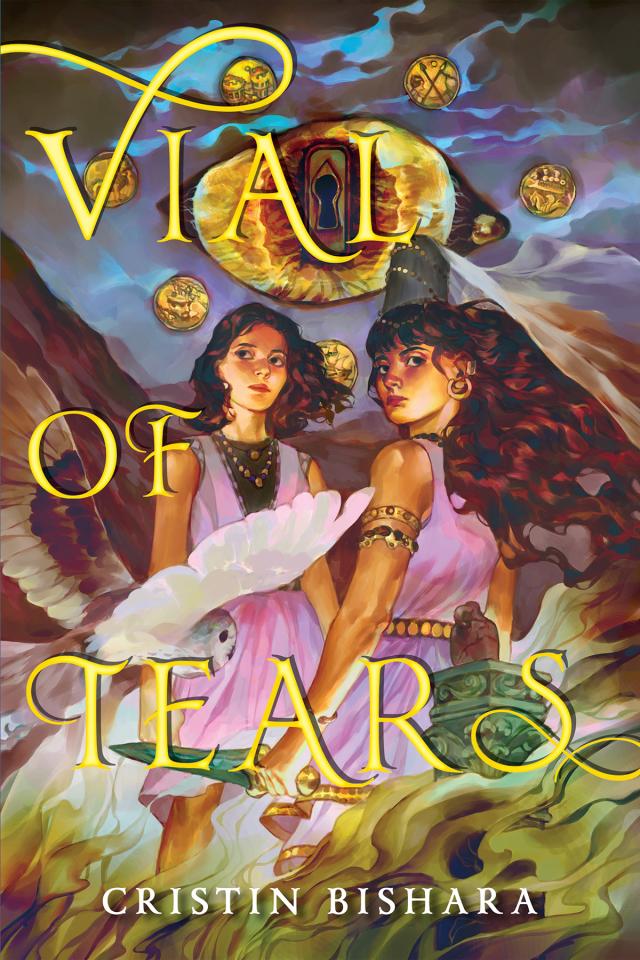
Vial of Tears, page 20


Hinnē! Ǵalmatu maǵayat.
Look! The maiden has arrived.
Horrified, she rushed past the chattering skulls, nervously looking around her. No one was nearby. No one had heard their announcement. Shaking, she pulled Helena’s wool blanket over her head to substitute for the lost cloak, tucking her wet hair inside.
Soon, she found herself on the outskirts of another šuqā, a street lined with vendors. Tents and lean-tos displayed goods for sale. Men haggled and argued over prices. She slowed her pace, second-guessing her decision to come this way.
“Hello,” a man said, stepping toward her. His cloak was covered in black bird feathers, shoulders to ankles. He lifted a lip at her, showing his gray teeth. “You are new here.”
Sam avoided his bloodshot eyes and walked on.
Kition was a dark carnival version of Sarepta. Instead of linen scarves and fragrant herbs for sale, here there were skulls and bones. The more booths she walked past, the faster her heartbeat. Sculptures of distorted faces peered out at her. Vials of dark liquids bubbled. The air carried a sulfurous odor like rotten eggs. Every instinct told her to leave this place. Her temples throbbed with adrenaline. Run. Hide. Suspicion and malice flashed on every face she passed; she was certain everyone was looking for an opportunity, predators watching for prey. Behind a group of women, ruḥā trailed. They hung on to the women like black wedding veils, following no matter which way they turned.
“A coin?” a voice asked behind her. “Is that what you seek?”
Sam’s heart lurched and she turned warily. It was a familiar voice.
One she knew, but had almost forgotten.
One she loved, deeply.
A blond man with reddish stubble on his chin stood behind her. He wore a flannel shirt—his favorite. The tips of cowboy boots poked out from underneath his blue jeans. They were the boots he’d bought in Texas, before Sam was born, and he’d taken them with him when he’d been deployed.
“I’ve been looking all over creation for you, kid.” He spoke perfect English with a slight twang. “I knew I’d find you sooner or later.” He smiled at her.
In that instant, every hope she’d been harboring, every dust-covered artifact of belief turned new and bright again. It was as if an entire fleet of sailboats suddenly caught their breath all at once, full sails leaping up, waking from a long, stagnant slumber.
Alive. He’s alive.
“Daddy,” she choked, heart racing. His grin made his eyes crinkle at the edges. “What are you doing here? Why…”
“Sammy,” he said. He took a step closer. “Whatcha say we go get an ice cream at Dairy Queen? Don’t tell your momma, okay?” He winked.
Inside, she felt like a kid again, small and full of joy. She wanted to brush her fingertips across his cheeks to count his face confetti. Nineteen, eleven-teen, fifteen, twenty.
“Okay,” she said helplessly. She inched closer, so much of her wanting to hug him. She kept Helena’s blanket tight around her. “How did you get here, though? How…”
Her voice trailed off.
It was his hands. They were all wrong. Bony and old, worn raw at the knuckles. They weren’t Dad’s hands, strong and young.
“Who are you?” she asked, backing away, hope waning.
He tucked his hands into his pockets and shrugged. “Don’t you recognize me?” He twisted his mouth with disappointment. “I guess I’ve been gone too long. Hands got all tore up. Street battle. Docs patched me up best they could.”
“No,” Sam said. “You can’t be… You’re not my father. Who are you?”
For a split second, the façade fell, and Sam saw that his eyes were the wrong color. They were icy blue. “Anyone you want.”
“Stop it,” Sam said, her heart in her throat. Without realizing it, she’d been backed toward a doorway. Was that what this creature wanted? To force her somewhere private? She sidestepped and spun back out into the marketplace.
“Where you goin’?” he asked. She walked faster, but his voice persistently followed. “Your rent is overdue!”
Sam glanced over her shoulder. He was Mr. Koplow now, down to the thinning hair and ill-fitting pants. But the terrible hands were the same.
“Go away,” Sam said. But Mr. Koplow had already overtaken her, and now he walked backward ahead of her, blocking her path, darting left and right each time she tried to pass. She spun and walked in the opposite direction, and he followed. She stopped and said, as firmly as she could, “Leave me alone.”
“Alone?” The Mr. Koplow look-alike sneered. “You can’t do this alone. That’s your trouble, see? You can’t admit you need a little help. You can’t do it all by yourself. You’re not supposed to.” With each sentence, he took a step closer. She could smell his cigarette breath. “Let a man take care of you. Sooner or later your mom will. She’s this close.” The look-alike pinched two fingers together, a sliver of space between. “So close to paying rent the way I want it.”
Sam’s stomach churned. He knew enough about her and her life to turn into Dad and Mr. Koplow. Maybe he knew about Rima, too. “Where’s my sister?” she demanded. “Have you seen her? Is she here?”
She blinked and he was Eshmun now, his keyhole pupil flaring. He wore his fur-trimmed cloak, and underneath it his hard chest was bare and glistening with sweat. His voice was a comfort. “Marry me and I will tell you how to get home.”
“Stop it,” Sam said, her heart pounding so hard she thought she might faint. “You’re not Eshmun. You’re some sort of shapeshifter.”
He laughed and then tipped his head sideways, his eyelashes extending into long wisps and his skin turning gray. “Where are the tears? Where is my vial? Have you filled it yet?”
“I—” Sam fumbled for words. “You’re not Zayin, either. Your hands stay the same, no matter who you pretend to be.”
“Ah,” Not-Zayin said with a pout. “The stains of alchemy. The substances burn deeply. Wounds born from dark magic cannot be masked.”
Was this why the guards at Sidon had asked to see their hands? They weren’t looking for weapons. They’d wanted to know if they were who they appeared to be. They’d been looking out for Môt’s alchemist—his shapeshifter. His gnarled hands.
Sam’s thoughts shifted to Zayin’s beautifully smooth skin. Her flawless hands and elegant fingers. But then Sam remembered how she’d carefully concealed them with gauzy fabric while in the tent in Sarepta. How the fortune-teller had so seamlessly transformed from Arba`ta`esre to Zayin. It hadn’t been a trick of the candlelight.
“You’re Arba`ta`esre,” Sam said.
“Sometimes.”
“Zayin wants the tears to stay young,” Sam said. “But you… you want the hair and the blood to make something terrible. Don’t you?”
“Did you get them for me?” the shapeshifter asked.
Sam swallowed, looking left and right for an escape route. She still had Eshmun’s hair in the small box, but she’d never give it to this vile creature.
Her hesitation cost her. The shapeshifter thrust out a hand and took her by the throat, clenching tight. Sam felt the world close in on her, like a door slamming shut. The business of the marketplace went on around them as if nothing were happening. No one cared.
There was suddenly the sound of whistles and shouts, and the shapeshifter turned to glance at a group of half-transformed ḥayuta who stood on the street corner. They bleated at the shapeshifter, beckoning. Sam clawed at her neck and pulled in a whistle of air, watching as one of the ḥayuta stood upright on hooved feet, showing her belly dotted with eight swollen nipples.
“You have been summoned!” she said.
The shapeshifter morphed into a gray-haired man with clenched, even teeth, his sharp green eyes still locked on Sam’s. “I cannot go to her in the dungeons without rousing suspicion,” he hissed at her, “but you can.” His handsome face still didn’t match his bony hands. Another false identity, Sam thought. “Above all, I want the gold of Chusor. I know your sister has it. Bring it to me, or die.”
Sam’s vision turned cloudy. There was a hammering inside her skull. She pulled in small gulps of air, hardly able to stay on her feet.
“You must go to Môt!” the ḥayuta insisted from her street corner, tutting at the shapeshifter. “Do you dare keep our master waiting?”
With that the shapeshifter released Sam as suddenly as he had grabbed her. As he turned his attention toward the ḥayuta, Sam steadied herself, and ran.
A tent hid her, and then another, and then she ran again. Gasping for a breath, she dodged a huge rooster with beady, watchful eyes as she pulled herself behind a crumbling wall, just catching a word behind her: Dungeons. She froze.
“This leg of lamb,” a man said, wearing what looked like a uniform, a badge on his sleeve, “if you take my shift in the dungeons.” A leather whip was curled through his belt. “You might get a look at that foreign girl.”
Foreign girl.
Sam held her breath, her hands sweaty as she gripped her blanket even tighter around her face. If these men worked in the dungeons, they might lead her there. She could follow them in.
“Leg of lamb? There is not a shred of meat left on that bone,” the man’s companion snarled. “A full flask of wine and another man’s wife are waiting for me. I will not take your shift. A look at a girl. Does no good for these loins.” He spat on the ground as a final gesture, then turned and stalked away.
The first man sucked on his bone, ripping at dark, greasy tendons with his teeth. As Sam moved closer, she caught a whiff of his foul hair and clothes, or maybe of his food. She could not imagine eating anything here. The marketplace had an underlying scent of sewage, and the vendors’ hands were creased with filth.
“Crocodile hides!” a hawker cried out. “From an expedition to Naukratis! What do you offer?”
“Trireme in the hidden harbor!” someone else shouted with a cackle. “They think they’re sneaking in! Who wants to kill some men and steal their cargo?”
“Vipers for sale!” another man shouted into the marketplace. “Scorpion tails! Come now, make a trade!”
Finally, the guard tossed his bone onto the ground. He picked up a caged rabbit that sat next to him, and then walked alone at a slow, uneven pace, in no apparent hurry. Sam followed at a careful distance, stepping around a man sitting cross-legged on the ground, surrounded by caged monkeys. They screeched at her, making a racket like an alarm. She flinched and quickened her pace, passing three sulking men with thick gray wings on their backs. As they glared at her, she could only imagine they might be fallen angels.
A ship in the harbor, she thought as she walked. A merchant ship? Pirates? Or could it be Eshmun’s? If it was, would his ship be attacked, driven out to sea, sunk? Had they sent only one ship as a decoy, while the rest of his fleet made landfall in another port?
Ahead, the guard sang to himself and stumbled back and forth across a dirt alley, the cage banging against his leg, the din of the marketplace fading behind them. The city ended, and fields of crops began to rise out of the land. It seemed, all at once, too quiet. Sam became aware of the sound of her own breathing. If the guard glanced back, he would see her following him. Meanwhile, she kept looking over her own shoulder, making sure the shapeshifter hadn’t followed her.
But the road was empty behind her, and above, the sky was darker than usual, a dull gray without any wisps of pastel colors. Nightfall seemed imminent.
Nearby, a farmer was sowing his seeds over tilled earth. Mist rose off the field like a tattered bedsheet, and as the road took Sam closer, she saw that this was no ordinary crop the farmer was tending. It was not like the garden of summer vegetables she was planting in her own backyard. There was something odd here—something evil.
The prison guard wobbled ahead slowly, allowing Sam a moment to pause. She watched as the farmer fetched and pushed a cart. Inside its wooden bed was a small tannîyn. Dead. Its lifeless toad-face grimacing with what must have been its last moments of pain. Flies lifted away from its scaled skin.
The farmer lifted pliers. What in God’s name is he doing?
She held her breath and watched as the man leaned into the dead tannîyn’s mouth and clamped the pliers around a fanged tooth. There was a sickening ripping sound as he extracted one tooth after another, twisting and yanking, dropping them into a nearby bucket. Sam’s stomach lurched, and she clapped a hand over her mouth. The farmer set the pliers down on the cart and walked into the rows of the field, scooping out a small hole for each tooth. He tamped the soil back in place with his foot.
He was planting tannîyn teeth. Why?
Sam’s heart pounded as she hurried on, her nerves making her tremble with each step, but the answer came soon enough. In the next field, dark roots sprang from the soil like bird legs—rows and rows of clawed feet.
They’re growing tannîyn in the soil. They’re harvesting a whole crop of them.
Her vision blurred with tears, but she wiped them away to keep sight of the prison guard through the mist.
The road curved and rose and then ended at a wall encrusted with lichen. Sam crouched behind some craggy ruins, watching closely as the guard approached a gate in the wall. Why did it seem to be moving? She crept closer, not understanding at first.
Goose bumps erupted along the back of her neck when she finally saw: The gate was made of dry vines with thorns the size of her thumb. The vines twined around each other, shifting, tightening, as if they sensed that someone was near.
The prison guard warily eyed them, approaching a face carved into the stone. The sculpture’s lower lip extended to make a bowl. While its eyes glittered with inset jewels, its tongue didn’t seem to be made of stone; instead it had a wet, soft quality.
The guard set down the cage he’d been carrying, pulled out the rabbit, and placed it inside the bowl.
“An offering for the god of death,” he murmured over the noise of the rabbit struggling.
The guard fidgeted, shifting from foot to foot, waiting as the vines began to untwine: pulling back, unknotting, vanishing into crevices. With a hurried step, he walked through an opening they’d revealed, and a moment later the vines creaked back into place, curling around each other, thorns clicking like locks.
Heart thrumming, Sam pulled in a breath for courage. She could smell the contents of the offering bowl—death and decay, the metallic tang of blood. She stood and went to it. Inside was a stew of bones and skins. The rabbit was an empty carcass, as if it had been consumed from the inside out.
“In the name of the gods,” she said sadly.
She took a long breath and looked at the gate of vines. What could she do to make it open? What did she have to offer? She had a blanket, and the weapon from Marid’s cave. She had a strand of Eshmun’s hair. She could cut herself. Her blood might be enough of a sacrifice. She could try.
Blade against the palm of her hand, steeling herself, she angled the tip. She would let her blood drip onto the mealy tongue.
But instead she hesitated, the metal sharp against her skin. Why? she thought. Why should I give Môt any part of myself?
If anything, she wanted to spit on the stone face, right in its cold, jeweled eyes. Slipping the weapon underneath her belt again, she secured the blanket around her shoulders and stepped up onto the lip of the bowl. The nose and brow made solid footholds until she’d clambered onto the head of the sculpture and stood. From there, she swung a leg over the wall.
Straddling it, she looked down onto the head of another sculpture, directly below, a mirror image, probably to open the gate from the opposite side. Shinnying onto her stomach, she lowered herself onto its head, and then jumped to the ground.
It had been too easy. Maybe no one had ever dared to try something so sacrilegious. So much was driven by fear and superstition here. She looked ahead, expecting to see a building—turreted prison walls lined with armed guards.
But there was nothing but a gaping hole in the ground.
She ran to it and dropped to her knees. Leaning over the edge, she could hear the guard’s off-key singing and see a spiral staircase leading deep into the earth. If the sun had been shining overhead, she might have been able to see the bottom, but it was impossible to discern anything beyond the first curve of stairs, which were lit by a torch.
Dizzy with fear, she pulled the torch out of its ring. She could carry it ahead of her down the stairway, but then again, it might give her away.
Sam was still deliberating when she felt the crush of a bony hand around her ankle. “No!” she gasped. She spun to look, but it wasn’t the shapeshifter—it was a vine that had unwound itself from the gate and slithered for her.
She struggled to free herself, yelping with pain as it tightened its grip, a thorn grazing her calf. It dragged her backward toward the gate, which was now twisting like a nest of snakes. Maybe they would strangle her. Maybe they would rip her apart and put her, piece by piece, into the offering bowl.
She waved the torch uselessly at the vine as it pulled her across the hard ground. The flame was too small. With a grunt, she brought it back toward her face and whispered one word:
“Môt.”
The flames turned green. Their heat felt chemical, smelled like burning acid.
She sat up and grabbed the vine—narrowly avoiding thorns—and stabbed the fire into it, sending sparks worming into its dry, stringy pith. Green flames crackling and tearing through it, the vine withered and loosened its grip. She desperately kicked it away and hobbled to her feet, bleeding from the wound the thorn had left. Then she threw the torch at the gate—flicked it like a knife—and it struck: an angry stinger in the center of the brambles.
The gate erupted with hellfire.
She turned, the wicked heat of the fire on her back, and ran to the hole in the ground, wavering at the top. Was Rima down there? She knew she was.
But what else was down there?
“I’m coming,” she whispered breathlessly, her voice cracked and splintered.
She glanced back one last time at the fire sending black smoke into the air, then put her foot on the first step, slippery with moss.