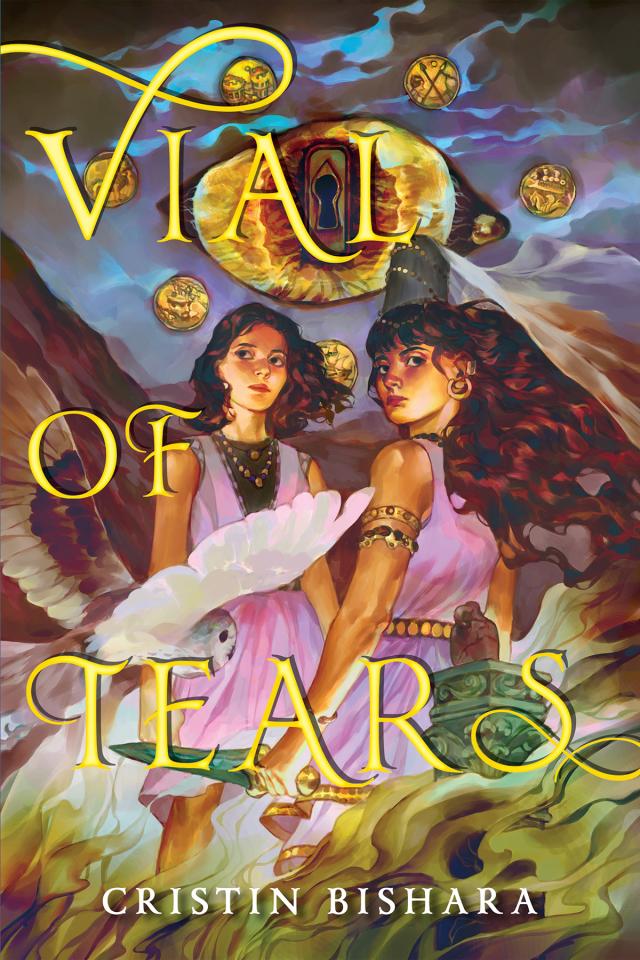
Vial of Tears, page 12


The streets were lined with tin bowls and clay jugs, wooden cups and ivory figurines. All of it for sale. There were rugs made of wool dyed shades of red and purple. Scarves and sashes that lifted with the light breeze like sails. A woman offering jars of honey. There was a man who mended clothing. Bins of glass beads made a river of color along the edge of the road. Firewood for sale. Wooden ladders. Grinning clay masks, and statues with tall hats. Garlic sold by the handful.
“Alabaster!” someone called out, holding up a pot brimming with fragrant mint.
All around them, men pulled smoke from their pipes, sending the sweet fragrance of cherries through the air. A few puppies playfully tumbled over each other, a woman with impossibly long legs scolding them to stay close. When the puppies darted off, chasing each other, the woman transformed into a greyhound and streaked after them, barking.
Sam blinked with disbelief, wondering if she’d imagined the whole thing.
Finally they stopped at a blacksmith’s shop, full of knives and tools and nails. The man’s hands were covered in thick burn scars. He watched Eshmun and Sam with curiosity, struggling not to stare, and finally dipping his head in deference. “My lord,” he said to his feet.
“Greetings, Mhaymnā,” Eshmun replied. “Please, do not bow to me when your own veins carry the mighty blood of Chusor.”
“Ah, but does a single drop of water call itself a river?” Mhaymnā asked. “The relation is so far removed.”
“And yet you know that a mere ounce of gold carries more value than a mountain of rock. What are you working on there?”
“Just what you speak of,” Mhaymnā said. “Gold melting into its next incarnation. What was once a ring becomes a necklace, which then might become a ring again. It is a cycle. How things change with fire.”
“Your fire,” Eshmun said, tipping his chin toward the small flames. “Be aware of it, my friend.”
Mhaymnā looked stricken. He lowered his voice. “The marketplace is a den of rumors,” he murmured. “Is it true, then? There is hellfire in the cedars? The Lord of Death stirs once more?”
Eshmun nodded, a grave look on his face. “My uncle will be brought to reason.”
Mhaymnā snuck a glance at Sam, so she stepped forward to speak to him. “Šlama ‘lakh,” she said. “Sir, have you seen anyone like me recently? A girl about my age?”
“Of this I am certain,” he said, bowing. “You have no equal.”
“Yishar,” Sam said, brushing off another sting of disappointment.
Eshmun wished the blacksmith well, and they continued on through the šuqā. The throng bowed and parted for them as they went, though Sam couldn’t help but notice the few scattered looks of disdain cast in Eshmun’s direction. Why?
“A gift of turquoise for Helena?” a jeweler called out, sweeping his arm over his array of goods. Engraved seashells and silver bird earrings. Faience amulets. Clay and glass pendants like the one Teth wore around his neck. Sam stopped: A dozen tiny bearded faces peered up at her, unmistakably Eshmun. Some were detailed enough to show his keyhole pupil. His hair and beard were made of small spiral shells.
“Amethyst, chalcedony, carnelian,” the jeweler continued, touching each bin as he went. “Serpentine, quartzite, onyx, lapis lazuli, and jasper. A pin for your cloak, sire, or a gem for your princess.” He winked at Sam.
Eshmun declined. Instead, he led Sam on to step inside a roofless shack, where a single chair sat in the center of a simple room. In the corner, a woman was hunched over a whirring contraption, her white hair as shiny and fine as a spiderweb. She pumped a pedal up and down with her foot, which made a stone wheel rotate; a hissing noise filled the room each time she pressed a metal blade against the spinning stone.
A whetstone. She was sharpening something. Were they here to purchase a weapon?
“Hello,” Eshmun said, and the woman turned with a start. She took her foot away from the pedal, and the wheel slowed to a stop.
Though the silkiness of her hair suggested youth, her face was ancient. On her forehead, warts peppered her skin. They looked like eyes, dark at the centers.
“Forgive me,” she said. “I did not hear you come in.” She did a double take, flustered. “Nor did I recognize you, my lord.” She skittered across the room on what seemed like more than two legs hidden beneath her long gray skirts. Her white hair brushed the ground as she bowed to Eshmun and then Sam.
Sam dipped at the waist in return, but Eshmun grabbed her by the back of her dress and pulled her upright. “She has traveled from afar,” he said. “Customs differ.”
“I see what she requires,” the woman said. She set her hands upon her bulbous stomach, thrumming her fingers. “Oh, I see, see, see.”
“A proper haircut,” Eshmun said.
“What?” Sam asked, realizing what the woman had been sharpening. Scissors.
“We will need to wash it first,” the woman said, assessing Sam’s hair.
“But—”
“Her clothing as well,” Eshmun added.
“She will clean up nicely,” the old woman said. “Indeed she will.”
“Is this necessary?” Sam asked. “We need to get to Sidon.”
“You are as filthy as a sailor’s mouth,” the old woman said. “Follow me. Behind here. Undress. No one can see.”
“I don’t care how I look!” Sam told Eshmun. “We’re wasting time.”
But the old woman shushed her, leading her to an enclosed changing area behind a woven screen. Grudgingly, Sam untied her rabbit-fur belt and placed the empty vial on the ground. Around the side of the screen, the woman handed Sam a bucket of water and a lump of something black. “Wash yourself.”
Sam held the lump to her nose and then thrust it away. “What is this?”
“Soap,” the woman answered.
“That’s not soap.”
“Indeed it is. Made of goat’s tallow and wood ashes.”
“Tallow?” Sam asked.
“Fat,” Eshmun’s voice came from across the room.
Sam handed it back to the woman. “I’ll just rinse off,” she said. “Water only.”
The old woman pressed it back. “I insist. You will emerge radiant, and all the others in the marketplace will desire my services.”
“Fine,” Sam said with a sigh.
She sloughed off her bag and dress and began to bathe. The water was freezing, and the soap didn’t lather. There were black marks on the tips of her fingers on her right hand; strangely, no matter how much she scrubbed them, they wouldn’t come off. Through the crack in the enclosure, she could see Eshmun step back outside. Her teeth chattered as she poured the cold water down her arms and over her head.
Moments later, the old woman thrust an arm around the screen with a robe. Sam wrapped herself in it, and then sat in the chair in the center of the room.
“Be still,” the old woman instructed as she braided Sam’s long bangs. The scissors were strange: two bronze blades connected at the bottom with a U-shaped handle. “Why are you trembling like a newborn? It is only hair, my beauty. I am not cutting out your heart.”
“I feel like my heart is already missing,” Sam said heavily. “Have you seen another girl like me in the marketplace? She’s taller and younger.”
“I am sorry, I have not, my child.” The old woman positioned the scissors just below Sam’s eyebrows, and then squeezed the curved handle at the bottom. The blades came together with a ringing sound. Several inches of Sam’s bangs fell into her lap with a soft thud. Lost in thought, she thumbed the braided strands of hair, while the woman skittered around her.
“Not yet,” she said, pressing Sam back down into the chair. She used another set of scissors, smaller, along with a comb, carefully snipping. Sam exhaled, blowing pieces off her lips.
“Now it is straight,” the old woman said, hooking a finger under Sam’s chin and twisting her head back and forth to examine her work. “A line as perfect as the horizon, where the sea meets the sky.”
“Yes,” Eshmun agreed as he returned to the shack. From his bag, he pulled a swath of soft, sheer fabric. “Silk,” he said, handing it to the old woman. “Procured from a recent expedition to Amarna.”
“It is very fine,” the woman said. She turned to Sam. “Now you can see the world, and the world can see your exquisite face.”
Soon, Sam’s dress was returned damp but clean, and she put it on behind the screen. The woman had mended the tiny holes in the fabric where the spit of the tannîyn had burned through. Sam picked up her bag and once again slung it over her shoulder, the weight of it beginning to feel familiar. Eshmun thanked the old woman, and she bent low.
“The reason you did not see the lions tracking us in the Beqa,” Eshmun said once they were outside, “is because they blend so perfectly.” He placed a soft hat on Sam’s head, its sheer veil streaming down her back to her waist. “Do you understand?”
“You’re saying I don’t blend.”
“The finer details are lacking,” he said, handing her a new pair of sandals. They roped up her legs with soft bands of leather and tied just below her knees. He then opened his palm and showed her a ring.
“Pretty,” she said.
“Put it on.”
Sam hesitated before sliding it onto a finger. The gold was buttery against her skin, and the stone wasn’t like any she’d ever seen before; it had not been dyed and polished or cut with smooth facets. This was a raw stone, rough and green, riddled with dark gray like a tornado sky.
“An emerald,” he said. “Does it fit?”
She spun the band on her finger, uneasy. “Yes,” she said, considering the weight of it. Something had changed; he was being too nice, and it made her uncomfortable. What had he been quietly deciding as they’d walked through the cedar forest? Had her harsh words in the mountains gotten to him? Was he feeling remorseful? Did he feel a sense of tyābutā, of shame, for betraying the gift of his ancestors?
Or was he only planning more pain for her?
She almost pushed the ring back; she didn’t want to owe him anything. But then again, if a ring, a veil, and a haircut would camouflage her, they would help her disappear into a crowd when the time came to run again—and it would come, she was sure. And she could trade the ring later for something else. Something more useful.
“Wait. This isn’t about blending in,” she said, another possibility dawning suddenly. “You’re going to sell me, aren’t you?”
“I could,” he said. “The gods would wage a bidding war over you.”
She felt a rush of dread. If she had the chance again, would she try to kill him?
“What should I do with you?” he asked, studying her face. “That is why we are here. To consult with the fortune-teller.”
He turned, and with a flick of his wrist, he directed her toward a tent. Its flaps were closed, but he parted them and motioned for Sam to follow. She stepped inside reluctantly, remembering the psychic Mom once paid to come to the house for a private séance.
Mom had collected a few of Dad’s things and spread them out on the floor. His hairbrush, a favorite flannel shirt, a baseball he’d caught at a Texas Rangers game when he was a kid.
“I feel him here,” the psychic had said. She’d made her voice sound spooky, wavering with sharp notes as she called to the spirit world. Underneath her flowing black gown dotted with sequins, Sam had seen tattered blue jeans.
“You mean he’s dead?” Sam had asked. “You feel his ghost?”
“Is he coming home?” Mom asked.
“What do the Marines tell you?” the fortune-teller responded.
Sam was confused by her answer, which was actually a question. “I thought the stars or spirits or whatever are supposed to tell you,” she’d said. She’d looked down at the pile of Dad’s stuff on the floor and suddenly felt the need to gather it up and put it safely away.
Now, burning incense cast a shroud of smoke in the dimly lit tent. A woman sat on a woven rug, cross-legged, back turned. Her long black hair spilled onto the ground. A snake was coiled next to her; she reached out and stroked it, her hands cloaked in gauzy fabric, and in the shadows of the candlelight her long fingernails traced the snake’s curved spine.
“Greetings, my lord,” she said, not turning to face them, not standing.
Eshmun pressed his palms together. “Arba`ta`esre,” he said to her back.
“Your dreams have been strange of late.”
“Yes.”
“As have mine. I dreamed there was a dead rabbit upon my hearth,” she said. “I took it as an omen. Within my dream I fell into a trance so that I might read its entrails. The heart and mind are at odds.”
“Yes,” Eshmun agreed.
“How will you reconcile them?” she asked.
“Tell me,” Eshmun said.
“Beneath the surface of the sea,” she said, “there is a flash of scales and color. What is it?”
“Tell me,” Eshmun said again.
“See with your own eyes,” Arba`ta`esre said. She motioned to a table to her left. On top sat a round shape, covered with a cloth. At first Sam thought it must be a crystal ball, but when Eshmun pulled the swath of fabric aside, she saw that it was a bowl of water. Inside swam a winged, iridescent creature with the head of a horse. Where its mane should have been, flowing fins streamed like a thousand miniature flags.
“Is that… a hippocampus?” Sam asked.
“A daughter of Yamm,” Eshmun said. He picked up a candle and took a step closer to look. “They were hunted to extinction.”
“It will grow until it is the size of a merchant vessel,” the fortune-teller said. “The question is: Is there another so rare? Would you not keep this gift safe and close?”
Eshmun watched the water horse in silence. “You will release it,” he said.
“Precious things must be guarded,” Arba`ta`esre said. Still without turning to face them, she added, “The girl stays for a moment. Her fortune differs.”
Eshmun gave Sam a solemn nod. He placed a coin on a plate before stepping back outside into the marketplace.
Sam shifted uncomfortably, not sure she wanted to be alone with this woman in the tent, not sure she wanted to know her future.
Arba`ta`esre stood and lifted the snake from the ground, draping it across her shoulders as she turned. Sam took a startled step backward. With what seemed like a trick of the candlelight and smoke, Sam realized that the woman’s hair was gray, not black. How could she have mistaken it?
And though her nose was pierced with gold studs, and symbols were tattooed across her cheeks, there was no mistaking her.
“Zayin,” she choked.
“One vial,” she cooed, “is so little to ask. And yet you willingly promised more.” She’d changed her voice for Eshmun, Sam realized. Just like the psychic had done for Mom. “Do you know where the tears are yet?”
“I will,” Sam said, her voice hoarse with fear. “I need more time. We’re still on our way to Sidon.”
The snake stretched toward Sam’s face, flicking its tongue. “Ah, but no,” Zayin said. “You cannot want more, because now you have less. Your sister,” she said with a coy shrug. “Taken.”
“How do you know that?” Sam asked, beginning to sweat. “The jackals have her.”
“Had,” Zayin corrected. “Commodities change hands quickly in this world.”
“My sister is not a commodity,” Sam said.
“No? What is she worth to you?” Zayin asked. She dipped her gauze-covered fingers into her robes and pulled out a small mother- of-pearl box. She pressed it toward Sam, her long fingernails jabbing Sam’s stomach.
“Where is she?” Sam asked, recoiling. “Did you… buy her? From the jackals? How is that possible? They were bringing her to—”
“Warships,” Zayin said. “Their bows extend into sharpened points of bronze. For ramming enemy vessels.” She pressed her nails deeper into Sam’s skin, twisting. “I will scrape your insides out, like a rabbit’s. I will read your entrails. Do you understand?”
The snake raised its head and swayed—so close—eyes glinting in the candlelight. Sam grimaced and carefully stepped back. “Yes.”
“Since our last meeting, I have acquired new information,” Zayin said. “A coin of Chusor’s gold may be in this world. Where would it be?”
“I don’t know,” Sam said, trying to steady her voice. “I don’t have it. That’s not our agreement, anyway.”
“True. Perhaps I shall make another deal with your sister. She might know where it is,” Zayin said, her amber eyes glowing. She reached inside her cloak and pulled out an ashen gray feather. “Here is a fallen angel’s feather.” She stroked it against Sam’s bare arm. “I have procured the poisonous arum berries, the scorpion tails. I have memorized the incantations long ago. What I lack is a strand of Eshmun’s hair, a drop of his blood.” She pressed Sam’s hands around the mother-of-pearl box, squeezing tight, Zayin’s hands feeling bony and hard. Cold. “Get them for me.”
“That’s not our deal, Zayin.”
“The price has increased, if you wish to buy back your sister.”
Sam swallowed. “Why do you need Eshmun’s hair and blood?”
“To make him mine,” Zayin said, batting her impossibly long eyelashes, “for a hundred centuries.”
“But Rima?” Sam choked. “Where is she?”
“Were you not listening?” Zayin shrugged, her voice acid. “The longer you take, the more you pay. And do not rely on Eshmun to find her—he will not. He has plans of his own, of course.…
“Continue to Sidon with him,” she ordered, punctuating each word with icy precision. “Procure the items. Make haste.”
The snake hissed and snapped at the air just above Sam’s head.
Fumbling backward, she tucked the box beneath her belt and struggled to find the part in the flaps of the tent. Finally she burst through and hurried back into the marketplace where Eshmun stood waiting.
The sound of Zayin’s venomous laughter echoed behind her.