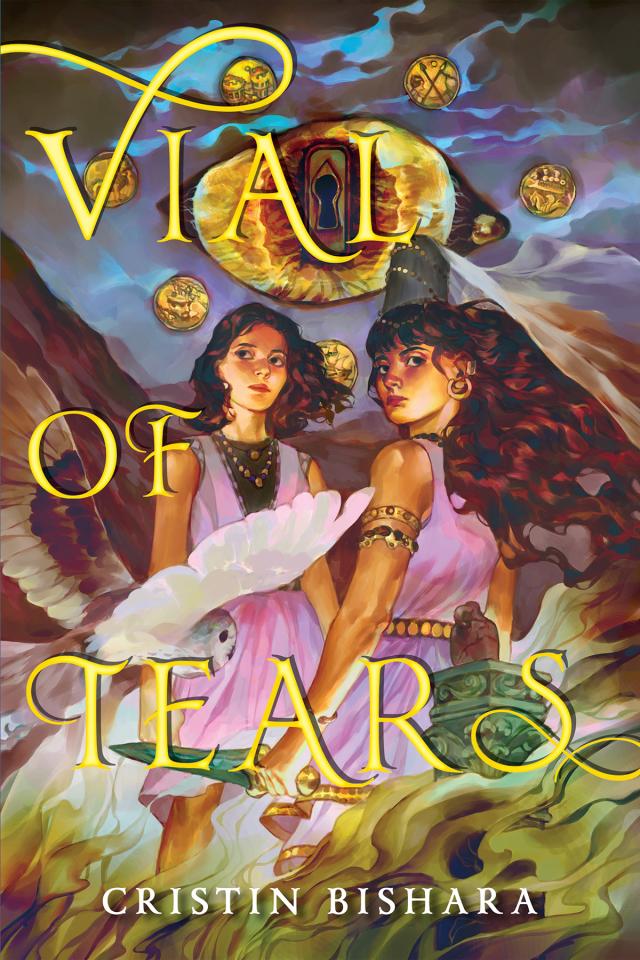
Vial of Tears, page 16


“Do I know you?” Helena’s eyebrows came together. She stepped toward Sam for a better look. Sam fumbled for words, and Helena seemed equally distressed. They stood staring at each other, nearly like looking in a mirror.
“Come,” Eshmun said finally. He ushered them inside the small apartment, cozy and warm with a fire crackling. A metal grate sat inside the fireplace; on top of the grate a wooden-handled pan bubbled with dark liquid.
“Would you like ahweh?” Helena asked. “Do you know what that is?”
“Coffee,” Sam said, breathing in the smell. “I would love some.”
Eshmun declined and sat on a chair, watching while Helena poured the liquid over a piece of fabric and into a cup, filtering out the beans. “It is spiced with cardamom,” she told Sam.
Sam took the cup and peered into the steaming brew. She sipped slowly, knowing it would be strong.
“Goat’s milk?” Helena asked.
“No, thank you.” It was perfect the way it was. Bitter and fragrant. She shed her bag and sat at a small round table across from Helena.
“Ah! Qamar,” Helena suddenly cooed as a long-legged cat emerged from the back room. The cat was tawny with black spots, too big to be an ordinary housecat.
“That’s a serval,” Sam said with certainty, déjà vu stirring in her once again.
“An Egyptian breed,” Helena said. “She was just a kitten, a baby, when Eshmun gave her to me as a gift.”
“Hello, Qamar,” Eshmun said, and at his voice the cat erupted into a purr so fierce Sam could feel the vibration in the air. Qamar darted across the room and launched herself into Eshmun’s arms. He smiled and rubbed his face against hers, scratching behind her ears.
“Let the fire die, now, Helena,” he said, setting the cat on the floor, his face turning serious again, “so that it might not become possessed.”
She gave him a startled look. “Of course,” she said. “Allahu al mustaan.”
Sam cocked her head at Helena. She had just spoken Arabic. God help us. It was something Mom said every once in a while, one of the few phrases Sam recognized.
Ahweh. Another Arabic word Sam knew. She looked into the dark liquid, as if it might hold answers.
“Who are you?” she asked Helena. “How do you know Arabic? Why do you look so much like my mother?” Helena’s hair was the identical color and texture; she even tucked it over her ear the same way.
“Who is your mother?” Helena asked.
“Helena,” Eshmun interrupted before Sam could answer, “please tell Samira how you came into this world. That is the place to begin the story.”
Helena furrowed her brow, perplexed.
“Tell her,” Eshmun said.
“If I must?” she asked. A dark look had settled in her eyes. She seemed to shake off a chill, pulling her arms around herself.
“Please,” Eshmun urged.
“It was so long ago, and yet I remember it like yesterday.”
“As do I.”
“It was the year 1903 on Earth.” Helena blew on her cup of coffee to cool it and then sipped. “Not that the years matter much here.” She looked at Samira. “On one of my many walks, I found a jug. I thought I’d uncovered every trinket around my mountain village, but there it was, a perfect artifact.” She smiled. “I remember being thrilled. It had been sitting sideways, just inside the cusp of a cave, one I’d explored before. I’d gone inside to get out of the sun for a moment.”
“The sun,” Sam repeated wistfully. On the wall behind her, a mosaic of pottery shards and bits of glass had been artfully arranged into a golden circle with outreaching beams, floor to ceiling. “Did you make that?”
Helena glanced at her work. “Yes,” she said. “Of all the things I miss most, it is the sun. Sometimes I dream of it. I am able to reach over the horizon and pull it back up by the scruff of its neck. It is just there over the edge, so close.” She reached an arm out across the table toward Sam, showing her how it was done. “All it takes is the tips of my fingers to pinch it.”
“It’s a beautiful mural,” Sam said.
“It warms my home,” Helena said, “in its own way.”
“The jug, Helena,” Eshmun urged. “Go on.”
She nodded, took another sip of coffee. “I carried the amphora home and set it aside. I was busy with my tasks: picking grape leaves and sweeping the porch, making cookies for the church. It wasn’t until later, by the light of the moon, that I discovered what was inside. A coin! I was sure it would be worth something.”
“A coin,” Sam said, setting her coffee down with a clatter. It sloshed onto the table as she shot a look at Eshmun. He nodded, as though confirming the connection she was making.
“It was odd,” Helena said, her voice far away as she remembered. “I knew it from the moment I saw it. I picked it up. I had it between my fingers and then…”
“The ground opened up,” Sam said.
Helena nodded, putting a hand to her chest as if she were feeling physical pain, deep inside. “I dropped the coin back inside the jug, but it was too late to stop what had started.”
“There was a funnel,” Sam said quietly.
“You know about coffee,” Helena said. “They had not heard of coffee here before I arrived. Imagine. I could not live without it, so Eshmun brings me beans when he finds them in his travels. I have not yet figured out a way to grind them properly. A mortar and pestle are a difficult way to do the work. I have spoken with the blacksmith and carpenter about the old grinder I had in the village, but they cannot get the crank just right. My diagrams are terrible, I know.”
“I cannot understand this obsession,” Eshmun said. “It is like drinking soot.”
“You know about coffee.” Helena kept her eyes on Sam. “And you know about funnels opening up at the touch of a coin.”
“Yes,” Sam said. She turned to Eshmun. “Where is my letter? The one Meem took when she searched me.”
Eshmun already had it in his hand; he must have known this was coming. He unfolded the thin paper and held it out to Helena.
“Will you please read this for me?” Sam asked. “It’s from my great-grandfather. He sent it along with an old jug that was filled with coins.”
Helena’s eyes widened.
“One of the coins brought me here… through a funnel,” Sam said quietly.
Helena cried out. “What are you telling me?” she asked.
“Read the letter,” Eshmun said.
Helena could not keep her hands steady, so she set the paper down on the table next to Sam. “My dearest Samira,” she began. “Beloved daughter of my beloved granddaughter. My only living kin and the last direct descendants of my bloodline are your mother, your sister, and you. By all accounts you are the most responsible, Samira. Therefore I send you my dearest possession. I send you this amphora, which my own mother discovered in a cave in Lebanon.”
Sam pulled her hands into her lap and tried to steady them. She’d broken what he called his dearest possession. It lay in pieces in her yard back in Michigan. “It was your jug?” Sam asked, but Helena continued shakily reading the letter.
“I have made wishes my entire life, but the genie refused to come again. And therefore, upon my death, I bestow it to you. My only regret in my living life is that I never met you, my great-granddaughter, nor your sister, my flesh and blood. My eyes.”
“My eyes?” Sam asked.
Helena nodded. “Einee. The Arabic word is einee. It’s like saying my heart. He writes at the end, ‘May all your wishes come true.’” She tapped a finger to the page. “This is his signature, the name I gave him when he was born.” Looking up, she wiped a tear from her cheek. “His handwriting is so beautiful, isn’t it? This… this was written by my son. Eshmun, is this true?”
Eshmun was silent, his head bowed. Qamar twined between his ankles, still purring.
Sam was trying to understand. “You’re the genie,” she said to Eshmun. “Jiddo thought you came out of the jug, so he tried to bring you back, along with his mother… Helena. He spent his whole life making a wish that could never come true. The coin was at the bottom of the jug, and he never knew it was there, or what it would do if he touched it. He thought he had to rub the jug like a genie jar.” She paused, thinking. “He must have added his own coins over the years, maybe hoping it would work like a wishing well.” How many times had Mom given her and Rima lucky pennies to toss into fountains? Don’t tell me your wish, or it won’t come true.
“Oh.” Helena let out a trembling breath. She looked up at Sam with tears. “I missed his whole life. What did he do? Where did he live? Who did he marry? He was just a child when I was taken from him.”
“Like he said in his letter, I never met him,” Sam admitted. “He only had one child, late. I think he was about fifty when he finally got married, and he stayed in the village his whole life. He would be a very, very old man now.” She hesitated. He’d sent her the jug because he was dying. She reached out and touched Helena’s arm. “I’m so sorry.”
In the few photos Mom kept framed on her bedroom walls, Jiddo smoked hand-rolled cigarettes, his olive skin deeply lined, his nose hooked. In one picture, he had a plate of figs and olives on the table in front of him. In another he posed with Sam’s grandmother, still vigorous and healthy, in front of some ancient ruins at sunset.
Ruins at sunset. Baalbek.
Sam knew she’d seen that word before, written in blue ink: Her great-grandfather’s precise and ornate handwriting on the back of a photo, along with a long-ago date.
“So I am in Lebanon,” she said, confirming what she already knew.
“Syria,” Helena said, seemingly confused by Sam’s assessment. “A part of the Ottoman Empire. At least that was what it was when I left. As you have probably surmised, we were both brought by the coin to another world—that of the Phoenicians.”
“We are Canaanites,” Eshmun said, adding his own correction.
“Yes, yes, that is what they call themselves. Phoenician is a word that would come later.” She leaned toward Sam and searched her face. “And you are the daughter… of the granddaughter… of my son,” she said, piecing it together.
Sam gripped the edge of the table. The very same coin had brought them both here, Sam and Helena, more than a century apart.
Helena reached out and squeezed Sam’s hands. “This is a gift,” she said. “It is almost like having him back, in some way. A part of him.”
Arba`ta`esre’s words came back to Sam once again, though being called a gift by Helena felt different. It felt right. “My mother says I have his hands,” Sam offered. “Long fingers.”
They sat looking at each other, wiping away their tears before they spilled into their coffee, while Sam told her about Rima, about the jackal-women, about the journey from Baalbek. Eshmun finally spoke. “I must go,” he said, stooping to give Qamar one last scratch behind her ears. “I have a boat and a crew to ready.”
Helena stood suddenly and thrust a finger at him. “Shame on you.”
Eshmun grimaced. He put his palms in the air. “When my obol calls me, I—”
Helena held up her own hand to stop him. “Not once, but twice you have pulled my family apart.”
Eshmun seemed to shrink. “I am overtaken by a force I cannot fight,” he mumbled.
“The damage you have inflicted,” Helena admonished, wagging a finger at him. “The hurt you have caused. Tyābutā.” She raised her voice. “Her sister—my great-great-granddaughter—is in grave danger!”
“I will find her,” Eshmun said.
“Yallah!” Helena said. Hurry! Eshmun stepped back, seeming to cower in the shadow of her fury. “I will not allow my family to suffer. Again.”
“It has been so long since you have recounted your story,” Eshmun said quietly, “I had nearly forgotten about your son.”
“Of course you did,” Sam chimed in. “But you think about your past, and being reunited with your family. So much, actually, that it blinds you.”
Eshmun pulled himself to his full height. He would tolerate Helena berating him, but Sam knew he would accuse her of being insolent. She braced herself, ready to argue, but instead he nodded.
“I will set things right.” He turned toward Sam. “I promise.”
“And tyābutā, for not healing this poor girl’s feet!” Helena cried. She pointed at Sam’s toenails. “They are green. There is something wrong with them!”
Eshmun’s face shifted. He let out a loud, deep laugh, and this time Sam couldn’t help but react with a small laugh of her own.
Palm up, he curled his fingers toward himself, beckoning Helena closer. Still huffing with indignation, she rummaged on a shelf, and then came to him with the same type of channeled glass the woman at the party had used. She pressed it to his cheek so his tears ran through it and into a vial she held underneath.
And while he finally repaired her blistered feet, and his healing tears were bottled, Sam looked out the window and wondered how far it was to Kition.
She wondered if Rima was still alive.
14
“I have a thousand questions,” Sam said to Helena after Eshmun had gone, “but I’m too exhausted to ask them all.”
Eshmun’s healing earlier had given her a wave of strength, but now she ached to lie down. Helena set the vial of tears on a windowsill next to a potted mint plant and three other vials.
“Start with one question,” Helena said, draping a blanket across Sam’s legs where she sat at the table.
Qamar twisted around Sam’s calves, purring, and she reached down to let her fingers run through the silken fur. She felt oddly at home. Helena was already treating her like her own, doting on her and offering every possible comfort. Even though Sam had stuffed herself at the marketplace in Sarepta, and had eaten again at the feast, she could not resist a bowl of lentils seasoned with garlic and drizzled with olive oil. A pillow with brown feathers poking out of its seams was nestled behind her back, too, after Helena insisted the chair was too hard.
Sam had already told her as much as she could: how she’d gotten the package in the mail from Jiddo; about Rima and the tannîyn and jackal ḥayuta; the journey through the mountains; the cedar forest; Sarepta.
“Helena, do you have a map?” Sam asked. “Of this world?”
“I do,” Helena said. “I drew it myself.” She pulled a basket from underneath another small table. Within it there were several white rolls, tied with bits of twine. She unknotted one. “Here it is.”
Sam spread it across the table. “It’s so soft,” she said, running her fingers across the mountains and sea and the dots of the coastal cities.
“Lambskin,” Helena said, placing her coffee on one corner and Sam’s cup on another to keep the map from curling up.
“Kition is just off the coast?” Sam asked, pointing to an island. “And we’re here.” She tapped a star on the mainland’s shoreline.
“That is correct.”
“I can’t read your Arabic,” Sam said. “Is this Baalbek, over here?”
“Yes.”
Sam judged the distance from Baalbek to Sidon, the route she’d already traveled. And then she calculated how far it would be to Kition from where she stood now. It seemed to be roughly the same distance. “What about everything beyond the boundaries of this map?” she asked. “What’s there?”
“Nothing,” Helena said. “Darkness as black as a moonless night. Some say that the border is made by an innumerable legion of ruḥā. They stand shoulder to shoulder. They will slowly press toward us, shrinking this world until it is engulfed in final darkness.”
Sam swallowed, staring at the map. “Can you tell me the story of Eshmun and the prophecy?” she asked. “It’s been mentioned more than a few times now.”
Helena went back to her basket and plucked out another rolled skin. She flattened it across the table, covering the map underneath and securing it again with the cups. She ran her fingers down the page, across the Arabic script.
“Did you write this?” Sam asked. The handwriting was beautiful and precise, just like Jiddo’s had been.
“Yes,” Helena said. She tucked a strand of hair behind her ear. “I wrote it as I have heard it recited so many times.” She pointed to a place on the skin and read, “And then a mortal—a human of otherworldly beauty—shall wed the beloved, a godly match.”
“Okay, so a mortal married a god. There are more than a few gods here, right?” Sam asked. “I’ve lost count.”
Helena held up a hand for Sam to be patient and listen. “This mortal was Eshmun’s mother, a princess from the city of Tyre. Eshmun’s father is the god Melqart, who is currently residing in Baalbek.”
“Yeah, I saw Melqart in the temple,” Sam said, recalling the shirtless man with the tusked mask. She remembered his chest puffed out with pride, the sleek leather gloves on his hands. “Surrounded by beautiful women.”
“That would be him, yes.” Helena said wryly. “You see, back when the Phoenicians reigned on Earth and ruled the Mediterranean, their gods often lived among them. Sometimes they fell in love with mortals. Melqart has had countless lovers, but only one child. Some say it is because he only truly loved one woman—Eshmun’s mother.”
“She was a princess,” Sam said. “A mortal. Teth told me a little about her. She’s gone now?”
“Yes,” Helena said. “She died in childbirth.”
“Oh,” Sam said. “How sad.” She thought for a moment. “Does Melqart blame Eshmun for her death, then?” It would be unreasonable and unfair, but possible. “Is that why they hate each other?”
“Perhaps, but the reverse is true as well. Eshmun blames Melqart for the death of his mother. He wasn’t there while she labored, and he might have saved her. But, alas, Melqart was too busy… elsewhere.” She gave Sam a pointed look. “He will never have his fill of women, that god.”
Outside, there were shouts, an argument. The voices faded, and Helena, who had paused to look toward the windows, shrugged. “I imagine there will be some unrest now.”
She shifted in her chair. Sam offered her the pillow, but Helena waved it off. “According to the prophecy, spoken by Ēl, the supreme deity, the father of all gods,” she continued, “the offspring of that union was to liberate the trapped souls of the underworld. So Eshmun searches for a rift, but he cannot find a way.