On the Lee Shore, page 28


The words flowed past Sexton unheard. His attention was fixed on the fingers of one of the boatswain’s mates as he worked in the space a few feet in front of his face. The man’s hands were large but dextrous. They pulled and twisting as they knotted the end of the rope into a noose. Once it was complete he slid the knot up and down a few times to check that it slipped without catching. The noose grew and shrank in front of Sexton’s face as he did so. The man pulled the ring back open to its widest size, and passed it to his companions who stood unseen behind the mutineer. The circle of rope swung out of sight behind him, and was then pulled down over his head. Someone lifted his pigtail clear, and then he felt the rough hemp prickle against the skin of his neck. The stone-hard knot was pulled tight behind his ear, forcing his head a little out of true.
Once the rope was in place the little party of seaman stepped back, and he found himself alone. He heard a cheer from over the side and looked that way. The water of the harbour was dotted with small boats. Fishing boats, rowing boats from Plymouth Hard and ships’ launches, all packed with sightseers. He caught the eye of a small boy in a nearby boat and saw him mimic being hanged with his hands around his throat and his tongue protruding. The boy’s father laughed at his son’s antics and then returned his attention to watching the condemned man. Sexton felt the rope tightened around his neck and his feet swing free as they lifted up off the deck. He turned through the air, the pain unbearable, and at last he was afraid. He jerked his body against the fire in his throat, and the noose narrowed with each movement. He tried to pull some air into his lungs, but his chest seemed to be locked in place. Colours around him became brighter, as if the sun had broken through at last. In his ears he could hear a growing roar, overlaid with the colossal double bump of his heartbeat. Then the sound faltered and fell away and a curtain of dark red spread across his vision. As sight and hearing failed him he was left only with touch. All he could feel now was pain, deep in his chest and the iron grip about his throat.
*****
Captain Alexander Clay hooked the finger of one hand under the linen collar of his shirt and tried to ease the pressure a little. Of all the days on which to pull my neck cloth too tight, this would be the one, he cursed. He tugged a little more firmly and at last was rewarded with some relief. He removed his hand from his collar, and brushed smooth the front of his captain’s full dress coat. Beside him stood his closest friend John Sutton, similarly constrained within his own smart uniform. Sutton saw the latest nervous movement and sort to reassure him.
‘Not long now, Alex,’ he murmured.
Clay drew his pocket watch out from his waistcoat pocket and glanced down at the dial. The hands had hardly moved since he last looked. Time must move this slowly for a man awaiting execution, he muttered to himself.
The two men were stood together beside the altar in the Ashton family chapel. It was a cold, forbidding space. When either man moved their shoes scraped on the bare flags beneath their feet and the sound echoed off the stone walls. The two candles that guttered on the altar did little to cut through the gloom. The only natural light came from narrow little windows high in the walls. All around them were the relics of long dead ancestors. Dark square plaques, their inscriptions thin and shaky with age, lined the base of the walls. Higher up, faded banners and scraps of dusty tapestry clung like weeds to the stone. Behind them a tomb had been cut into the wall. The lid was topped by a recumbent stone Ashton who’s mailed feet crushed the small dog that was placed beneath his heels.
Just as forbidding were the faces on the bride’s side of the aisle, as they surveyed the two young naval officers. Lady Mary Ashton sat in the front pew, beside a severe older sister. She looked on with her face struggling to conceal her doubts.
‘How the deuce did you succeed in persuading Lady Ashton to accept you?’ murmured the best man. ‘If she looks this sour at a wedding, I pray God I never see her at a funeral.’
‘I am most uncertain,’ whispered Clay. ‘When I first went to visit her in London she would barely see me at all. The most commitment I could obtain was that she would consult with some friends upon my proposal. I was as surprised as you when she agreed to give Miss Browning to me.’
‘Perhaps she was a little dazzled to see the caterpillar of a lieutenant she had rejected before now metamorphosed into a post captain?’ suggested his friend. The groom choked back a laugh, and the sound reverberated through the chill air. It caused the congregation to swing their gaze his way again. The Ashtons’ faces were dark with disapproval. In contrast the small group of guests on his side of the aisle smiled encouragement. His sister Betsey’s open grin was like a beam of sunshine among the shadows, forcing her brother to respond in kind.
From the back of the chapel came the scrape of wood on stone as the door clanged open, propelled by a footman in a powdered wig. He then stood to one side to allow the chaplain to enter. This was a short man, enormously fat, with a periwig perched on top of his large head. He waddled down the aisle, his surplice swishing from side to side in time with his laboured gait till he arrived at the altar and turned to face the congregation.
‘Not long now, sir,’ he said to Clay. The sound of his words echoed around the space and drew fresh frowns from the bride’s side of the chapel. Unperturbed, the man drew out a large silk handkerchief, mopped his brow and then blew his nose. Sutton and Clay’s faces locked themselves into those of persons determined not to laugh.
‘I must say, you have chosen well,’ continued the priest in a conversational tone. ‘Damned fine filly, that one, if I say so myself, what? Ah! Here she comes now.’
Clay turned to face the door and froze at the sight of Lydia.
‘Oh my word,’ he heard himself murmur as their eyes met across the dark space. She was on the arm of an elderly uncle, another Ashton, but Clay only had eyes for her. She wore a long dress of the palest ice blue silk over which was laid a net of silver lace, thin as gossamer, that caught what little light was in the chapel and shimmered as she moved. The dress was gathered to a high waist by a belt of pearls that echoed the string that were clasped around her slender white neck. Apart from a few careless locks that hung down, her rich dark hair was piled up on top of her head, making her ears and face seem small and vulnerable in comparison. Weaved into her hair was a simple crown of white and pale blue flowers, their colours echoing her ice blue eyes.
‘You look utterly lovely,’ he breathed as her uncle handed her across to him. She smiled up into his grey eyes, her face radiant with joy, and the chapel with its gloomy congregation and droning priest seemed to fade away, leaving the two of them, him in his dark blue broadcloth, she apparently wrapped in starlight. At that moment it was only they that mattered, lost in the pleasure of each other. It had been a long journey, but they were together at last.
The End
Note from the Author
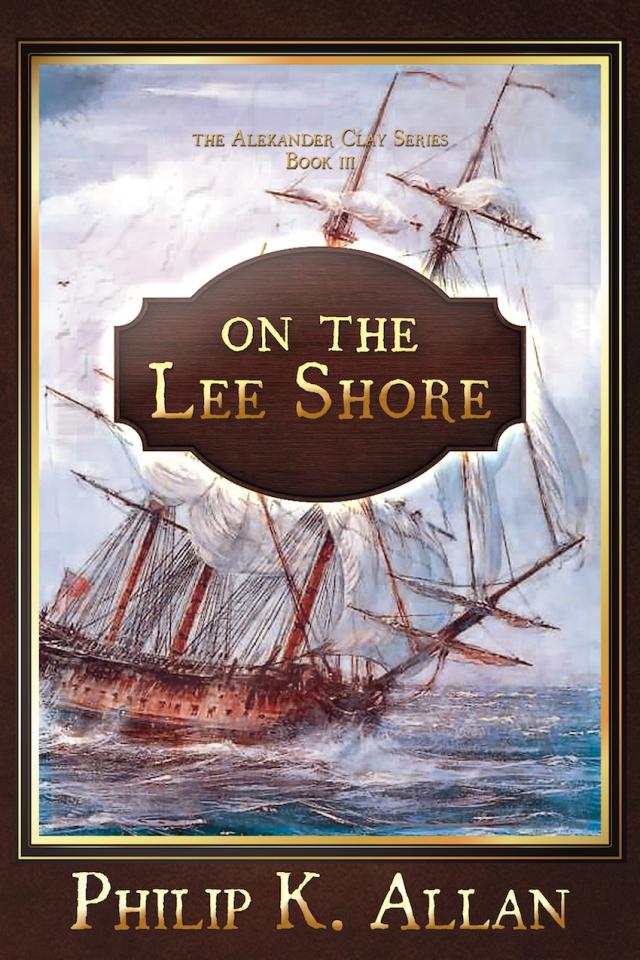
Historical fiction is a blend of truth and the made up, and this is the case with On the Lee Shore. For readers who would like to understand where that boundary runs, the ships Rush and Titan are fictitious, as are the characters that make up their crews. I have tried my best to ensure that my descriptions of those vessels and the lives of their sailors are as close to actual ships and practices of the time as possible. Where I have failed to achieve this, any errors are my own.
The other ships mentioned in the book, such as those of the Inshore Squadron, the Royal George and their French opponents are historically accurate, as are characters such as Sir Edward Pellew, Lord Bridport and Sir Charles Middleton. The adventures of the Titan off the coast of Brittany is my own creation, although it is representative of the sort of activities that Royal Navy ships would have carried out among the extreme navigational hazards of that treacherous lee shore. There was no French attempt at landing troops in Ireland in the manner, or location I have described in my novel, but there were repeated attempts by the French to do so, most notably at Bantry Bay in 1796 with a force of 15,000 soldiers under General Lazare Hoche.
The mutiny portrayed on board the Titan is fictitious. That of the Channel Fleet did take place, as did the subsequent mutiny of Admiral Duncan’s North Sea fleet based at the Nore. As shown in my book, no word of these extraordinary events reached Paris during the critical weeks before the mutiny of the Channel Fleet was resolved.
About The Author
Philip K Allan
Philip K. Allan comes from Watford in the United Kingdom. He still lives in Hertfordshire with his wife and his two teenage daughters. He has spent most of his working life to date as a senior manager in the motor industry. It was only in the last few years that he has given that up to concentrate on his novels full time.
He has a good knowledge of the ships of the 18th century navy, having studied them as part of his history degree at London University, which awoke a lifelong passion for the period. He is a member of the Society for Nautical Research and a keen sailor. He believes the period has unrivalled potential for a writer, stretching from the age of piracy via the voyages of Cook to the battles and campaigns of Nelson.
From a creative point of view he finds it offers him a wonderful platform for his work. On the one hand there is the strange, claustrophobic wooden world of the period’s ships; and on the other hand there is the boundless freedom to move those ships around the globe wherever the narrative takes them. All these possibilities are fully exploited in the Alexander Clay series of novels.
His inspiration for the series was to build on the works of novelists like C.S. Forester and in particular Patrick O’Brian. His prose is heavily influenced by O’Brian’s immersive style. He too uses meticulously researched period language and authentic nautical detail to draw the reader into a different world. But the Alexander Clay books also bring something fresh to the genre, with a cast of fully formed lower deck characters with their own back histories and plot lines in addition to the officers. Think Downton Abbey on a ship, with the lower deck as the below stairs servants.
Advertisements
If You Enjoyed This Book Visit
PENMORE PRESS
All Penmore Press books are available directly through our website, amazon.com, Barnes and Noble and Nook, Sony Reader, Apple iTunes, Kobo books and via leading bookshops across the United States, Canada, the UK, Australia and Europe.
Philip K Allan, On the Lee Shore