On the Lee Shore, page 21


‘Well, that all sounds very fine,’ she said. ‘What about his more important qualities? Is he rich, for example?’
‘I doubt his family is wealthy,’ replied the admiral. ‘His father was a clergyman who passed away when he was but a boy.’
‘When I met him recently he informed me that he had several thousand invested in the Funds, and would soon touch more prize money that was due to him. Would that be an accurate summary of his holdings?’ said Lady Mary.
‘I dare say that may be the case,’ he said. ‘He has certainly done tolerably in the matter of prizes. But I am all agog, Lady Mary. Money due to him? Investments in the Funds? I cannot conceive under what circumstances you might have had such a peculiar conversation with him.’
‘Captain Clay came to see me recently to ask for my niece’s hand in marriage,’ said Lady Mary.
‘Did he, by Jove!’ exclaimed Sir Charles. ‘I knew he was a plucky cove, but you do surprise me. I wonder at him having the opportunity to be introduced to Miss Browning? He doesn’t seem the type of person who would naturally mix in the society of ladies of her standing. How did they chance to meet?’
‘Oh, as for that I hold myself to be very much to blame,’ she said. ‘It was over a year ago. Back then he was a mere lieutenant aboard the warship that was protecting our convoy on the first part of our journey to India.’
‘Ah, I see,’ he said. ‘Matters are often rather less formal onboard ship.’
‘So I learnt to my cost, Sir Charles,’ she continued. ‘Had I attended properly to Lydia, I might have been aware how close their acquaintance was becoming before it was too late. Once my suspicions had become firm, I made my husband aware of his approaches to her, and he naturally forbade any further contact with such an unsuitable match.’
‘Yet that was not an end of the affair, I gather?’ he asked.
‘Regrettably not,’ she replied. ‘You must know how wilfull young ladies can be when they imagine themselves to be in love. Apparently Lydia was able to accept him in an informal way just before the ships parted at Madeira. Now I learn that his declaration has been repeated the day before Captain Clay came to see me. What am I to do, Sir Charles, left all alone, with such decisions to make?’
‘There there, Lady Mary,’ he said, taking up the hand that she had left within easy reach beside her. ‘I can see that these matters must be very vexing, but you are not without friends in the world.’
‘Oh, Charles,’ she murmured. ‘You do so fill me with hope.’
‘I believe that the solution to your problem does indeed lie in forming a marriage alliance to another suitable family, one that may supply the male guidance you stand so much in want of.’
‘Do you truly, Charles?’ she asked.
‘I do, Lady Mary,’ he replied, still holding her hand. ‘You need someone who is able to take the burden of such weighty decisions from your slight shoulders.’ She glided a little closer across the smooth satin of the chasse-longue.
‘Did you have a particular gentleman in mind?’ she asked.
‘Would you consider me to be suitable?’ he replied.
‘I might, once I had heard a suitable declaration of your admiration for me,’ she purred, smiling up into his eyes.
‘Ah... yes, Lady Mary,’ he said. ‘I believe I may have been guilty of a failure to communicate with adequate clarity. It is your niece, Miss Browning who was the object of my interest.’
‘My niece?’ she exclaimed, pulling her hand back. ‘Lydia? But how can that be? Surely it was to me that your remarks tended.’
‘As the one in need of masculine council, yes,’ said the admiral. ‘I would propose to furnish such advice from the position of your son in law.’
‘My son in law!’ she repeated, her face flushing. ‘But Sir Charles, you are older than I am! No, there must be some mistake.’
‘No, madam, no mistake,’ he said. ‘I urge you to consider for a moment the advantages of such a match.’
‘But this is quite absurd,’ she said. She rose to her feet, her eyes ablaze with fury. ‘I have been led on in a most cruel and insupportable fashion! You were clearly referring to me earlier. How can you now switch you attention to Lydia? You are quite old enough to have sired her yourself. In fact you could almost serve as a grandparent to her.’
‘Steady now, Lady Mary,’ he said. ‘I am still a man in the full vigour of life. Consider the superior merits of my connections, my status and my ability to confer preferment when compared with the slender advantages available to Alexander Clay, fine man though he is. I offer an alliance with one of Scotland’s chief families as against an association with the son of a rural parson’s widow. I beg you to think of all this before you reject my handsome proposal out of hand.’
‘Ha!’ yelled Lady Mary. ‘And how do you suppose my niece will react when she finds that the young, dashing officer she has set her heart on has been replaced by an elderly Caledonian satyr?’
‘A Caledonian satyr!’ roared Middleton. He in his turn stood up, his face red with rage. ‘I have never been so insulted in all my days! If you were not a lady, I should call for my horse whip! Am I to stand here and have my sincere and well meaning proposal tossed back in my face! It is not to be borne! Very well, I will remove the pollution of my presence, since you now seem to find it to be so revolting.’
‘At least we can agree on one thing, Sir Charles. Hilton!’ she called.
‘Yes, Lady Mary?’ said the butler as he glided into the room, the only oasis of calm between the two indignant protagonists.
‘Sir Charles is leaving,’ she spat. ‘At once!’
‘Before I depart, I will observe that it is passing strange how welcoming you were earlier when you thought that my attentions were intended for yourself, eh? There was no shortage of interest in me then, with your “come sit next to me” and your pawing at my hand! Good day to you, madam.’
‘For my part, you have my eternal thanks, Sir Charles,’ she said, her voice now calm as ice. ‘You have rendered me a singular service.’
‘How so?’ he said, pausing mid-way to the door.
‘You have quite made my mind up for me,’ she replied. ‘I am now resolved that I must see my niece wed, if only so she will no longer be prey to every lecherous old widower who has a fancy to bed a young maiden.’
*****
‘Here they are again, sir,’ reported Lieutenant Blake. ‘Like a pair of eels they come sliding out from their cave amongst the rocks.’ Clay followed the line of the lieutenant’s pointing arm, towards the two powerful French warships that were standing out of Bertheaume Bay. The first was the big French frigate that had been anchored there ever since they had cut out the brig back in April. Behind her came a companion ship that had recently joined her. It was a similar sized frigate to the first. They both had long sleek hulls, decorated by a broad white stripe that ran the length of their gun decks. The ships looked to be fresh from the dockyard, to judge from how clean the white paint was and how bright their new canvas sails. They slid out across the Iroise Channel like a curtain, blocking the Titan’s approach to reconnoitre Brest.
‘Is the second ship not a touch superior in size?’ asked Clay, trying to count the number of lids in the row of gun ports.
‘Perhaps sir, yes,’ replied Blake. He frowned with concentration as he too counted. ‘Her masts do look to be a little taller. She might be one of their new forty-four gun frigates, sir.’
‘One such ship we might challenge, but two is a perhaps too much for us to handle, especially with so many hostile gun batteries here about,’ said his captain. He tilted his head back and called up to the masthead. ‘Mr Butler, Mr Russell! Are you able to see anything in the Rade de Brest?’
‘No sir,’ replied one of the midshipmen. ‘I can only see a jumble of masts at this range.’
‘The enemy is closing quickly with us, sir,’ urged the officer of the watch beside him. ‘Shall I have the ship cleared for action?’
‘Not today, Mr Blake,’ he replied. ‘Put the ship about, and let us stand back out to sea.’
‘Aye aye, sir,’ replied the lieutenant. He reached forward to take the speaking trumpet from its becket and ordered the ship to turn around.
Clay watched the men at work as the ship swung up into the wind and then fell away onto the other tack. The crew all knew their places now and moved with purpose and efficiency from rope to rope as the manoeuvre progressed. He smiled to himself at what he saw. Each mass of seamen arrived at a point together, coalescing into a line as they took their places along the length of the rope. Then they hauled and pulled in time, secured the rope, and dissolved back into a mass as they ran to the next task with barely a second lost. He could sense the much better atmosphere on board now, the gentle skylarking among the men, the shared laughter and jokes that drifted up from the main deck as the watch returned below once the ship was on her new course.
‘One might almost mistake them for an efficient crew, sir,’ said Blake. He had replaced the speaking trumpet in its place and joined his captain once more.
‘You might indeed, John,’ agreed the captain. ‘They are certainly better natured, to judge by how thin Mr Taylor’s punishment list has grown. Pumping the bilges and cleaning the heads may need to become a normal part of the men’s duties if we cannot find enough ne’er do wells to perform the task.’
‘Why should they not be happy, sir?’ replied the lieutenant. ‘Two weeks shore leave just enjoyed, a pay rise in place and a good slice of prize money to come from all those coasters.’
‘They shoot tolerably, too,’ said Clay. He looked round behind them at the two French frigates. They had hauled their wind as soon as it was clear that the Titan was retreating, and now they too were turning about. ‘I almost wish we might take on those two. Fresh out of dock, their crews barely worked up after years blockaded in Brest, while we are close to a peak of efficiency. Who do you suppose would win?’
‘Why, we would of course, sir,’ grinned Blake. ‘But alas, we shall not find out today. The eels have slithered back into their cave. It’s been the same story for a week now. Why do you think they are so keen to block our approach?’
‘I live in hope that the French have simply grown weary of our regular trips to peer into their naval base, and have decided to put a stop to our antics,’ said Clay. ‘But I am not at all certain that that is the true explanation.’
‘What is it that you fear they may be up to, sir?’ asked the lieutenant.
‘Why do they do this now?’ replied his captain. ‘Our frigates have been reconnoitering these waters since the start of the war.’
‘New orders from above?’ speculated Blake.
‘Maybe,’ said Clay. ‘Or perhaps the enemy is up to something that they would rather we did not see.’
‘If Mr Warwick is to be believed, it will be a few days before we can try and look in again, sir,’ said Blake. ‘He holds we may be in for some heavy weather.’
‘With the glass falling like a stone, and the wind strengthening from the west, one doesn’t need to be an expert pilot to make a prediction like that,’ replied Clay. He looked beyond the frigate’s long elegant bowsprit. Out towards the horizon was a wall of towering grey cloud, the sea dark and angry beneath them. ‘Signal the commodore when the flagship is in sight, if you please, Mr Blake. Titan to flag. Unable to observe enemy fleet. Then you had best strike down the topgallants and get some sea room between us and the shore before this storm arrives.’
‘Aye aye, sir,’ replied the lieutenant.
*****
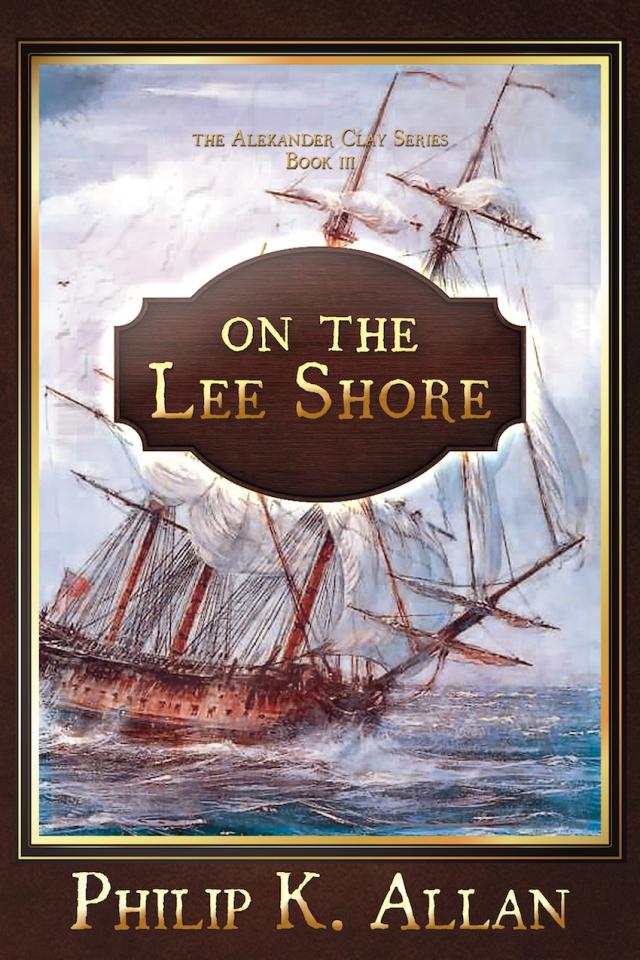
By the time that four bells struck in the dog watch later that day, the storm that the ship’s master had predicted was about to reach its climax. The wind that howled in from the Atlantic had had almost three thousand miles of open ocean to gather speed. All that lay between the driving wind and the colossal waves on one hand and the iron hard reefs and granite cliffs of the Brittany coast on the other were the fragile little ships of the Inshore Squadron. Aboard the Titan every preparation that could have been made for the storm had been. Her upper masts had been brought down on deck and secured. Every gun or other piece of heavy equipment that might work loose had been double lashed into place, and her most competent quartermasters manned her wheel. The frigate battled her way from the summit of one huge Atlantic roller to the next via the deep trough in between. First the bow was forced up the slope of the onrushing wave, tilting the frigate steeply backwards. Then the ship rolled over first to port and then to starboard as the wave travelled diagonally down the length of her keel. Then to finish it was the bow’s turn to descend into the trough between waves, while the stern climbed ever higher.
Four bells in the dog watch was also the time when dinner was taken by the crew of the Titan. It was the main hot meal of the day, and was served to the men as they sat at their mess tables on the lower deck of the ship, a windowless space down on the waterline. In the narrow confines between the deck below them and the one above, most of the crew of the Titan struggled just to stay seated at their wildly swaying places. Each time the frigate pitched, anything on the tables not held in place by its owner was sent cascading to the deck. Conversation had to be pitched above the constant groan and creak of the ship’s timbers all around them. The lanterns that provided the only lighting for the crew circled in wild loops, making the demented shadows of the men surge and retreat across the wooden walls of their ship. Over all there was a constant wetness. Water dripped down from above as the seams in the planking of the main deck worked above their heads. It wept in silver beads through the ship’s sides and ran down the painted walls. It sloshed down the ladder ways whenever a freak wave surged across the deck outside. Most of all it steamed into the dank air in a fetid vapour from the sodden clothes of all the men packed into the space.
‘Well, I’ll be damned,’ exclaimed Evans, as he loomed up in his dripping oilskins and thumped himself down on an empty mess stool. ‘I’ve just been collared by that John Waite as was on the coaster we captured – you know, Sean, the bleeder as wanted to leave us behind.’
How could I fecking forget?’ growled O’Malley. ‘I was after running the fecker through with me cutlass, if Preston hadn’t turned up when he did. What did that shite want, Sam?’
‘What do you make of this?’ said Evans. ‘He has just come up to me all civil like, asked me how I was doing, and then said how he wanted to say he was sorry about what happened. He told me how he was right scared then, him being no swimmer, and no hard feelings like.’
‘That’s very big of him to say that to you,’ enthused Trevan. ‘Proper shipmately like.’
‘Easy for the shite to say that now,’ muttered O’Malley. ‘Let’s see how sorry he is the next time we’re on a sinking ship and he’s after fecking drowning.’
‘What’s it like up top, Sam?’ asked Sedgwick.
‘It’ll be worse before it gets better, Able mate,’ said Evans. ‘I reckon we are in for a long night. The Indy’s put up the signal for us to take up our storm positions, which means the rest of the Channel Fleet boys will be scarpering for the shelter of Torbay as quick as quick, the bastards.’
‘It’ll not blow over long though,’ said Trevan. ‘These summer storms never last. Not like back in my whaling days in the Southern Ocean. You boys should try forty degrees south. You get a proper storm blasting away on eight days from ten.’
‘Your summer storm is like to a whore,’ declared O’Malley. ‘Wet, fierce and fecking over before you knows it.’
‘Have a care with the vittles, lads,’ said Rosso, as he appeared at the head of the mess table, and banged down the kid of hot food he had brought from the galley in front of him. ‘Cook says they’ll be dousing the galley fire after this. It’ll be cold provender for us till this gale blows itself out.’
‘Let’s be having it while we fecking can then,’ said O’Malley, holding his plate up. ‘I am starving.’ Like hungry nestlings the men pressed forward with their empty plates, just as the piercing sound of whistles reverberated through the air.
‘All hands, all hands on deck!’ The boatswain’s mates hurried along the deck from table to table, urging the sailors to their feet and plying their ropes ends around them to drive the men on. A collective groan of disappointment sounded around the deck, accompanied by the noisy clatter of mess stools as the men rose from their tables.
‘All hands there!’ yelled Powell, quite the fiercest of the boatswain’s mates as he came level with the table. He was second only to Evans in height amongst the crew, a dark haired brute with a savage red cutlass scar on his face that lay across one eye. ‘Stow that grub, Rosso, and show a leg! Rest of you can run now!’
Rosso stared around him in desperation for somewhere safe to wedge the container of hot food on the heaving deck. Eventually he hung the rope handle over a hook on the beam above the table and ran to join the throng of men who poured up the ladder way, with Powell close at his heels.
The lower deck was deserted now. From the deck above came the shout of orders and the collective cries of men heaving in unison. Beneath one of the beams the wooden bucket with its solid lid steamed in the air as it swung freely with the motion of the ship. The rope handle of the bucket moved jerkily up and down the hook as the ship was battered by the sea. Then the bow of the frigate crashed into a particularly large wave, tilting the ship to its steepest angle yet and the handle slithered along till it reached the end of the hook. It held for a moment on the very tip of the curve of iron, and then slipped free. With a crash the heavy kid hit the planking below. It now began a rolling journey across the deck. With each surge of the ship it swept first one way, and then another. The lines of its progress were marked by arcs of food that dribbled out until there was nothing left inside for the cold, wet and weary messmates when they should return from battling the storm above.