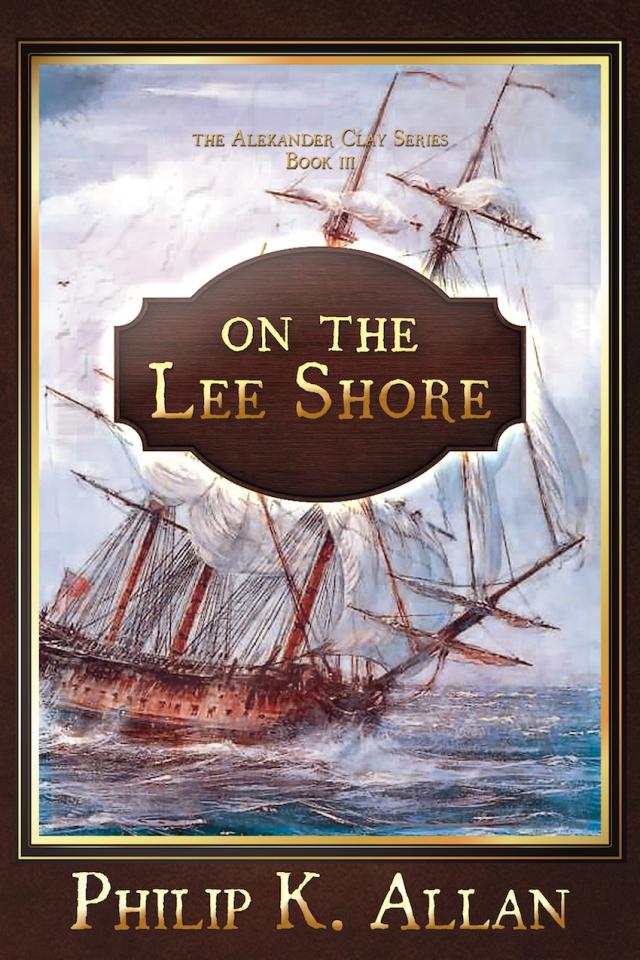
On the Lee Shore, page 23


*****
‘Deck there!’ yelled the lookout the following morning. ‘Sail ho!’
Preston tilted his head back and yelled towards the distant little figure who sat on the royal yard high up on the foremast. ‘Where away?’ he asked.
‘A point off the starboard bow, sir,’ came the reply. ‘Topsails just lifting over the horizon.’
‘Mr Russell!’ said the lieutenant. ‘My compliments to the captain, and please inform him that a ship is in sight, bearing north by east.’
‘Aye aye, sir,’ replied the midshipman, and he ran for the companionway ladder.
‘Good morning, Mr Preston,’ said Clay, as he arrived on deck a little later. ‘Where is this ship of yours then?’
‘Not visible from the deck yet, sir,’ he replied. ‘The lookout can just see the topsails.’ Clay looked around him and spotted Blake seated at the very stern of the ship with Warwick’s book on his knees.
‘Kindly have Russell sent aloft to see what he makes of this sail,’ he ordered. ‘And signal the commodore. “Titan to Flag. Ship in sight bearing ten degrees. Am investigating.” ’
‘Aye aye, sir,’ replied Preston. Clay walked back along the length of the quarterdeck to join Blake, who rose to his feet at his captain’s approach.
‘Good morning, sir,’ he said. ‘I trust this sail may be the French.’
‘Good morning, Mr Blake,’ replied his captain. ‘That might be the case, although like as not it will prove to be one of our merchantmen. We are presently crossing the mouth of the English Channel, so we are sure to encounter some shipping. You have chosen a nice spot for your reading.’
‘It is pleasant here for sure, but I am not reading, sir,’ replied Blake. ‘I am trying my hand at capturing Nancy’s likeness.’
‘Nancy?’ queried Clay. The lieutenant showed him his sketch book. The pages fluttered beneath his grasp in the keen breeze. His captain angled his head a little, and his face cleared. ‘Oh, I see. You are drawing the wardroom goat. May I?’ He took the book and looked at the collection of drawings on the page. In the centre was the animal, lying on a section of deck with her neat hooves tucked in beside her. She held her head high and alert, caught in a moment as if startled by some noise. Around the main sketch were smaller drawings that captured some of the detail. One just showed the goat’s head, a single liquid eye looking back out of the page at Clay. As he looked he could almost feel the animal regarding him. He glanced across to where Nancy was tethered to one of the aft carronades munching on some ship’s biscuit, and back at the page.
‘This is really very good,’ he said admiringly. ‘I have always thought that goats have eyes like the devil, which you have captured very well. I had no idea what talent lurked down in the wardroom.’
‘Thank you, sir,’ said Blake as he took back his book. ‘I am obliged to Lieutenant Preston for suggesting to me that I might try my hand at a little drawing. I must confess I had forgotten how engaging a pursuit it can be. In time I may progress from goats to some more challenging subjects about the ship.’
‘That will be very interesting,’ said the captain. ‘Shipboard life is so ill recorded in general. And should you ever find yourself progressing onto portraits I may have a commission for you. Yes, Mr Butler?’
‘Mr Preston’s compliments, and Mr Russell reports that the sail is a merchant brig flying British colours,’ he said.
‘Thank you,’ said Clay. ‘Kindly ask Mr Preston to lay us on a course to intercept the brig. I wish to pass them within hailing distance.’ Once the midshipman had saluted and left them, Clay turned back to Blake. ‘As I feared, it is not the French, but at least with no prospect of immediate action you will have the leisure to complete your drawing of Nancy.’
Carrying all the sail she could manage in the gusty wind, the Titan sped down towards the little ship. Her sharp bow plunged into each fresh wave with gusto and threw a fan of spray downwind. An occasional rainbow flashed into existence in the sunlight as she tore on. The ships converged quickly, till the brig was hull up from the quarterdeck. She had not altered her course at all since they had first seen her, in spite of the large frigate that loomed ever closer. As soon as she was within range, Clay had a signal sent up that ordered her to haul her wind.
‘Why is she ignoring my signal?’ he fumed as the brig continued on her way.
‘She probably fears we plan to press some of her hands, sir,’ said Taylor.
‘Which I damned well might if she doesn’t stop soon,’ said Clay. ‘Mr Preston! Have the bow chaser cleared away and send a ball across her bow.’
‘Aye aye, sir,’ replied the lieutenant.
A few minutes later a gush of dirty white smoke erupted from the forecastle, followed by the deep boom of the long nine pounder firing.
‘Ah, that’s better, sir,’ reported the first lieutenant.
‘About time too,’ muttered his captain.
‘Why did I ignore your direction to stop, sir?’ repeated the brig’s master in response to Clay’s hail. ‘We did see your flags, but my ship’s mate who understood what all these damned signals mean was pressed off my ship last voyage. Still, no harm done. How is it that I can help you?’
‘I am seeking a French naval squadron that has escaped from Brest,’ explained Clay. ‘Five warships, all frigates, probably bound for Ireland. Have you seen them at all?’
‘Five warships, you say?’ said the brig’s master. He was a large man, unused to being hurried. After a few moments of staring towards the horizon, lost in thought he returned his speaking trumpet to his mouth. ‘Yes, I believe I might have seen them, sir. There was a mass of navigation lights on the horizon, around dusk yesterday night. We thought it was like to be a convoy of some sort, but it might very well have been these Frogs you are after.’
‘Perhaps so,’ said Clay. ‘Do you recall where it was you saw them, captain?’
‘Well now, let me think,’ he replied. He returned his gaze to where sea and sky met for a further moment of contemplation. Clay shifted from one foot to the other while he waited.
‘Maybe twenty-five or thirty miles north west of here,’ he eventually replied. ‘Would you like me to go below and consult the log?’
‘No, no, captain, I pray,’ hailed Clay. ‘I have detained you quite long enough. You have been most helpful. I trust you have a prosperous voyage.’
‘You too, sir,’ came the reply.
‘Mr Preston, kindly bear away and let us make all speed to close with the flagship so I can signal to them,’ he ordered. ‘I fear the French are still far ahead, but they may suffer some mishap that will serve to slow their progress.’
‘You believe we may catch them before they reach Ireland, sir?’ asked the lieutenant.
‘Probably not, but we can but try,’ he replied.
*****
‘Ah, the hills of County Kerry in all of their fecking glory!’ enthused O’Malley. He stood up against the bow rail of the frigate and threw wide his arms. ‘Did you ever hear tell of such a beautiful green at all?’
‘What about them forests we saw back in Saint Lucia?’ asked Evans as he coiled the middle staysail halliard with care and hung it over its belay pin. ‘They was about as green as it comes.’
‘But that was in the fecking tropics!’ protested the Irishman. ‘That don’t signify. Where have you seen green like over there in any proper Christian land like?’
‘Cornwall is very green,’ said Trevan. ‘In the spring it can be proper lush in the fields near my village. Easily as green as these hills here of yours.’
‘Cornwall!’ spluttered O’Malley. ‘Don’t tell me you’re after comparing fecking Cornwall with them mountains over there?’
His shipmates all paused in their work to contemplate the view. The Titan had rounded Bray Head and was standing into Dingle Bay, while the other two frigates pressed on to search the next inlet up the coast. The north side of the bay was a majestic sweep of green mountains tumbling down into the blue water at their feet. Just near them the land had been sheared off as if by a blow from some monstrous cleaver which had left towering cliffs of grey stone, streaked with white from the clouds of sea birds that flew in drifts of smoke across them. At their base Atlantic rollers thudded in from the open sea and sent white water foaming up the rock. Above the cliff tops the hills were indeed lush and green in the sunshine, fading to blue in the distance as the land rose again to form a broken spine of mountains.
‘Tis a mighty fine land, our Sean,’ said Trevan, patting his friend on the shoulder. ‘You know we be only jesting with you. Must seem strange for you, mind, to be so near to home like?’
‘Oh Christ, this isn’t home, Adam!’ exclaimed O’Malley. ‘No, I don’t come from round here at all. Your folk from Kerry are fecking peculiar sods. Mad savages the lot of them, barely human at all. But they do have nice green hills.’
‘Look alive,’ hissed Rosso from the base of the foremast. ‘Grunters are coming.’
The men hastened to carry on their work as the tall figure of their captain strode up the portside gangway with Lieutenant Taylor by his side. Both men were carrying telescopes in their hands. The sailors stepped aside as the officers passed them, knuckling their foreheads in salute.
‘Carry on, you men,’ said Taylor, and the friends continued to coil and tidy the ropes on the forecastle while trying their best to overhear what the two officers were saying.
‘Any sign of the French?’ asked Clay. He scanned the far shore of the bay as it opened up before them.
‘Nothing yet, sir,’ replied Taylor. ‘This inlet does go a long way inland, so they may be farther up it.’ His captain shook his head.
‘I doubt it,’ said Clay. ‘No French commander would take his ship so far from the open sea. In a westerly he could be trapped in here for weeks. No, Mr Taylor, I fear we have drawn another dud, as we have been doing all day. No French in Kenmare, or in Dunmanus Bay.’
‘I thought we might have found them in Bantry Bay, sir,’ replied the first lieutenant. ‘That is where they attempted to land troops last year.’
‘There are such a multitude of inlets on this blasted coast,’ muttered Clay. ‘Where can the damned French be?’
‘Begging your honours' pardon,’ said O’Malley, ‘but do we know what these Frog ships are planning to do here abouts, sir?’
‘O’Malley!’ bristled Taylor. ‘You speak when spoken to! If you have something to say, you know you must ask permission to speak first.’
‘Sorry, sir,’ replied the Irishman. ‘Can I have your permission to speak at all?’
‘Yes, you can,’ said Clay. ‘To answer your question, we believe that the French plan to effect a landing on this coast. Perhaps of as many as two thousand soldiers, some guns and a lot of supplies. Do you have anything to suggest, O’Malley?’
‘I do sir,’ he said. ‘I was thinking that you might want to asked some of the Kerry men amongst the crew where they would go to land such a body of men. Murphy in the afterguard would be best. He’s a fisherman from Tralee. I doubt if there’s a soul aboard as knows this coast better.’
‘Murphy was one of the mutineers wasn’t he, O’Malley?’ asked Taylor.
‘Aye, sir, but that was only because them arses Kenny and Sexton filled his head with all sorts of stuff, pardon my language,’ replied the Irishman. ‘He’s steady enough now.’
‘Just a minute,’ said Taylor. ‘I recall you were reported to me for fighting with Murphy by the Master at Arms.’ O’Malley looked a little sheepish at this.
‘Well sir, Murphy was one of them what tricked Beak..., I mean Mr Morton into having Evans and Sedgwick put in irons,’ he said. ‘I was angry with your man, for setting on my messmates. Murphy’s not what you might call quick on the uptake. He takes more note of fists than words like, but we are fine with each other now.’
‘Very well, O’Malley,’ said Clay, trying hard not to crack a smile. ‘Can you give my compliments to the captain of the afterguard, and let him know I would like to have a word with your fellow countryman.’
When he appeared on the forecastle, Murphy was a pleasant looking young sailor with dark hair and eyes, and a thin, angular frame. He shifted from one foot to the other in the presence of both his captain and his first lieutenant.
‘Stand still, man,’ ordered Taylor. ‘You’re not in any trouble.’
‘O’Malley here told us that you are familiar with this coastline,’ said Clay. ‘Is that the case?’
‘Why yes, sir,’ replied the sailor. He pointed towards the shore. ‘My family come from the other side of that peninsular over there. I’ve been after fishing these waters with my father and uncles since I was first able to totter down to their boat.’ Clay smiled in encouragement.
‘Very good, Murphy,’ he said. ‘I want you to imagine that you had come to this coast with five warships, all much the size of the Titan, with the object of landing a large body of men, together with some cannon and a good quantity of warlike stores. Where might you choose to go to accomplish such a thing?’ Murphy looked around for a moment, took in the natural beauty all about him and shook his head.
‘If it was troops and guns an’ all you was after putting ashore, I would not be doing it here, sir,’ he said. ‘Dingle Bay is awful pretty like, but it has no shelter to speak off if it was to blow above a cap full of wind out of the west like, which it pretty well does all of the time hereabouts.’
‘Very well,’ said Clay. ‘Let us discount this bay then. So where might you go instead?’
‘Once I had put these troops an’ all that other stuff ashore, would I be thinking of heading inland like?’ asked the Kerry man.
‘Most likely that will be their intention,’ confirmed his captain. Murphy’s face cleared at this.
‘Then I would go a bit farther up the coast. Just round the next headland is Ballyheige Bay. She’s a fine wide inlet, nice and deep like. That’s where I would be fetching up, for certain,’ he said.
‘You seem most decided in your view, Murphy,’ said Clay. ‘Would you share your reasoning with us?’
‘For a start there is plenty of shelter from the west, sir,’ he explained. ‘I have taken refuge from a blow behind Rough Point many a time with my Da and Uncle Niall. Good holding ground to anchor a ship in, and plenty of sandy beaches to land them stores and men. Open to the north, so I wouldn’t be trapped with the wind in the west. Perfect for what them Frogs is about.’
‘It does sound promising, sir,’ said Taylor.
‘I agree,’ said Clay, considering the sailor. ‘And what of the French troops moving inland from there?’
‘Which they could do as easy as kiss my hand, sir,’ said Murphy. ‘Doesn’t the mighty Shannon River empty into that very bay? She cuts right through these mountains. You could land at dawn and be beating on the gates of Limerick itself before nightfall.’
‘Very good, Murphy,’ said the captain with decision. ‘We shall try this Ballyheige Bay of yours. Mr Taylor, have the ship put about on the other tack and see if we can weather that headland.’
‘Aye aye, sir,’ said the first lieutenant. He hurried off towards the quarterdeck. Clay turned back towards the two seaman. ‘Thank you for your help, Murphy, your advice has been most useful. And to you too, O’Malley, for your valuable suggestion that we avail ourselves of Murphy’s local knowledge.’ The two sailors muttered something unintelligible, and Murphy’s pale skin flushed red with embarrassment. Clay spared them any fresh agony by looking out into Dingle Bay.
‘Tell me, Murphy, does the surf always sound as loud when it beats against the cliffs over there?’ he asked. The sailor glanced across to the far side of the inlet, a puzzled look on his face.
‘Not really, sir,’ he replied. ‘It can boom a bit like, but I have never heard it like this.’ They all looked at the far headland for a moment and the realisation came slowly that the rhythm of the sound they could hear was quite out of time with the crashing waves.
‘That’s not surf we are after hearing, sir,’ said O’Malley. ‘That’s the sound of gunfire.’
Chapter 16
Ballyheige
As the Titan sailed back out of Dingle Bay, her crew were busy clearing their ship for action. They were encouraged in their efforts both by the increasing sound of distant gunfire from somewhere ahead, and by the roar of noise produced by their marine drummer as he beat to quarters. He was positioned at the centre of the main deck and his drumsticks were a blur of motion. Men swirled around him as they ran to their places, or paused to deliver and receive hasty hand-slaps from friends as they passed each other. From behind him came the sound of the carpenter and his mates knocking loose the wedges that held the bulkheads on the main deck in place. Soon the captain’s suite of cabins, already stripped of their furniture, would vanish completely. That would leave the gun deck as a single uninterrupted space from the very apex of the bow to the glass window lights at the back of the stern.
Some of the drummer’s fellow marines hung in the air above him as they made their way up the shrouds, hauling their muskets and extra pouches of ammunition behind them. These were the better shots among the men who would act as sharpshooters, sniping down on an enemy ship alongside to add their puny musket fire to the massive eighteen pounder cannon that formed the Titan’s main armament.
The drummer had a good view of the guns. They ran down both sides of the main deck, and around each one he could see their crews as they prepared for action. Most of them had stripped to the waist, ready for the furnace heat and hard physical labour to come. Many wound their neck clothes into bandanas which they pulled tight around their heads to protect their ears from the deafening roar of each broadside. Some checked over the rammers and hand spikes that they would use to point and load the cannon. Others cast loose their pieces and pulled experimentally on the rope tackles that they would need to run the loaded guns back out through the ship’s side. The drummer found his view had become hazy and vague with smoke as each gun captain lit his spluttering linstock and whirled it into glowing life. Then the ship’s boys came running up in an excited pack from below with the first of the charges. They spread out across the deck, each one carrying his heavy bag of powder in a leather case to his allotted gun.