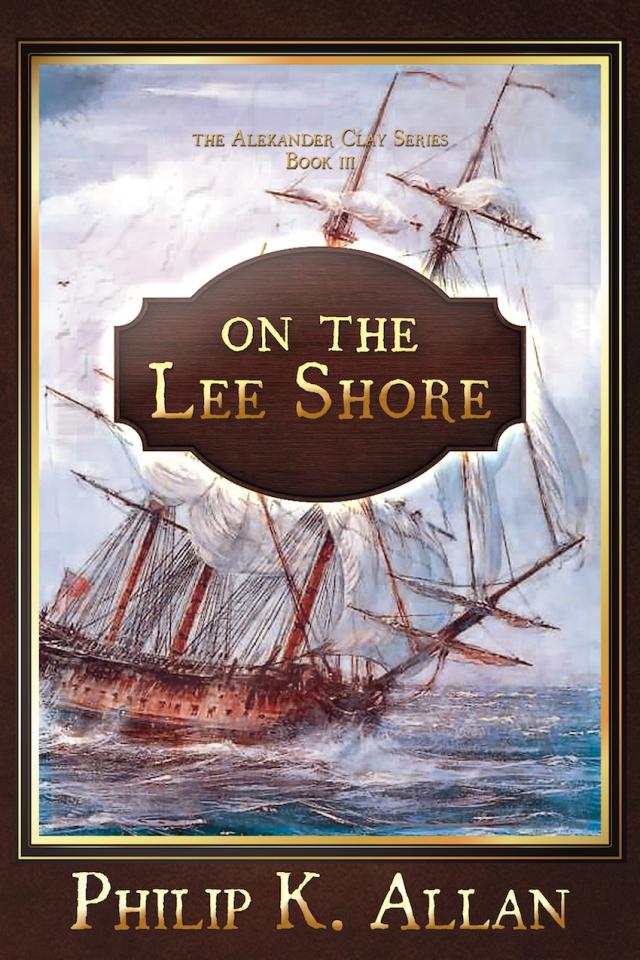
On the Lee Shore, page 16


‘With pleasure,’ the commodore said, taking a drink from the battered tray that Hart held beside him. He sipped at his drink and his eyebrows rose for a brief moment. ‘Very eh... nice,’ he commented.
‘I was not able to complete my cabin stores before departure either, Sir Edward,’ explained Clay.
‘Well, no matter. I have some excellent sherry wine onboard the Indy,’ said Pellew. ‘Will you permit me to send you across a couple of cases? It is the least I can do to apologise for my absence these last several weeks. Believe me when I say I had no control over events, but was compelled under duress by my crew to abandon you here.’
‘I had assumed that must be the case, Sir Edward,’ replied Clay. ‘But I have been quite starved of any intelligence this last month or more. Might I trouble you to tell me what on earth has been going on?’
‘The day after that gale, the whole damned squadron mutinied, that’s what,’ replied Sir Edward. ‘The people must have learnt that the Channel Fleet had risen, how I cannot begin to fathom, for I shared that intelligence with no one other than my four captains. But the fact that four ships of the squadron all revolted as one suggests a well laid plot amongst the men had been afoot for some time. The only mystery is how the Titan came to stay loyal.’
‘We did not escape the mischief wholly, Sir Edward,’ replied Clay. ‘Some of the men did mutiny, shortly after the rest of the squadron withdrew, but thanks to the intervention of a body of loyal hands I was able to regain control of the ship. I have the chief ringleader in irons below, and of his main accomplices one is now dead and the other injured. The rest of the crew members are obedient to their duty. Regrettably Lieutenant Morton was killed by the mutineers, and I shall need my purser to be relieved of his duties, but apart from a generally deficiency in water and stores, particularly pork, we are in good shape.’
‘That is excellent news,’ smiled the commodore. ‘For my part we were all forced to sail to join the Channel Fleet at Spithead. When we got there it was a truly dreadful sight. There were red flags at every masthead. Unpopular officers were being roughly manhandled off the ships. Lord Bridport had been cast ashore together with all his captains, myself included, while delegates from the ships negotiated with the Lords of the Admiralty as if they were their damned equals. I tell you, Clay, I have never seen the like, and hope I never shall again. Fortunately it is all now resolved, and the fleet is obedient once more, although I hear there is some fresh mischief that may have started at the Nore. But what of you Clay? What have you been about for all these weeks?’
‘I have been keeping the men busy, pushing them hard so they are unable to dwell on thoughts of mutiny, Sir Edward’ he replied. ‘We have patrolled the approaches to Brest as normal, but I have avoided any action with the enemy, not wanting to hazard the ship with no other vessels at hand to take our place.’
‘Very wise,’ said Pellew. ‘And what of the French?’
‘They have been quiet, Sir Edward,’ replied Clay. ‘We have carried on as if the fleet were still in place, just beyond the horizon. We have reconnoitred when we could and signalled to the empty sea for the benefit of the French watching us from the shore.’
‘Have you, by George?’ chuckled Pellew. ‘That was cleverly done. Remind me never to play you at whist. You certainly know how to act when you are dealt a deuced poor hand.’ He regarded Clay for a moment, his look kind.
‘Are you not curious to know how the mutiny in the Fleet was brought to a successful resolution?’ he asked.
‘Yes, of course, Sir Edward,’ replied Clay. Pellew returned his glass, still half full, to Hart and rose to his feet.
‘I thought so,’ he said, with a mischievous twinkle in his eye. ‘If you would be good enough to have your crew summoned for me to address them, I will reveal all. Shall we return to the quarterdeck?’
‘All hands!’ went out the call. ‘All hands to assemble by divisions!’ In a disciplined rush the watch below flooded up the ladder ways till the main deck was thronged with a jostle of figures all making their way to their places. Every man aboard was present, except for the ringleaders of the mutiny and their marine guards. When the blocks and lines of upturned faces were quiet and settled, Pellew strode forward to the quarterdeck rail, and took out a sheet of paper from the inside pocket of his coat. As he unfolded it the corners fluttered a little in the breeze that flowed across the ship from the open ocean. In a loud voice that was pitched to reach the furthest man, the commodore began to read aloud.
‘The Lord Commissioners of the Admiralty have ordered that the following notice is to be read aboard every ship of the Channel Fleet,’ he began. ‘In light of the recent disorder that has afflicted the fleet of His Majesty the King, the actions listed below have been executed.’ Pellew paused to run his eye over the assembled crew to confirm that he had all of their hushed attention. He then returned to the paper.
‘His Majesty the King has this day, at the Court of St James, signed into law an Act of Parliament that shall provide for an increase in the rate of pay for the loyal seaman of His Majesty’s Navy. All seamen rated able shall have their pay increased by five shillings and six pence per month, and all other ratings shall receive an increase of four shillings and six pence.’ Pellew paused till the excited hubbub that had broken out among the crew was silenced by the petty officers. When it was quiet again he resumed reading.
‘His Majesty’s Government shall form a commission of enquiry to investigate the quality of all manner of provisions supplied to His Majesty’s ships by the Victualling Board with a view to their immediate improvement. The Lord Commissioners of the Admiralty have further issued new instructions to the officers commanding His Majesty’s ships requiring them to grant any reasonable requests for shore leave that do not imperil the efficient running of said vessels.’ He again paused while the men turned to one another, many of the faces now openly smiling.
‘Furthermore, His Majesty has graciously issued a Royal Pardon to any seaman charged with mutiny following the recent disturbances that have taken place aboard His ships, on condition that the said individuals return to dutiful obedience of their lawful officers without delay. Any further incidents of revolt will be dealt with under the full rigor of the Articles of War and the Mutiny Act.’ Pellew refolded the sheet of paper with care and returned it to his coat pocket, before facing the men once more. ‘Three cheers for the King!’ he bellowed. ‘Hip hip!’ After a moment of hesitation the men began cheering, and he turned back towards Clay.
‘You can dismiss the men now,’ he said. Clay looked across at Taylor, who gave the order, and the life of the ship returned to normal as the men went back to their duties, many still discussing the news.
‘You have my thanks, Clay,’ said Pellew. ‘You have done your duty this last few weeks. It only saddens me that you had to do it alone. The Argos will relieve you now so that you can return to Plymouth to resupply, and I will send you instructions with regard to a new purser and lieutenant to replace poor Mr Morton. Let the men have some shore leave, and take some yourself. I shall expect you to rejoin the squadron by mid June. We should be able to keep an eye on the French without you till then.’
‘Thank you, sir,’ said Clay. He touched his hat in salute as they walked back to the entry port together. As they reached the ship’s side a number of small sacks were being swung up from Pellew’s barge.
‘Ah, I almost forgot,’ he said. ‘What with all this nonsense going on in the fleet there has been a decided build up in undelivered mail. I brought it all out with me. There is a considerable amount for you, including a lot forwarded from your previous ship the Rush. Goodbye for now, Clay, and well done again.’ He waved a hand in farewell and disappeared down over the side to the further squeal of boatswain’s pipes. Clay waved back at him, and then turned towards his first lieutenant.
‘Do I understand that this Royal Pardon is to apply to our mutineers too, sir?’ Taylor asked.
‘You heard of the Lord Commissioners instructions on that point as clear as I did, Mr Taylor,’ said Clay. ‘I do not believe that we have very much of a choice upon the matter.’
‘I can just about stomach that rogue Page and those who followed him escaping justice, sir, but surely it cannot apply to that blackguard Sexton,’ he said. ‘Where is the justice in that?’
‘What would you have me do?’ asked his captain. ‘Go against an order from the King?’
‘No, of course not, sir,’ conceded Taylor. His hands worked in front of him for a moment, and then hung limp by his side. ‘So must I order his release?’
‘Yes,’ said Clay, his grey eyes stern. ‘And then you may have him confined in irons once more.’ The first lieutenant looked at his captain in surprise.
‘He has been pardoned for the crime of mutiny, Mr Taylor, but I heard no mention of any Royal Pardon for murder. I am quite resolved to see that he swings for the death of Lieutenant Morton.’
Chapter 11
Ashore
His Majesty’s frigate Titan swung at anchor once more, safe within Plymouth harbour. She was turning around her mooring with the flow of the tide, so that the view from Clay’s great cabin had changed from the sunlit fields above Cremyll point via the naval dockyard to the grey stone town itself. He looked up from the gunner’s indent he had just signed as his first lieutenant came into the cabin for their regular morning meeting.
‘Goodness, sir,’ exclaimed Taylor. ‘What an extensive correspondence you have.’ Clay glanced across the cabin at the large piles of opened letters that were heaped on top of his sea chest.
‘Yes, I do,’ he smiled. ‘Some are from my mother and sister, but the chief part are from a passenger who I met aboard an East Indiaman last year. I was the first lieutenant of the Agrius then, and we were convoying her ship as far as Madeira. Then we sailed for the Caribbean while the convoy carried on to India.’
‘Ah, I see,’ said Taylor. ‘A lady, then, I collect?’
‘I do not believe I mentioned my acquaintance’s sex?’ said Clay.
‘I beg your pardon, sir, but you did indirectly. You described the vessel you were convoying as “her ship”.’
‘Oh, did I?’ said his captain. He looked so crestfallen at this lapse that Taylor found himself forced to laugh.
‘I am sorry, sir,’ he apologised. ‘It is very impertinent of me to pry. I would have guessed that your correspondence was from a lady even if you had not let slip. I have rarely seen you in such good humour since you joined the Titan, and I must say I am delighted for it. These last few months have been so trying that it is a miracle you have not acquired some of my many grey hairs. But perhaps we can now look forward to some calmer waters ahead?’ Clay looked at the older man with surprise, and then he too started to laugh.
‘Let us hope so, George,’ he said. ‘I have been writing letters to this person for over a year now, with never a reply to sustain me. At times it has felt just as it did when we signalled to that empty horizon. The reason was that I was chiefly writing from the West Indies, and she from Bengal. It would take a ship four months just to sail from Barbados to Bengal, and a letter must travel by a much more circuitous route. What with my change of ship and this mutiny, it is small wonder I have had to wait. And here is the reward for my patience, at long last.’ The two men looked at the stacks of letters.
‘I can see her correspondence has been extensive, but has it been, eh... satisfactory?’ asked Taylor.
‘Very much so, George,’ grinned Clay. ‘It seems she has been every bit as diligent in writing to me, including the excellent news in her last letter that she is recently returned to England. Which brings me on to the vexing subject of shore leave.’
‘Ah, yes, sir,’ said Taylor, the smile draining from his face. ‘Sir Edward’s pronouncement on that subject has resulted in every man jack of them putting in a request, sure that they will all be granted.’
‘Which in most cases we must accede to,’ said his captain. ‘I have the new regulations here, they are quite specific. We can only deny leave to those that we know will desert.’
‘But most of them shall!’ protested the lieutenant. ‘They always have, given the opportunity, sir.’
‘You must consider that this time will be different,’ said Clay. ‘Apart from our vessel being a rather happier ship, matters have changed in other ways. What do you believe stops a man from deserting?’
‘Well, by rights it should be the fear of a flogging when they are caught, sir,’ said Taylor. ‘But that has never really answered. We catch too few of them.’
‘Indeed so,’ agreed his captain. ‘The main discouragement has always been the back pay that the Navy holds back. If they run, they lose the lot. Except that their pay had become much too low to serve as any true deterrent. Most of our people could make up any lost pay in a few months aboard a merchantman. But not anymore; the case is altered.’
‘So you hold that the pay rise will keep them from deserting, sir?’ said Taylor. He shook his head in disbelief. ‘I hope you are proved right.’
‘We are sure to lose a few ne'er do wells,’ said Clay. ‘I would be surprised if Page does not take this opportunity to run, but for most it will answer. Give the men two weeks of liberty, the officers too. That will still give us time to prepare the ship for our return to the squadron by the middle of June.’
‘Two weeks, sir!’ protested Taylor.
‘Two weeks, you and I included, George,’ repeated Clay. ‘If the men are quite resolved to desert, they will do so whether we grant them two hours or two weeks. If we are certain to be hanged, it may as well be for a sheep as for a lamb.’
‘Aye aye, sir,’ grumbled Taylor.
‘Now, I have been giving some thought to our new officers,’ continued Clay. He searched for a letter on his desk, and produced it from under the ship’s log. ‘What are your feelings about us giving an opportunity to an excellent young man who has just been promoted to lieutenant?’
‘How young is the gentleman you have in mind?’ asked Taylor.
‘He is eighteen years old,’ replied the captain.
‘Oh, that is very young,’ said the first lieutenant. ‘And of course Mr Blake is quite inexperienced too, sir.’
‘I can confirm that this gentlemen certainly does have the advantages that comes with youth,’ smiled Clay, ‘while each day he is being cured of its shortcomings.’ Taylor failed to smile at his captain’s joke.
‘I was more concerned with his want of experience, sir,’ he said.
‘Have no fears on that score,’ said the captain. ‘He has done his six years of sea time as a midshipman, all in the Navy, and much of it with me. His record is good. He has experienced several actions at sea firsthand and was commended by General Abercromby for his part in the defense of some siege guns during his last commission. I can vouch for his character, which is very amiable and open.’
‘What is the young man’s name?’ asked the first lieutenant.
‘Edward Preston,’ said Clay. ‘He was one of my midshipmen on the Rush, and now he has made lieutenant. My particular friend Captain Sutton has no role to offer him aboard his current ship, so he wrote to me to see if I might oblige him with a position. We could move Mr Blake up to second lieutenant and make Mr Preston our new third. As you say he will have much still to learn, but I can think of no better mentor for the young man than yourself, George.’
‘That is very good of you to say, sir,’ said Taylor, smiling a little. ‘If he comes with your recommendation I am sure he will make a very valuable addition to the wardroom.’
‘Good, that is settled,’ said Clay. He wondered for a moment if Sir Charles Middleton had found him as malleable as Taylor, when he had flattered him into accepting command of the troubled Titan. He returned to the letter from the commander of the Rush. ‘Captain Sutton goes on to say that his purser, Mr Charles Faulkner, very much misses his close friend Lieutenant Macpherson, and if we have need of such an officer he would be interested in a transfer.’ Clay looked across at his first lieutenant. ‘This could hardly have worked out better,’ he said. ‘Not only is Mr Faulkner a capital fellow in his own right, he has the unusual trait among pursers of being an honest man. After all the trouble that Mr Haywood has caused, that would seem to be just what we require. Shall I write to Captain Sutton and say we will take both officers?’
‘Yes, please do, sir,’ replied the first lieutenant. ‘I look forward to meeting them.’
*****
The motion of the cart was doing little to help Adam Trevan recover from his hangover. The unmade road was narrow and winding, with steep banks topped with stone walls that hemmed them in to such an extent that the carter had no option but to lurch from one deep rut to the next. As the vehicle swayed and bumped along, even the cast iron stomach of the seasoned mariner began to protest.
‘What was I thinking?’ he groaned. He held his hand up to his mouth for a moment, and then retched over the wooden side. ‘Why did I let that sod O’Malley lead me on to that damned gin cellar? I should have returned to the ship with Rosso and Sedgwick when we left the tavern, or I could have gone off along with Evans when he went to find a whore.’ He closed his eyes as the cart heaved first to one side and then the other, and like countless men before him suffering from the aftereffects of drink, he wondered if death might be a preferable outcome to the way he felt now.
At last the cart creaked to a halt and Trevan opened his eyes. He blinked for a moment at the tall chimney that belched a thick smear of black smoke across the otherwise clear blue sky. He sat up and as the angle changed he recognised the grey spoil heap of the tin mine that loomed above the road. He grabbed his canvas bag of possessions and jumped down, feeling a little better as soon as his feet touched solid ground.
‘Thanks, mate,’ he croaked. The carter waved to him in friendly fashion, laid his whip on the horse’s back, and the cart wallowed back into motion. Trevan watched him go for a moment, and then set off down the side track that led towards the coast.