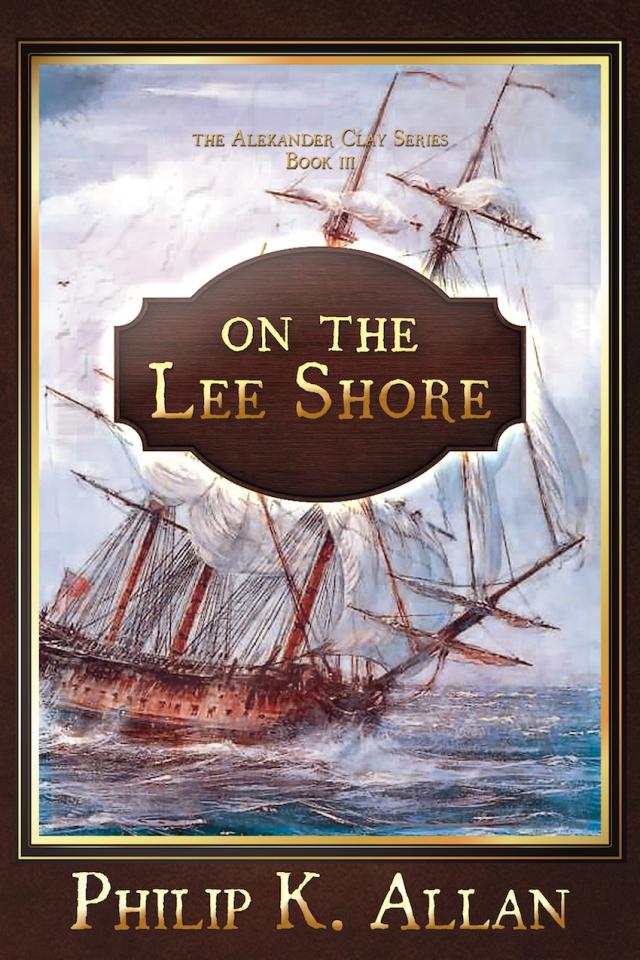
On the Lee Shore, page 20


‘Good luck, Griggs,’ said Preston. ‘I shall return to the frigate now to see if we can catch another prize.’
*****
‘Right, secure the prisoners,’ Griggs reminded himself. He clapped his hands together with decision as the launch vanished back into the fog.
‘Would you like Evans and me to see about that anchor at all, Mr Griggs?’ prompted O’Malley. ‘The Fillets reef will be getting awful close now, and I can’t swim at all.’
‘Oh God yes, the reef,’ said the master’s mate, moving both of his hands up to his face in horror. ‘A very worthy suggestion, O’Malley. Carry on then, you two.’ Evans and O’Malley needed no prompting, and disappeared towards the bow. The boom of breakers crashing against the notorious rocks was very close now as the last of the tide swept them onwards towards the Goulet. They dropped anchor just in time, and the big cargo boat swung round in the tide. She pulled and fretted at her anchor cable like a dog trying to break free.
‘This fog is after lifting fecking soon,’ said the Irishman, indicating the tendrils of cloud that drifted by in the freshening air. Off to one side they saw a flash of white spray from another reef, before the fog closed in once more.
‘We had best go and bleeding remind our new captain what he needs to do next, before he kills the lot of us,’ said Evans.
Back at the stern of the boat the prisoners had been locked away below deck, and the other hands stood around waiting for the next order. Griggs seemed content to look at the fog while he gathered his thoughts.
‘That anchor is holding, Mr Griggs,’ announced the big Londoner.
‘Thank you, Evans,’ said the warrant officer, still peering into the fog. The circle of sea visible from the boat was much larger now, and when Evans glanced up a patch of blue sky was briefly visible.
‘Would you like me to take the helm at all, Mr Griggs?’ suggested O’Malley. ‘The lads could sheet home these two lug sails, Big Sam here can slip the anchor cable, and we will be on our way before the Frog gunners in all of those batteries are any the wiser.’
‘Batteries?’ said Griggs. He looked round towards the land. A break in the fog showed a small patch of rocky shore no more than five hundred yards away, easy range for a cannon.
‘Shall I get ready to slip that cable then, Mr Griggs?’ prompted the Londoner. ‘Like what Sean just said?’
‘Yes please, Evans,’ decided the master’s mate at last. ‘I will take the helm, O’Malley, you get those sails sheeted home.’
Once they were underway it was slow work for the chasse-maree to beat against both wind and tide, in spite of her two tall masts and huge brick-red sails, for she was laden with cargo and the wind was light. Once the anchor had been slipped she clawed her way forward away from the land behind her, while all the time the fog continued to lift.
‘Tide is easing, Mr Griggs,’ reported Evans after twenty minutes, looking over the side. ‘We should be able to make a bit better progress once it is slack water.’
‘Oh, look,’ said several excited voices at once, as a wide gap was torn in the fog ahead of them. Through it they could see the frigate as she beat out to sea a few miles away. Scattered behind her were five captured coasters of various sizes.
‘It’s the fecking old Titan herself,’ said O’Malley with a smile, ‘Ain’t that a princely sight.’
Moments later a chain of huge splashes skipped past the boat, followed by the sound of a heavy calibre cannon. The men all looked round at the shore behind them. Another gap in the fog had opened to reveal the solid grey stone wall of a battery perhaps a thousand yards away. It promptly disappeared behind a cloud of dirty white smoke, and the air was full of the sound of shot tearing past them. A large hole appeared in one of the sails, and Evans was splashed as a near miss ripped into the sea close over the side.
‘How the fuck do they know we ain’t one of their bleeding coasters?’ he spluttered, dashing water from his eyes.
‘Might be because we’re after sailing in the wrong fecking direction, Sam,’ replied O’Malley.
An age seemed to pass for the sailors as they waited for the battery to reload its guns. Meanwhile O’Malley scanned the water around them for a solution. He looked to the north and his face cleared.
‘Mr Griggs,’ he yelled. ‘We’re a sitting duck out here moving so slow in the open. Can’t we head for the remains of the fog over there?’ The warrant officer paused for a moment, and then threw over the tiller, steering the boat towards the last clump of the vanishing fog. They had almost reached it when the air once more filled with the shriek of passing shot. There was a loud crack from the foremast of the chasse-maree. For an instant all seemed well to the watching sailors, but then the tall spar began to topple forward. It gathered pace as it fell with a crash into the sea alongside, amongst a welter of clattering blocks and falling rigging. The boat flew up into the wind and came to a rocking halt.
The men picked themselves back up from the deck and turned towards the helm for orders to find that Griggs was no more. While his little crew had been crouched down to avoid the shower of falling debris, they had not noticed the ball that had dashed him into an unrecognisable bloody pulp on the deck.
‘Come on, lads,’ said O’Malley, becoming their leader by dint of being the first to emerge from shock. ‘Let’s clear away that wreckage. Ain’t we still got one mast as works? Use knives, cutlasses, whatever you can find.’
They fell on the wreckage with the fury of the desperate. Cutlasses flashed in the early morning sun, and gradually they cleared away the wreck of the foremast. Another salvo splashed all around them as they worked, but mercifully did no further damage. With a final heave the last of the mast slid over the side, the hull of the chasse-maree rolled back up again, and the men looked about them once more for direction.
‘Right then,’ panted O’Malley. ‘Sam, you take the helm. Rest of yous man the sheets on the main mast.’
With only the one sail now the boat was very slow, even when the tide began to pull them towards the open sea. The green fields and grey cliffs of the Brittany coast were visible around them on three sides, with the open sea away to the west. O’Malley searched for any remaining fog to hide them, but the warm sun had burnt it all off. Now the light glittered on the surface of water that was turning from green to blue in the morning light. The battery that was firing at them disappeared in smoke once more, and moments later the sea foamed into white all around them as the cannon balls ploughed into it. Out in the channel the Titan waited for them, hove to amid a cluster of little prizes. A fresh battery joined the first one, and struck lucky with its first salvo. Evans saw a line of splashes flash up off the surface of the sea as a cannon ball sped towards the boat. It seemed to be coming straight for him. For a brief moment he thought of the pitiful remains of Griggs that lay bleeding at his feet. Then he heard a massive crash underneath where he stood, and the whole boat slewed round as if it had been hit by a monstrous hammer.
O’Malley rushed to the ship’s side and peered down at the spot where the shot had struck. He bobbed back up and pulled a face at the others.
‘Barky’s gone, lads,’ he announced. ‘Fecking great hole right between wind and water.’
‘An’ she’s settling fast,’ said Evans, the sluggish motion of the stricken boat obvious to him through the tiller he still held.
‘What shall we do now, Sean?’ asked Brown, a thin, tall seaman with a prominent scar on his neck.
‘Go and find the fecking tender!’ shouted the Irishman. ‘Every coaster has one. Unless you fancy a swim.’
‘It was stowed by the foremast,’ said another of the hands, an older seaman with a blue skin of tattoos up one arm.
‘Mother of God!’ exclaimed O’Malley as he led a general charge forward. ‘Was it damaged when the mast fell at all?’
They found the tender lashed down beneath its canvas cover. It was a little rowing boat with only four oars, but mercifully it was undamaged.
‘Christ, it’s bleeding small,’ exclaimed one of the men. ‘Why, it’s even smaller than the Titan’s jolly boat.’
‘It will be tight, lads, but the sea is calm enough,’ said the older seaman. ‘She should get us as far as the old Titan. Let’s get her over the side.’
Getting the boat afloat was an easy task. The tender seemed to weigh little to the eight desperate men, and the chasse-maree had now settled so low that the sea was almost lapping over the side. Another salvo ploughed into the water all around them and one ball bounced across the deck. It sent a shower of splinters flying up, but did no damage to the precious little tender. As the ball struck the deck they heard the sound of furious hammering and cries for help from near to the stern.
‘Shit! The prisoners!’ exclaimed O’Malley. ‘They will be up to their arses in water.’
‘Ah, leave them,’ said Brown. ‘They’re only bleeding Frogs. We ain’t got no room for passengers.’
‘You shut your mouth,’ snarled Evans. ‘We ain’t leaving them to drown. Go and let them out, Sean.’ The Irishman sloshed along a deck now awash with sea. When he was out of sight, there was a general push forward towards the tender.
‘You may want to drown with them Frenchies, Sam Evans,’ said the old seaman with the blue arm. ‘But I ain’t going to hang around to watch.’
‘Back off, all of you!’ yelled Evans. He picked up one of the tender’s sculls in a single huge fist and waved it in front of him like a cudgel. The others stepped away from the furious Londoner. ‘That’s better. No bleeders going to drown, unless they try and make off in this here tender, in which case it’ll be me as will be doing the fucking drowning.’
O’Malley returned with the original ten man crew of the chasse-maree at his heels just as the latest salvo from the shore swept away their vessel’s one remaining mast. Every one ducked for cover once more as fresh wreckage poured down from above.
‘At least the bastards may leave us alone now,’ said Evans, the first to regain his feet. The others stood up too, and contemplated the little tender as it bobbed on the oily water beside the stricken coaster.
‘Ten of them and eight of us,’ counted Brown. ‘That’s way too many for that little boat. It’s only got four benches.’
‘Two in the stern sheets, four on each bench,’ said O’Malley. ‘Come on, lads, let’s give it a go.’ The men began to gingerly step across. The coaster had settled so low in the water now that they had to step up a little to get into the boat. Those left on board stood knee deep in sea, while the occasional wave washed over the gunwales.
‘It’s a fecking miracle it hasn’t sunk on us yet,’ said O’Malley. He turned to the chasse-maree’s former owner. ‘Monsieur Captain, why le boat he not sink?’ The Irishman made a diving motion with the flat of one hand, and accompanied the gesture with a look of enquiry. The Frenchman pointed towards the flooded hold.
‘Chanvre,’ he said, and then seeing the incomprehension on the faces around him he picked up a trailing line and mimicked pulling it apart. ‘Chanvre,’ he repeated.
‘Hemp!’ said Evans, realising what the man was trying to say. ‘They must be carrying a cargo of hemp for rope making. Does rope float, then?’
‘It does for a bit, until it gets waterlogged like,’ said O’Malley.
The little boat was packed full now, and there were still four men left on the coaster, including both Evans and O’Malley.
‘You lads wait here while we row over to the barky,’ suggested Brown. ‘Once we unload we can come back for you.’
‘Why the fecking hell is it not you as is going to do the waiting?’ questioned O’Malley.
‘That’s right,’ said the seaman stood next to him. ‘How do we know you are going to come back? Five minutes ago you was all for leaving the Frogs to drown.’
‘Look, the sooner we go, the sooner we can return,’ said one of the other sailors. ‘Why would we leave you?’
‘Hey, weren’t you one of the mutineers?’ said Evans. ‘I remember cracking your skull. You’re John Waite, one of Sexton’s mates. Why the fuck should I trust you?’
‘You go and suit your bloody self, Sam Evans,’ said Waite. He pushed the tender away from the side of the coaster. Evans grabbed the end of his oar and pulled the crowded boat violently back. There were cries of dismay as it heeled to one side and water sloshed into it. Several of the occupants reached for their weapons.
‘Just you let go there, Evans,’ snarled Waite, pulling a pistol out from the back of his waistband.
‘What is the meaning of this!’ shouted a voice behind them that came from low on the water. Evans spun round to see the angry face of Lieutenant Preston in the stern sheets of the Titan’s launch. The boat had slid unnoticed up to the side of the coaster behind them. ‘You men, put up those cutlasses there. Waite, away with that pistol! Disgraceful! Royal Navy sailors squabbling like Spanish Bumboatmen! You should all be ashamed of yourselves.’
‘Sorry, sir,’ muttered a few of the men.
‘Very well,’ continued Preston. ‘Now, get out of that little boat at once. It is far too over burdened. Let those Frenchmen use it to return to the mainland if they so wish, and the rest of you climb aboard the launch before that wreck settles under you.’
Chapter 14
Storm
‘There is barely a milliner in Piccadilly we haven’t visited this morning, Kitty,’ said Lady Mary Ashton to her maid as she undid her bonnet in the hall. ‘I am quite exhausted, but I must confess to being rather pleased with my new hats. What is a little fatigue compared with the jealousy the blue one with the spray of feathers will cause Lady Catherine tomorrow. What is it, Hilton?’
‘Sir Charles Middleton has arrived to see your ladyship,’ announced the butler. ‘I have shown him into the Orangery as you instructed.’
‘Has he now?’ said Lady Mary, looking at the magnificent figure of her servant in his embroidered coat and powdered wig for a moment. She returned her attention to the hall mirror and examined her reflection, angling her face first one way and then the other before patting at her hair. Once she was satisfied with what she saw, she crossed the hall towards her drawing room. The butler scrambled ahead of her to throw open the double doors, and she swept through. She settled down at one end of the chaise-longue and arranged the folds of her pale green dress into a pleasing fan. ‘You may show him in now, Hilton,’ she ordered. Her butler bobbed his head in acknowledgement, and stalked out of the room.
‘Lady Mary, my dear,’ said Sir Charles as he came through the door. He bent over her proffered hand and lightly touched it with his lips. ‘It is so very good to see you. And out of those dreadful widow’s weeds at long last. Black is such an ill match for your character. There are few ladies of my acquaintance more disposed to be cheerful.’
‘Sir Charles, my dear friend, you are such an inveterate flatterer,’ she smiled. ‘Thank you so much for coming to see me in my time of need. Please do take a seat.’ She patted the seat next to her in invitation, and he parted the tails of his admiral’s coat and sat down.
‘How are you coping Lady Mary, without the protection of Sir Francis?’ he asked.
‘Oh, very ill, Charles,’ she said, dabbing at the corner of a dry eye with her lace handkerchief. ‘I have barely been able to leave the house.’
‘How very odd, Lady Mary,’ he remarked. ‘I could have sworn that your butler said you had been out most of the morning.’
‘Only in an attempt to restore my fragile constitution with a little air,’ she insisted. ‘When Francis died, I must confess that I was quite persuaded out of my senses. Were it not for the support of my dear niece Lydia, I do not know what I would have done.’
‘She is a most agreeable young lady, to be sure,’ he said. ‘How old is your ward?’
‘She is three and twenty.’
‘Is that so?’ mused the admiral. ‘And still not wed, I collect?’
‘With all the trying events that have happened of late, I have hardly been at leisure to address such matters,’ said Lady Mary. ‘But you are right. She really should be married by now. Francis and I had hoped to find a suitable match in India, but he succumbed to the cholera before we were able.’
‘It must have been difficult to make progress under such circumstances, Lady Mary,’ said the admiral. ‘Do you miss him greatly?’
‘Oh indeed, Sir Charles, you have no idea!’ she exclaimed. ‘I find myself having to engage in all manner of activities that as a lady I am wholly unprepared for. Not only is there my niece’s future happiness to plan for, but there are matters of property and business that need to be resolved. It is his guidance and council in such affairs that I truly miss.’
‘I do sympathise, my dear,’ he said. ‘It is fully five years now since I lost my own dear Margaret, and I declare there is hardly a day that passes when I do not miss her advice on matters that fall within a women’s nature.’
‘Five years! Has it been so long, Sir Charles?’ she said. ‘Have you never considered remarriage?’
‘Frequently,’ said the admiral. ‘But a suitable candidate has yet to appear.’
‘Not yet, perhaps,’ she said, rolling a languid eye in his direction. ‘But one never knows when the opportunity may present itself.’
‘That is very true, Lady Mary,’ he said, smiling at her. ‘Shall we address the substance of my visit? Your note mentioned seeking my advice on a matter of some delicacy.’
‘I was interested to learn what your opinion was of Captain Alexander Clay?’ she asked.
‘Clay?’ he queried, surprised by the shift in the conversation. ‘The commander of the Titan?’
‘I suppose so, Sir Charles,’ she said. ‘Does the navy have more than one Captain Clay?’
‘No, of course I know of whom you speak,’ said the admiral. ‘I have only met with him on the one occasion. He is newly promoted, and therefore quite a junior captain. That said, he does possess a growing reputation in the service. He performed very well last year when he was in the Windward Islands with Admiral Caldwell, and his current commander, Sir Edward Pellew seems very content with the manner in which he has discharged his duties. I set him a delicate and difficult task when I persuaded him to take command of the Titan, which at the time was a most unhappy ship. It is a duty which he seems to have performed with some distinction.’