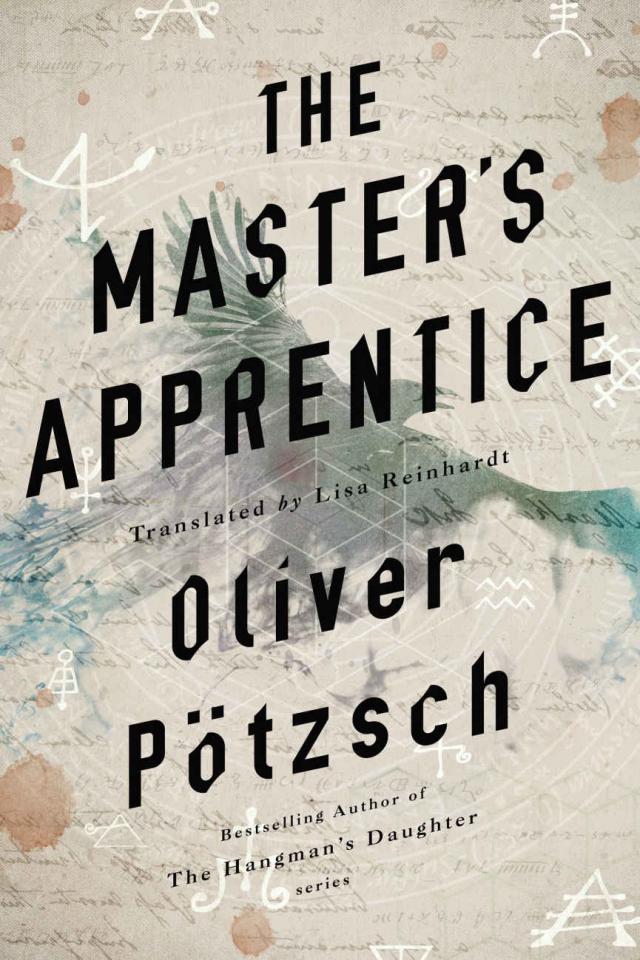
The Master's Apprentice, page 47
part #1 of Faust Series


“Leave it,” replied Karl. Suddenly he got the bad feeling that it hadn’t been such a good idea to invite the handsome youth into the wagon. His demeanor seemed very experienced—calculated, even. Karl suspected this wasn’t the first wagon he had sifted through.
“Leave it, I said!” he repeated more loudly. But the boy didn’t listen. He continued to rummage through the chest, lifting out a black hat, red scarves, and a white wooden egg. Then he turned to the chest with the books and carelessly picked up and dropped several volumes.
“Watch out—you’re damaging them!” shouted Karl.
Suddenly the youth snorted with surprise. He dropped the books he was holding, bent down, and lifted a knife from the chest. He studied it with awe in his eyes, and Karl also gazed at it with wonder. He had never seen the knife before; it must have been buried underneath all those books. The handle appeared to be carved from some kind of bone and was decorated with black patterns and lines. It looked very old and precious. The boy ran his thumb along the blade with a smile.
“It’s so beautiful,” he said. “Will you give it to me as a gift?”
Karl cleared his throat. This whole situation was taking a direction he didn’t like at all. He gave an awkward laugh. “You’re not serious, are you? That knife belongs to the doctor, and he—”
“And now it belongs to me,” the boy said decisively. He eyed Karl with a cold stare and pointed the tip of the knife at him. “Or do you want to take it off me?”
Karl nervously glanced at Satan, who was happily chewing on her bone. He couldn’t believe it. For once the mutt could have been useful, but she was behaving as gentle as a lamb.
The youth grinned and his eyes flashed wolfishly. “Then we have an understanding. I’m going to take this knife and—”
Suddenly, the curtain was yanked open behind him. To Karl’s enormous relief, it was the doctor, arriving back much sooner than anticipated. He was out of breath, and his mouth stood open as if he’d just been about to say something when he happened upon the scene with the boy and the knife.
“What is going on here?” he snapped.
“Um, nothing,” said Karl. “We were just talking.”
“We?” The doctor looked the youth up and down. Faust seemed to suddenly realize what the boy was holding in his hand. His face turned ashen as if he’d seen a ghost.
“Put that down immediately,” said Faust very quietly. “I’m going to count to three, and then Satan will tear you into tiny pieces. Afterward I will feed you to the gulls. One. Two.”
The boy dropped the knife and ran past Faust. They could hear his footsteps for a few more moments, and then everything was silent.
“I . . . I’m so—” began Karl, but Faust cut him off with a wave.
“Pack your things. We’re leaving.”
“But . . . but our show with the laterna,” stammered Karl. “Klaus Störtebeker . . .”
“I said we’re leaving. And if I catch you with another boy like him, Satan’s going to bite off the balls of both of you—understood?”
Karl lowered his eyes and nodded. “Where . . . where are we going?” he asked quietly after a while.
“To Cologne. We’re going to visit someone I should have met a long time ago. Years ago. Hitch the horse to the wagon. Now!”
As Karl slunk away, he saw the doctor pick up the knife and gaze at it thoughtfully.
Then he dropped it into the chest as if it had burned his fingers.
22
THE WAGON SLOWLY rattled along the dusty road that wound endlessly through the heath. Satan jogged alongside the wagon, panting, and stopped to relieve herself or rest up every now and then. She no longer had the strength for long journeys and tired easily. They had left Hamburg in the early evening and set off in the direction of Lüneburg. The heath glowed purple in the light of the afternoon sun; they had been on the road almost nonstop for three days now, and Johann had barely spoken.
He looked over at Karl, who was sitting next to him with a pinched expression. He probably thought Johann was still angry because of the young lad in Hamburg. And Johann had been angry. It was encounters like those that could cost them both their heads. He didn’t care whether Karl lusted after girls, boys, or sheep—as long as he didn’t put them both in danger with his escapades. Especially not now that Johann finally had set his sights on a goal and purpose again. He needed to meet Heinrich Agrippa and speak with him about his masterpiece, De Occulta Philosophia. If anyone knew about the constellations and prophecies, it would be Agrippa. Maybe Johann would finally learn the mystery of his birth.
And perhaps he’d find out more about Tonio del Moravia and Gilles de Rais.
Had it been coincidence that the young thief in Hamburg found the knife? Johann had kept it for all those years, even though he couldn’t tell why. It had brought him nothing but ill luck, but it also served to remind him of the guilt he’d heaped upon himself. He hadn’t dared to throw it away—almost as if the act might trigger a curse. The knife had been resting at the very bottom of the chest, and now it had reemerged. When Johann had picked it up from the floor of the wagon, he was reminded of the engraving.
G d R.
Gilles de Rais.
Another murder of crows rose up from the wide-open space of the heath and moved across the sky like a poisonous black cloud. The birds cawed noisily, and suddenly Johann heard the name again.
Sheel draay . . . Gilles de Rais . . . sheel draay . . .
Why couldn’t he get that accursed name out of his head? It had been torturing him for years now! As if the name was irrevocably connected to his fate. Like Tonio. Like everything that had happened since those days in Knittlingen.
On this trip, they didn’t spend much time on shows, and so they made rapid progress. Large areas of the north of the empire were covered in moors and heath, a desolate, desertlike landscape without any hills to speak of, without valleys, and without lakes. The wind blew up small clouds of any sand the heather shrubs didn’t hold down, and several times the wagon wheels got stuck in soft, sandy ruts and they’d have to push the wagon out like from a snowdrift. Once they started to travel along rivers again, the roads became better. Every time they passed through a new county or a new small barony, they had to pay road tolls. The whole empire was like a threadbare carpet sewn from countless tiny scraps and held together only by an emperor who was as far away as the moon.
The closer they came to the Rhine Valley, the lovelier the landscape became. The first vineyards appeared. Finally, twelve exhausting days of travel later, they looked upon the wide ribbon of the Rhine, and they knew it wouldn’t be far to Cologne now.
So far, Johann had avoided the city of Cologne, which was one of the largest in the empire. The prior of the Dominican monastery of Cologne was also the papal inquisitor, and he had a reputation for being particularly strict with alleged heretics. Also, the city was a famous pilgrimage destination with countless relics, most notably the remains of the three wise men. Magicians and chiromancers weren’t well received in such a place. But the reputation of the legendary Doctor Faustus had even reached Cologne. When Johann loudly declared his name at the city gate, the guards discussed for a while before allowing him in—not without confiscating one or two bottles of theriac. Satan was lying in the back of the wagon. It was difficult enough to gain entrance to the city without the oversized animal, and the dog had been increasingly dragging her right hind leg. Johann was worried about her.
In the northeast, the unfinished spire of the cathedral rose up. The people of Cologne had been working on this architectural masterpiece for more than two hundred and fifty years, and it still wasn’t finished. The city was speckled with smaller and larger churches, and almost every single one exhibited some reliquary or other. On their way through the busy streets, they passed many pilgrims with staffs and humble clothing. After Rome and Santiago de Compostela, Cologne was the best-known pilgrimage destination in the Western world. But the city was also a place of learning and boasted one of the largest universities of the empire. The famous Albertus Magnus, whom Johann had venerated since his days at Maulbronn Monastery, had studied theology and been ordained a priest here.
“And where do you propose to find this Agrippa?” asked Karl as they drove the wagon through the narrow, unpaved lanes toward the river. By now Johann had forgiven him for the affair in Hamburg, but he hadn’t told Karl what exactly he was hoping to gain from meeting Agrippa. He had merely said he was looking forward to an exchange between learned men.
“Well, Heinrich Agrippa of Nettesheim is no stranger in Cologne,” replied Johann. “The bottles of theriac for the guards were a sound investment. They gave me his address. Apparently he lives near the hay market with his sister, who cooks for him. It shouldn’t be far now.”
They turned onto another narrow lane and neared a two-story half-timbered house that was freshly painted and appeared generally well looked-after. Johann felt himself growing nervous. What if Agrippa refused to receive him? After all, most scholars considered Johann to be nothing but a fraud. Or what if Agrippa couldn’t help him? The whole idea—the hasty departure from Hamburg, the hope to learn more about his birth from the famous scholar—suddenly seemed awfully naive. What could he expect? But it was too late to turn back now.
“Wait here,” said Johann to Karl. He climbed down from the box seat, walked over to the house, and pulled on the string that operated a bell inside. After a few long moments, a plump young woman wearing a bonnet and an apron opened the door. She gave Johann a friendly albeit reserved look. It seemed she was used to supplicants.
Johann cleared his throat. “My name is Doctor Johann Georg Faustus. I am looking for the eminent scholar Heinrich Cornelius Agrippa of Nettesheim. Can you tell me where to find him?”
“My brother is still at the university,” the woman replied curtly. “He’ll be home soon. You best wait outside.”
Johann was about to make a reply, but Agrippa’s sister had already closed the door. With a frown he returned to Karl, who was trying to chase away a bunch of nosy street kids. This wasn’t going the way he’d hoped at all.
Soon, a crowd had gathered around the wagon. Johann was wearing his blue-and-black star cloak and the floppy hat, and the strange symbols on the wagon did the rest. Word was spreading fast that a well-known magician was waiting outside Agrippa’s house.
“It’s the sorcerer Doctor Faustus,” whispered an elderly farmer to his wife in a broad Cologne accent. “A necromancer and devil worshipper! I’ve heard of him. Down at Speyer he made two calves fly to the moon! They’re still up there today.”
“God protect us,” said the old woman, shaking her head. “When two magicians come together, terrible things will happen.”
The crowd grumbled, and the first few troublemakers started to pull at the canvas, probably trying to see what sort of devilish things were hidden inside. Karl jumped down and tried to fend off the most daring fellows. But they didn’t stop—on the contrary, more and more people came forward, shouting, swearing, and shaking the wagon. The lane was so full of people that they wouldn’t be able to get the wagon out. Johann looked about nervously. It wouldn’t be long before some city guards turned up, and that wouldn’t help his cause at all. He was already considered trouble. Should he set Satan on the mob? But that would only make things worse.
“What’s all this about? Off with you, there’s nothing to see here!”
Johann turned around and saw a rather short man with a beret and a gown striding through the throng of people. He was probably younger than Johann, but his black university garb and lordly demeanor made him appear older and more dignified. The man had intelligent, alert eyes, a pointed nose, and a thin mouth that seemed set in a permanent sneer. Despite his youth, his hair and thin beard were already turning gray.
“Don’t ask me—ask the people,” replied Johann from the box seat.
“Well, if you are who the people think you are, you are definitely the source of all this trouble.” The man smiled and suddenly looked much younger. He spoke with a Cologne accent, which made his stilted way of speaking sound like a cheap farce. “Doctor Faustus, am I right? Considering the sheer number of tales about you, I would have thought you much older.”
“Considering the number of your works, Master Agrippa, I thought you, too, were older,” replied Johann coolly, still annoyed about the turmoil he had caused. “Or were they written by someone else, perhaps?”
“Touché, dear colleague!” Agrippa laughed and bowed mockingly, the crowd now keeping a respectful distance. “I much prefer an open attack to the backstabbing attempts of all those old scholars who would love nothing more than to see me convicted of heresy. Let us go inside, where we can speak undisturbed.” He grinned and gestured toward an alleyway to the left of his house.
“You’ll find a gate to the backyard of my humble abode down there. You must forgive my sister, Martha, for not letting you in. We simply get too many supplicants—mostly traveling students hoping for a position. But I wouldn’t miss your visit, honorable Doctor. On the way home from the university alone, I heard at least a dozen stories about you.”
“Only half of them are true,” said Johann with a shrug.
“And he won’t tell you which half,” said Karl with a sigh.
Agrippa glanced at the young man. “You have an assistant?”
“A talented young man,” replied Johann. “Even if his passion runs a little wild at times.”
He walked through the crowd at Agrippa’s side. The people readily gave way now, and some even took off their hats. But Johann also saw some men and women making the sign of the cross and other gestures to ward off evil. Meanwhile, Karl climbed back onto the box seat and steered the wagon through the crowd toward the alleyway.
The front door was followed by a plainly furnished hallway, with furs and carpets on the walls and fragrant reeds on the floor.
“Follow me into the stove room,” said Agrippa as he went up the stairs. “We’ll be able to converse undisturbed there. Your assistant may wait in the kitchen and let Martha spoil him. She’s made fresh Cologne doughnuts—a veritable delicacy. As for you and me, we will content ourselves with the meager yet equally delicious fare of collegial dispute.”
The stove room was dominated by a green tiled stove as high as a man. Such stoves were increasingly the fashion in houses of burghers. Unlike the tidy hallway, this room was very messy. Books and loose pages were strewn across chests and small tables; a brown apple core lay rotting between an inkwell and a quill. Johann smelled parchment, dust, and sweat.
“My realm,” said Agrippa with a smile and gestured for Johann to sit on a stool. They both sat down, and Agrippa eyed Johann for a long while.
“Well, well, the famous Doctor Faustus,” he said eventually and leaned back. “Someone told me about your lectures at Erfurt. I was impressed by your views on the theological term of God. A little dangerous, though, because it doesn’t take much to be called a heretic these days. I know what I’m talking about.”
“And you are lecturing here in Cologne?” asked Johann.
“Simple theological discussions without any particular classification—on request of the rector.” Agrippa gave a shrug, and Johann wasn’t sure whether this show of boredom was an act or real. Agrippa was certainly clever, but he also had something pretentious and loud about him.
Just like me, thought Johann.
“I doubt I’ll be staying in Cologne for much longer,” continued Agrippa. “I’ll probably have to travel to Italy soon. It is my duty to accompany a heavily guarded chest of war as an imperial officer. Earlier this year I helped a friend of mine in Spain to win back his castle. Oh yes, and not long ago I worked in England as an agent. The emperor sent me to develop good trade relations with the new king, Henry VIII. I speak English, you see.” He paused and raised one eyebrow. “Do you know the feeling of never being satisfied, always wanting more from life, forever searching and exploring, regardless of the consequences?”
Johann nodded. “Oh yes. I know it well.”
Too well.
“I guess that makes us brothers in spirit.” Agrippa laughed, and his laugh was soft and melodious, almost like that of a woman. He looked around for a jug of wine, grabbed two dirty cups from a table full of books, and filled them.
“You see, I’m just as restless as you. Today I’m here, tomorrow gone—the studium generale includes all parts of life. But you haven’t come here just to chat, have you? So why are you here?”
Johann cleared his throat. “While you were in England, you wrote a manuscript. I was fortunate enough to purchase a copy in Hamburg.” He nervously pulled out the bundle of pages and smoothed them on the table in front of him. Agrippa shot a glance at them.
“The Occulta Philosophia,” said the scholar with a nod. “I’m a long way away from finishing it.” He sighed. “I should never have let that fat merchant buy a copy. But he paid well, and the emperor is once again in arrears.”
“I must congratulate you. It’s a masterpiece!” Johann tapped the pages. “No one has ever approached magic as systematically as you have. Astrology, invocations, spells, manticism, potions—”
“Pure theory.” Agrippa waved dismissively. “I lack practical experience, and that is where you are the teacher and I am but an eager student. Why are you so interested in it?”
“Well, your work touches questions that”—Johann paused—“that concern me personally.”
For the first time Agrippa seemed genuinely interested, and he leaned forward. “What do you mean?”
“Certain things have happened in my life that . . . Well, one could say I am cursed. And I’ve been wondering for a while now whether those incidents have anything to do with my birth chart. I was born under Jupiter. The sun and Jupiter stood in the same degree of the same zodiac on the day of my birth.”
Agrippa nodded. “A strong constellation indeed. Born under the lucky star—hence your name, I guess.”