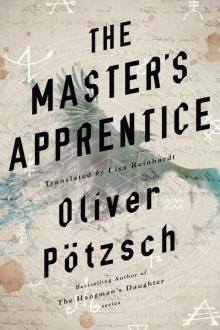
The Master's Apprentice, page 21
part #1 of Faust Series


“Hrmh—” was all he managed before everything turned black.
The attack had come as a complete surprise—he hadn’t heard anyone approach. Johann thrashed about widely, but the sack only grew tighter. A rope closed in around his neck, and Johann thought he was being throttled, but then someone lifted him up like a piece of furniture and tossed him over their shoulder. Johann cussed and screamed, and his abductor knocked Johann’s head against the wall so hard he thought his skull was going to burst.
Someone growled angrily, like a bear. Johann gathered it was a warning and kept quiet. He tried to figure out what the fellow wanted from him. Was he going to throw him into one of the canals running through the city and leave him to drown? But if he wanted to kill Johann, that would be unnecessary. The man carrying him was strong enough to squash him like a bug.
Johann was bounced through Augsburg like a sack of flour on the man’s shoulder. He smelled dust and musty grain but couldn’t see a thing. Finally the man’s steps slowed. His mysterious abductor lifted him up and threw him onto the hard ground. Johann gasped with pain when he landed on his sore shoulder.
“Open the sack, Mustafa,” said a voice he’d heard before.
Johann heard a ripping sound, and then he was blinded by the light of the moon. He blinked repeatedly and waited for his eyes to adjust. It seemed he was lying in a dirty back alley amid piles of foul-smelling garbage. Two wagons he’d seen before stood nearby. Their canvases were torn, the front wheel of one of the wagons was broken, the box seats were damaged, and one of the shafts was shattered.
And standing in front of Johann was the redheaded fiddler.
He wore a dirty bandage around his head, and his right eye was swollen shut. He studied Johann with pinched lips, as Johann, trembling with fear and cold, looked about himself. The muscular body of Mustafa towered behind him, and Salome and Emilio emerged from the shadows of the yard.
“So we meet again,” snarled the fiddler, still wearing his yellow-and-red costume. He spoke with a slight lisp, and Johann saw in the pale light that he was missing a tooth. “Soon you’ll realize that it was a mistake to mess with Peter Nachtigall. No one makes a fool out of me—no one! Understood?”
“Madonna, calm down, Peter,” said Emilio in a foreign-sounding southern accent. The little bells on his costume gave a jingle. “No one is helped if you skin the boy alive, eat him up, and spit out his bones. We need him to give us back our money and pay his debts.”
“Debts?” said Johann hoarsely, feeling stone-cold sober now. He rubbed his throbbing forehead and slowly got to his feet. “What . . . what debts?”
“Are you kidding me?” shouted Peter. “You . . . you . . .” He lowered his voice. “Our wagons have been trashed—not to mention my face. We can consider ourselves lucky that the guards didn’t lock us up and we’re allowed to stay in this stinking yard for the night. We must leave Augsburg in the morning because we’ve been banned from performing here. And all that just because one little good-for-nothing thought he’d pull one over on us!”
“That’s not quite right,” Johann said quietly. “You were trying to pull one over on me.”
“You dirty little smart-ass . . .” Peter Nachtigall raised one hand, ready to strike, but stopped short when Salome laughed out loud behind him. Her voice sounded husky and quite low for her delicate stature.
“He’s right, Peter. I told you in Würzburg that the shell game is too dangerous. People see through it—though usually not as quickly as this clever boy.” She eyed Johann closely and not without sympathy. He guessed she was about ten years older than him, although it was hard to tell. “I wouldn’t be surprised if you turned out to be a juggler yourself. Are you?”
Johann hesitated briefly, then nodded.
“Ha! So you were sent to have us chased out of town,” Peter growled. “Who do you work for? Steffen Lautenschläger? Or Karl Froschmaul and his gang? Speak up before I cut out your tongue!”
“For . . . for no one,” Johann replied. “I’m on my own. I traveled with an astrologer for a while, but we . . . we went our separate ways.”
“With an astrologer?” Salome gave him a wink. “I hope he wasn’t an old drunkard like our venerable Magister Archibaldus. I swear, if you hadn’t blown up our show today, he would have ruined the next. He drinks like a fish and then passes out.” She gestured behind herself. “Hear him snore?”
Indeed, Johann heard a wheezy rattling from one of the wagons, followed by a loud fart and more snoring.
“We should cut the old boozer loose, damn it,” grumbled Emilio. “His gold trick is ridiculous, and if we’re not careful, he’ll fall into his own bowl sooner or later.”
“You know very well why he’s with us,” Peter said. “So shut up.” He turned to Johann with a challenging look. “Now back to you, boy. Give me back my coins!”
“I . . . I don’t have them anymore,” Johann replied sheepishly. “I spent all but one at a tavern.”
“At the White Lamb, we know.” Salome nodded. “You acted like a little lord and splurged on a night out. But your card tricks weren’t too bad, apparently.”
Johann’s jaw dropped. “How do you . . . ?”
“Maledetto, we’ve been looking for you since this afternoon,” Emilio exclaimed. “When one of the Augsburg harlots told us there was a young man in peasant’s clothes with too much money at the White Lamb, we sent Mustafa.”
The giant nodded and cracked his knuckles.
“Search him!” commanded Peter.
Mustafa grabbed Johann, shook him like a wet coat, and patted down his pockets. He pulled out the last coin and handed it to Peter Nachtigall.
“Damn, he wasn’t lying,” Peter said and tossed the penny onto the dirty ground. “And how are we supposed to fix the wagon now?”
“One of the wagons still goes,” said Salome soothingly and picked up the coin. “We can sell the broken one and the old horse and still have enough room for all our gear. The old nag would never have made it across the Alps anyway.”
Johann’s heart started beating faster. “Across the Alps, did you say? Where are you going?”
“Where do you think?” Emilio gave a shrug. “To the warm lands beyond the mountains. That’s where I come from, and I speak the language. Jugglers are always welcome in the cities of Lombardy. Everything is much brighter and friendlier over there, and the people are so wealthy that there’s always enough for the likes of us. And we’ll have winter quarters in Venice that Archibaldus—”
“That’s enough!” barked Peter. “I’m still not convinced that this guy isn’t a spy for another troupe. So you better shut it.” He pointed at Johann. “And you better run along now, before I tell Mustafa to beat you to a pulp.”
“I . . . I could come with you,” Johann blurted suddenly. The words had simply slipped out. Ever since he could remember, he’d dreamed of seeing Venice. He had almost traveled across the Alps with Tonio; perhaps this was his last chance.
“Come with us?” Peter raised his eyebrows, then he gave a laugh. “And why should we take a weed like you to Italy with us?”
“I . . . I could pay back what I owe you.”
“And how are you going to do that?”
“Jesus, Peter, don’t act more stupid than you are,” said Salome. “He’s a juggler, remember? Clearly, he’s one of those little tricksters like Lukas used to be.” She gave Johann an encouraging smile. “What can you do, boy?”
Johann swallowed hard. His head felt like thick honey, and his right shoulder ached. Whenever he looked up, he felt dizzy. And yet he knew this was his only chance.
“Does anyone have an egg and a hat?” he asked.
He performed his trick with the egg and the blanket, a few coin and card tricks, the seven Dalmatian knots, the broken stick, and the snake of Giza, whereby a length of rope was brought to life. He briefly considered juggling but decided against it. The troupe already had a juggler; what they needed was a magician, and a good one—who could do more than card tricks.
When Johann was finished, he bowed and awaited their judgment. Cold sweat was running down his forehead, and he thought he might faint.
The jugglers were sitting in a half circle in front of him, eyeing him thoughtfully.
“Not bad,” said Peter Nachtigall grumpily. “Almost as good as Lukas—but only almost.”
“I think he’s better,” said Salome, gazing at Johann with a look he couldn’t read. “He’s charming, and, well . . . not too bad looking. And he can talk. People will like him—the girls, especially.”
“The trick with the egg is good,” said Emilio. “I’ve never seen it before. And we can work with the coin tricks. I think he might be a good addition.”
“You’re not serious about taking him along, are you?” groused Peter. He pointed at his missing tooth. “I’ve got him to thank for this! And one of our wagons is wrecked!”
“Come on, we’ve had blowups before,” said Salome. “If he hadn’t called you out on the shell game, someone else would have.” She ran her fingers through her long black hair. “He’ll pay back his debt. Coin for coin. Isn’t that right?”
Johann nodded, and Salome turned to Mustafa, who hadn’t said a word the whole time. “What do you think?”
Mustafa gave Johann a long look. Then he made a few strange signs with his hands.
“What’s he saying?” asked Peter.
“He’s saying there’s some dark secret surrounding the boy,” Salome replied. “But he doesn’t think he’s a spy for another troupe.” She gave a grin. “And Mustafa likes the trick with the egg, too.”
Peter Nachtigall sighed and raised both hands as if surrendering. “All right. We’ll give him a chance.” He looked sharply at Johann. “But I promise you one thing, boy: I’m keeping an eye on you. And I’ll find out about your dark secret.”
9
THEY LEFT AUGSBURG the following morning, using the same gate through which Johann had entered the city the day before. He turned to cast one last glance at the famous golden city with its towers, patrician palaces, and mighty cathedral. But he no longer felt awe. After just one night, Johann’s enthusiasm had given way to the conviction that there was as much poverty and misery in the empire’s wealthiest city as anywhere else. Only very few were benefiting from the new times the wine merchant had spoken of, while the rest went hungry and struggled to get their children through the next winter or the next drought.
Feeling much better than the night before, Johann walked beside the only slightly damaged wagon drawn by a skinny gray horse. Emilio had managed to sell the second, broken wagon and the old nag to the Augsburg knacker. They hadn’t gotten much, but it would be enough to have the other wagon fixed up in the next town. And they’d bought some food for their journey.
The road followed the Lech River, which was already busy this time of year. The troupe passed rafts laden with wine, oil, and bales of fabric, which were wrapped in a waxed layer to protect them from water. Watching all the action coming downstream, Johann tried to imagine how difficult it must have been to cart all those wares across the mountains. Now he’d be making the same journey, only in the opposite direction.
Peter Nachtigall sat on the box seat with the reins in his hand and stared straight ahead. His eye looked even worse than the day before, and he still wore the bandage around his skull. Johann guessed it would take some time before the troupe’s leader would say more than a few words to him. Peter still didn’t seem fully convinced that this serious-looking smart aleck was a good addition to his troupe. But at least Emilio and Salome were on Johann’s side. He wasn’t so sure about Mustafa—the hulking man hadn’t uttered a single word so far. Johann suspected he was mute.
Salome, Emilio, and Mustafa also walked alongside the wagon. The group headed south at a leisurely pace, straight toward the Alps. When Johann discerned the mountains as a white ribbon on the horizon, he walked a little faster. Finally he had a destination. He would see Venice, the best-known city in the world! All he knew about Venice so far were the stories his mother had told him. Apparently, the city was built on islands in the sea and crossed by countless canals. The roofs of the houses gleamed like pure gold, and every day, ships arrived carrying spices and the strangest goods from Africa and India. Hundreds of Christian pilgrims started their journeys to Jerusalem in Venice. For the first time in days, Johann managed to forget Tonio and the gruesome experience in the woods.
Salome was walking a few steps ahead of him. Suddenly she climbed a small tree by the wayside, as nimble as a cat, sat on a branch, and winked at him. Johann looked away with embarrassment. He wasn’t sure what the exotic beauty, with her long black hair and voluptuous curves, thought of him. He guessed Salome to be in her late twenties, and if he interpreted Emilio’s looks and gestures correctly, the two of them were an item. But he wasn’t certain. He decided to be careful, in any case. The last thing he needed right now was more trouble.
Johann could hear soft, flat singing from inside the wagon. It was Magister Archibaldus, who had slept late and now seemed to liven up. So far, Johann had only seen him drunk or asleep.
“Hey, boy!” Peter Nachtigall whistled and nodded at Johann. “Do me a favor and check on the old drunkard in the back, will you? I’ve got a feeling he’s on the wine again. I want to give a show at Landsberg tonight and need him sober.”
Johann nodded, glad that Peter had given him a task. He jumped on the back of the wagon, pushed aside the canvas, and climbed in. He was immediately enveloped by a cloud of alcohol fumes and the smell of old man. The wagon was loaded heavily with chests and sacks. In one corner, Archibaldus was leaning over an open chest and seemed to be searching for something, humming softly to himself. Johann awkwardly cleared his throat, and Archibaldus slammed shut the lid with a start.
“Um, I was just making sure the straw of Bethlehem was still there,” the old man gabbled. “I was afraid we’d left it behind in the rush.” His hair looked as wild as the day before, but his beard was noticeably shorter. Johann realized the straggly, Methuselah-like growth had been a fake.
“If I’m not mistaken, that’s the chest with the supplies,” Johann said, gesturing at the chest. “The one with the relics is over there.”
“Of course, you’re right, boy!” Archibaldus slapped one hand against his forehead. “I’m getting old and forgetful.” He squinted and looked more closely at Johann. “You’re the new fellow, aren’t you? Well, at least you’re older than Lukas.” He winked at him. “And smarter, from what I hear.”
“Who is Lukas?” asked Johann. He’d heard the name the day before but hadn’t asked about him.
“The question should be, Who was Lukas?” replied Archibaldus dryly. “One of the wagon wheels got the poor lad as we were rolling down a hill near Leipzig. His leg broke like a twig. I put a splint on it and treated it with a salve, but fever took him in less than a fortnight. He was only fifteen years young.” The old man suppressed a burp. “Shame about the boy. He was a good juggler. Knew a lot of tricks.”
“I’m sorry,” said Johann.
Archibaldus waved his hand dismissively. “That’s just life. We come and we go, and no one knows when his time will be up. I never thought the dear Lord would grant me this many years. Almost seventy now.” He gave a grin. “I was a dapper lad when I was your age. And I had a smart mouth on me. A traveling scholar who never turned away a girl, no matter how ugly.” He laughed loudly.
“Did you study?” asked Johann. He knew students often traveled from university to university, sometimes succumbing to drink and idleness and ending up as jugglers. Itinerant clergymen known as goliards also frequently joined the performing troupes.
“Oh yes, I come from a good family. Although you wouldn’t think so, looking at me now.”
Archibaldus had taken a seat on a bench along the side of the wagon, and now Johann joined him. The man’s clothing smelled of rancid fat, and his hair was full of nits.
Archibaldus shook his head as he continued. “My father was a wealthy merchant from Hamburg. The Stovenbrannts were once among the most powerful families there. I was the third-born son and supposed to study philosophy and medicine, and law, and ah! Theology, too.” He sighed deeply. “Let us speak of other things. I hear you’re a good trickster. Who taught you?”
“A . . . widely traveled man. Tonio del Moravia.”
Archibaldus frowned. “Tonio del Moravia? I feel like I’ve heard the name before. Hmm . . .” He paused. “A juggler, you say?”
“A chiromancer and astrologer,” said Johann, disliking the intent look Archibaldus was giving him.
“And did he teach you any of the arcane arts?” asked the old man.
“Just bits and pieces.” Johann suddenly felt very uncomfortable. Maybe it had been a mistake to mention Tonio’s name. Quickly, he changed the subject. “Are you a real alchemist?”
Archibaldus looked surprised. “What makes you think that?”
“Well, the golden tip on your staff . . .”
“Oh, that.” The old man laughed. “It’s just a little gold leaf. If you smear a little mud on it, you can’t see it. The rest is hocus-pocus.”
Johann grinned. “Hoc est enim corpus meum . . .”
“So you speak Latin. A learned trickster. Wonders never cease!” Archibaldus gave Johann a mischievous wink. “Or is that the only phrase you know?”
“Lingua latina sermo patrius meus est,” replied Johann in fluent Latin. “Deorum antiquorum modo colloqui amo. Homo Deus est.” The last sentence had just slipped out—and Tonio’s favorite phrase had a strange effect on Archibaldus: the man flinched as if Johann had struck him.
He gave Johann a long, hard look. “How do you know these words?”
Johann shrugged, rattled by Archibaldus’s gaze. “I guess I heard them somewhere.” He quickly changed the topic. “Emilio mentioned yesterday that it was thanks to you that the troupe has winter quarters in Venice. Is that true?”